Smart AI Extends EV Battery Life Without Slowing Fast Charging
Electric vehicles have reached a turning point. Carmakers are pouring billions into battery technology, governments are investing heavily in charging infrastructure, and fleet operators are under mounting pressure to electrify transport operations without sacrificing reliability or profitability. Yet one stubborn technical compromise has remained difficult to escape. Drivers want faster charging, while batteries prefer a gentler approach.
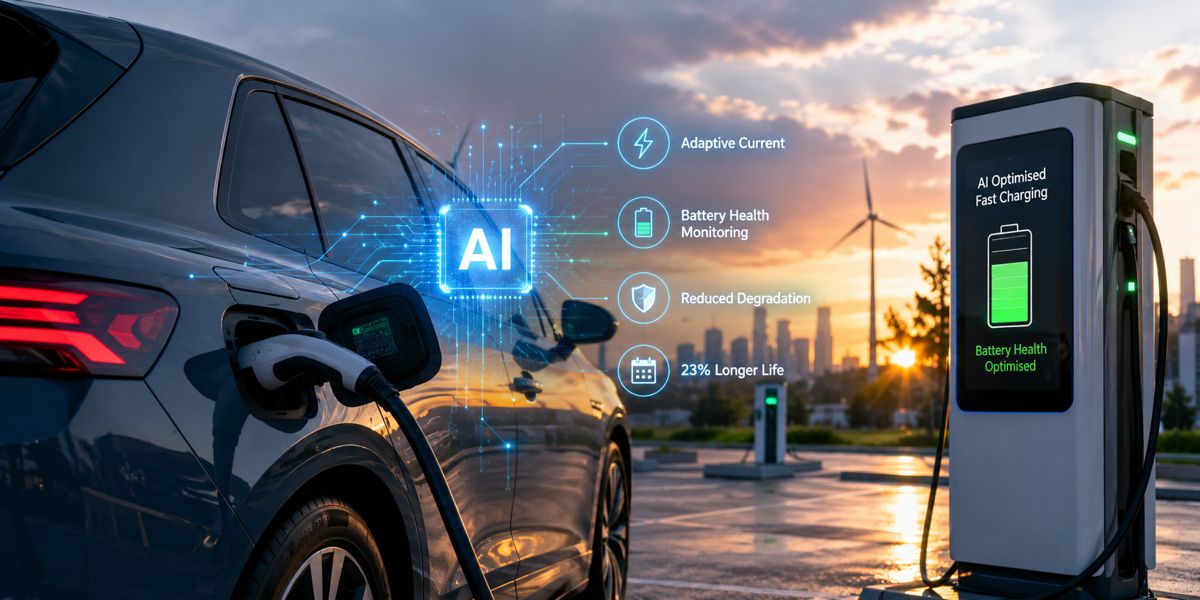
Researchers at Chalmers University of Technology now believe they’ve found a practical middle ground. A newly developed artificial intelligence charging strategy could extend lithium-ion battery life by nearly 23 per cent while maintaining charging times close to current fast-charging standards. Crucially, the system doesn’t require expensive new battery chemistries, redesigned vehicles, or major infrastructure upgrades. According to the researchers, the solution could potentially be introduced through software updates to existing battery management systems.
At a time when the global transport sector is racing toward electrification, the implications stretch far beyond passenger cars. Battery longevity has become one of the defining economic and environmental challenges facing the automotive, logistics and infrastructure sectors. Extending battery life by almost a quarter could influence everything from fleet operating costs and residual vehicle values to mining demand for lithium, nickel and cobalt.
The research also arrives as concerns over battery degradation continue to shape public perception of electric vehicles. While EV adoption has accelerated rapidly across Europe, China and North America, anxiety around battery lifespan and replacement costs still lingers among consumers and commercial buyers alike. Fast charging, despite being essential for long-distance mobility and commercial uptime, has long been associated with increased battery wear.
Now, researchers believe artificial intelligence may finally offer a smarter route forward.
Briefing
- Researchers at Chalmers University of Technology developed an AI-based fast charging strategy that extends EV battery life by nearly 23 per cent
- The system adapts charging behaviour according to battery age, chemistry and state of health in real time
- Charging speeds remain effectively unchanged, differing by only a few seconds compared to current methods
- The technology could potentially be deployed through software updates rather than costly hardware redesigns
- Longer battery life could reduce warranty costs, improve sustainability and ease pressure on critical raw material supply chains
The Fast Charging Dilemma Facing Electric Transport
Fast charging has become one of the most important pillars supporting mass EV adoption. Public charging infrastructure is expanding rapidly across Europe, China, the Middle East and North America as governments and private operators scramble to support growing vehicle numbers. Ultra-fast charging corridors are now central to transport policy, freight electrification and urban mobility planning.
For commercial operators, particularly taxi fleets, delivery vehicles and heavy transport, charging speed directly affects operational productivity. A vehicle sitting idle at a charging station isn’t generating revenue. Even for private motorists, confidence in the availability of fast charging remains closely linked to purchasing decisions.
Professor Changfu Zou from the Department of Electrical Engineering at Chalmers explained the importance of charging convenience across transport sectors, saying: “For taxis or heavy vehicles in industry, for example, access to fast charging means a lot, but this is also true for passenger cars. Although private motorists usually charge their electric cars at home, the availability of fast charging outside the home is a crucial factor, as it facilitates commuting and driving over longer distances.”
That convenience, however, comes at a cost. Lithium-ion batteries experience greater stress during rapid charging because high electrical currents accelerate unwanted chemical reactions inside the battery cells. Over time, this degradation reduces capacity, limits range and shortens operational lifespan.
Battery degradation is already one of the most significant economic considerations in electric mobility. Most EV manufacturers currently provide battery warranties of around eight years or 160,000 kilometres, reflecting industry expectations regarding long-term performance decline. Real-world lifespan estimates typically range between eight and fifteen years depending on charging habits, climate and operating conditions.
Lithium Plating Remains a Major Technical Challenge
One of the most damaging side effects associated with aggressive fast charging is lithium plating. This occurs when lithium deposits build up on the battery’s electrode surface rather than integrating correctly into the cell structure during charging cycles.
The consequences can be serious. Capacity loss is the most immediate issue, but severe lithium plating may also create uneven internal structures capable of causing short circuits and safety failures. The problem becomes more pronounced as batteries age, which creates an awkward contradiction in many existing charging systems.
Current charging approaches often apply standardised current and voltage profiles regardless of whether the battery is brand new or approaching the later stages of its service life.
Meng Yuan, Assistant Professor at Victoria University of Wellington and former researcher at Chalmers, explained the issue clearly: “The risk of lithium plating increases with the age of the battery. However, the standard methods of charging today use the same current and voltage regardless of whether the battery is new or has been used for years.”
That one-size-fits-all approach has become increasingly difficult to justify as EV adoption scales globally. Battery systems are no longer niche technologies reserved for early adopters. They now sit at the heart of national transport strategies, industrial decarbonisation programmes and critical infrastructure planning.
Artificial Intelligence Learns How Batteries Behave
Rather than redesigning battery hardware, the Chalmers-led research focused on improving how charging decisions are made. The team developed an AI-based charging strategy using reinforcement learning, a branch of machine learning in which systems improve performance through repeated trial and reward mechanisms.
The AI was trained within a simulation environment based on one of the world’s most common EV battery types. Researchers incorporated variables affecting both battery health and charging speed, allowing the system to evaluate countless charging scenarios.
Instead of applying a fixed charging pattern, the AI dynamically adjusts current levels according to the battery’s real-time electrochemical condition, charge level and overall health state. The result is a charging strategy that reduces harmful side reactions while preserving practical charging times.
“We show that it is possible to charge more or less as fast as today, but with significantly less long-term degradation of the battery,” said Meng Yuan.
The improvement achieved during testing was substantial. According to the study, battery lifespan increased by approximately 23 per cent when measured in equivalent full cycles before capacity dropped to 80 per cent of original performance. Charging durations remained effectively unchanged apart from minor variations measured in seconds.
Professor Zou summarised the broader significance of the findings: “Our study shows that smart adaptation of the current during charging, taking into account the changing electrochemical state of the battery, can maximise both the performance and the life of the battery.”
Software Could Become the New Battleground in EV Performance
One of the most commercially significant aspects of the research is its potential ease of deployment. Unlike next-generation battery breakthroughs requiring new materials, factory retooling or redesigned vehicle platforms, this approach largely relies on software intelligence.
Battery management systems already exist within modern EV architectures. Updating their charging logic through AI-based optimisation may prove far more cost-effective than pursuing entirely new hardware solutions.
That could carry major implications for the automotive industry. Extending battery life by nearly a quarter affects several critical financial variables simultaneously.
Longer-lasting batteries reduce warranty exposure for manufacturers. Residual vehicle values could improve if battery degradation slows. Fleet operators may extract more usable service years from expensive electric assets. Meanwhile, reducing premature battery replacement would help ease demand pressure on critical minerals such as lithium, cobalt and nickel.
Those supply chain concerns are becoming increasingly important. According to the International Energy Agency, global demand for battery minerals is expected to grow dramatically over the coming decade as transport electrification accelerates. Extending the useful life of existing battery systems could become just as valuable as increasing battery production itself.
The environmental implications are equally significant. Manufacturing lithium-ion batteries remains energy intensive despite major improvements in production efficiency. Extracting more operational lifespan from each battery pack reduces lifecycle emissions and improves overall resource efficiency.
Charging Infrastructure and Grid Planning Could Also Benefit
The research may eventually influence infrastructure planning as much as vehicle engineering. Governments and energy providers worldwide are investing heavily in ultra-fast charging networks capable of supporting mass electrification.
Europe alone is seeing rapid expansion of high-capacity charging corridors linked to Trans-European Transport Network goals. China continues to dominate public charging deployment, while the United States is investing billions through federal infrastructure programmes.
Yet battery degradation concerns have sometimes complicated infrastructure strategies. Ultra-fast charging may support convenience and commercial operations, but repeated high-speed charging can accelerate battery wear if poorly managed.
Smarter AI-based charging profiles could ease some of those tensions. Infrastructure operators may eventually integrate adaptive charging logic directly into charging networks, allowing vehicles and chargers to communicate dynamically based on battery health data.
That kind of intelligent charging ecosystem aligns closely with broader smart infrastructure trends emerging across transport and energy systems. Connected mobility networks, predictive maintenance platforms and AI-driven energy optimisation are rapidly becoming central themes across infrastructure planning worldwide.
Commercial Fleets Could See Major Economic Gains
Fleet electrification stands to benefit particularly strongly from improved battery longevity. Commercial vehicles accumulate mileage far more rapidly than private passenger cars, making battery degradation a direct operational cost issue.
Taxi operators, logistics firms, municipal fleets and industrial transport operators often depend heavily on public fast charging due to continuous vehicle utilisation. For many fleets, battery replacement costs remain one of the largest long-term financial unknowns in electrification planning.
An almost 23 per cent improvement in usable battery lifespan could significantly alter total cost of ownership calculations. Vehicles may remain operationally viable for longer periods before battery replacement becomes necessary. Secondary market values could also strengthen if buyers gain greater confidence in long-term battery durability.
Professor Zou highlighted that commercial reality directly, saying: “And for the automotive industry, an almost 23 per cent increase in battery life can mean lower warranty costs, better resale value and more efficient use of critical raw materials.”
As commercial fleet operators increasingly evaluate electric heavy vehicles, buses and industrial machinery, battery health optimisation is becoming every bit as important as vehicle range itself.
The Road Toward Smarter Electrification
The study, titled Lifelong Reinforcement Learning for Health-Aware Fast Charging of Lithium-Ion Batteries, was published in the journal IEEE Transactions on Transportation Electrification. The research was conducted by Changfu Zou of Chalmers University of Technology and Meng Yuan of Victoria University of Wellington.
The next phase will involve testing the AI charging strategy on physical battery systems rather than simulation models alone. Researchers also acknowledge that calibration will be required for different battery chemistries and vehicle architectures.
Still, the underlying principle appears increasingly difficult to ignore. The future of EV performance may depend less on forcing batteries harder and more on teaching systems how to treat them intelligently.
As the global transport sector pushes deeper into electrification, software-driven optimisation is emerging as one of the industry’s most powerful tools. Batteries may remain chemical devices at heart, but increasingly, their future performance will be shaped by algorithms.
And in a world where charging speed, infrastructure efficiency and resource sustainability all collide, smarter charging could prove just as valuable as bigger batteries.