England’s Bus Lanes Getting a New Set of Electronic Eyes
A US technology firm has just cleared the one hurdle that turns an ordinary city bus into a roving enforcement officer. Hayden AI, a San Francisco-based outfit that bolts artificial intelligence onto public transport fleets, has secured approval from the UK’s Vehicle Certification Agency for its Civil Traffic Enforcement System, logged under certification number EADM063. On paper it reads like a dry compliance footnote. In practice, it hands councils across England a tool they’ve been circling for years, and it does so at the precise moment the legal floodgates are opening.
The certification confirms the system meets the VCA’s technical bar for capturing evidence of parking offences, bus lane incursions and a set of moving contraventions such as drivers straying into cycle lanes or down restricted routes. Crucially, that evidence can be gathered by kit fitted to a bus and then passed to a local authority for a human to review and act on. For anyone watching the infrastructure and urban mobility space, the headline isn’t really the gadget. It’s that England’s enforcement market, long stuck in neutral, now has a certified, road-tested way to move.
Briefing
- Hayden AI’s Civil Traffic Enforcement System has earned UK VCA approval (certification EADM063), the green light needed for bus-mounted cameras to gather enforcement-grade evidence in England.
- The system covers bus lanes, cycle lanes, bus stops, restricted routes and parking offences, with footage and number plate data sent to councils for human review.
- Certification lands as 22 English councils outside London gain fresh powers to enforce moving traffic contraventions under a 2024 designation order.
- Hayden AI already runs comparable programmes in New York, Los Angeles, Washington and Philadelphia, giving British authorities a body of evidence to weigh.
- The commercial prize is a fragmented enforcement gap that local government surveys suggest councils are eager to close.
Why England Has Been Stuck In First Gear
Here’s the awkward truth that this announcement quietly addresses. Outside London, moving traffic offences have historically been the preserve of the police, and the police, stretched thin, have largely left them alone. A Local Government Association survey back in 2019 found that 67% of responding councils said officers weren’t actively enforcing any moving traffic offences in their patch. The same exercise found that 90% would happily take up civil enforcement powers if they were handed the keys, chiefly to ease congestion and make roads safer. That’s a yawning gap between what’s on the statute book and what actually happens at the kerbside.
London has been the conspicuous exception for years, with Transport for London and the boroughs treating these offences as civil contraventions rather than criminal matters. Everywhere else, drivers blocking bus lanes or sailing through box junctions did so with little fear of a penalty notice. That patchwork has frustrated transport planners who watch bus services crawl behind illegally parked cars while the legal levers to fix it sit just out of reach. The arrival of a certified, bus-borne enforcement system doesn’t rewrite the law, but it does give councils a practical instrument that fits the powers now coming their way.
The Legal Window Swinging Open
The timing is no accident. Under Part 6 of the Traffic Management Act 2004, highway authorities outside London can apply to the Secretary of State for designation as civil enforcement areas, which lets them use approved camera devices against moving contraventions. For a long stretch those powers gathered dust. Then in late 2024, the Bus Lane Contraventions and Civil Enforcement of Moving Traffic Contraventions Designation Order designated parts of 22 council areas as enforcement zones, covering offences from banned turns and no-entry breaches to driving in mandatory cycle lanes. The order came into force in December 2024, and councils from West Sussex to Calderdale have since been lining up their own schemes.
What ties the legal machinery to Hayden AI’s news is the certification requirement itself. Authorities can’t simply deploy any camera they fancy. The kit has to be an approved device, and the VCA is the body that signs off on whether the technology measures up. So a certification like EADM063 isn’t a marketing trinket; it’s the document that lets a council formally declare a system fit for use. Penalties under the regime aren’t trivial for repeat offenders either, with charges scaling up depending on the contravention and how promptly they’re paid, and any surplus ring-fenced rather than treated as a revenue stream. Government guidance has been blunt that the point is compliance, not topping up the coffers.
What’s Actually Bolted To The Bus
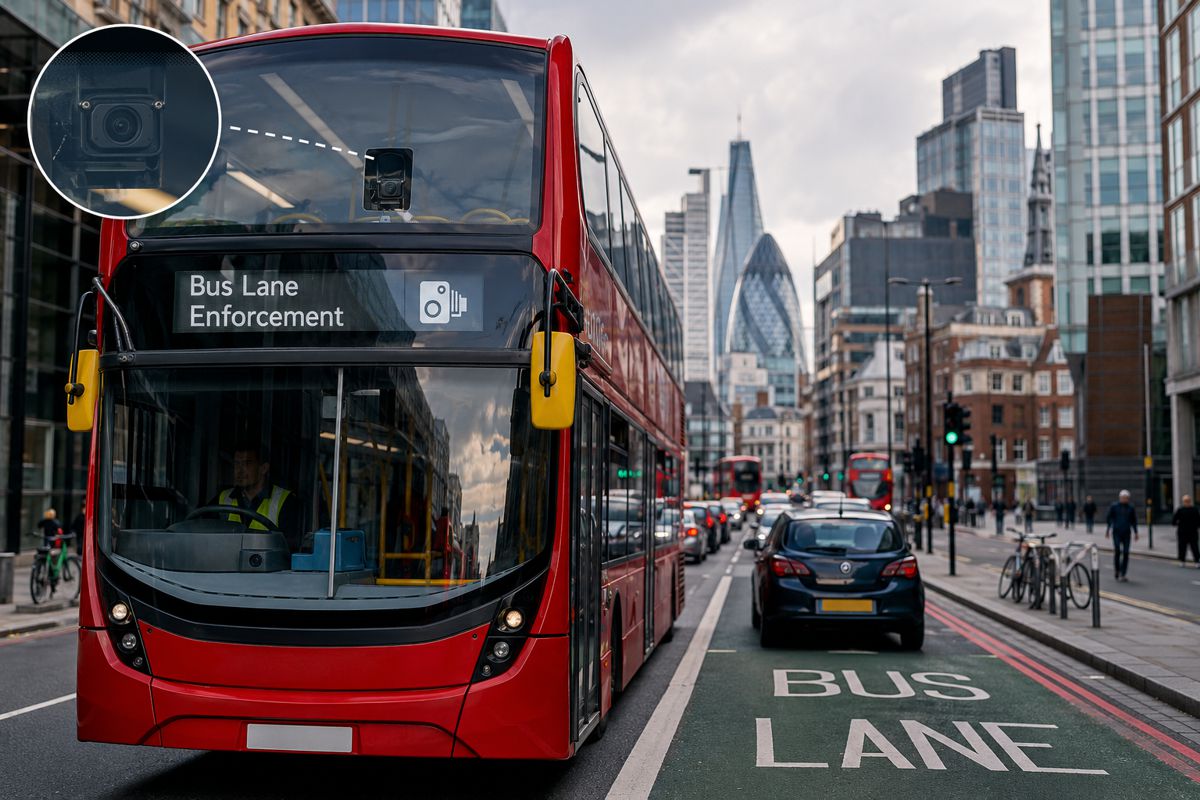
Strip away the jargon and the hardware is straightforward enough. The core component is a forward-facing camera system mounted behind a bus windscreen, peering out at the road ahead as the vehicle goes about its normal route. It automatically spots a contravening vehicle, reads its number plate, and logs precise location data so the system can confirm the offence happened inside an enforceable zone rather than a few metres outside it. That last detail matters more than it sounds, because a penalty notice issued for the wrong stretch of tarmac is a penalty notice headed straight for appeal.
The appeal of the bus-mounted approach, as opposed to fixed roadside cameras, is reach. A single bus running its loop covers far more ground than a stationary pole, and a fleet of them turns the everyday rhythm of public transport into a moving net of coverage. Evidence captured on board is transmitted back to the local authority, where a human reviews it before any notice goes out. That human-in-the-loop step is part of how these schemes square automated detection with the evidentiary standards British enforcement demands.
A Track Record Shipped Over From America
England isn’t being asked to take a leap of faith on untested kit. Hayden AI, founded in 2019, has spent years deploying versions of this technology across major US cities, and the numbers offer councils something concrete to chew on. In New York, the firm won its first contract with the Metropolitan Transportation Authority in 2022, an initial $19.6 million deal to fit cameras on hundreds of buses, since expanded dramatically as the MTA scaled up its Automated Camera Enforcement programme. Washington’s Metro, Los Angeles and Philadelphia have followed with their own deployments.
The performance data is what tends to catch the eye of policymakers. The MTA has reported that 86% of drivers who pick up a bus lane parking violation never get a second one, a figure the agency reads as proof that automated enforcement nudges behaviour rather than simply harvesting fines. Earlier MTA work on the M14 route logged measurable gains in bus speed once enforcement kicked in. The company has also run trials further afield, including a three-month pilot in Braga, Portugal, that flagged nearly 8,000 parking violations at bus stops, a pointed illustration of how often kerbside obstruction quietly degrades service. None of that guarantees identical results on a wet morning in Leeds or Bristol, but it gives British authorities a real-world baseline.
The Commercial Read For Britain
For Hayden AI, the certification is a beachhead. Marty Beard, the company’s chief executive, framed it in the language of regulatory credibility. “We are incredibly proud that our Civil Traffic Enforcement System has received approval from the VCA,” said Beard. “This approval demonstrates that Hayden AI’s system – from our purpose-built hardware to our highly-accurate detection software – meets the highest legal and statutory standards for traffic enforcement technology in the world. We are excited to help local authorities in England and across the United Kingdom improve public transport safety, reliability, and accessibility with our proven, vehicle-mounted automated enforcement platform.”
For the wider infrastructure ecosystem, the significance runs deeper than one supplier’s win. A certified, scalable enforcement system that piggybacks on existing bus fleets lowers the cost and complexity of doing something councils have wanted to do for years. If bus lanes stay clear, services run faster and more reliably, which feeds directly into the patronage and modal-shift targets baked into England’s bus strategy.
Investors eyeing the urban mobility and smart-city sector will note that the addressable market here is the slow-moving sprawl of English local government, not a single flagship city, and that the legal scaffolding is finally in place to support it. Whether councils move quickly or cautiously, the gap between what the law permits and what the technology can deliver has just narrowed sharply, and that shift will shape how England’s streets are policed for the next decade.