The Crooked Logs That Could Rewrite Timber’s Rulebook
For as long as anyone in the trade can remember, a tree has had one job to earn its keep on a building site: grow straight. Anything that forked, curved or twisted as it climbed towards the light was quietly written off, sent to the pulp mill or fed into a furnace for energy. Now a researcher at Finland’s Aalto University reckons that whole way of thinking is leaving good structural timber to rot on the forest floor, and he’s got the load tests to prove it.
Jaakko Torvinen, an architect and doctoral researcher, has published what Aalto describes as the first structural load tests on organically shaped roundwood columns: the curved, double-curved and forked logs that almost never make it past a sawmill’s sorting line.
The headline finding is almost disarmingly modest. The same equations engineers already reach for when sizing ordinary straight timber columns turn out to work just as reliably on the awkward stuff. For an industry hunting low-carbon materials and cheaper supply, that quiet result carries a lot more weight than its understated tone suggests.
briefing
- Aalto University researcher Jaakko Torvinen has released the first structural load tests on curved, double-curved and forked roundwood used as columns, published on 4 June 2026 in Wood Material Science and Engineering.
- The study found that standard, widely used calculation methods predict the load-bearing capacity of irregular logs accurately, removing a long-standing engineering objection to so-called misfit wood.
- In Finland, barely a third of harvested wood ends up as sawn timber, with much of the rest going to pulpwood or energy wood despite being structurally sound.
- Paired with digital design and fabrication, the approach could make mass customisation commercially viable and pull large volumes of overlooked material back into the construction supply chain.
- Torvinen’s built work, including Helsinki’s Pikku Finlandia hall and the award-winning Puusauna, already demonstrates the aesthetic and structural case in practice.
A simple sum that solves an expensive problem
The technical breakthrough here isn’t a new wonder material or a patented process. It’s the realisation that the maths was never the obstacle. Torvinen and his co-authors, Janusch Töpler, Gerhard Fink and Matti Kuittinen, set out to test whether the conventional formulas used for straight timber columns could predict how much load a knotted, bending log would carry before failing. They could. It’s actually a pretty simple equation that can be used to gauge its load-bearing capacity, says Torvinen. What’s surprising is that nobody has done this earlier.
That gap in the research record speaks to a deeper habit of mind across the timber and construction sectors. Engineers have spent centuries refining their understanding of standardised, dressed sections, while a tree’s natural geometry was treated as a defect rather than a design input. We’re so used to thinking in terms of standardised planks or beams, Torvinen explains.
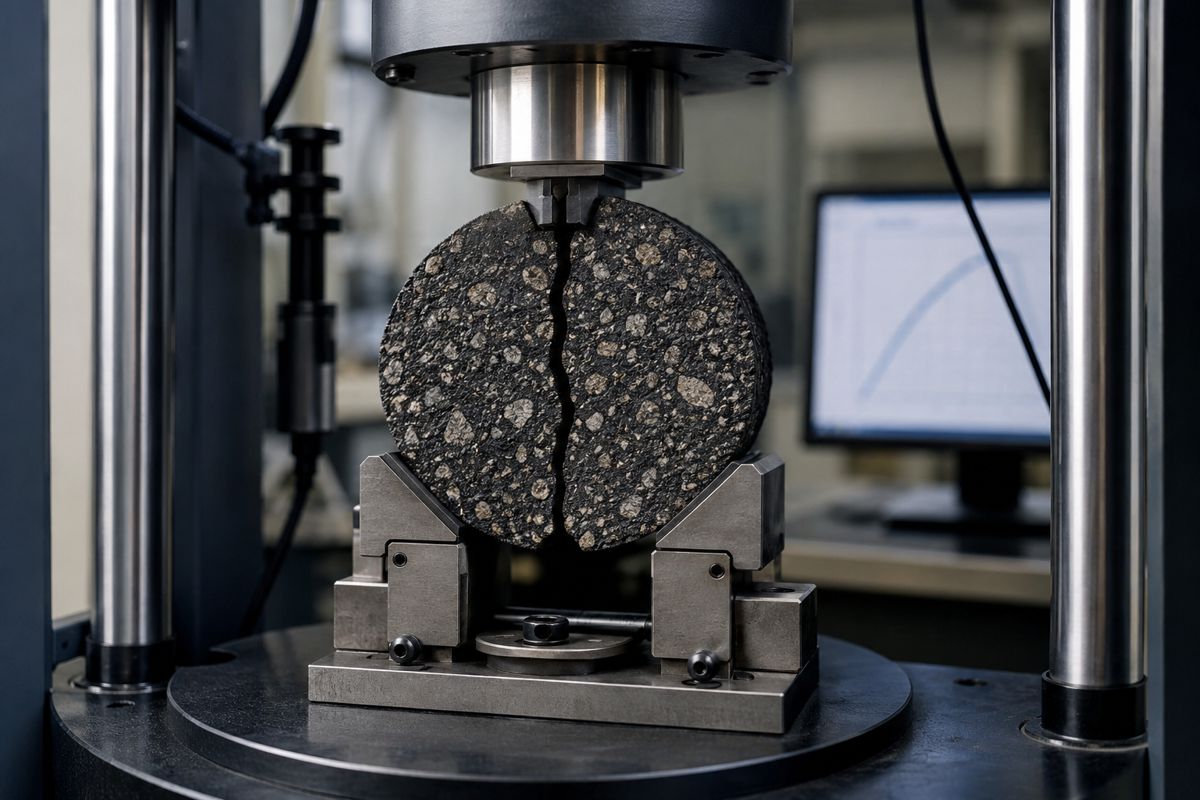
This explains why nobody has ever looked at a tree trunk and come up with an algorithm to gauge its strength. The method behind the study was deliberately low-tech where it could be: the basic shape and curvature deviation of each log, the so-called bow-imperfection, was captured using manual tools and image processing, while compressive load and deformation were tracked with draw wire sensors as the columns were pushed towards their limits.
The economics of throwing wood away
What makes the finding commercially interesting is the sheer scale of what currently gets discarded. In Finland, a country built on its forests, only around a third of harvested wood becomes sawn timber. The remainder, much of it perfectly capable of holding up a roof, is downgraded to pulp or burned for energy because it doesn’t fit the straight-and-uniform template that sawmills and structural codes were built around. Torvinen finds that waste hard to stomach. If it’s not suitable as saw logs, it goes to pulpwood or energy wood, he says. But our assumption that ‘generic is best’ is old-school thinking, and we’re wasting way too much good wood.
Every cubic metre of structurally sound timber that gets pulled back into the building supply chain is a cubic metre that doesn’t need to be replaced by carbon-intensive concrete or steel, and it’s wood that already exists rather than premium grade stock that commands a premium price. There’s a carbon storage argument layered on top, since timber locked into a building keeps its sequestered carbon out of the atmosphere for the life of the structure. Across global forestry, the proportion of harvest that ends up as low-value residue runs into the hundreds of millions of tonnes a year, so even a modest shift towards structural use of irregular wood would register at industrial scale.
Where digital fabrication changes the maths
The catch with crooked timber has always been that no two pieces are alike, which is precisely why standardisation won the argument in the first place. A straight beam can be specified, ordered and bolted into place without a second thought. A forked log demands that someone work out how it behaves, where it sits and how it connects. Torvinen’s view is that digital design and fabrication tools now handle that complexity cheaply enough to tip the balance. Scanning, modelling and computer-controlled cutting let designers treat each unique log as data rather than a headache, and the load calculations validated in the study slot neatly into that workflow.
That combination is what makes mass customisation a realistic commercial proposition rather than an architectural curiosity. Using standard timber only is something that cash-strapped consumers are ready to abandon. So I want to clear the path to industry embracing the possibilities of misfit wood too, says Torvinen.
The wider market backdrop helps his case. The global mass timber sector has been growing at high single-digit rates, with one estimate putting it at roughly USD 13 billion in 2025 and on track to nearly double over the following seven years, while cross-laminated timber alone is forecast to expand at double-digit annual rates through the early 2030s. A supply chain that’s already scaling up engineered wood is one that’s primed to absorb a new category of cheap, low-carbon structural feedstock.
Proof you can stand under
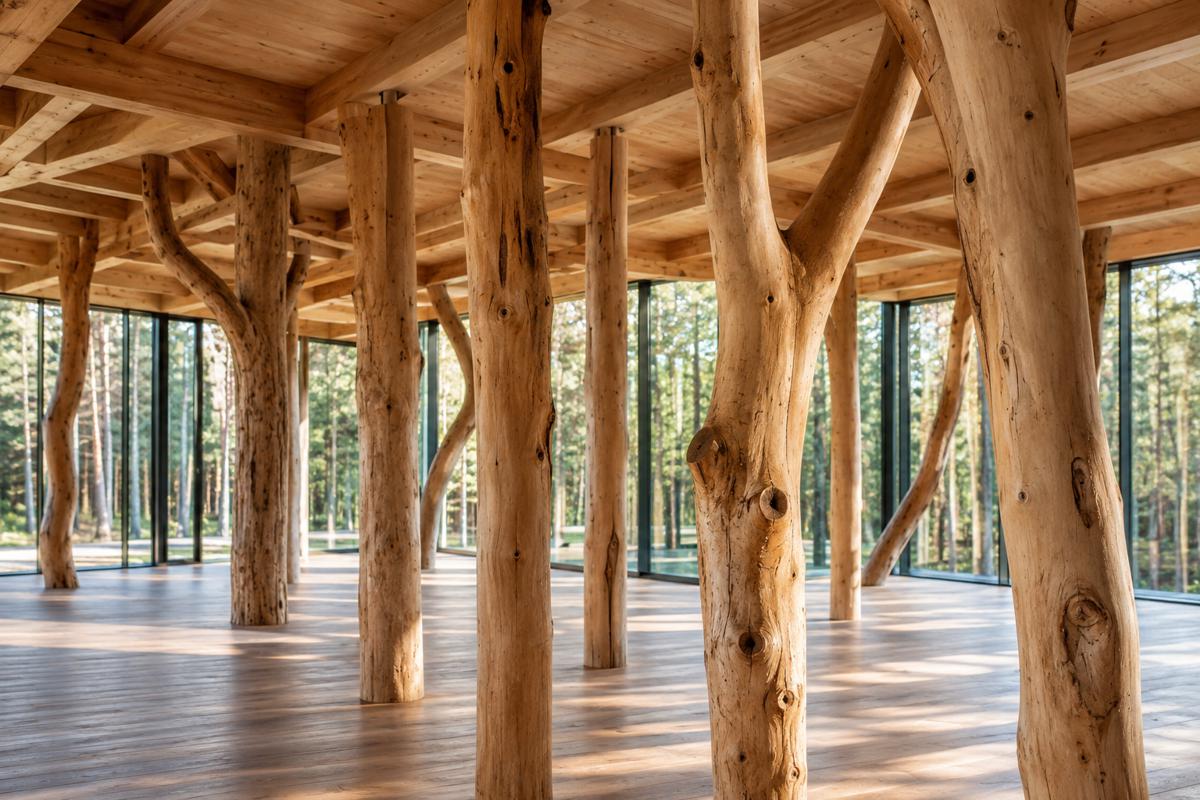
Torvinen isn’t arguing from the lab bench alone. His built work has been quietly making the structural and aesthetic case for years. Pikku Finlandia, the temporary events hall raised beside Helsinki’s landmark Finlandia Hall, stands on untreated pine trunks with their branches still attached, pressed into service as columns.
Torvinen has described the result as like a forest in the centre of Helsinki, and the building has become a calling card for the idea that raw, irregular timber can carry real loads while looking remarkable doing it.
His Puusauna project pushes the same logic into the realm of slow living, and it picked up a 2026 Wallpaper* Design Award for its trouble. The structure, which uses wood that would otherwise have been thrown away, forms part of Aalto University’s Designs for a Cooler Planet 2026 exhibition in Helsinki, running from 1 September to 30 October 2026.
Torvinen hopes the new paper does for the engineering conversation what those buildings have done for the visual one. In future projects, when a designer or client wants misfit wood in a building, it won’t be laughed at as an icebreaker, but considered as a legitimate design proposal like any other, he says.
The road from curiosity to convention
None of this means crooked columns will appear in next year’s structural drawings as a matter of course. The study is a first set of tests, not a finished design code, and turning a validated calculation method into the kind of standardised guidance that insurers, building control officers and structural engineers will sign off on is a longer road.
Questions around grading, supply consistency, jointing and long-term performance will all need answers before a contractor specifies a forked log with the same confidence as a glulam beam. Even so, the direction of travel is clear enough.
Torvinen has taken the one objection that reliably killed the conversation, the inability to say how much weight an irregular log would bear, and shown that the answer was sitting in textbooks all along. For an industry under pressure to cut embodied carbon, shorten supply chains and squeeze more value from every harvested tree, a method that turns waste into structure without demanding new materials or exotic processing is the kind of unglamorous innovation that tends to stick.