FLIR Builds an App Store Into the Thermal Camera With Its New iXX-Series
Teledyne FLIR has spent decades selling thermal imagers as precision instruments judged largely on their optics and detectors. The iXX-Series, introduced in September 2025, shifts the basis on which those cameras compete.
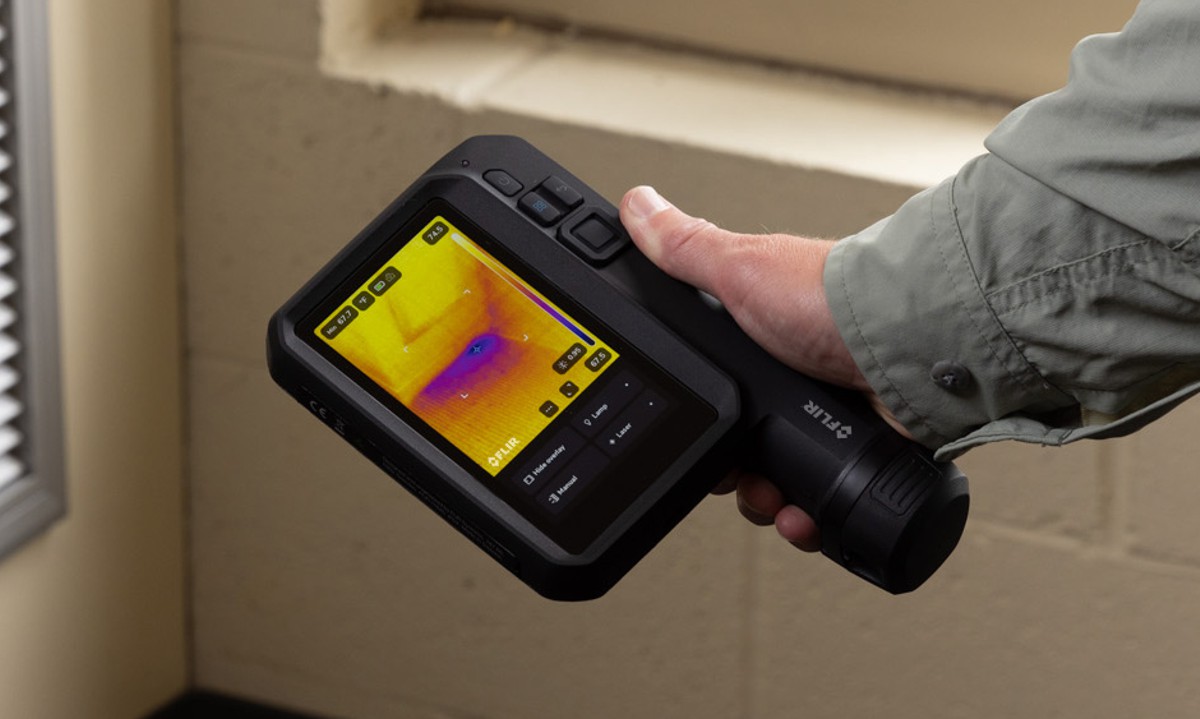
Built on a new platform the company calls ACE, short for Android Camera Ecosystem, the range behaves less like a fixed-function instrument and more like a smartphone for thermography, running software written by FLIR, by its customers and by approved third-party developers. For sectors that have long treated infrared inspection as a specialist craft, that repositioning carries more weight than any single line on a specification sheet.
The commercial reasoning is borrowed openly from consumer electronics, and FLIR has not tried to disguise it. The bet is that the durable value of an inspection camera now sits in software, data and connected workflow rather than in the sensor on its own, and that whoever controls the platform controls the customer relationship that follows.
That is a meaningful change for plant operators, facilities teams, electrical contractors and the utilities and data-centre owners who depend on thermography to keep critical assets running. It also reframes how investors should read the handheld instrument market, which has tended to be valued on hardware refresh cycles rather than recurring software and cloud revenue.
Briefing
- FLIR launched the iXX-Series in September 2025, built on its new ACE platform, turning the handheld thermal camera into an app-hosting device with FLIR, third-party and privately developed software.
- The range spans four models: the i34 and i35 at 240 × 320 resolution, and the i64 and i65 at 480 × 640, with LTE connectivity reserved for the i35 and i65. All offer sub-40 mK thermal sensitivity and ±2°C accuracy.
- FLIR positions the line against a skills shortage, citing that around 60% of maintenance teams report a lack of qualified thermographers, and pairs the cameras with guided, app-led workflows and an onboarding app.
- Connected workflows are pitched at the reporting burden, which FLIR says can consume up to half a technician’s time; one named user reports cutting large-job report turnaround from 8 to 12 hours down to about five minutes.
- The cameras feed FLIR’s Assetlink and Ignite cloud software, link to maintenance management systems, and ship with ISO 27001 information-security accreditation behind the platform.
A platform play, not a product refresh
What separates the iXX-Series from a conventional generational update is the ACE ecosystem sitting beneath it. Rather than shipping a closed feature set, the cameras carry an on-device app store, letting inspection teams load tools built for a specific task and retire them when needs change. FLIR supplies its own applications, opens the platform to vetted external developers, and lets larger customers commission or build private apps that run behind their own firewall. The effect is to convert a one-time hardware sale into the entry point for an evolving software relationship, much as a handset does for a mobile operating system.
Rob Milner, Director Business Development at FLIR, set out the thinking: “Most people don’t buy smartphones for the hardware, but to take advantage of capability-enhancing apps,” he said. “Using its ACE ecosystem, our new iXX becomes a portable infrared camera that hosts Flir and third-party apps to solve end-user pain points. Customers gain from simplified & faster workflows, support for inexperienced operatives, and the ability to solve documentation, communication, and decision pains. With the iXX, it’s even possible to create private apps that meet user-specific requirements and goals.”
For competitors in the handheld thermography market, the move raises the stakes, because matching a detector specification is straightforward in a way that matching a developer ecosystem and an installed software base is not.
Aimed squarely at the thermographer shortage
The most consequential commercial argument behind the iXX-Series is about people rather than pixels. FLIR cites figures suggesting that roughly 60% of maintenance teams report a shortage of skilled thermographers, a constraint that has limited how widely condition-monitoring programmes can be deployed even where the underlying business case is sound.
Thermography has traditionally demanded trained interpretation, with the value of an inspection resting heavily on the operator’s judgement. By pushing that expertise into guided, app-led workflows and supplying an onboarding app with each camera, FLIR is trying to lower the barrier so that a technician without formal thermographic training can still capture usable, consistent data.
The strategic prize here is market expansion rather than incremental share. If less experienced staff can run reliable inspections, the addressable population of users grows well beyond certified thermographers, and inspection frequency can rise across more assets and more sites. That matters for construction and infrastructure operators in particular, where maintenance teams are stretched and where the cost of recruiting specialist inspectors has often capped programme scope.
The same dynamic that has driven the wider shift from periodic checks toward continuous asset-health monitoring is at work, and FLIR is positioning the iXX as the handheld tool that lets understaffed teams participate in it.
The economics sit in the reporting, not the image
For all the attention on detectors and resolution, the part of the inspection cycle that consumes time and money is the paperwork that follows. FLIR puts the figure starkly, noting that reporting can absorb up to half a technician’s working time under traditional methods.
The iXX-Series ships with Assetlink, a browser-based application that lets users plan inspections, connect radiometric images directly to an asset hierarchy and generate reports, with data flowing to the cloud over Wi-Fi or, on the i35 and i65, over LTE. Trend visualisation and dashboards then turn individual snapshots into a record of how an asset is changing, which is where condition monitoring earns its keep.
The operational payoff is most visible in field accounts. Tyler Grant, Project Manager for Electrical Testing, Project Engineering, and Construction Safety at Blackmon Power, described pairing the FLIR i65 with the third-party Condoit app as a step change in how his team works.
“Using the Flir i65 and Condoit app as our new workflow platform is a total game-changer. I’ve been doing this job for 10-15 years, and it’s never been this easy,” he said. On reporting specifically, his account is more concrete still: “Once the data and images are gathered on site, we can generate a report within five minutes. Once synchronized to the cloud, I can run the report and send it to the customer immediately from my location in the office. That whole process would previously take us 8-12 hours for a large job.” Compressing a day’s reporting into minutes changes the unit economics of an inspection contract, and it is the kind of measurable saving that tends to drive procurement decisions more reliably than image quality alone.
Where it lands in the field
FLIR has built the range with a clear primary target in electrical and mechanical inspection across manufacturing, industrial, commercial, data-centre and utility environments, where early fault detection translates directly into avoided downtime. The cameras offer glove-friendly controls and wide fields of view suited to inspecting energised equipment through infrared windows, and a Meterlink application captures load, voltage and other electrical readings alongside the thermal data to give context for prioritising repairs. Building diagnostics forms a second strand, covering moisture detection, HVAC performance checks and energy-loss surveys, with on-camera routing intended to keep results consistent from one inspection to the next.
On the hardware itself, the four models share a common measurement core while splitting on resolution and connectivity. The i34 and i35 deliver 240 × 320 thermal resolution, the i64 and i65 step up to 480 × 640, and every model carries sub-40 mK sensitivity, ±2°C accuracy and FLIR’s MSX feature, which embosses visible-light detail onto the thermal image to make faults easier to locate.
An 8-megapixel visual camera and a large touchscreen round out a specification that is competitive without being exotic, consistent with a strategy that treats the sensor as the platform’s foundation rather than its main selling point. LTE on the i35 and i65 is the practical differentiator for teams that need to upload and collaborate from sites without reliable Wi-Fi.
A shift the wider market has been moving toward
The iXX-Series arrives as condition monitoring and predictive maintenance attract serious capital. The machine condition monitoring market is projected to grow from around $3.24 billion in 2026 to roughly $6.80 billion by 2034, while broader predictive maintenance forecasts run to tens of billions of dollars over the same horizon, driven by an estimated cost of unplanned industrial downtime that runs into the hundreds of billions globally each year.
Against figures of that scale, a tool that widens the pool of people able to catch faults early, and that strips hours out of every report, addresses a cost asset-intensive operators already feel acutely. The link to maintenance management systems matters here too, since insight that lands inside an existing CMMS as a work order is far more likely to be acted upon than a report that sits in an inbox.
There is a governance dimension that will weigh with utilities, data-centre operators and public infrastructure owners. FLIR holds ISO 27001 accreditation for information security, and the platform supports managed app deployment behind a firewall, which speaks to the reservations that critical-infrastructure buyers tend to have about cloud-connected field devices.
The open question is competitive rather than technical. By moving the contest from optics to ecosystem, FLIR is inviting rivals to answer in kind, and the firms best placed to respond may be those that can combine credible thermal hardware with software and developer relationships of their own. For buyers, the more immediate calculation is whether tying an inspection programme to one vendor’s platform delivers enough in consistency, speed and reach to outweigh the lock-in that any ecosystem inevitably brings.