Hytera PDC580 Bridges Narrowband and Broadband on the Critical Front Line
The launch of a single handheld radio rarely counts as a strategic event, yet the release of Hytera’s PDC580 dual-mode rugged radio touches on a question that sits near the top of the agenda for infrastructure owners, transport operators and utilities across every developed market. That question is not whether communications should move from narrowband radio to broadband, because the direction of travel has been settled for years.
It is how organisations get from one to the other without stranding investment, retraining thousands of workers overnight or accepting a coverage gap on the day a network is switched. The PDC580 is aimed squarely at that middle passage, the long and often awkward period in which private mobile radio and cellular broadband have to coexist inside the same operation.
For anyone responsible for keeping crews safe and connected on a motorway maintenance contract, a rail corridor, a substation upgrade or a large civils site, the practical value of a device that speaks both languages is easy to grasp. Narrowband radio remains the backbone of front-line voice because it is resilient, predictable and works where cellular does not.
Broadband, by contrast, is where the data lives, from live video and location tracking to dispatch analytics and connected sensors. Hytera’s proposition is that teams should not have to choose between the two, nor carry two devices, nor rebuild their command structures to accommodate a migration that regulators and network operators openly concede will run for the rest of the decade. The commercial significance lies less in the hardware than in the way it lets asset owners defer the most expensive decision of all, which is wholesale infrastructure replacement.
Briefing
- The PDC580 combines private mobile radio, in both digital and analogue form, with push-to-talk over cellular in a single rugged handheld, allowing users to move between local radio coverage and broadband networks without changing equipment or working habits.
- Its PMR-PoC Simul-call feature lets one transmission reach users on narrowband and broadband networks at the same time, while a voice gateway mode lets the device bridge existing radio fleets into broadband groups.
- The launch lands in the middle of a multi-year, phased migration from legacy radio to broadband that national programmes across Europe and beyond do not expect to complete before the end of the decade.
- Hytera positions the device for outdoor, safety-critical work, citing professional noise reduction, all-day operation, Type-C fast charging and operation in temperatures as low as minus 30 degrees Celsius.
- For infrastructure owners, the strategic pull is the ability to modernise gradually, preserving existing radio investment and shifting communications spend from a single large capital outlay towards a managed transition.
The Economics of a Migration That Refuses to Happen Overnight
The market backdrop explains why a dual-mode device is more than a convenience. Estimates for the professional mobile radio sector vary between analysts, but one recent forecast values the global market at around 22 to 23 billion US dollars in 2026, projecting expansion towards roughly 48 billion by the mid-2030s at a compound annual growth rate approaching nine per cent.
The push-to-talk over cellular segment is smaller and its sizing is far less settled, with published 2025 valuations ranging from about 3.8 billion to 5.9 billion US dollars and forecasts stretching from around 6.8 billion by 2030 to 11.6 billion by 2034, depending on the methodology used. The spread in those numbers is itself the story. It reflects a market in transition, where narrowband and broadband are not competing for the same budget so much as overlapping within it. Land mobile radio still accounted for the majority of push-to-talk revenue in 2025 on most measures, a reminder that reports of narrowband’s demise remain premature.
That persistence is not sentiment, it is engineering and economics. National critical communications programmes illustrate the timescale plainly. The United Kingdom’s Emergency Services Network is replacing its legacy TETRA system, France is building its Réseau Radio du Futur, Sweden’s SWEN roadmap does not expect basic-service migration to gather pace until around 2028 with users moved across by roughly 2030, and railway operators across Europe and Asia are shifting from GSM-R to the 5G-based Future Railway Mobile Communication System.
Each of these transitions is planned as a phased hybrid, precisely because operations cannot pause while networks change underneath them. For commercial infrastructure operators, the same logic applies without the state funding. A phased approach converts a large capital project into a managed operating cost, softens the training burden and keeps proven narrowband voice in service trackside, roadside and in tunnels while broadband is layered in at depots, stations and control rooms. A device that carries both networks in one shell is one of the cheapest ways to buy time inside that plan.
One Device, Two Networks, One Transmission
At the centre of the PDC580 is a deceptively simple idea, which is to let a single handset operate across private mobile radio, in digital and analogue modes, and push-to-talk over cellular without asking the user to think about which network they are on. During routine patrols or maintenance work, familiar physical controls and dedicated press-to-talk buttons let a worker reach on-site colleagues over local radio and remote dispatchers over broadband in the same motion. #
When a situation escalates, the device’s PMR-PoC Simul-call feature allows one transmission to be heard simultaneously by users on both narrowband and broadband networks, which removes the delay and the room for error that comes from relaying the same message twice across separate systems.
Arthur Luo, Product Manager of Hytera Smart Terminal BU, framed the device around continuity rather than replacement. “The transition from narrowband to broadband is not an overnight replacement,” he said. “Many organizations will operate mixed communication environments for years to come. The PDC580 is designed to make that transition seamless, allowing teams to stay connected without changing established operational workflows.”
The emphasis on established workflows is telling, because the greatest hidden cost of any communications change is rarely the hardware. It is the retraining, the revised procedures and the risk that a crew under pressure reaches for a control that has moved. Regional distributor material indicates the handset carries separate press-to-talk controls for each mode and a small always-legible display that surfaces radio and cellular status together, details that matter to supervisors managing mixed groups where a missed instruction near live traffic or moving plant has consequences.
Turning Existing Radio Fleets into Broadband-Ready Assets
Beyond individual use, the PDC580 can act as a voice gateway between radio and cellular users, and this capability may prove the more consequential for infrastructure buyers. By bridging an existing radio system into a broadband group, the device lets an operator extend collaboration across mixed environments without ripping out fleets that still have years of service left in them.
In effect, radios already deployed on a project can be pulled into wider broadband coordination through a single bridging unit, which preserves the sunk investment in handsets, repeaters and the accessory ecosystem built around them. For a contractor or asset owner weighing a communications refresh, that changes the calculation from replace-everything to connect-what-you-have.
The approach sits within a broader industry pattern. Standards bodies have defined interworking functions to let next-generation broadband services communicate with legacy narrowband technologies such as TETRA, P25 and GSM-R, precisely because so many user groups will rely on narrowband for years while others move ahead. A handheld that performs a similar bridging role at the edge of the network, rather than only in the core, gives smaller operators and individual projects a route into hybrid working without a systems-integration programme.
Hytera describes the device as supporting a gradual migration towards next-generation infrastructure without disrupting established operations, and the commercial reading of that is straightforward. It lowers the entry cost of hybrid communications and lets modernisation proceed at the pace of the budget rather than the pace of the technology.
Built for the Roadside, the Railhead and the Substation
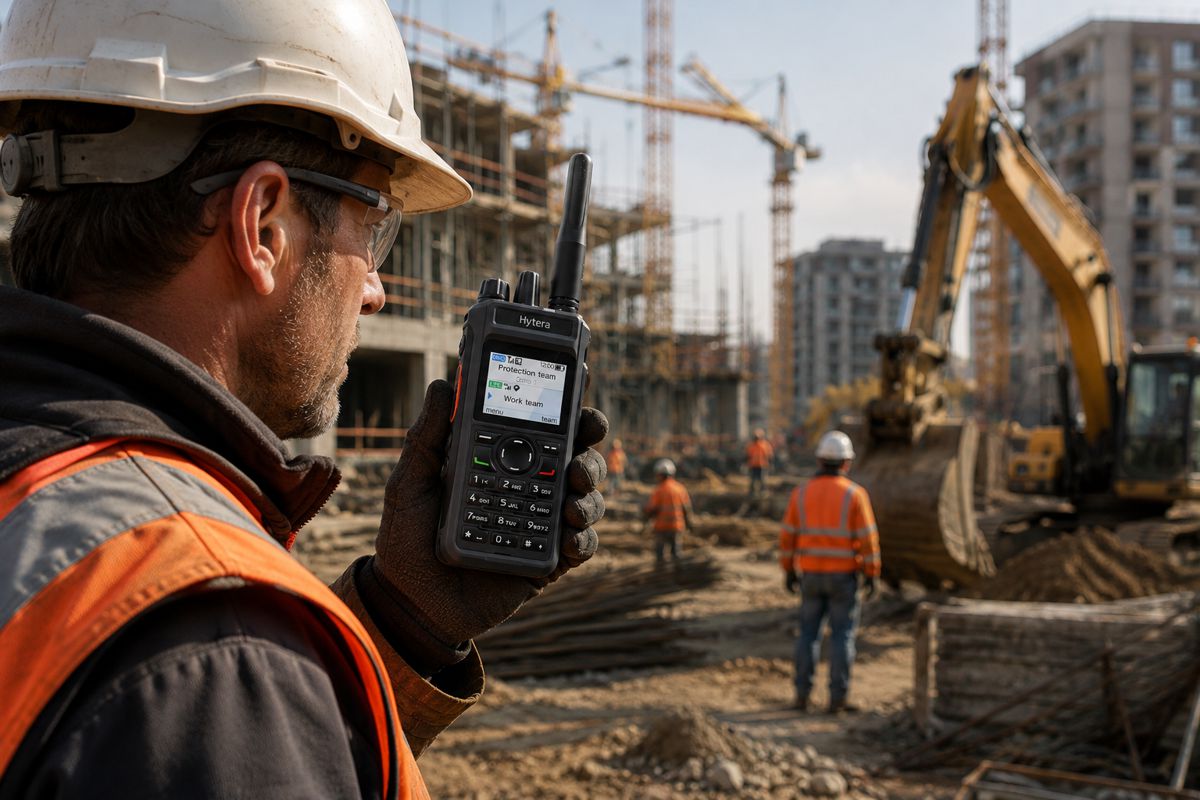
None of this matters if the device cannot survive the environment it is sold into, and the PDC580 is pitched firmly at outdoor, safety-critical work. Hytera cites loud, clear audio with professional noise reduction intended to keep instructions intelligible near traffic, power facilities, rail lines and in wind and rain, alongside rugged protection, all-day operation, Type-C fast charging and the ability to work in temperatures as low as minus 30 degrees Celsius. Those are the conditions that define infrastructure delivery in much of the world, from winter maintenance on northern road networks to exposed civils sites and remote energy assets, and they are exactly the conditions in which consumer-grade devices fail early and expensively.
Regional distributor listings add further detail that buyers will want to verify against Hytera’s own specification before procurement, including an IP67 dust and water rating, VHF and UHF radio bands, five watts of radio output, a wide-temperature battery rated from minus 30 to plus 60 degrees Celsius, high-output audio in the region of 100 decibels, extended tamper-resistant voice recording for evidence and dispute resolution, and an inactivity alarm aimed at lone-worker safety.
Some of these listings also indicate the radio falls back to digital mobile radio operation if the cellular network is lost, which preserves the single most important property of professional radio, namely that it keeps working when the wider network does not. Taken together, the feature set reads as a device engineered around the realities of a shift pattern in the field rather than a specification sheet, and the recording and lone-worker functions in particular speak to the safety and accountability obligations that now shape procurement in construction, utilities and transport.
Where the PDC580 Sits in a Mixed-Fleet Procurement Strategy
The PDC580 does not stand alone in Hytera’s range, and understanding where it fits helps clarify who should buy it. The company already offers smartphone-style dual-mode devices such as the PDC680, which pair a mission-critical radio with an Android handset and lean towards data-rich roles that need cameras, touchscreens and applications. The PDC580 keeps the form and muscle memory of a traditional radio while adding broadband reach, which suits front-line users who need reliable voice first and data second, and who work in gloves, in the cold and in noise.
In a mixed fleet, that distinction supports a tiered procurement strategy, with data-heavy supervisory and command roles on smartphone-class devices and the bulk of field crews on rugged radios that broaden coverage without changing how people work.
That tiering matters because total cost of ownership, rather than headline device price, increasingly drives decisions in this category. Analysts point to a shift towards subscription and device-as-a-service models that spread cost, shorten refresh cycles and move spend from capital to operating budgets, a pattern that aligns neatly with the phased migration logic already reshaping the sector.
For infrastructure owners running frameworks across multiple projects and geographies, a device that reduces the need for parallel radio and cellular estates, and that can bridge legacy fleets rather than retire them, offers a route to consolidation without a disruptive switchover. The procurement question it poses is less about the radio itself and more about how an organisation wants to sequence its move to broadband, and how much optionality it wants to retain while networks, spectrum and standards continue to mature.
The Direction of Travel
The broader lesson of the PDC580 is that the critical communications market has stopped treating narrowband and broadband as an either-or choice and started designing for coexistence. National programmes have set the tone, committing to migrations that run for years and depend on narrowband continuing to carry mission-critical voice throughout.
Vendors are following at the device level, and hybrid handsets, bridging units and interworking functions are becoming the practical machinery of a transition that will define infrastructure communications well into the 2030s. For the operators and contractors who build and maintain the physical world, the significance is that modernisation no longer has to arrive as a single expensive rupture.
Whether the PDC580 specifically wins share will depend on price, network certification, distributor support and how its real-world specification holds up against rivals from established competitors in a crowded field.
The more durable point is strategic. Infrastructure communications is entering a long hybrid era, and the organisations that navigate it best will be those that keep their options open, protect existing investment and adopt broadband capability at a pace they control. Devices built to bridge the two worlds, rather than force a jump between them, are how that measured approach becomes possible on the ground.
Key Industry Questions
- What is a dual-mode rugged radio, and how does it differ from a standard two-way radio or a push-to-talk app on a phone? A dual-mode rugged radio combines private mobile radio and push-to-talk over cellular in one hardened device. A standard two-way radio relies solely on narrowband and stops at the edge of its own network coverage, while a push-to-talk app on a smartphone depends entirely on cellular and lacks the durability and instant group voice that front-line work demands. A dual-mode device gives users the resilience and predictable coverage of radio for local voice, plus the wide reach and data capability of broadband, in a single unit built to survive dust, water, cold and impact on infrastructure sites.
- Why do organisations keep narrowband radio instead of moving fully to broadband? Narrowband radio remains the most reliable option for mission-critical voice, particularly in tunnels, remote corridors and areas with weak or congested cellular coverage. It offers native group calling, direct device-to-device operation when networks fail, and coverage characteristics that broadband cannot always match. National critical communications programmes retain narrowband throughout their migrations for exactly this reason. Ripping it out prematurely would strand investment, create coverage risk and impose heavy retraining costs. The prevailing approach is to run hybrid environments, keeping proven narrowband voice in service while layering broadband data and reach on top, until broadband can fully match narrowband’s resilience.
- What does the PMR-PoC Simul-call feature actually do in practice? Simul-call lets a single transmission reach users on both narrowband and broadband networks at the same time. In practice, a supervisor issuing an instruction during an incident does not have to repeat the message separately over radio and over cellular, which removes delay and the risk that one group misses a command. On a live site or roadway, where seconds and clarity affect safety, that single-transmission reach across mixed groups shortens the chain between decision and action. It also simplifies command structures during escalation, because dispatchers and on-site teams on different networks hear the same message simultaneously rather than through a relay.
- How does the voice gateway function protect existing radio investment? The gateway mode lets the device bridge an existing radio system into a broadband group, so radios already deployed on a project can join wider coordination without being replaced. This preserves the capital already spent on handsets, repeaters and accessories, which often have years of service life remaining. For an infrastructure owner, that reframes a communications upgrade from a full replacement into an extension of current assets. It lowers the cost and complexity of adopting hybrid working, and it allows broadband capability to be introduced incrementally rather than through a single disruptive switchover that risks operational continuity.
- Which infrastructure and construction sectors stand to benefit most? Roads, rail, utilities, energy and large civil engineering projects are the clearest beneficiaries, because they combine dispersed crews, harsh outdoor conditions and a strong dependence on reliable voice. Winter road maintenance, rail corridor works, substation and grid projects, and remote energy assets all operate where cellular coverage is patchy and where narrowband still carries the load. Logistics, mining and public safety share similar profiles. In each case, the value of a device that extends broadband reach and data without abandoning radio resilience is highest where the work is mobile, safety-critical and spread across environments that punish fragile equipment.
- How large is the push-to-talk market, and how fast is it growing? Sizing varies by source. The wider professional mobile radio market has been valued at around 22 to 23 billion US dollars in 2026 in one forecast, growing towards roughly 48 billion by the mid-2030s. The push-to-talk over cellular segment is smaller and less settled, with 2025 estimates ranging from about 3.8 billion to 5.9 billion US dollars and forecasts reaching between roughly 6.8 billion by 2030 and 11.6 billion by 2034, at growth rates cited between about four and eight per cent. Land mobile radio still held the majority of push-to-talk revenue in 2025 on most measures, underlining that hybrid demand, not outright replacement, is driving the market.
- What should procurement teams weigh when specifying dual-mode devices? Beyond headline price, buyers should assess total cost of ownership, network and regulatory certification in their region, battery endurance across a full shift, environmental ratings against real site conditions, and the strength of local distributor and after-sales support. The ability to bridge existing fleets, rather than force replacement, can materially change the economics of a rollout. Teams should also consider how a device fits a tiered fleet, matching rugged radios to field crews and smartphone-class devices to data-heavy supervisory roles. Finally, growing interest in subscription and device-as-a-service models means procurement increasingly weighs financing structure alongside the hardware itself.
- How does the PDC580 compare with smartphone-style rugged radios such as the PDC680? The two serve different needs within the same portfolio. Smartphone-style devices such as the PDC680 pair a mission-critical radio with an Android handset, favouring data-rich roles that require cameras, touchscreens, video and applications. The PDC580 retains the shape, controls and simplicity of a traditional radio while adding broadband reach, which suits front-line users who need dependable voice first and who work in gloves, cold and noise. In a mixed fleet, the sensible pattern places data-intensive command and supervisory users on smartphone-class hardware and the majority of field crews on rugged dual-mode radios, broadening coverage without changing established working habits.
Strategic Takeaways
- The commercial case for the PDC580 rests less on the hardware than on optionality; it lets infrastructure owners defer wholesale network replacement and adopt broadband at a pace they control, converting a large capital decision into a managed transition.
- Narrowband is not going away this decade, and procurement strategies built on the assumption of a clean switchover are misreading the market; hybrid coexistence is the operating reality that national programmes and vendors alike are now designing around.
- Bridging and gateway capabilities that fold existing radio fleets into broadband groups are becoming a decisive purchasing factor, because they protect sunk investment and reframe upgrades as extensions rather than replacements.
- Tiered fleet strategies, matching rugged dual-mode radios to field crews and smartphone-class devices to data-heavy roles, are likely to become the default procurement model as total cost of ownership and subscription financing shape decisions more than headline device price.
- Buyers should treat vendor specifications as a starting point and verify environmental ratings, network certification and after-sales support against their own conditions, since the practical value of any dual-mode device is decided in the field rather than on the datasheet.