BCU and HadleyFRAME Show How Automation Is Reinventing Structural Engineering
A research project costing a fraction of an enterprise software licence has just demonstrated something the construction technology market has been slow to price properly. Researchers at Birmingham City University, working with Midlands light steel specialist HadleyFRAME, have built two custom automation programs that reduce the checking of structural connections in a digital building model from four hours to ten minutes, a 96% time saving verified against a five-storey modular residential building in Derbyshire containing more than 18,000 connections.
The headline number is arresting, but the commercial signal underneath it matters more. At a moment when the largest construction software vendors are spending heavily on acquisitions to broaden their platforms, the capability that actually removes cost from an offsite steel manufacturer’s workflow was written to order, in weeks, inside a regional innovation sprint.
That distinction is becoming central to how value is distributed across the digital construction market. Generic platforms handle coordination, documentation and clash detection across disciplines, and they do it well. What they rarely handle is the specific verification logic that governs whether a particular manufacturer’s panelised system has been detailed correctly before steel is cut.
That logic sits in the heads of experienced draughtspeople and in the conventions of a single product system, which is precisely why it has resisted productisation. The Birmingham City University work suggests that gap is now cheap enough to close directly, and that manufacturers who close it will hold a defensible advantage as regulatory scrutiny of design information intensifies across the United Kingdom.

Briefing
- Two custom automation tools developed by Birmingham City University with HadleyFRAME cut structural connection checking from four hours to ten minutes, a 96% saving, validated on a Derbyshire modular residential scheme with over 18,000 connections.
- A second efficiency gain reduces batch copying of five connections from 15 minutes to 12, a 20% saving that compounds heavily across large panelised projects.
- Funding came through a Business & Innovation Support Sprint backed by the West Midlands Advanced Construction Cluster and the West Midlands Combined Authority, positioning the work as a replicable template rather than a one-off.
- The Get It Right Initiative estimates avoidable error costs UK construction between 10% and 25% of project value, with a best estimate of 21%, or around £21bn a year, against average sector margins nearer 3%.
- Regulatory direction of travel, from Building Safety Act gateways to the planned single construction regulator’s commitment to interoperable data, is raising the commercial value of verifiable, front-loaded design assurance.
Where Fabrication-Stage Error Actually Costs Money
The economics of an offsite steel frame business are unforgiving in a particular way. Once a panel enters the roll-forming and assembly sequence, an error in the model has been converted into physical steel, a delivery slot and a site programme commitment.
Dr Ilnaz Ashayeri, Senior Lecturer in Construction Management at BCU and Principal Investigator on the project, framed the problem precisely when she observed that “Missing structural connections have historically gone undetected until the fabrication stage, where identifying and fixing errors is far more costly and disruptive.” The cost curve is not linear, because a missing connection discovered on the factory floor triggers re-detailing, re-scheduling, revised loading of transport and, on a constrained urban site, a knock-on to crane and installation sequencing that no amount of contingency float absorbs cleanly.
Quantifying that exposure has been the work of the Get It Right Initiative for a decade. Its research places the measured direct cost of avoidable error at roughly 5% of project value, and concludes that once unrecorded process waste, latent defects and indirect costs are included the true figure sits between 10% and 25%, with a best estimate of 21% and an annual cost to UK construction of around £21bn.
Set against average industry margins closer to 3%, error avoidance is not a productivity refinement but the largest single lever on profitability available to most contractors and manufacturers. A GIRI training pilot involving Kier, BAM UK and Ireland, VolkerStevin and Taylor Woodrow reported £92.6m of errors identified and avoided across 25 projects, close to 10% of the value being delivered, which gives a sense of how much value sits in the gap between current practice and disciplined checking.
The Regulatory Case for Front-Loaded Assurance
Design assurance in the United Kingdom has acquired a regulatory price tag that did not exist five years ago. Under the Building Safety Act 2022, higher-risk buildings must clear Gateway 2 before construction can begin, with the Building Safety Regulator assessing compliance with Building Regulations, the adequacy of project management arrangements and the competence of the project team.
Performance has improved sharply through 2026 following the regulator’s move into a standalone body under the Ministry of Housing, Communities and Local Government, with approval times falling from peaks of 48 weeks in London and 43 weeks nationally to around 13 to 14 weeks, and some applications now meeting the statutory 12-week period. In the 12 weeks to 28 June 2026 the regulator made 368 decisions on building control approval applications, with 1,505 live applications in the system.
The important detail for manufacturers is that faster decisions have been driven substantially by better submissions. Batching, account management for major developers and refined application quality have separated well-prepared schemes from those still carrying unresolved compliance risk, which means the quality of the information package now translates directly into programme certainty.
That pressure will increase rather than ease. MHCLG has confirmed that the single construction regulator, targeted to be operational in 2028 and built on the existing Building Safety Regulator, will depend on findable, accessible, interoperable and reusable information across the whole building lifecycle, with interoperable digital services forming a core part of its operating model. A manufacturer able to demonstrate that every connection in a model has been machine-verified against a defined rule set, rather than sampled by eye, is producing exactly the kind of structured evidence that regime is being designed to consume.
Light Steel Framing’s Opening and the Verification Premium
Light gauge steel framing has been quietly gaining ground in the UK panelised market while attention has focused elsewhere. Barbour ABI valued the UK panelised modular buildings market at £1.26bn in 2024, with timber frame holding roughly 70% share and light gauge steel frame and hybrid solutions gaining traction, supported by public sector demand across schools, hospitals, prisons and defence estates.
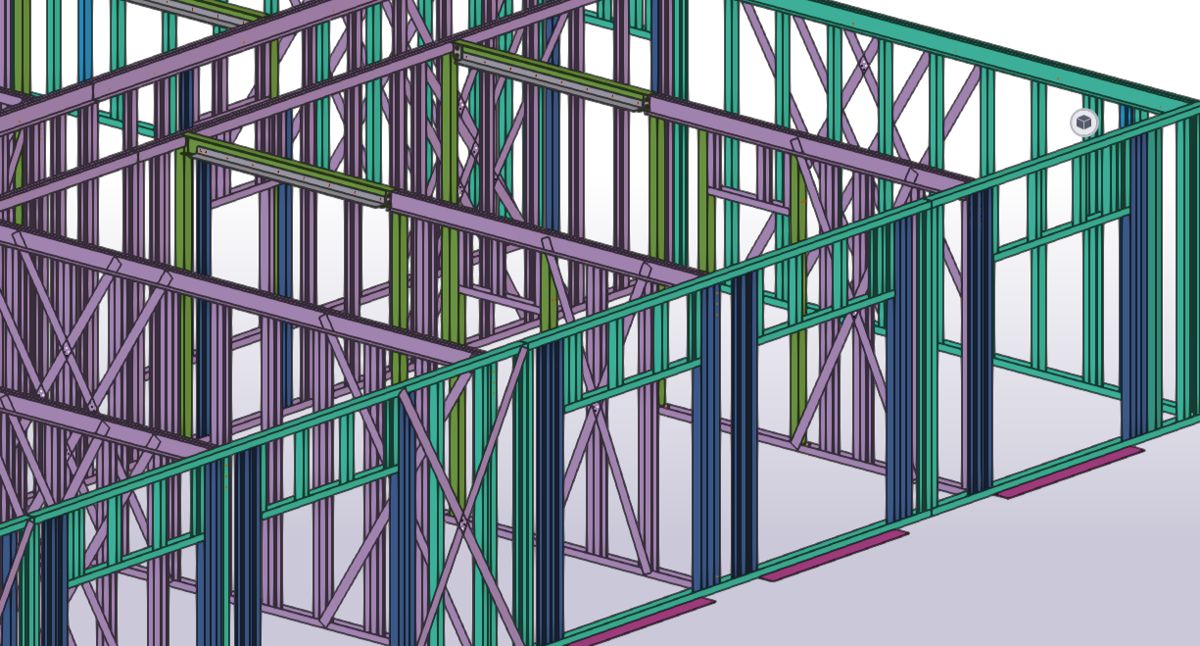
Globally, the light gauge steel framing market is estimated at around $37bn in 2026, growing at low single digits, with the UK accounting for a meaningful share of European volume on the back of modular housing and commercial redevelopment. Hadley Group sits within that competitive set alongside FRAMECAD, Metek and ArcelorMittal, and its HadleyFRAME system delivers pre-panelised galvanised steel walls, floors, lift shafts and stair cores, with bracing distributed through wall panels rather than relying on hot-rolled braced bays or a concrete core.
The sector’s credibility problem has never been the material, which is durable, light and well understood, but the consistency of how it is specified, detailed and assured across a fragmented supply base. The British Constructional Steelwork Association addressed that directly with the National Light-Gauge Steelwork Specification, developed with the Steel Construction Institute and brought into force in April 2025, which harmonises terminology and sets out a framework of requirements intended to be written into construction contracts.
BCSA chief executive Jonathan Clemens tied the specification explicitly to the Building Safety Act’s focus on competence and capability. Automated model checking is the operational counterpart to that specification, because a written standard only reduces risk if a manufacturer can prove compliance at the scale of 18,000 connections rather than assert it.
Platform Consolidation and the Narrow Automation Gap
The wider construction software market has spent 2026 consolidating at speed. Procore completed its acquisition of AI agent platform Datagrid in January, Autodesk closed its purchase of jobsite data firm Rhumbix at the end of March, Trimble agreed to acquire AI contract analysis specialist Document Crunch in April, and Nemetschek signed to acquire Heavy Construction Systems Specialists from Thoma Bravo in the same month.
Trimble also released its 2026 Tekla suite in March, introducing a human-in-the-loop AI service that generates fabrication drawings from a user’s own historical drawing libraries, alongside cloud publishing of Tekla Structures models into Tekla Structural Designer for verification. The pattern across all of it is capability breadth bought at the platform level and delivered to a broad customer base.
What that consolidation does not resolve is the last layer of specificity. A rule that flags a missing connection between two particular cold-formed sections in one manufacturer’s panel configuration is not a feature a global vendor will build for a single customer, and a generic clash detection routine will not find an omission that produces no geometric conflict at all. Absence is harder to detect than collision, which is why missing connections have historically survived until fabrication.
The Birmingham City University tools address exactly that blind spot by scanning an entire model for missing or unexpected connections, and the parameter-driven copying utility that reduced batch times from 15 to 12 minutes attacks the same problem from the input side by letting engineers define conditions per scenario rather than reconfiguring for every case. Both are narrow by design, and that narrowness is the source of their value.
The Sprint as a Procurement Route for Capability
The funding mechanism deserves as much attention as the technology. The work was delivered through a Business & Innovation Support Sprint backed by the West Midlands Advanced Construction Cluster and the West Midlands Combined Authority, part of a regional innovation architecture that has channelled significant public investment into demand-led collaboration.
The West Midlands Innovation Programme, led by the combined authority under the wider Innovation Accelerator portfolio managed by Innovate UK, reports that earlier phases generated over £28m in additional gross value added and levered more than £13.5m of co-investment. For a mid-sized manufacturer, that structure converts what would otherwise be a speculative internal R&D budget into a bounded, time-limited engagement with a university research team and a defined deliverable.
Ashayeri was explicit about the philosophy, arguing that “Automation isn’t optional anymore in construction, it’s a necessity” while adding that “But big promises don’t move industries forward, real deliverables do.” She went on to note that “Small, focused projects like this one are exactly what it takes to show people what’s actually possible and get them genuinely interested in doing more.”
The project has been positioned as a replicable template for other firms across the construction sector, which is the more consequential outcome. If manufacturers of composite floor systems, precast concrete, modular bathroom pods or curtain walling can each commission comparable verification logic for a similar outlay, the aggregate productivity effect across UK offsite manufacturing would considerably exceed anything a single platform release delivers.
Detailing Talent and the Knowledge That Gets Encoded
There is a workforce dimension that infrastructure owners and manufacturers should read carefully. The tools were designed, developed, tested and validated by Research Assistant and PhD student Fatemeh Najafi Sanagoo, who was a runner up in the 3-Minute PhD Pitch competition during BCU’s 2026 Innovation Fest, with support from Professor Franco Cheung and Dr Panagiotis Patlakas of the university’s School of Architecture, Built Environment, Computing and Engineering.
Oliver McCormick, Lead Draughtsperson at HadleyFRAME, described the value of that arrangement in operational terms, noting that “Working directly with Birmingham City University gave us the opportunity to test innovative ideas against live projects and real detailing requirements” and that “The collaboration ensured the tools were not only technically robust but also capable of delivering meaningful benefits to the way modern construction projects are designed and delivered.”
The significance is that experienced detailing knowledge, which is scarce, slow to build and usually undocumented, has been converted into an executable rule set owned by the business. Senior draughtspeople remain the source of that judgement, but their time shifts from repetitive verification towards resolving the exceptions the scanner surfaces.
Ashayeri’s observation that “Both savings matter not just for efficiency but for safety” holds on both counts, because a checking process that takes four hours invites sampling under programme pressure while one that takes ten minutes can be run on every model revision without argument. For a sector competing for engineering talent against automotive, energy and defence employers across the same West Midlands labour market, the ability to offer detailing roles built around analysis rather than repetition is a recruitment argument in its own right.
Where the Advantage Consolidates From Here
The near-term commercial implication for light steel frame manufacturers is straightforward enough to act on. Verified, machine-checked model data is becoming a procurement differentiator rather than an internal housekeeping matter, and clients assembling Gateway 2 submissions for higher-risk residential schemes will increasingly favour supply chain partners who can evidence how their information was assured rather than simply asserting that it was.
Contractors and developers should be asking specialist subcontractors what automated verification runs against their models, at what frequency and against which rule set, and treating the answer as a proxy for delivery risk in the same way they treat factory production control certification.
For investors and technology strategists, the wider read is about where margin accrues in construction digitalisation. Platform consolidation will continue, and the acquisitions completed through 2026 will strengthen the general-purpose layer that every contractor needs. The differentiated returns, though, look likely to sit with manufacturers who own the domain-specific automation that sits between a generic modelling environment and their own production line, because that layer encodes proprietary system knowledge and cannot be replicated by a competitor buying the same software licence.
The Birmingham City University and HadleyFRAME collaboration has priced that proposition unusually clearly. A modest, well-scoped sprint produced a 96% reduction in a critical assurance task on a real scheme, and the template for repeating it is now in the public domain for any manufacturer prepared to define the rules that matter to their own product.

Key Industry Questions
- What exactly do the two automation tools do? The first tool handles the copying of structural connections within a digital building model, allowing engineers to define their own parameters for each scenario rather than reconfiguring the utility every time conditions change. That reduced the time to produce a batch of five copies from 15 minutes to 12, a 20% saving that scales across projects with thousands of repeated details. The second tool scans an entire model to identify missing or unexpected structural connections before components reach the factory floor, cutting a check that previously took four hours down to ten minutes. Both were validated against live HadleyFRAME projects rather than test models, which is what gives the results credibility with practitioners.
- Why do missing connections escape conventional clash detection? Standard coordination software is built to detect geometric conflict, meaning two objects occupying the same space. A missing connection creates no conflict at all, because nothing is there to collide with, so the model can pass a clash routine while still containing an omission that will halt fabrication. Identifying absence requires a rule set that knows what should exist at a given junction for a specific structural system, which is inherently manufacturer-specific and product-specific. That is why the capability has generally not been available off the shelf and why building it as a custom tool against one system’s detailing conventions produces a result that generic platforms cannot match.
- How does this connect to Building Safety Act compliance? Higher-risk buildings in England must pass Gateway 2 before construction begins, with the Building Safety Regulator assessing regulatory compliance, project management arrangements and team competence. Approval performance has improved substantially during 2026, with times falling towards the statutory 12-week period, and the improvement has been driven partly by better-quality submissions. Automated, repeatable model verification produces auditable evidence that structural information was checked systematically rather than sampled, which strengthens a submission package. Looking further ahead, MHCLG has confirmed the planned single construction regulator will rely on interoperable, reusable information across the building lifecycle, making structured verification records more valuable over time.
- Is light steel framing gaining or losing ground in UK offsite construction? Light gauge steel frame is gaining share within a panelised modular market that Barbour ABI valued at £1.26bn in 2024, although timber frame still holds around 70% of UK volume. Public sector demand across education, health, custodial and defence estates provides a stable buyer base, and the material’s strength-to-weight characteristics suit constrained urban sites and mid-rise residential work. The launch of the British Constructional Steelwork Association’s National Light-Gauge Steelwork Specification, in force from April 2025, has given clients and designers a contractual standard to reference, which addresses one of the historic barriers to wider specification.
- What is the National Light-Gauge Steelwork Specification and why does it matter here? The NLSS is the first national specification for cold-formed light gauge steelwork in the United Kingdom, developed by the BCSA with the Steel Construction Institute and industry input, and brought into force in April 2025 after a familiarisation period. It harmonises terminology, defines the information required by designers, manufacturers and installers, and is intended to be incorporated directly into construction contracts. Its relevance to automated checking is practical rather than theoretical, because a written standard establishes what compliance looks like while automated verification establishes that compliance was actually achieved at scale. The two work as a pair, particularly on projects where thousands of connections make manual assurance impractical.
- Could other manufacturers replicate this approach? The project was structured deliberately as a replicable template through a Business & Innovation Support Sprint funded by the West Midlands Advanced Construction Cluster and the West Midlands Combined Authority. The model involves a bounded engagement between a university research team and a manufacturer, with tools developed and validated against live projects rather than laboratory cases. Manufacturers of precast concrete elements, composite flooring, modular pods, curtain walling and volumetric units all face comparable verification challenges with system-specific logic. The main requirement is a clear articulation of the detailing rules that govern the product system, since the automation encodes existing engineering judgement rather than creating it.
- How does this relate to the wave of construction software acquisitions in 2026? Procore acquired Datagrid in January, Autodesk closed its acquisition of Rhumbix at the end of March, Trimble agreed to acquire Document Crunch in April, and Nemetschek signed to acquire HCSS in the same month. Those deals broaden general-purpose platform capability across contract analysis, field data capture and heavy civil operations. They do not address the manufacturer-specific verification layer, which remains too narrow for a global vendor to build for individual customers. The commercial implication is a two-tier market, where platforms supply the common infrastructure and manufacturers develop or commission the proprietary logic that differentiates their own production process.
- What is the realistic return on investment for a manufacturer? The direct saving is measurable, since a check reduced from four hours to ten minutes on a model with more than 18,000 connections frees senior engineering time on every revision cycle. The larger return sits in avoided rework, where the Get It Right Initiative places the cost of avoidable error at between 10% and 25% of project value with a best estimate of 21%, against typical construction margins near 3%. A single missing connection identified before fabrication rather than after can absorb a substantial share of the project cost of building the tool. Programme certainty and improved regulatory submission quality add commercial value that is harder to quantify but increasingly visible in procurement decisions.
Strategic Takeaways
- Domain-specific verification logic is emerging as a defensible competitive asset for offsite manufacturers, because it encodes proprietary system knowledge that cannot be acquired by a competitor purchasing the same software licence.
- Error avoidance, not speed, is the strongest financial argument for construction automation, given that avoidable error consumes a share of project value several times larger than average sector margins.
- Regulatory reform is converting design assurance into a priced commodity, and supply chain partners able to evidence machine-verified model data will hold an advantage in Gateway submissions and in the interoperable data environment the single construction regulator is being built around.
- The university sprint model offers manufacturers a low-risk procurement route to bespoke capability, delivering validated tools against live projects at a fraction of the cost and commitment of enterprise software development.
- Platform consolidation and narrow custom automation are complementary rather than competing, and the firms that benefit most will run both, using general-purpose systems for coordination while owning the specific rules that govern their own production line.