Beyond Heavy Iron – The Next Century of Construction Equipment
One hundred years ago the construction equipment industry crossed a threshold it never crossed back over. Steam shovels, cable excavators and the first crawler dozers replaced the muscle that had built roads, harbours and railways for millennia, and in doing so they changed the industry’s sense of what was worth attempting. Dams rose higher, tunnels ran further beneath mountains, and cities climbed because machines multiplied what a single skilled person could achieve. The century that followed refined that bargain relentlessly, trading steam for diesel, cables for hydraulics, and guesswork for satellite positioning accurate to the centimetre.
The industry now stands at a comparable threshold, and this one is arriving on order books rather than in laboratories. Caterpillar’s autonomous fleet has already moved more than 11 billion tonnes of material across more than 380 million kilometres of travel, a body of operating experience no simulation could substitute for. Boston Dynamics has put its electric Atlas humanoid into production, with Hyundai planning factory deployment from 2028 and stating an ambition to expand into logistics, energy, construction and facility management. Volvo Group has given its autonomous solutions business a revenue ambition approaching three billion dollars within five years, which is what happens when a technology graduates from an innovation budget to an earnings line.
What makes the coming hundred years genuinely different is not that machines will grow more capable, because they have done that in every decade since the 1920s. It is that the word equipment is about to expand until it no longer means a machine at all. It will mean fleets that coordinate without instruction, robots that stay with a bridge for its entire life, structures designed on principles borrowed from coral and bone, materials that repair themselves from within, and construction sites that behave less like collections of plant and more like a single organism with a plan. The excavator of 2126 will still move earth. The site around it will think, and the asset it builds may never stop thinking afterwards.
Briefing
- The next century of construction equipment will be defined by intelligence and collaboration as much as by horsepower, with heavy machinery remaining essential while an entirely new family of specialised robots grows up alongside it.
- Equipment manufacturers are becoming technology companies, combining mechanical engineering with autonomy stacks, connectivity and site orchestration software that spans whole fleets rather than individual machines.
- Construction robotics is expanding into environments conventional plant cannot reach, including the air above sites, the interior of tunnels and pipelines, and the seabed beneath offshore foundations.
- Biological principles refined across billions of years, from termite ventilation to coral accretion and bone remodelling, offer optimisation strategies that conventional engineering has barely begun to exploit.
- Distributed robotics, programmable materials and microscopic repair systems point towards living infrastructure that senses, adapts and heals continuously, blurring the distinction between the machines that build and the assets they create.
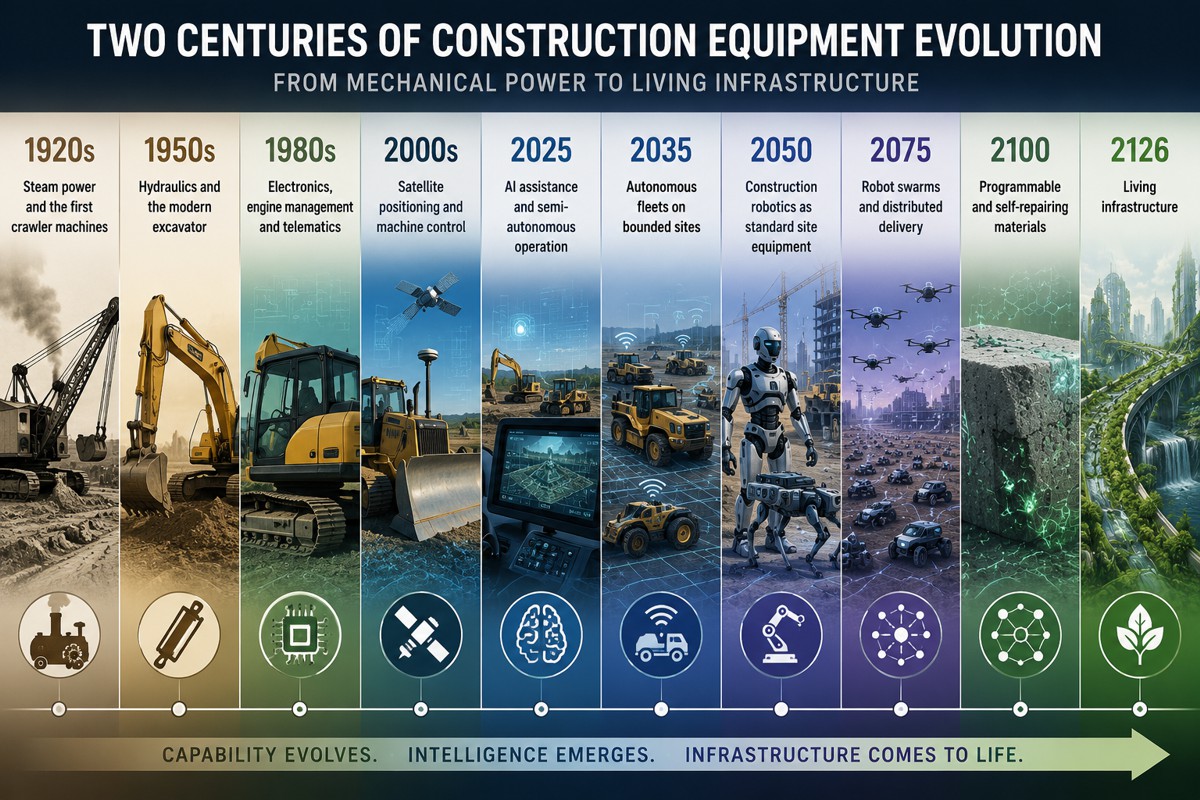
Two Centuries of Construction Equipment in One Line
The industry’s technological history divides cleanly into eras, each defined by the capability that mattered most at the time. Steam gave construction mechanical power. Hydraulics gave it fluency and control. Electronics gave it measurement, and satellite positioning gave it precision against a design model rather than against a peg in the ground. Every one of those transitions felt disruptive while it was happening and obvious once it was complete, which is a useful thing to remember when assessing what comes next.
The dates from the 2030s onward are informed projection rather than forecast, and the specific years matter far less than the sequence. What the arc shows is a steady migration of capability, from the muscle of the machine, to the senses of the machine, to the judgement of the machine, and finally into the fabric of the asset itself.
The Evolution of Heavy Equipment
The excavator illustrates the industry’s direction better than any other machine, because it has absorbed every technological wave without losing its identity. Hydraulics gave it the fluency that cable systems never had, quick couplers turned one machine into dozens, and tiltrotators gave operators a wrist where they previously had only an elbow.
Today a well-specified excavator carries three-dimensional machine control, payload monitoring, proximity detection and remote diagnostics, allowing an operator to cut a complex foundation to within millimetres of the design model while the productivity data reaches a project office hundreds of kilometres away. Across the coming century the machine will increasingly understand what it is digging, adjusting its sequence to soil conditions, minimising wasted movement and coordinating directly with the haulage waiting to receive the spoil.
Dozers and graders are travelling the same road from a different starting point, and their transformation is happening inside the cab rather than under the bonnet. Automatic blade control already reduces overcut and material waste against a digital terrain model, and the next generations will read ground conditions continuously through lidar, radar and vision systems rather than following a pre-computed pass plan.
Fleets of autonomous dozers on large earthworks will understand not only their own task but the objective of the wider programme, redistributing work between machines as conditions change. Rather than waiting for a survey crew to confirm what has been achieved, they will compare every blade movement against a digital twin that updates as they work, correcting deviation before it becomes rework.
Wheel loaders are likely to undergo the most conceptual change of any established machine, evolving from material movers into material intelligence centres. Payload weighing is already accurate enough to serve as a commercial record, and the systems that follow will identify material type optically, estimate moisture content, flag contamination and route each bucket to its most valuable destination.
In quarries and ports, autonomous loaders could reshape stockpiles continuously to improve drainage and reduce segregation, work that is valuable but rarely prioritised when a machine and operator are needed elsewhere. In recycling facilities the loader becomes the first stage of a sorting line rather than a feeder to it, identifying recoverable material before it ever reaches a picking station.
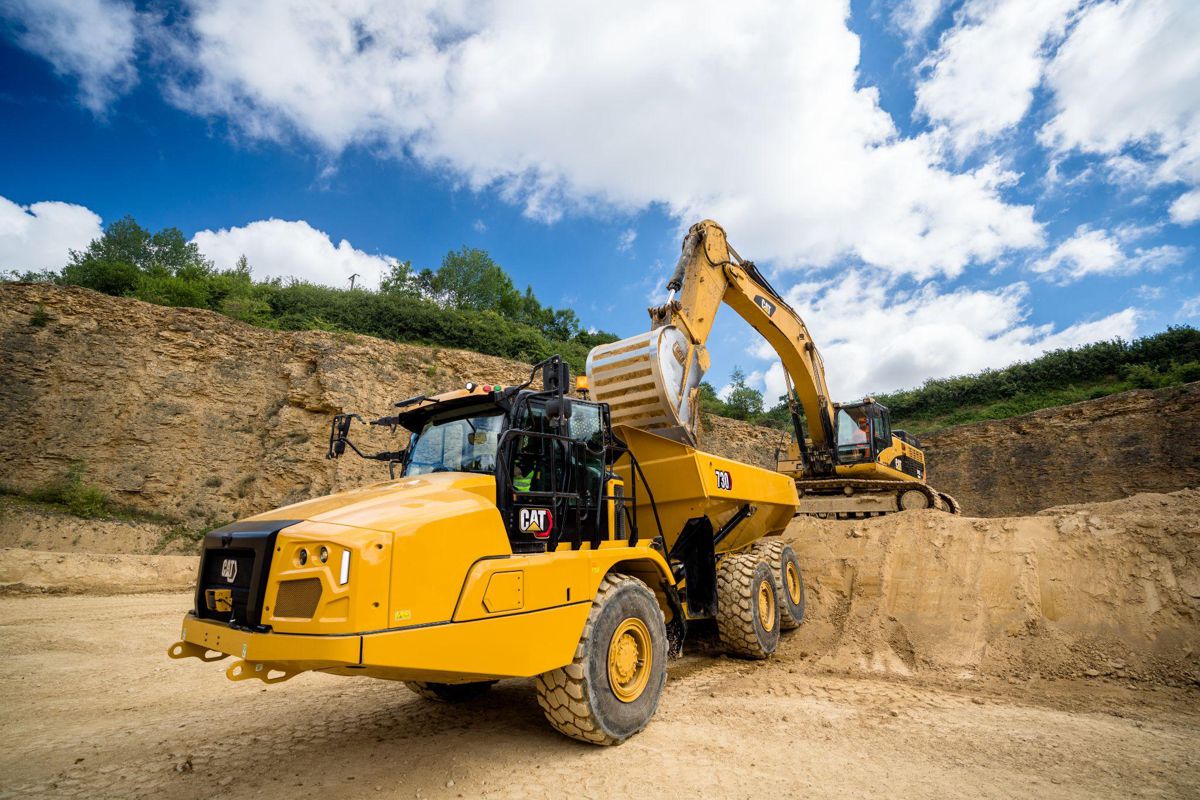
Haulage is where autonomy has travelled furthest, and construction will follow the path mining has already proven. John Deere’s autonomous articulated dump truck for quarry operations navigates between load and dump zones defined through a fleet app, using twelve cameras and a perception stack developed across agriculture as much as construction, and the company’s Chief Technology Officer Jahmy Hindman has been direct that “autonomy can help address this challenge” of finding skilled operators.
Dedicated haul roads offer exactly the bounded conditions autonomy handles best, and early construction adoption will concentrate there. Further out, the giant truck may lose ground to a different arrangement altogether, in which many smaller autonomous carriers move material simultaneously, easing congestion on haul roads and allowing production to continue while individual units charge or are serviced.
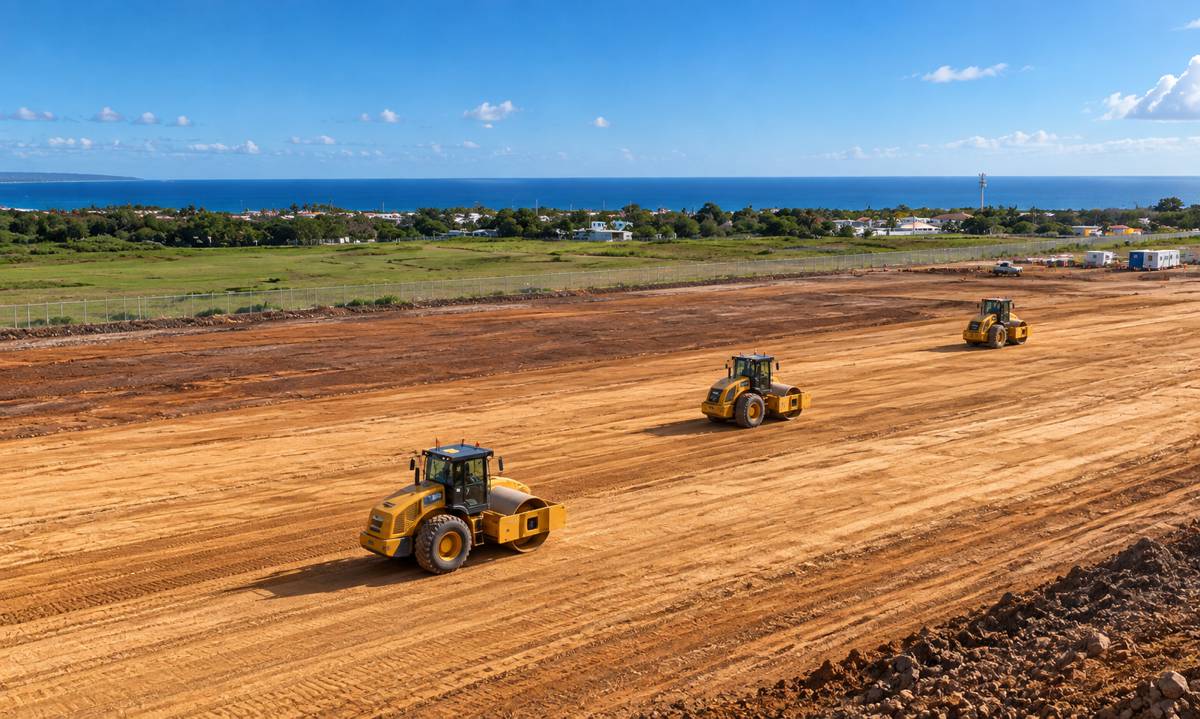
Road construction may automate more completely than any other discipline, because the desired outcome is defined mathematically before work begins. Graders already achieve exceptional accuracy from satellite guidance, rollers monitor compaction as they pass, and pavers integrate thermal mapping and real-time quality control. The obvious progression is a single continuous digital process in which survey drones map the corridor, artificial intelligence calculates optimal earthworks, autonomous graders shape the formation, driverless rollers achieve consistent density, and pavers adjust temperature, speed and material delivery to hold quality across an entire shift. Inspection drones then verify the finished surface within minutes of laydown, closing a feedback loop that currently takes days.
Cranes and telehandlers will gain a different kind of intelligence, built around planning and spatial awareness rather than terrain. Artificial intelligence will assemble lift plans that account for weather windows, structural loading, crane capacity and site logistics simultaneously, while anti-collision systems mature from warning devices into coordination platforms managing several cranes in a shared airspace.
Building information models will feed lifts directly, positioning structural components from the design model without repeated manual setting out, and augmented reality will give operators sight of blind lifts. Telehandlers, already the most adaptable machines on any site, are well placed to become mobile robotic handlers that identify loads by vision, route themselves around a changing site, and eventually assist with installation as well as delivery.
Compact equipment deserves particular attention, because it is where autonomy is likely to reach the widest number of contractors first. Mini excavators, compact loaders and small dumpers dominate urban work, refurbishment and utilities, where sites are constrained, neighbours are close and electrification is already commercially attractive.
A compact machine that can work quietly on battery power, operate remotely in a trench or confined basement, and be supervised rather than continuously driven changes the economics of small-site work more profoundly than any equivalent advance in a 90-tonne excavator. The largest machines will keep setting records, and the smallest may end up shaping how most of the industry actually works.
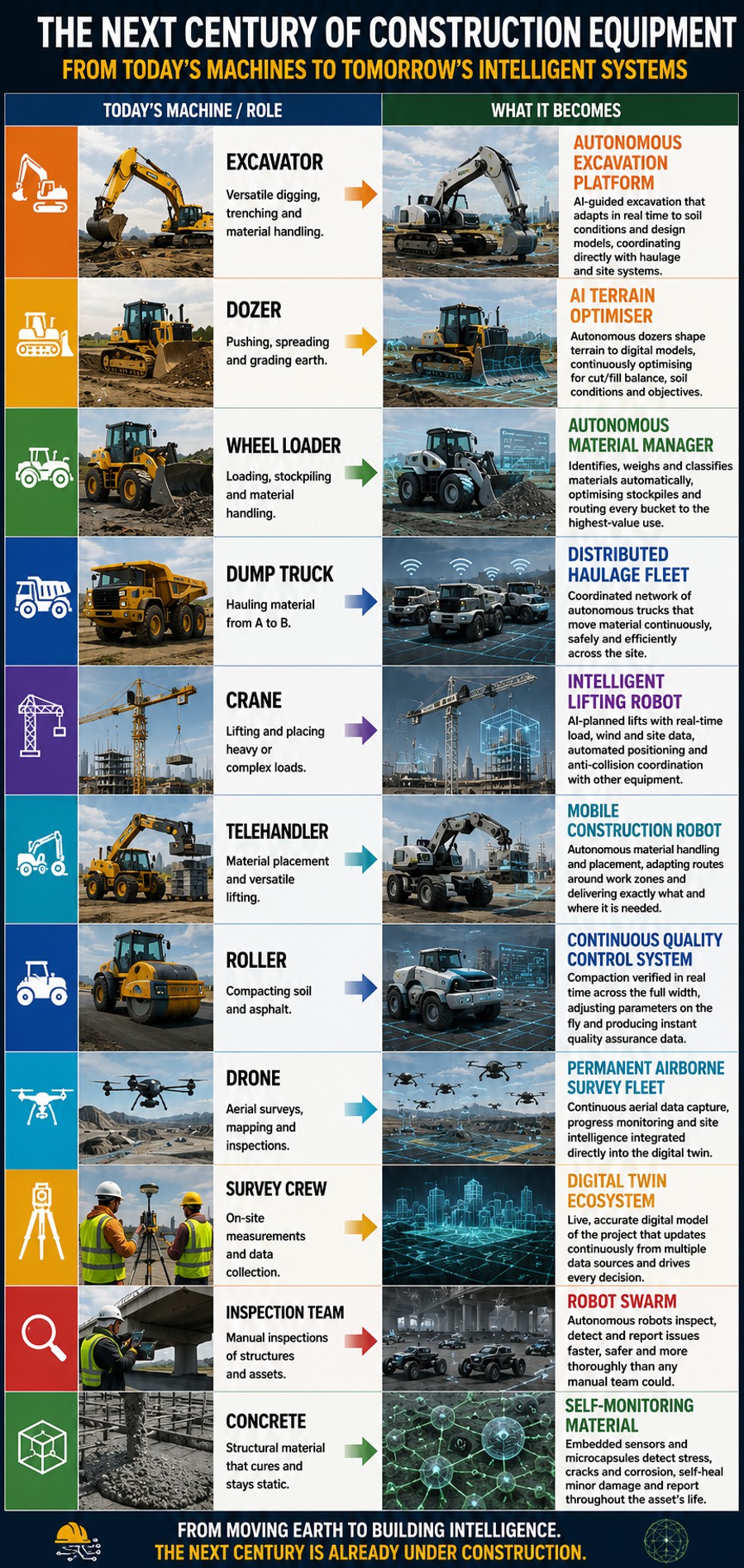
Machine Evolution: What Each Familiar Asset Becomes
The most useful way to understand the transition is to look at what each familiar item on a plant schedule turns into, because the change is one of function rather than form. A machine that keeps its silhouette can still change its job entirely, and several of the most significant transformations involve assets that are not machines at all today. Survey crews, inspection teams and concrete itself all appear on the list, which is the clearest indication that the definition of construction equipment is widening rather than simply modernising.
Read as a whole, the table describes a fleet migrating from execution towards judgement. The tools that currently carry out instructions become tools that generate them, and the disciplines that currently produce information periodically become systems that produce it continuously. The commercial consequence is that capability increasingly attaches to the site and the asset rather than to any individual item of plant.
Beyond Heavy Iron: The Rise of Construction Robotics
For more than a century the industry’s identity has been carried by excavators, dozers, cranes and trucks, and the most striking prospect of the next hundred years is that construction equipment will stop being defined by heavy machinery alone. Some of the machines joining the fleet will walk, some will fly, some will swim, and some will be too small to see. They are not replacements for heavy iron, and framing them that way misses the commercial logic entirely. They exist to reach the work that conventional plant has never been able to reach economically or safely.
Humanoid robots attract attention because they look like people, but their real advantage is that construction sites are already built for people. Doors, staircases, scaffolding, ladders, hand tools and vehicle controls all assume a body of roughly human proportions, which means a humanoid can be introduced without redesigning the workplace around it. Boston Dynamics unveiled the production version of its electric Atlas at the start of 2026 with every unit for the year already committed, and Hyundai has set out a path from parts sequencing in factories towards broader industrial deployment. The construction applications that follow will begin with the physically punishing and repetitive, including carrying materials up unfinished structures, holding components during installation, and working in contaminated, confined or high-temperature spaces where human exposure should be limited.
Quadruped robots may ultimately prove the more valuable family across infrastructure, precisely because they are less spectacular. Four legs handle stairs, rubble, uneven formation and partially completed structures without prepared access, which makes them suited to exactly the environments that are difficult for wheels and dangerous for people. Their first commercial role has been inspection, patrolling tunnels, industrial plants, power stations and bridges with thermal cameras, lidar, gas sensors and high-resolution imaging.
The consequence for asset management is not simply that inspection becomes cheaper. It is that inspection becomes continuous, and an asset understood continuously can be maintained on evidence rather than on a calendar.
The deeper change is that these machines need never demobilise. A quadruped commissioned to inspect a bridge during construction can remain with that bridge for sixty years, tightening connections, installing sensors, applying coatings and reporting deterioration long after the main contractor has left site. Robotic assistants working alongside trades will follow a similar arc, moving from single-task tools to general helpers that understand spoken instruction, interpret drawings and adapt to a site that changes daily.
Construction equipment that stays with the asset for its whole life is a genuinely new category, and it will be procured, financed and valued differently from plant that leaves at practical completion.
Construction Takes to the Air, Underground and Underwater
Few technologies have matured as quickly as the drone, which arrived as a flying camera and became indispensable to surveying, progress monitoring and inspection within a decade. Its current capability barely hints at where aerial construction systems are heading. Drone swarms will survey progress continuously rather than periodically, updating digital twins several times a day and allowing artificial intelligence to compare what has been built against what was designed while the concrete is still curing. Deviations, delays and emerging safety risks surface as they form rather than at the next monthly review, which changes what project control can realistically achieve.
The response role may prove even more valuable than the routine one. Aerial inspection following storms, floods, seismic events or vessel strikes can assess bridges, tunnels and buildings within minutes and deliver engineers detailed structural information without exposing anyone to a compromised structure. Larger autonomous aerial platforms will carry lightweight materials across terrain that defeats conventional logistics, resupply remote sites, and support offshore work where marine access windows are narrow and expensive. Other aircraft will serve as temporary communications relays, mobile lighting rigs, environmental monitoring stations and airborne security, until the airspace above a major project is as carefully managed as its ground traffic.
Underground and underwater, the machines will rarely be seen and may matter most. Modern economies depend on assets that are almost entirely hidden, including water networks, utility tunnels, metro systems, subsea cables, pipelines, bridge foundations and offshore wind arrays, and inspecting them has always been difficult, costly and hazardous.
Autonomous underwater vehicles equipped with sonar, laser scanning and advanced imaging will monitor bridge piers, monopiles and coastal defences continuously, detecting scour, movement and corrosion long before they threaten integrity. Compact robotic systems will navigate live utility networks, mapping buried infrastructure, sealing defects and rehabilitating pipes without opening the road above.
Micro-tunnelling robots point towards something more ambitious still, creating service corridors with precision that makes underground utility placement a planned architecture rather than an accumulation of historic accidents. Combined with continuous robotic monitoring, this begins to solve one of the industry’s most persistent problems, which is that nobody holds a complete and current record of what lies beneath a city street.
Much of the next century’s construction effort will go into maintaining invisible infrastructure rather than building new assets, and the equipment that does it will spend its working life out of sight.
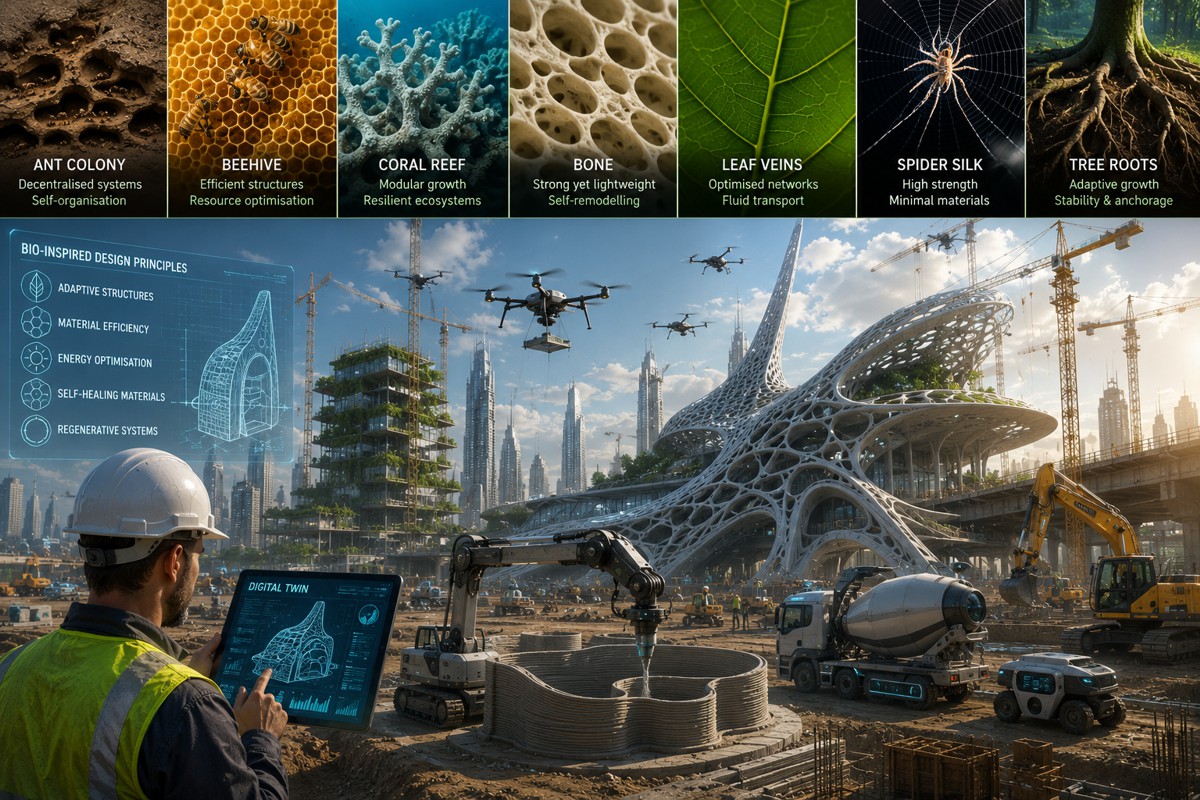
Bio-Inspired Construction: Four Billion Years of Research and Development
Nature has been running structural engineering experiments for roughly four billion years, discarding everything that failed, and construction has barely begun to read the results. The organisms that survive are those that build efficiently under severe constraint, using minimal material, local resources and no central coordination, which describes almost exactly the pressures now bearing on the construction industry.
Termite mounds maintain internal temperature and gas exchange through passive ventilation geometry that outperforms many mechanical systems, and their design principles have already informed low-energy buildings. Ant colonies excavate and maintain vast subterranean networks with no drawings, no supervisor and no single individual holding the plan.
Structural biology offers lessons of a different order again. Bone is the most instructive example, because it does not simply resist load, it redistributes material in response to load, laying down mass where stress concentrates and removing it where stress falls away. A structure that could remodel itself on the same principle would carry material only where it is genuinely needed, and the weight and carbon savings implied by that are considerable.
Coral reefs demonstrate accretive construction, in which a structure grows continuously from locally available minerals and repairs damage as part of ordinary metabolism rather than as an exceptional event. Spider silk achieves tensile performance and toughness that steel cannot match by weight, from ambient temperature processing and non-toxic inputs, which is a standing rebuke to the energy intensity of conventional material production.
Root systems may be the most directly applicable of all for infrastructure. Trees anchor enormous structures in poor ground by distributing load across a branching network that adapts continuously to soil conditions, moisture and wind direction, and mycorrhizal networks connecting them exchange resources and information between individuals.
Applied to foundations, ground improvement and slope stabilisation, that logic suggests adaptive systems that respond to actual ground behaviour rather than fixed designs sized for a worst case that may never occur. Several of these principles are already visible in practice, in branching column geometries, in lattice structures generated by optimisation software and in the encapsulated bacterial agents used in self-healing concrete trials.
The genuinely interesting prospect is that artificial intelligence may prove to be the tool that finally makes biological principles usable at scale. Evolutionary and generative design methods already produce structural geometries that no human designer would draw, and which conventional fabrication could not have delivered until additive manufacturing and robotic assembly matured.
As those methods extend from single components to whole projects, an AI planner may optimise a construction programme the way a colony optimises a nest, through distributed local decisions and continuous adaptation rather than a fixed master schedule. Construction has spent a century learning to impose order on sites, and the coming century may involve learning when to let order emerge instead.
From Giant Machines to Robot Swarms
For a hundred years the reliable route to higher productivity was to build a larger machine, and the next century may overturn that assumption in specific and important places. Distributed robotics takes the biological lesson literally, deploying many compact autonomous units where the industry currently deploys one large one. Each individual performs simple work with limited awareness, yet the collective achieves outcomes that no single unit could attempt, and the coordination cost falls as communication and positioning technologies improve.
The practical attraction is resilience as much as productivity. A swarm in which some units excavate, some transport, some survey, some inspect and some recharge the others can redistribute work instantly when a single unit fails, whereas a project built around one enormous machine stops when that machine stops. Small autonomous units also reach places large plant cannot, working inside completed structures, in confined basements, across environmentally sensitive ground and on sites where access is the binding constraint rather than power.
The environmental case is equally strong, since many light machines impose far less ground pressure and disturbance than one heavy one, which matters increasingly on projects with strict ecological conditions.
Early commercial evidence already exists in bounded tasks, where fleets of small robots complete narrow jobs repeatedly and reliably. Layout marking, drilling, rebar tying and solar pile installation have all attracted successful robotic fleets, and the pattern in each case is the same, in that the robots that succeed do one job extremely well and integrate with existing workflows rather than attempting to replace them.
Extending that to coordinated excavation, transport and assembly across an entire project requires progress in distributed decision-making, positioning within cluttered environments and interoperability between units from different suppliers. None of those are trivial, and none of them look intractable.
The strategic significance reaches beyond productivity into how projects are conceived. A swarm can begin work before a site is fully accessible, continue through conditions that would stand down conventional plant, and scale by adding units rather than by mobilising a larger machine. On the very largest projects, that flexibility may prove more valuable than raw capability, and tomorrow’s most ambitious construction programmes may depend as much on their smallest machines as on their largest ones.
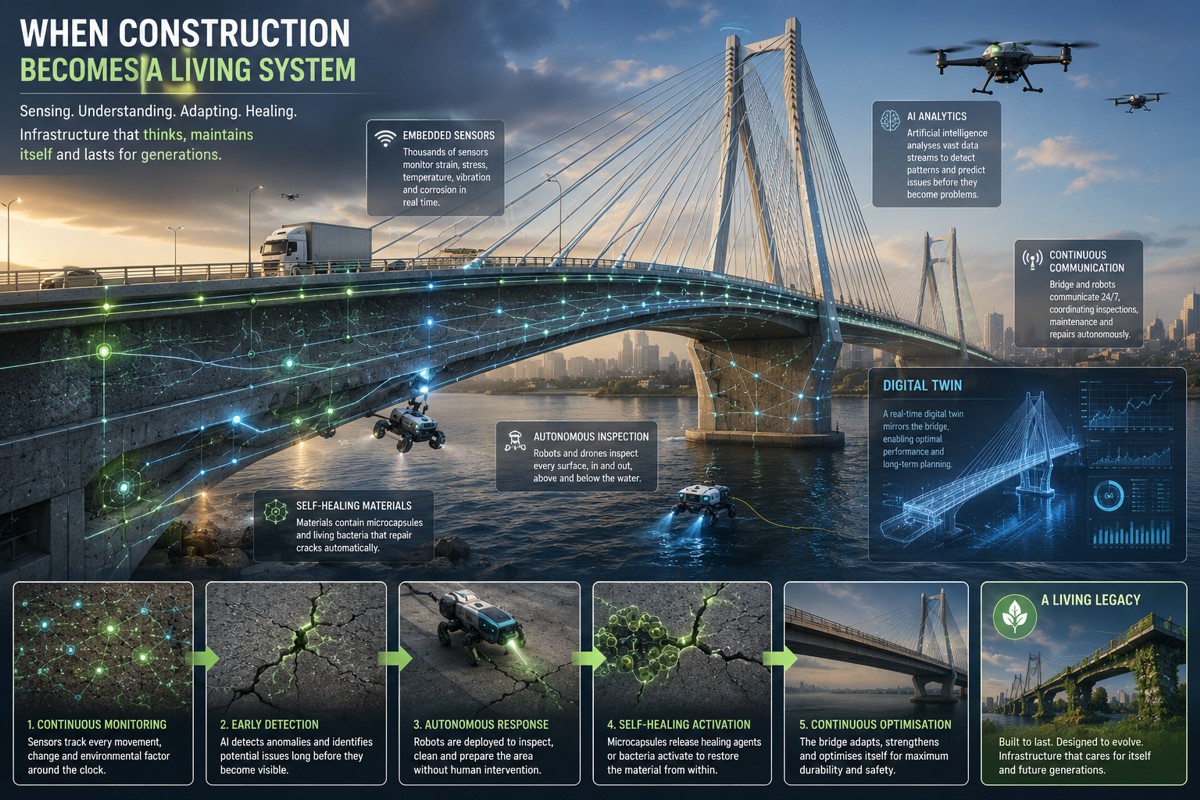
When Construction Becomes a Living System
The most far-reaching idea in this entire field is not a machine at all. It is the possibility that infrastructure stops being an object that deteriorates and becomes a system that persists, and the technologies pointing towards it are already leaving laboratories. Cambridge University engineers working with National Highways installed a 3D-printed concrete headwall on the A30 in Cornwall containing embedded piezoceramic sensors that monitor strain and loading through construction and into service, printed without formwork or steel reinforcement and stable by virtue of its geometry alone.
The Materials for Life programme run by Cardiff, Bath and Cambridge delivered the United Kingdom’s first site trial of self-healing concrete at the A465 Heads of the Valleys upgrade, using shape-memory polymers, vascular healing networks and encapsulated bacterial agents both individually and in combination. Those are modest structures, and they describe an immodest future.
Consider what that future does to a bridge. Rather than waiting six years for a principal inspection, the structure reports its own condition continuously, because the sensing is cast into the deck rather than carried to it by an inspection team. Rather than waiting for cracks to become visible and then programming a repair, healing agents distributed through the concrete mobilise the moment microcracking begins, sealing damage while it is still measured in microns.
Rather than closing lanes so that crews can chase deterioration that started years earlier, microscopic repair systems rebuild damaged regions continuously from within the material, and the traffic above never knows it happened. At no point does such a structure become finished in the sense the industry currently uses that word, since it never stops sensing, adapting and repairing. It simply continues, and the maintenance regime it requires looks less like a programme of works and more like a health record.
The economic implications of that are difficult to overstate for asset owners. Whole-life cost has been an argument in infrastructure procurement for thirty years and an accounting reality for rather fewer, largely because the evidence base for long-term performance has always been thin and contested. A structure that generates a continuous, verifiable record of its own condition changes the risk profile of a concession, the reserve provision required against future maintenance, the premium an insurer needs and the case that can be presented to a lender.
Assets that repair themselves are not merely cheaper to own; they are fundamentally different financial instruments, and they will eventually be valued as such.
The direction extends well beyond concrete. Programmable materials that alter stiffness, thermal performance or permeability in response to conditions would allow a road surface to change its behaviour between a summer heatwave and a winter freeze, and a façade to manage solar gain without mechanical intervention. Retaining walls could detect ground movement and stiffen before failure develops, while bridge components request inspection on their own evidence rather than on a schedule.
Fully autonomous nanorobotics remains many decades away and honest assessment should say so plainly, yet the trajectory from embedded sensors, through encapsulated healing agents, to genuinely responsive materials is already established by work in the field rather than only on the bench. The distinction between the machines that build and the assets they create begins to dissolve at that point, because machines build intelligent materials and intelligent materials then behave as permanent machines.
The Intelligent Construction Site
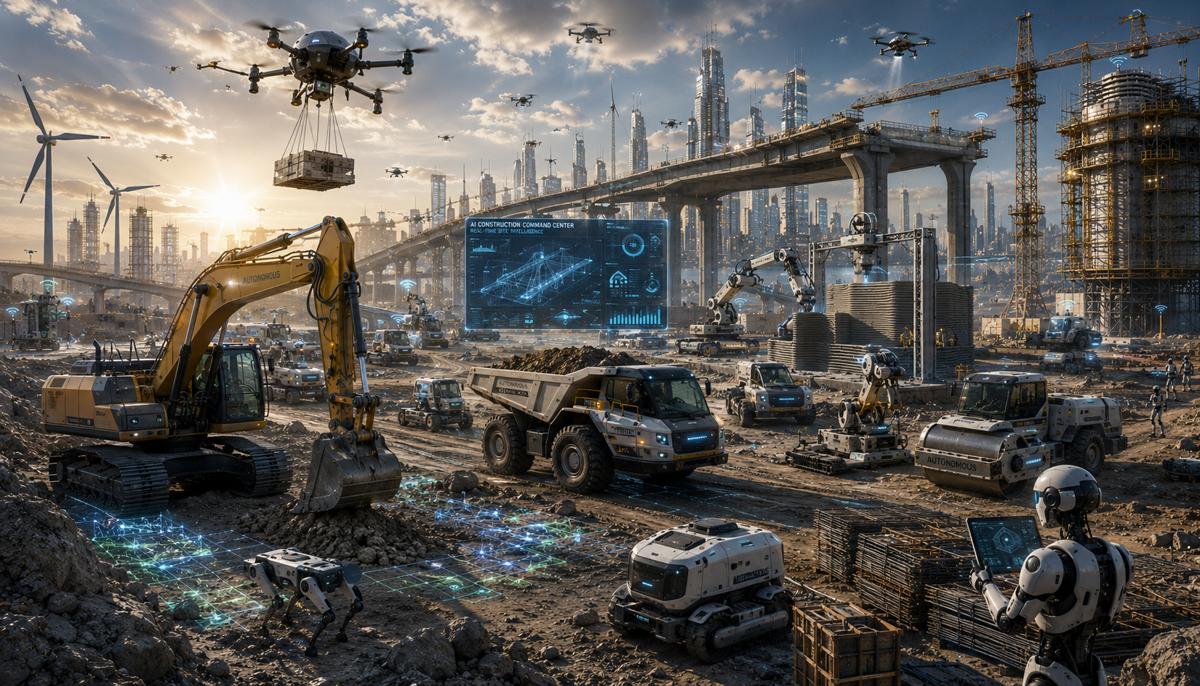
The most consequential shift during delivery may involve no single machine either. Construction sites already generate remarkable volumes of information through machine telematics, drone survey, wearable safety devices, weather feeds, traffic data, supply chain tracking, building information models, programme software and cost reporting. Almost all of it is generated in parallel and reconciled by people, usually after the fact and often too late to change the outcome. The intelligent site connects those streams into a single operating picture that is current rather than retrospective.
Caterpillar’s Chief Technology Officer Jaime Mineart has described the company’s strategy as “embedding autonomy into construction workflows”, and the choice of noun is significant, because workflows rather than machines are what determine whether a project makes money. Artificial intelligence comparing planned against actual progress can identify slippage while it is still a variance of hours, reschedule deliveries around a forecast weather window, and reposition equipment overnight so the following shift starts productively.
Autonomous charging replenishes electric fleets without intervention, maintenance is scheduled from actual duty cycles rather than nominal hours, and the digital twin updates continuously as every machine reports position and condition.
Looking further ahead, advances in computing itself could unlock another step change in construction planning. As quantum computing matures over the coming decades, optimisation problems involving millions of variables, from fleet movements and logistics to supply chains, energy use and project sequencing, may be solved in minutes rather than days. While still an emerging technology, the ability to evaluate countless construction scenarios simultaneously could eventually allow AI to orchestrate projects at a level of complexity that is currently beyond even the most powerful supercomputers.
The cultural consequence is larger than the technical one. Project management has historically been a reactive discipline, in which capable people spend their days resolving problems that became visible too late to prevent.
An orchestrated site moves that work forward in time, replacing reaction with anticipation, and the value released is not primarily in labour saved but in disruption that never happens. Fewer stood-down crews, fewer clashes discovered on site, fewer deliveries arriving into a full compound and fewer sequences repeated because information arrived after the pour.
Connected infrastructure then extends the same logic past handover, which is where the intelligent site and the living asset meet. A road that reports traffic loading, a retaining wall that detects ground movement and a bridge that requests attention on its own evidence all turn the asset into a participant in its own maintenance.
The project becomes an intelligent system during delivery, and the asset inherits that intelligence for the rest of its life, which may be the single most valuable thing construction hands over in the century ahead.
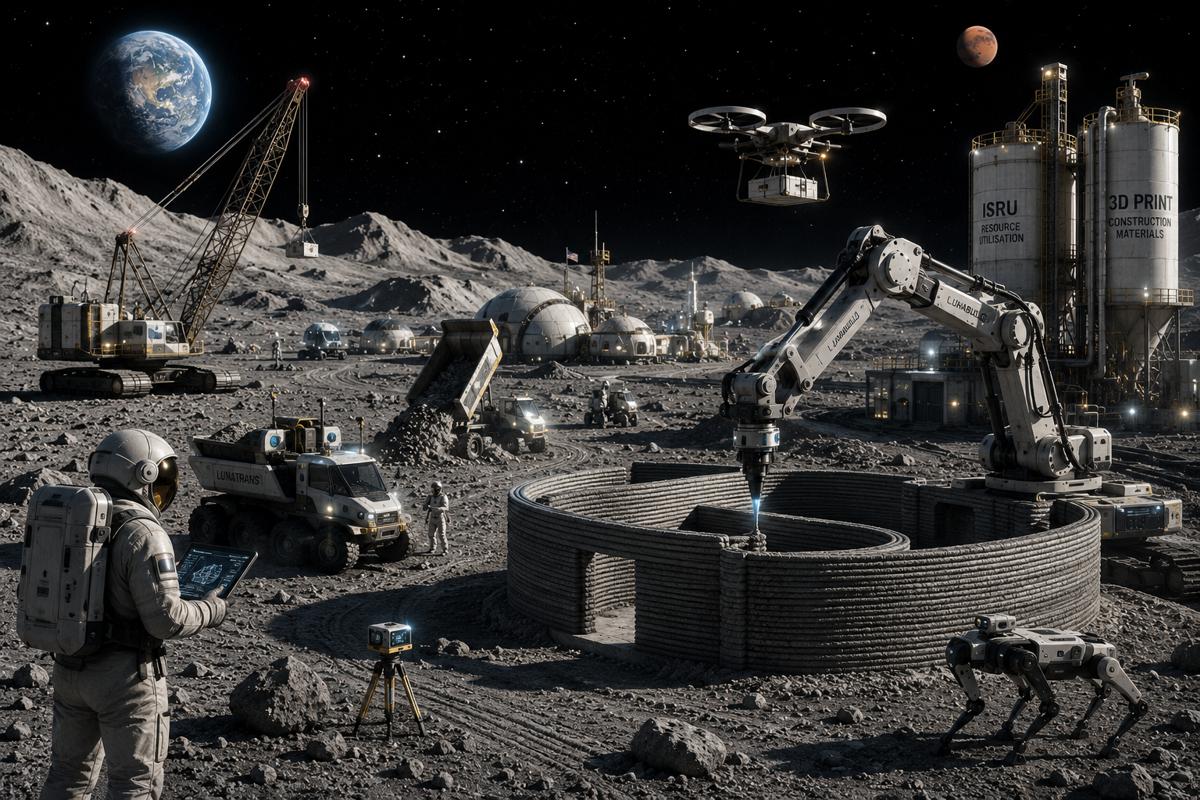
Building Beyond Earth
If humanity establishes a permanent presence on the Moon or Mars during the next century, construction equipment will have to reinvent itself once more, and the constraints are severe enough to force genuine innovation. There will be no operator sitting in a cab through a twelve-hour shift. Machines will need to work through extreme temperature swings, abrasive dust that destroys seals and bearings, reduced gravity that changes how excavation forces resolve, and communication delays that make real-time remote control impossible over interplanetary distances. Equipment will therefore have to be autonomous not as a convenience but as a precondition.
The likely sequence begins before people arrive. Autonomous excavation systems prepare landing pads and protective berms, robotic crews manufacture habitat structures from local regolith rather than imported material, and swarms of compact units assemble solar arrays and expand settlements incrementally.
Every kilogram launched carries a cost that makes terrestrial logistics look trivial, which places enormous value on machines that build with what is already there. Additive manufacturing using in-situ material, autonomous survey, and highly reliable low-maintenance mechanisms all become mandatory rather than desirable. Asteroid resource extraction, further out still, would demand machines that operate for years without any human contact whatsoever, diagnosing and repairing themselves as a matter of routine.
The return journey is where the commercial interest lies for terrestrial contractors. Space programmes have repeatedly delivered technologies that reshaped industries never involved in them, from satellite navigation and materials science to imaging and communications. Machines engineered to run for years without intervention, to build from unprocessed local material, to operate on minimal energy and to maintain themselves solve problems that also exist in remote mining, deep tunnelling, Arctic and desert infrastructure, disaster response and any project where mobilising people is expensive or dangerous.
The equipment that builds humanity’s first lunar outpost will very probably improve the roads, bridges and buildings constructed here, and the industry should watch that research for the same reason it once watched military and aerospace positioning systems.
The Human Workforce of 2126
Discussion of automation tends to begin with the assumption that machines take work away from people, and construction’s own history argues almost the opposite. Steam power reduced manual labour and created engineers. Hydraulics transformed excavation and increased demand for skilled operators who could exploit it.
Digital machine control introduced surveyors who work in three dimensions, fleet analysts, telematics specialists and remote diagnostics engineers, none of which existed as careers when the technology arrived. Every wave changed the shape of the work rather than the quantity of it, and the industry has consistently found itself short of people rather than short of jobs.
The demographic position makes that continuity more likely rather than less. Trade analysis presented around CONEXPO-CON/AGG in 2026 indicated that close to 40 per cent of the current construction workforce is approaching retirement while fewer young workers enter the trades, which means autonomy is being deployed largely to cover work that would otherwise go undone.
Teleoperation demonstrations at the same show, in which machines in Florida and Arizona were controlled from a booth in Las Vegas, hint at how experience will be conserved. An operator with thirty years of judgement need not be on the machine, or even in the country, to apply that judgement where it is most valuable.
The roles that emerge are already recognisable in outline. Operators will supervise several autonomous machines at once, intervening on exceptions rather than driving continuously. Surveyors will become digital twin specialists responsible for the fidelity of the model everything else depends upon. Technicians will diagnose software and hydraulics in the same visit, and construction managers will coordinate robotic capability alongside subcontractors with much the same skills they use today. Robot fleet supervisors, autonomous systems technicians, AI construction planners, swarm coordinators and materials health analysts will be ordinary job titles long before 2126.
What that suggests about training is more urgent than the century framing implies. The competencies that determine whether an autonomous fleet delivers its theoretical productivity are supervision, exception handling and diagnostics, and experienced plant operators are usually the strongest candidates to develop them.
Investment in retraining existing people tends to be faster, cheaper and more effective than recruiting externally into roles the labour market has not yet defined. The industry that gets this right will find automation strengthening its workforce proposition rather than threatening it, offering safer work, better conditions and a career that a technically curious young person might actually want.
The Machines That Will Build the Next Century
A hundred years ago the great achievement of construction equipment was replacing muscle with mechanical power, and it changed what humanity believed it could build. The next hundred years will not be remembered for replacing diesel with batteries, nor for replacing operators with computers, because both of those are staging posts rather than destinations. They will be remembered for replacing isolated machines with intelligent ecosystems, in which the unit of capability is the site rather than the excavator, and eventually the asset rather than the site.
Heavy iron will remain at the centre of that picture wherever scale is the answer. Tunnel boring machines will grow more intelligent without growing smaller, crawler cranes will become autonomous while still needing immense lifting capacity, and 400-tonne haulers will keep moving ore because physics rewards them for it.
Around that established fleet, an entirely new family will establish itself, comprising humanoid assistants working beside skilled trades, quadrupeds maintaining bridges and tunnels for decades, drone swarms mapping progress from above, underwater vehicles guarding offshore foundations, distributed robots collaborating like colonies, and microscopic repair systems preserving concrete and steel from within.
One hundred years ago, the world’s greatest engineers dreamed of building bigger machines. One hundred years from now, the greatest engineers may instead build machines that disappear entirely. Some will orbit above our projects, some will walk beside us, some will tunnel beneath our feet, and some will exist only as microscopic systems hidden within concrete and steel.
Future generations may not remember this century as the age when construction became autonomous. They may remember it as the moment when infrastructure itself became intelligent. The first century of construction equipment taught machines to move earth. The next century may teach them to understand it, repair it and perhaps one day improve it without being asked.
Key Industry Questions
- Will autonomous machines replace equipment operators? The evidence points towards redeployment rather than replacement. Autonomy is being adopted fastest in repetitive, bounded work such as quarry haulage, large earthworks and compaction, where the shortage of available operators is most acute and the cycle is most predictable. Complex, variable and interface-heavy work remains firmly in human hands and is likely to stay there for decades. The realistic outcome is one operator supervising several machines, intervening on exceptions and applying judgement where it carries most value. Teleoperation extends this further by allowing experienced operators to work across multiple projects from a control centre, which conserves scarce expertise rather than discarding it.
- Which machines will change most over the next fifty years? Wheel loaders and compact equipment may change most in character, even though excavators and dozers attract more attention. The loader is moving from a material mover towards a material intelligence platform that identifies, assesses and routes what it handles, which is a change of purpose rather than degree. Compact machines will change the industry most broadly, because urban work, refurbishment and utilities account for an enormous share of activity and are where battery power, remote operation and supervised autonomy combine most naturally. The largest machines will continue to advance, but their evolution will concentrate on utilisation, reliability and coordination rather than on redefinition.
- What does living infrastructure actually mean in practice? It describes assets that sense, report and repair themselves continuously rather than deteriorating between scheduled interventions. In practice it combines three things that already exist separately, namely embedded sensing cast into the structure, healing agents distributed through the material, and robotic systems that remain with the asset for its operational life. A bridge built on that basis reports condition continuously, seals microcracking as it forms, and requires intervention on evidence rather than on a calendar. The practical significance is that maintenance shifts from a programme of works towards something closer to a health record, with engineers directing strategy rather than chasing defects that began years earlier.
- How could bio-inspired design change engineering practice? Biological systems optimise under constraints that increasingly match construction’s own, using minimal material, local resources and distributed rather than central control. Bone remodels itself to place material where stress concentrates, coral builds accretively from local minerals, termite mounds ventilate passively through geometry, and root networks adapt anchorage to actual ground behaviour. Applied to construction, those principles suggest structures that use less material, foundations that respond to real conditions rather than worst cases, and programmes that adapt continuously rather than following a fixed master schedule. Generative and evolutionary design software combined with robotic fabrication is what makes these geometries buildable, which is why the field is accelerating now.
- How close is robotic swarm construction to practical use? Bounded swarm work is already commercial, while general swarm construction remains a research direction. Fleets of small robots are being used successfully for layout marking, drilling, rebar tying and solar pile installation, where the task is narrow, repeatable and measurable. Extending that to coordinated excavation, transport and assembly across a whole project requires advances in distributed decision-making, positioning in cluttered environments and interoperability between units from different suppliers. A reasonable expectation is steady expansion through the 2030s and 2040s into progressively less structured tasks, with heavy plant continuing to handle bulk work while swarms take the confined, sensitive and access-constrained portions.
- What is the realistic timeline for humanoid robots on construction sites? Manufacturing is the proving ground and construction is the declared destination, which implies the 2030s rather than the immediate future. Production humanoids exist and are being deployed into factory environments where conditions are controlled, tasks are repeatable and safety cases are easier to build. Construction sites are dirtier, wetter, less predictable and full of people, all of which raise the reliability bar considerably. The earliest realistic site applications are likely to be internal, including fit-out, plant rooms, confined spaces and repetitive material handling within completed structures, before anything resembling general site work becomes practical.
- Are self-healing and instrumented materials ready to specify? They are ready for structured trial and selective specification rather than default use. Site trials in the United Kingdom, including the instrumented 3D-printed headwall on the A30 in Cornwall and the self-healing concrete panels at the A465 Heads of the Valleys, have demonstrated real-world feasibility under working conditions. Material cost remains higher than conventional alternatives and standardised testing regimes are still developing, which limits routine adoption. The strongest present case is on assets where intervention cost dwarfs material cost, such as motorway structures, tunnel linings, marine foundations and any location where a closure carries heavy economic penalty.
- What should contractors be doing now to prepare for autonomous fleets? Three actions matter more than the rest. Fleet specifications should address control system openness, data ownership and interface access alongside conventional performance criteria, because those provisions determine whether a machine can be upgraded during its life or only replaced. Training investment should shift towards supervision, exception handling and combined software and mechanical diagnostics, drawing on existing operators wherever possible. Digital foundations should be strengthened before autonomy arrives, since autonomous machines depend on accurate models, reliable positioning and disciplined data management, and a fleet placed on weak digital foundations will underperform regardless of how capable the machines are.
- How do space construction technologies benefit terrestrial projects? Off-world requirements force solutions to problems that also exist on Earth in less extreme form. Machines built to operate for years without human intervention, to diagnose and repair themselves, to work with minimal energy and to build from unprocessed local material address exactly the challenges facing remote mining, deep tunnelling, Arctic and desert infrastructure, and disaster response. Historically, technologies developed for demanding environments have transferred broadly, with satellite positioning being the obvious example for this industry. Contractors need not follow space programmes closely to benefit, but the direction of research there is a reasonable leading indicator of where autonomous and self-sufficient equipment is heading.
Strategic Takeaways
- The defining characteristic of construction equipment is shifting from size to intelligence, and the organisations that prosper will treat software, data and coordination as core plant capability rather than as accessories to it.
- The most valuable transformation is not the autonomous machine but the intelligent asset, since infrastructure that senses and repairs itself changes the risk profile of concessions, the reserves held against maintenance and the terms on which projects can be financed.
- Biological principles offer a design and optimisation resource the industry has scarcely touched, and AI-driven generative design combined with robotic fabrication is what finally makes those principles buildable at scale.
- Robots that remain with an asset for its operational life represent a genuinely new equipment category, and procurement, financing and depreciation practices will need to catch up with plant that never demobilises.
- Automation is arriving as the workforce ages, and the industry that invests early in supervision, diagnostics and digital skills will convert a demographic pressure into one of the strongest recruitment propositions construction has had in a generation.