Predictive Sales Data Comes for Construction Equipment Dealers
For most of the past decade, competitive advantage in construction equipment distribution has been argued in terms of iron. Dealers and manufacturers have competed on product line, price, uptime and the strength of their product support, and they have measured themselves after the fact on units moved and market share held. BiltData.ai’s latest United States release points at a quieter but more consequential contest, one fought not over the machine itself but over the model of demand that surrounds it.
The company has launched an AI sales platform for construction equipment OEMs, dealers and rental companies that pairs on-demand market intelligence with a closed-loop pipeline, turning ordinary sales activity into a predictive read on outcomes. BiltData states the platform is already in use by businesses representing more than two billion dollars in annual equipment revenues.
The premise behind it exposes an uncomfortable truth the industry has learned to live with. Commercial teams have long built their prospecting around public financing records, the Uniform Commercial Code filings that lenders lodge to perfect a security interest in financed equipment. Those records are shared, incomplete and, by BiltData’s own analysis, capture only around a third of actual buyers while skewing heavily towards the smallest businesses and individuals.
When every dealer and OEM in a territory works from the same partial dataset, the data stops being an edge and starts becoming a shared liability. The commercial logic of BiltData’s launch is that differentiation now sits in proprietary demand intelligence and in the discipline of instrumenting a pipeline stage by stage, rather than in the raw information everyone can already see.
That shift lands at a revealing moment for the wider equipment data economy. The value of machine data has already been proven, with the construction and heavy equipment telematics market growing into a multi-billion-dollar category expanding at double-digit annual rates, and with the largest manufacturers holding the commanding positions. What BiltData is targeting is the demand side of the same equation, the question of who is likely to buy or rent next rather than what an owned machine is doing right now, and that is territory the incumbents have left comparatively open.
Briefing
- BiltData.ai has launched a United States AI sales platform for construction equipment OEMs, dealers and rental companies, combining ranked market intelligence with a closed-loop pipeline that converts sales activity into a predictive forecast.
- The platform is built to move commercial teams beyond UCC public financing records, which BiltData’s analysis says capture only about a third of buyers and lean towards the smallest operators, leaving high-value fleets and rental demand hidden.
- BiltData reports that opportunities it surfaces convert four to six times more often than status-quo public-record leads, that nearly 95 per cent carry top-tier credit against roughly a quarter for traditional data, and that about one in five buyers accounts for around three-quarters of equipment spending.
- Groff Tractor & Equipment, the largest John Deere Construction and Forestry dealer in Pennsylvania, and OEM parts specialist GCIron are among the named users applying the closed loop to forecasting, coaching and new-hire productivity.
- The launch reframes competitive advantage in equipment distribution around proprietary buyer intelligence and pipeline instrumentation at a time when machine-side telematics data has already become an OEM-dominated, multi-billion-dollar market.
Beyond The Public Record
The case against relying on public financing data is not that the records are wrong, but that they are noisy, partial and universally available. UCC-1 filings exist to protect lenders, not to describe a market, and the sheer volume involved makes them an awkward foundation for commercial strategy. The scale of the problem is easy to underestimate. During fiscal 2024, the Texas Secretary of State’s Office, one of the largest for UCC filings, processed approximately 662,000 UCC filing transactions, a torrent of documents in a single state that says little about credit quality, fleet value or genuine purchase intent. Working a territory from that raw feed means chasing whoever financed a machine most recently rather than whoever matters most.
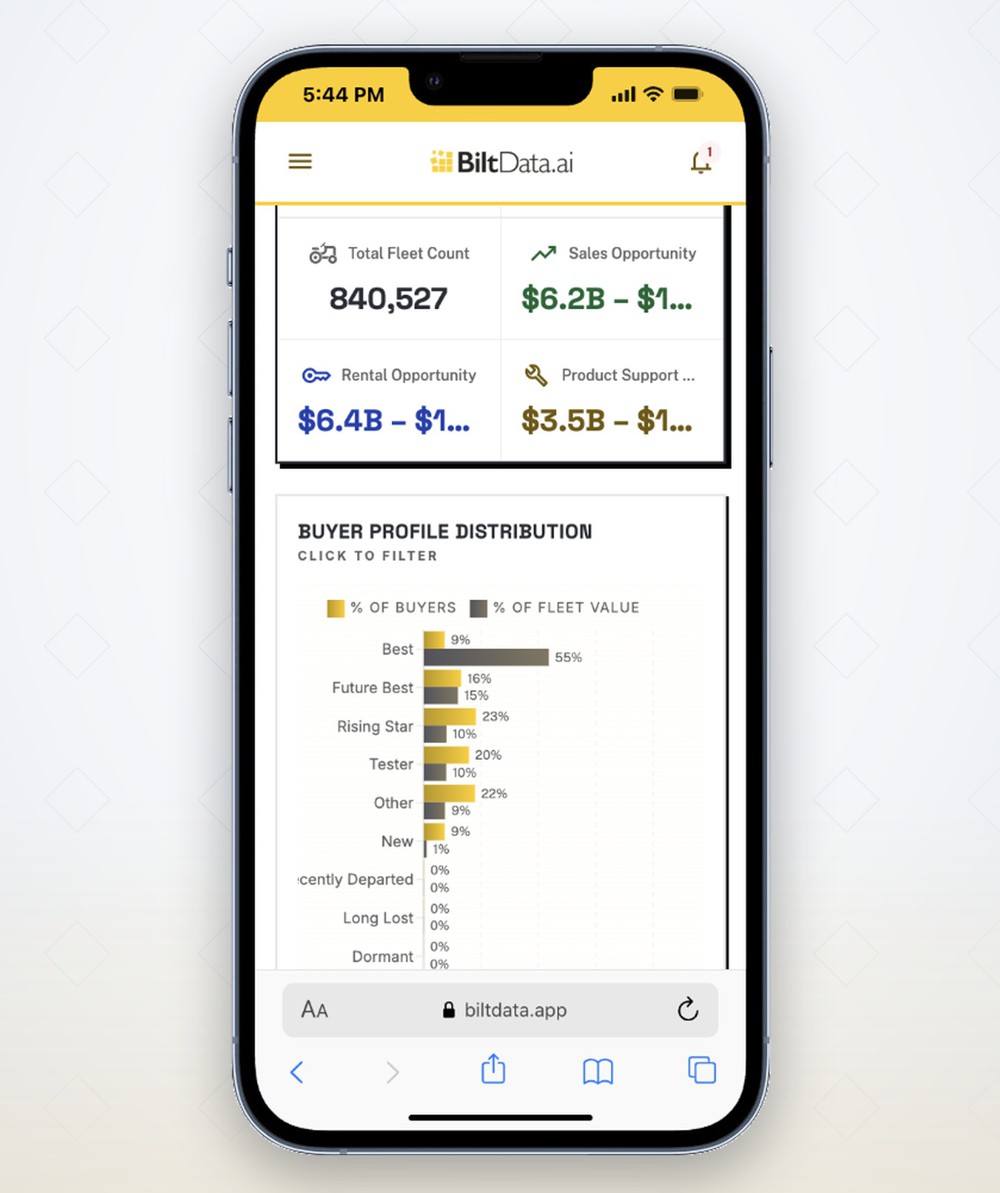
BiltData’s answer is to build a view of the whole market and then rank it. The platform scores every buyer and renter in a territory by likelihood to purchase, credit quality, fleet value and competitive position, sorting them into tiers with ‘Best’ and ‘Future Best’ at the top. The commercial argument rests on concentration. By BiltData’s reckoning, about one in five buyers accounts for roughly three-quarters of equipment spending, so identifying and prioritising that fifth is worth far more than broad coverage of the field.
The quality gap BiltData claims for its own sourced opportunities is stark, with conversion running four to six times higher than public-record leads and nearly 95 per cent carrying top-tier credit against roughly a quarter for traditional data. Those are the vendor’s figures rather than independently audited numbers, but the direction of travel is one experienced dealers will recognise, because value in this market has always clustered around a small number of serious fleets.
Matthew Pixler, SVP Sales at Groff Tractor & Equipment, frames the shift in terms of visibility rather than volume. “Every dealer and OEM has access to the same public information, but the reality is that it’s incomplete for everyone. What BiltData allows us to do is look beyond those limitations, identify the customers that truly matter, and prioritize them from the start. Even more importantly, we’re able to track every step of the process—from the first conversation all the way through the sale. That visibility gives us real data to make better decisions, improve how we sell, and move from reacting to predicting outcomes.” The tell in that account is the emphasis on tracking, because the ranked list is only half of what the platform is selling.
From List To Closed Loop
Most sales technology organises information a business already holds and leaves execution unmeasured, which is why so many dealer CRM deployments quietly become expensive contact databases. BiltData’s distinction is that it feeds scored opportunities into the top of the funnel and then instruments every stage beneath it. As representatives log calls, visits and quotes, the platform tracks each opportunity from contact through quote to won or lost, recording participation rate, coverage rate and market share along the way. The information stops being a snapshot and becomes a moving picture of how a territory is actually being worked.
The closed loop is what turns that picture into a forecast. Won-and-lost outcomes flow back into the model, sharpening the next week’s rankings and the next quarter’s projection, so better prospects produce better outcomes that in turn refine the model. For leaders, the practical value is a live, stage-by-stage forecast of what a pipeline will become rather than a retrospective tally of what it already did.
Nick Mavrick, founder and chief executive of BiltData, sets the ambition plainly: “If you cannot see it, you cannot sell it. We show the industry the buyers, renters and projects that public records miss, rank them, and then prove what happens next. That’s the difference between a list and a predictive model, and it’s why no opportunity gets left behind. In God we trust, all others must bring data.”
The last line, popularly attributed to quality pioneer W. Edwards Deming, captures the pitch neatly, since the entire product is an argument against managing an equipment business on instinct and incomplete records.
A Forecast In The Chief Executive’s Hands
Groff Tractor & Equipment is a useful test case because it is precisely the kind of business where the stakes of getting prospecting right have been rising. Founded in 1958 and now the largest John Deere Construction and Forestry dealer in Pennsylvania, GT&E has grown through consolidation, acquiring Plasterer Equipment’s four locations in 2023 and two former Murphy Tractor branches in Western Pennsylvania to build a multi-branch footprint spanning the state. Scale of that sort multiplies the cost of an unfocused sales effort, because every additional territory is another place where high-value fleets can be missed. Matching every recent quote back to BiltData’s scored buyer model, the dealer identified room to lift participation with ‘Best’-tier buyers, the very accounts that carry the highest win rates.
For leadership, the appeal is decision-grade visibility. With ranked prospects feeding the funnel and each stage now measured, GT&E’s executives can see market share, coverage and win rates broken into factors the team can actually influence, and trace where the next point of share will come from before the quarter closes.
Jeff Oldham, appointed the dealer’s chief executive in early 2025, describes the change as a move from hindsight to foresight: “As a leader, I’m looking for better visibility to make better decisions. BiltData helps us identify the right opportunities, understand how well we’re executing, and see where future growth is likely to come from. Instead of simply looking backward at results, we’re making decisions with greater confidence about where to focus next.” That reframing, from scorekeeping to steering, is where the commercial value of the closed loop is most defensible, because it converts market share into a set of levers rather than a lagging outcome.
Closing The Gap On A Thin Sales Bench
The platform also addresses one of the industry’s more persistent operational headaches, the thin and fast-turning sales bench that leaves many dealers carrying representatives with less than a year of tenure. Learning a territory the hard way has traditionally taken months, during which a new hire burns goodwill and leaks opportunities while working out who is worth a call.
BiltData compresses that ramp by opening every representative with a ranked, credit-qualified list of the highest-value buyers in their patch, complete with the fleet, brand and replacement-cycle signals that tell them how to start the conversation. Managers get the complementary view, seeing which prospects each representative has contacted, how far each opportunity has moved and where deals are stalling, which turns coaching into a grounded, stage-by-stage exercise rather than guesswork.
Frank Villella, president and chief executive of OEM parts specialist GCIron, ties the productivity gain directly to how a business hires and forecasts. Deals in this trade, he argues, are rarely lost on a single catastrophic error but on incremental inefficiency, and he notes that teams: “leak one inefficient call at a time, often off incomplete data, such as UCC filings.” The remedy he describes is structural rather than motivational. “Every rep opens a ranked punch list of the highest-value buyers in their territory, already credit-qualified, and I can see exactly how far each one has moved from first contact to signed. A new hire who’s been here under a year is calling on the right accounts in their first week instead of their twelfth month. It changes how we hire, coach and forecast.” For dealers wrestling with recruitment and retention, shortening the distance between a start date and a first productive quarter has a value that extends well beyond any single sale.
One Account, Three Revenue Streams
A construction equipment customer is rarely a single transaction. The same account may buy machines outright, rent additional equipment for individual projects and require a continuous stream of parts and service across the life of its fleet, yet those opportunities have traditionally lived in separate lists and separate systems.
BiltData brings them into one platform, combining predictive buyer intelligence with rental-opportunity mapping and product-support insight so that a team can see the total potential in each account and territory rather than three fragments of it. For dealers whose margins increasingly depend on aftermarket and rental income, a unified view of lifetime account value is more than an administrative convenience, because it is where a great deal of the durable profit actually sits.
The platform extends the same logic to the project pipeline, mapping construction projects by value, stage, contractor and location and estimating the equipment sales and rental revenue tied to each. That surfaces rental and aftermarket demand that financing records simply cannot identify, since a project generating months of rental and parts activity may never produce a UCC filing at all.
It also feeds the way BiltData measures performance, reporting market share and then decomposing it into participation rate, which shows how much of the available market a team is actively covering and quoting, and close rate, which measures how often it wins once it competes. Under-covered counties and low-participation territories are flagged automatically, so a broad market-share figure becomes a specific set of weekly actions rather than an abstract target.
Where Competitive Advantage Is Migrating
The strategic significance of BiltData’s launch becomes clearer when set against where the rest of the equipment data economy has already concentrated its value. Machine-side intelligence is a mature and lucrative battleground, with the construction and heavy equipment telematics market now measured in billions of dollars and growing at double-digit annual rates, and with the largest manufacturers holding the strongest hands.
Caterpillar led the construction equipment telematics market with over 14 per cent share in 2024, and the top five players, including Caterpillar, Komatsu’s Komtrax, Verizon Connect, Geotab and MiX Telematics, collectively held around 46 per cent. The direction of travel there is towards consolidation onto single platforms, illustrated by moves such as Geotab’s launch of Geotab Build in March 2026 to unify mixed-fleet management across construction machinery, specialty equipment, tools and on-road vehicles. Owning what a machine is doing has become both valuable and crowded.
The demand side has attracted far less competition, and that is the gap BiltData is moving into. Knowing which fleets are likely to replace, which projects will generate rental and parts demand, and which accounts a dealer is under-covering is a different and arguably more commercially potent form of intelligence than telematics alone, because it acts before the sale rather than after the purchase.
For OEMs and dealers, the read is that proprietary buyer and pipeline data is on course to become a genuine competitive asset rather than a nice-to-have, in the same way telematics did a decade earlier. For investors and acquirers watching the sector’s software layer, the interesting question is whether demand-side intelligence follows the same path towards concentration and platform consolidation that machine data already has.
The businesses that instrument their pipelines and treat buyer intelligence as strategic infrastructure will be better placed to out-execute those still working a territory from the same public records as everyone else, and in a market where roughly a fifth of buyers carry most of the spend, that advantage compounds quickly.

Key Industry Questions
- What are UCC filings and why are they considered incomplete for equipment sales? Uniform Commercial Code filings are public records that lenders lodge with a state authority to perfect a security interest in financed equipment. They exist to protect creditors, not to map a market, and they only capture machines bought with financing that a lender chose to file against. Cash purchases, many rental relationships and much aftermarket activity leave no filing at all. BiltData’s analysis puts the capture rate at around a third of actual buyers, skewed towards the smallest operators. The volume is also enormous and unstructured, with a single large state processing hundreds of thousands of filings a year, which makes the raw feed difficult to convert into reliable commercial priorities without significant enrichment.
- How does a closed-loop sales platform differ from a conventional dealer CRM? A conventional CRM largely stores information a business already holds and depends on staff to keep it current, which often leaves execution unmeasured. A closed-loop platform starts by feeding externally scored, ranked opportunities into the funnel, then instruments every stage beneath, tracking each prospect from first contact through quote to won or lost. Crucially, those outcomes are fed back into the scoring model so that rankings and forecasts sharpen over time. The practical difference is that leaders gain a forward-looking forecast of what the pipeline will become and a diagnosis of where it is leaking, rather than a retrospective record of activity that has already happened.
- Are BiltData’s conversion and credit-quality claims independently verified? The headline figures, including four-to-six-times higher conversion, nearly 95 per cent top-tier credit and the concentration of roughly three-quarters of spend among about a fifth of buyers, are drawn from BiltData’s own analysis rather than independent audit. They should be read as vendor performance claims. That said, the underlying pattern of value concentrating in a small number of high-quality fleets is consistent with long-standing experience in equipment distribution, and named users including Groff Tractor & Equipment and GCIron have publicly described measurable gains in participation and new-hire productivity, which lends the claims practical credibility even where the precise multiples cannot be externally confirmed.
- Why does this matter for equipment rental and product support, not just machine sales? A single account typically buys, rents and consumes parts and service across a fleet’s life, yet dealers have historically managed those revenue streams in separate systems. Rental and aftermarket activity is also largely invisible in financing records, so it is precisely the demand that public data misses. By mapping rental opportunities and product-support demand alongside buyer intelligence, and by estimating the revenue tied to individual projects, a unified platform surfaces lifetime account value. For dealers whose margins increasingly depend on aftermarket and rental income rather than one-off machine sales, that fuller view of an account is where much of the durable profitability now sits.
- How does buyer intelligence help with sales-force turnover? Many equipment dealers carry a high proportion of representatives with under a year of tenure, and traditionally it has taken months for a new hire to learn which accounts in a territory are worth pursuing. A ranked, credit-qualified list with fleet, brand and replacement-cycle context compresses that ramp by pointing new staff at the right accounts from their first week. Managers gain a parallel view of who has been contacted and where deals are stalling, which turns coaching into a specific, evidence-based conversation. The commercial value is a shorter distance between a start date and a productive quarter, which improves both retention economics and forecasting accuracy.
- Where does this sit relative to telematics and machine data? Telematics addresses what an owned machine is doing, covering location, utilisation, diagnostics and predictive maintenance, and it has grown into a multi-billion-dollar market dominated by the largest manufacturers. Buyer intelligence addresses a different question, namely who is likely to buy or rent next and which accounts a dealer is under-serving. The two are complementary rather than competing, but the demand side has attracted far less competition to date. That relative openness is a large part of the commercial opportunity, because acting before a sale is potentially more valuable than optimising an asset after it has been purchased.
- What should dealers and OEMs actually do with this? The immediate action is to audit how much of their prospecting still rests on shared public records and to quantify the high-value fleets, rental demand and aftermarket activity those records omit. Beyond that, the strategic move is to treat pipeline instrumentation and proprietary buyer data as competitive infrastructure rather than a reporting overhead, measuring participation and close rate at territory level and coaching against them. Given that a small share of buyers drives most spending, the highest return comes from lifting participation with top-tier accounts rather than chasing broad coverage. Businesses that build this capability early are likely to hold an execution advantage as the sector’s software layer matures.
Strategic Takeaways
- Competitive advantage in equipment distribution is migrating from the machine to the demand model around it, and dealers relying on the same public financing records as their rivals are increasingly working from a shared liability rather than an edge.
- Value in this market concentrates sharply, with roughly a fifth of buyers driving most equipment spending, so the highest commercial return lies in lifting participation with top-tier accounts rather than pursuing broad, undifferentiated coverage.
- The durable innovation is the closed loop rather than the ranked list, because feeding won-and-lost outcomes back into the model converts market share from a lagging score into a set of levers leaders can actually move before a quarter closes.
- Buyer intelligence has a direct operational payoff on sales-force turnover, compressing the ramp from new hire to productive representative and turning coaching into an evidence-based exercise, which improves both retention economics and forecast reliability.
- With machine-side telematics already an OEM-dominated, multi-billion-dollar category, the comparatively open demand-side intelligence layer is a plausible next site of consolidation, and businesses that treat proprietary pipeline data as strategic infrastructure will be positioned to out-execute those that do not.