Buying a Used Excavator Without Buying Someone Else’s Problems
A used excavator with clean paint, reasonable hours and an attractive price can still conceal an expensive history. Worn undercarriages, tired hydraulic components, structural repairs and undocumented modifications rarely show themselves in the sales photographs, but they can quickly become the most expensive part of ownership.
Buyers are not purchasing an excavator from new. They are purchasing the remaining hours of its working life, and establishing the likely quality and cost of those hours requires more than checking the number on the meter. Previous applications, maintenance, operating environment and component condition can reveal considerably more about a machine than its appearance.
That becomes particularly important when relatively young premium machines are being compared with cheaper new equipment or machines offered through the independent used market. Volvo Construction Equipment has been developing this part of the market in Asia through its Approved Used Equipment programme, combining inspection, documented maintenance and extended coverage. The underlying principle applies far beyond one manufacturer: the more that is known about a machine before purchase, the easier it becomes to put a realistic price on the life it has left.
Briefing
- A used excavator should be assessed on condition and operating history rather than hours alone.
- Undercarriage wear can expose substantial expenditure that is not immediately obvious from the purchase price.
- Oil analysis can reveal metal contamination and provide evidence about internal component condition.
- Damage or unauthorised modification to the rollover protective structure requires particularly careful examination.
- OEM-approved used programmes are increasingly combining inspections and service histories with warranty or extended coverage.
Start With the Machine’s Working Life
An hour meter provides useful information, but it does not explain what happened during those hours. An excavator that has spent its life loading loose material under relatively controlled conditions may present very differently from one of similar age and hours that has worked demolition, rock, salt-laden coastal environments or highly abrasive sand. Extreme temperatures add another variable, particularly where maintenance practices have not been adapted to the operating environment.
Previous applications and jobsite conditions therefore belong alongside age and operating hours when assessing a machine. Service records can help reconstruct its working life, particularly when they show consistent maintenance rather than a collection of invoices produced immediately before sale.
Volvo has made documented maintenance one of the qualification requirements for its Approved Used Equipment programme in Asia. According to the company, eligible machines must have been maintained by an authorised Volvo dealer in accordance with its maintenance schedules, while certification involves more than 100 inspection checks. That degree of documentation will not accompany every excavator on the open market, so where records are incomplete, the physical inspection has to carry considerably more weight.
Oil Can Tell a Different Story
Engine and hydraulic oil contain evidence that cannot necessarily be found during a walk-around inspection. Laboratory analysis can identify metals including iron, copper, lead, tin and aluminium, providing clues to internal component wear that may otherwise remain hidden until a problem develops.
The results need context. Metal concentrations should be considered against the component being sampled, lubricant condition, oil age and previous results where they are available. A single sample is useful, but a sequence of samples taken through the machine’s working life can provide a much clearer picture of developing wear.
Hydraulic hoses and fittings also deserve inspection throughout the machine. Corrosion around fittings, damaged outer coverings, seepage and obvious leaks can reveal both immediate maintenance requirements and something about the conditions in which the excavator has been working. These checks become particularly valuable when the maintenance record is incomplete, since fresh paint can improve appearances far more easily than it can change the underlying mechanical condition.
The Undercarriage Deserves Time
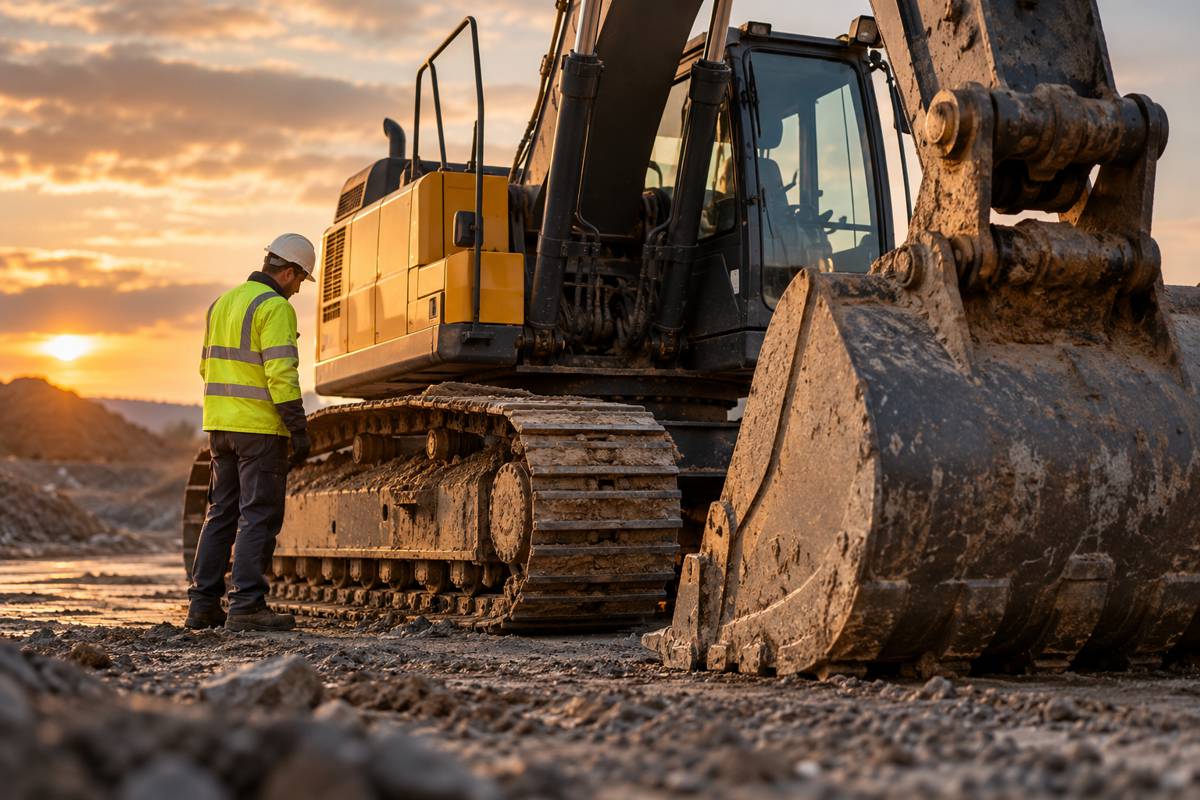
On a crawler excavator, the undercarriage is one of the areas where a hurried inspection can become expensive. Sprockets, chains, rollers, idlers and track components wear together, and their condition needs to be considered as a system rather than as a collection of individual parts.
Sharp sprocket teeth indicate wear, while leaking idlers, damaged or missing track guides and flat spots or leakage around carrier rollers deserve investigation. The objective is not simply to establish whether the excavator can still travel, but how much usable life remains beneath it. Significant undercarriage work can represent one of the largest maintenance costs outside the engine and hydraulic system, turning an apparently attractive purchase price into a much less convincing proposition.
Tracking provides another useful operational check. Volvo recommends moving the excavator forward and then reversing it for roughly ten metres to see whether it returns to the same position. A machine that does not track consistently may require adjustment or further investigation.
The bucket can provide another window into previous use. Cracks, dents, excessive wear and heavily rounded teeth should all be examined, including underneath where damage can be less obvious from a normal standing position. None of these observations necessarily makes the machine a poor purchase, but each contributes to the calculation of what it is really going to cost.
Look Beyond the Iron
The cab deserves more attention than a quick check that the engine starts and the display illuminates. Seats, controls, joysticks and displays should operate correctly, particularly on machines expected to work long shifts, while warning lights, cameras, climate controls and other fitted systems should be checked rather than assumed to work.
Problems in the cab may be relatively inexpensive compared with major powertrain repairs, but a neglected operator environment can provide clues about the standard of care applied elsewhere. Electrical and electronic faults can also be time-consuming to diagnose on increasingly sophisticated machines, especially where previous owners have fitted or removed accessories.
The rollover protective structure requires a different level of scrutiny. Damage to its corner posts, previous welding, drilling or other modifications can affect structural integrity. Undocumented alteration to the ROPS should therefore be treated as a safety issue rather than a cosmetic defect.
Condition Has to Become a Price
Inspection only becomes useful when its findings are translated into money. A machine requiring undercarriage work, hydraulic hoses, bucket repairs and several smaller cab components may still be worth buying if those costs are reflected in the transaction. Equally, an excavator carrying a higher asking price may represent the cheaper proposition when it comes with a credible maintenance record and significant component life remaining.
This calculation is also where the used-equipment market increasingly overlaps with manufacturers’ aftermarket businesses. Volvo’s Approved Used Equipment programme in Asia covers selected small and medium excavators and combines inspection and verified maintenance records with Volvo Extended Coverage. The first machines sold through the programme in Malaysia were EC350DL excavators, with the customers also taking service contracts.
Approved-used programmes allow manufacturers and dealers to remain involved as equipment passes to another owner, extending parts, servicing and support relationships deeper into the machine’s lifecycle. For buyers, the attraction is rather different: some of the uncertainty surrounding a second-hand machine has already been investigated and documented before it reaches the sales yard.
That does not remove the need to understand what is being purchased. Certification standards, warranty coverage and inspection requirements vary, and the badge on the machine is only as useful as the programme behind it.
Buying the Remaining Hours
Two excavators displaying similar figures on their hour meters can carry very different mechanical histories. Application, environment, maintenance, operator behaviour and previous repairs accumulate in the undercarriage, hydraulics, attachments, structure and fluids, leaving evidence that a careful inspection can uncover.
A comprehensive condition report provides a starting point, while service documentation, oil analysis and an operational test add further evidence. Components approaching replacement can then be identified and their likely cost incorporated into the acquisition decision rather than discovered during the first months of ownership.
OEM-backed schemes attempt to reduce some of that uncertainty by establishing eligibility standards before a machine is offered as approved equipment. Under Volvo’s Asian programme, approved machines are less than six years old, have fewer than 7,000 operating hours, carry a complete service history and undergo more than 100 checks before qualification, according to the company’s guidance supplied for the programme.
Jerome Ho, Uptime Services Product Manager at Volvo CE Region Asia, describes the proposition in terms of reducing that uncertainty: “With Volvo Approved Used Equipment, cost-conscious customers get a high-quality Volvo machine that meets strict, OEM-backed qualification criteria. Buyers get further peace of mind from our Volvo Extended Coverage package, an advantage that most other used machines cannot offer. It includes a full warranty for all major powertrain components, so buyers can take advantage of the industry-leading productivity and reliability that come from owning a Volvo machine.”
Used equipment will always involve an element of judgement because part of the machine’s productive life has already been consumed. The best purchase is not necessarily the excavator with the lowest asking price, but the one whose remaining life, likely maintenance requirements and operating risks are understood before the paperwork is signed.
Key Industry Questions
- What should be checked first when buying a used excavator? Begin with the machine’s age, operating hours, service records and previous applications. Together, these provide the context needed to interpret the physical inspection.
- Are excavator operating hours a reliable measure of condition? Hours are useful but insufficient on their own. Application, maintenance, environment and operating practices can produce substantial differences between machines showing similar figures on their meters.
- Why is undercarriage condition important? Tracks, rollers, idlers, sprockets and related components are major wear items. Their remaining life can materially alter the real acquisition cost of a crawler excavator.
- What can oil analysis reveal? Laboratory analysis can detect metals and other indicators associated with component wear or contamination. Results are most useful when considered alongside maintenance records, lubricant condition and previous samples.
- How can a buyer check whether an excavator tracks correctly? One basic test is to drive the machine forward and reverse it over the same distance, checking whether it returns to approximately the same position. Poor tracking warrants further investigation.
- What should be inspected on an excavator’s ROPS? Look for structural damage, welding, drilling and undocumented modifications to the rollover protective structure. Alterations can affect its protective performance.
- Is an OEM-approved used excavator necessarily better than another used machine? Certification can provide additional evidence about inspection, servicing and machine history, but buyers should examine the particular programme’s qualification requirements and coverage rather than relying on the badge alone.
- What does Volvo require for its Approved Used Equipment programme in Asia? According to the supplied Volvo material, qualifying machines are less than six years old, have fewer than 7,000 hours, carry a complete authorised-dealer service history and pass an inspection covering more than 100 checks.
- Should repair costs affect the purchase decision? Yes. Identified wear should be converted into likely repair or replacement expenditure and considered alongside the asking price. A cheaper machine can become the more expensive option if significant work is imminent.
Strategic Takeaways
- Operating hours become considerably more useful when considered alongside application and maintenance history.
- Undercarriage condition can materially change the economics of a seemingly attractive excavator.
- Oil analysis adds evidence about internal condition that cannot be obtained from appearance alone.
- Structural modifications to the ROPS deserve particular scrutiny because they involve operator protection.
- Approved-used programmes are giving OEMs and dealers a larger role in the second life of construction machinery.