Volvo A45 Hauler Makes its Japanese Quarry Debut
A one-tonne increase in payload does not sound particularly dramatic on a machine already capable of carrying more than 40 tonnes. Repeated hundreds of times through a quarry haul cycle, however, small changes in payload, loading accuracy and fuel consumption begin to accumulate.
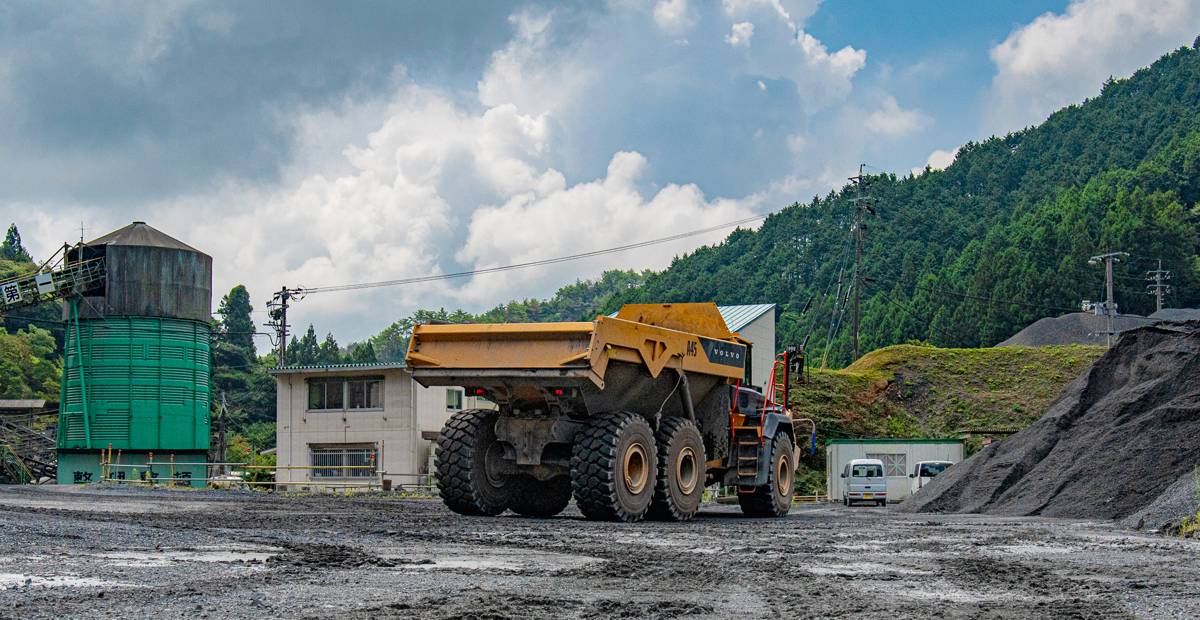
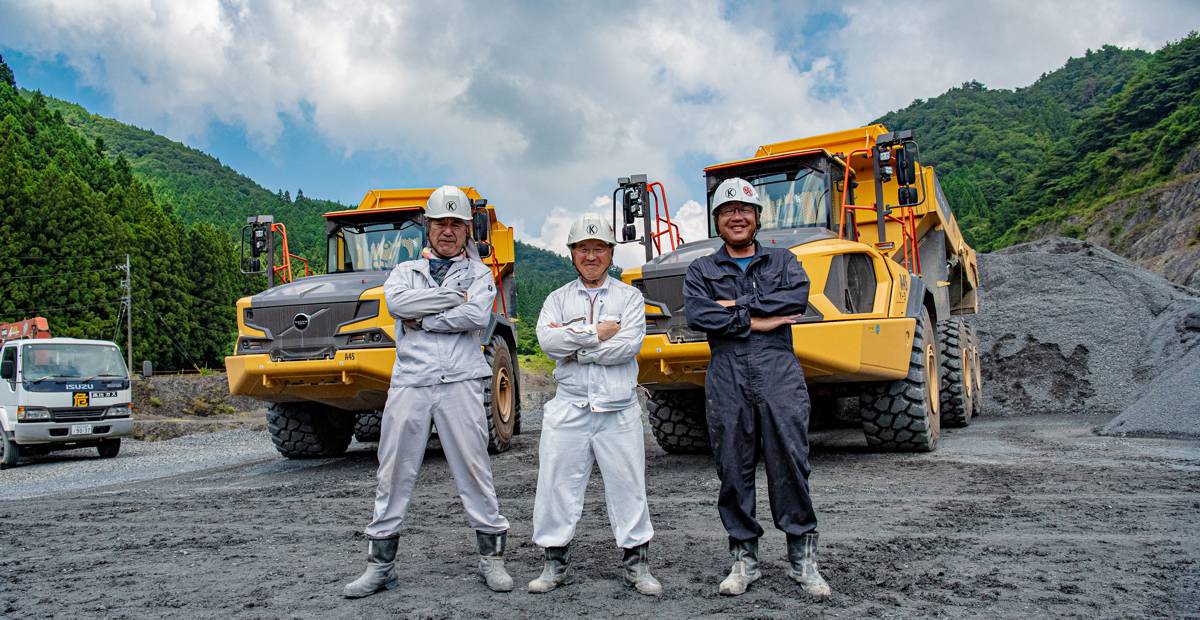
That is the operating environment now facing two new-generation Volvo A45 articulated haulers at Kano Kousan’s quarry in Shunan City, Yamaguchi Prefecture. The machines are the first of the new A45 generation delivered in Japan and are being used continuously to move raw stone, overburden and processed aggregates across difficult quarry terrain.
Volvo Construction Equipment has increased the A45’s rated payload from 41 to 42 tonnes while introducing a new transmission, reinforced axles and an updated electronic architecture. Haul Assist with On-Board Weighing is also standard, giving operators real-time payload information rather than leaving loading accuracy largely to judgement.
For an aggregates operation, those changes are best considered together. Quarry haulage is repetitive by nature, and the economics are determined across thousands of cycles rather than a single impressive load. A tonne carried unnecessarily below capacity is lost production. An overloaded machine can increase wear, fuel consumption and stress on tyres and drivetrain components. Loading consistently close to the intended payload provides a firmer basis for controlling cost per tonne.
Briefing
- Kano Kousan has received Japan’s first two new-generation Volvo A45 articulated haulers for its quarry in Shunan City, Yamaguchi Prefecture.
- Rated payload has increased from 41 tonnes on the previous generation to 42 tonnes.
- Haul Assist with On-Board Weighing is fitted as standard to provide real-time payload information.
- The new A45 uses Volvo’s D16J engine and a redesigned transmission, alongside reinforced axles and an updated operator environment.
- Dealer Daiichi Toyo reports higher productivity and lower fuel consumption at Kano Kousan, although quantified comparative operating data has not been released.
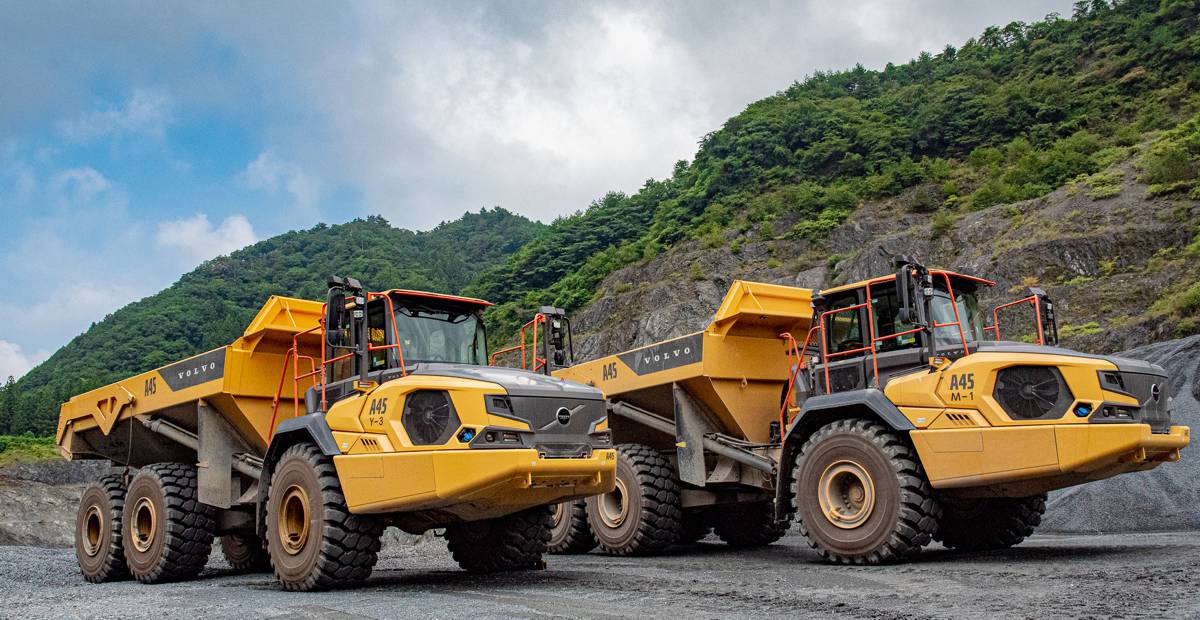
Payload and On-Board Weighing
The new A45 sits towards the upper end of Volvo CE’s conventional articulated hauler range, with a 42,000 kg payload and a 25.5 m³ SAE 2:1 heaped body. Maximum gross engine power from the Volvo D16J is 365 kW, with maximum gross torque of 2,600 Nm.
Volvo’s Haul Assist system uses On-Board Weighing to provide payload information through the Volvo Co-Pilot display. The operator can see whether the machine is underloaded, correctly loaded or carrying too much material, allowing the loading operation to be adjusted before the hauler leaves the loading area.
The system can also identify carry-back, where material remains in the body after tipping and becomes dead weight on subsequent cycles. In sticky material, retained material can interfere with payload calculations while adding unnecessary mass to the machine. The aim is to keep each journey as close as practicable to its intended payload without repeatedly exceeding it.
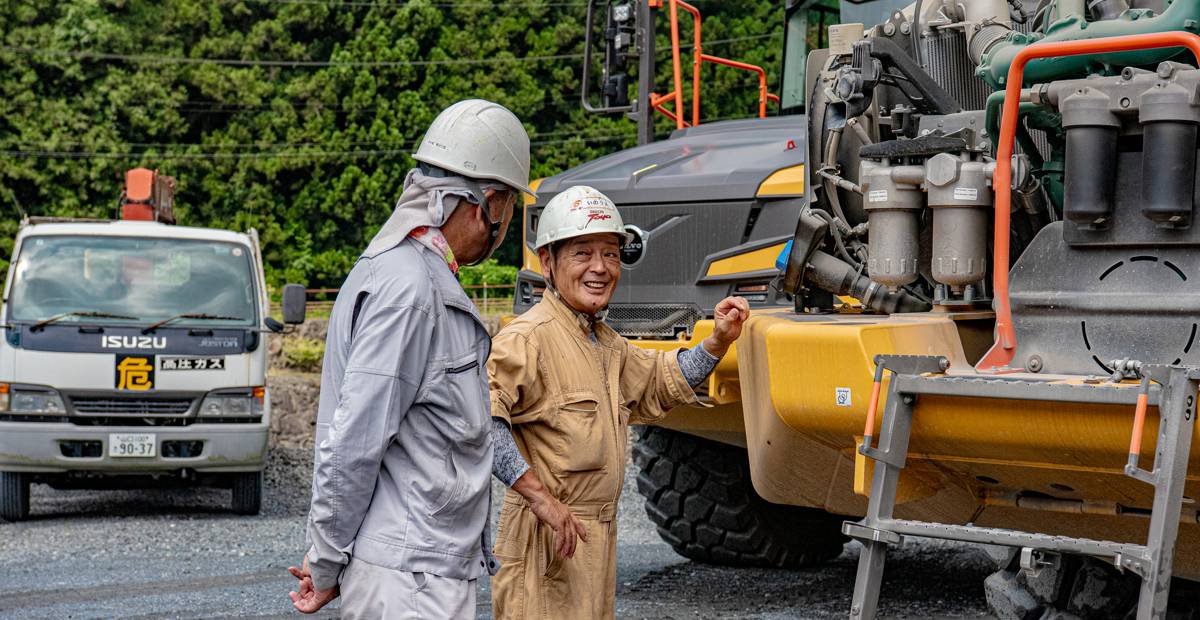
New Drivetrain for Repetitive Work
The A45 is part of the new articulated hauler generation introduced by Volvo CE in 2025. Across the range, the manufacturer replaced the previous transmission architecture with an in-house developed system and introduced a new electronic platform designed to accommodate future software and machine developments.
Volvo claims fuel-efficiency improvements of up to 15% across the new-generation hauler range, depending on model and application. That figure is a manufacturer claim covering different machines and operating conditions rather than a specific measured result from Kano Kousan.
The Japanese A45 uses the Volvo D16J engine, while the transmission and reinforced axles are intended for the sustained loads encountered in quarrying, mining and heavy earthmoving. The machine retains Volvo’s articulated hauler arrangement with six-wheel drive and Automatic Traction Control, which manages drive according to available grip.
The underlying concept dates back to Volvo’s 10-tonne DR631, known as Gravel Charlie, introduced in 1966. It established the basic articulated hauler configuration as a way of moving material across ground where conventional road-going trucks struggled. The current A45 carries more than four times its payload.
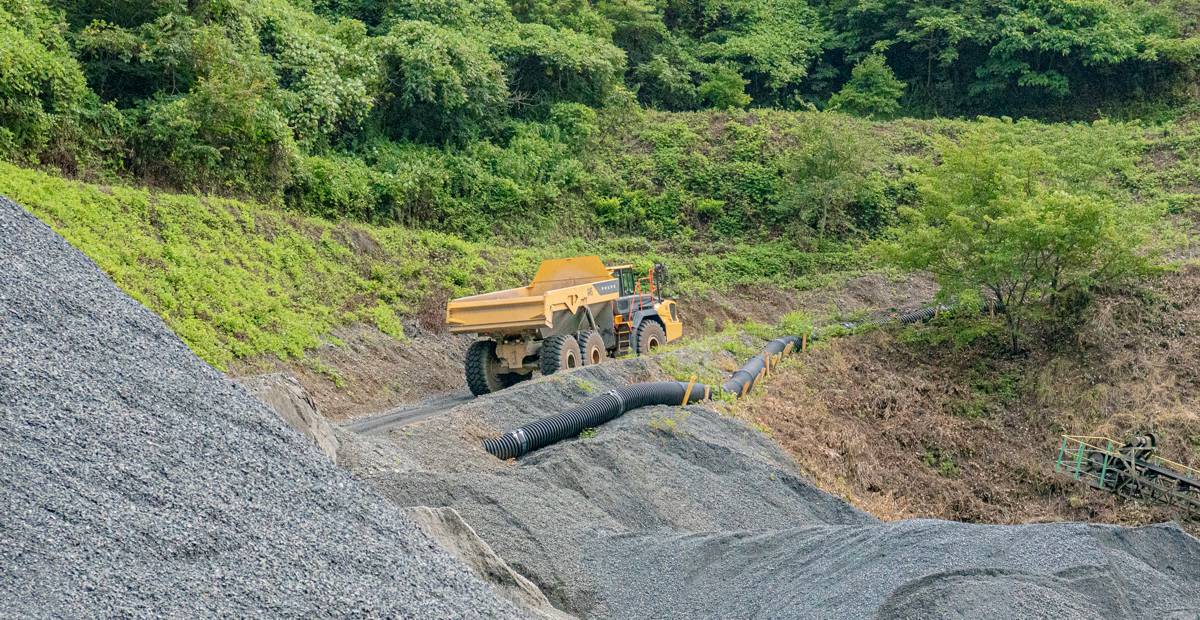
Working the Yamaguchi Quarry
At Kano Kousan, the two A45s are moving several types of material rather than performing a single narrowly defined haul. Raw stone, overburden and aggregates place different demands on loading and transport, while quarry surfaces can move quickly between firm haul roads, broken rock and softer ground.
Daiichi Toyo, Volvo CE’s local dealer, supplied the machines and is providing parts and service support.
“Kano Kousan needs to keep its operations running efficiently,” said Shuji Kinoshita, Chairman at Daiichi Toyo. “The new generation Volvo A45 haulers give the company the confidence and capacity it needs for tough terrain, and the machines are already proving themselves as key workhorses on site.”
The dealer reports that Kano Kousan has been able to move more material in fewer trips and has experienced lower fuel consumption since introducing the machines. No tonnes-per-hour, fuel-per-tonne or comparative cycle-time figures have been published, so the scale of those improvements cannot yet be independently assessed.
Kinoshita also points to On-Board Weighing as part of the improvement.
“With the new A45 haulers Kano Kousan saw a substantial increase in productivity. The company was able to move more material in fewer trips, while the On-board Weighing is a valuable tool for preventing under- or overloading and carry-back,” Shuji Kinoshita added. “The customer also reported consuming less fuel, and their operators commented on how easy and comfortable the machines are to operate even on the roughest terrain.”
A 42-tonne rated payload establishes what the hauler can carry. Actual quarry productivity still depends on excavator or loader matching, loading time, haul distance, gradients, road condition, queueing, tipping time, operator technique and the availability of the rest of the production system. A larger or faster hauler gains little if it spends its shift waiting beneath the loading tool.
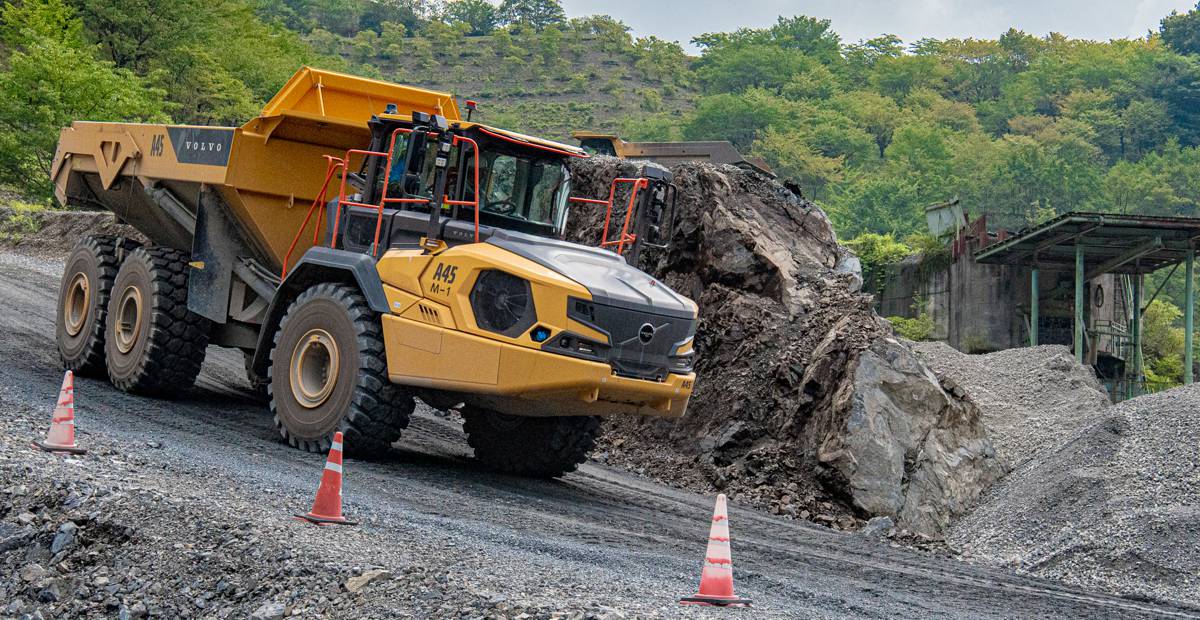
Controlling the Descent
Descending with tens of tonnes of material demands predictable speed control, particularly where gradients, loose surfaces and changing weather affect available traction. The A45 uses Automatic Traction Control to manage drive according to ground conditions, while Volvo’s Downhill Speed Control allows the operator to set and maintain a controlled speed on descending sections.
Visibility has also received attention in the new generation. The redesigned cab combines an updated operator interface with an integrated camera system intended to reduce blind spots around a machine with a gross operating weight that can reach approximately 74 tonnes when loaded.
Kano Kousan’s operating routine adds a more conventional layer of risk control. According to the supplied material, crews carry out pre- and post-shift checks and routinely clean camera lenses and work lights in the quarry’s dust and mud. These are mundane jobs compared with electronic traction management or onboard payload measurement, but a camera provides little assistance when its lens is covered in quarry dust.
Dealer Support Behind the Machine
Daiichi Toyo’s involvement extends beyond supplying the two haulers. The Okayama City-based dealer assisted Kano Kousan with machine selection and is providing aftermarket support and genuine Volvo parts.
Production equipment generates value while it is moving material, and an immobilised hauler can leave loading capacity unused or force the remaining fleet to absorb its cycles. Service response, parts availability and maintenance planning therefore sit alongside payload, fuel consumption and machine availability in the purchasing calculation.
An underloaded truck wastes available capacity, while an overloaded truck carries additional mechanical risk. Poorly maintained haul roads consume fuel and tyres. An incorrectly matched loading tool introduces waiting time, while carry-back occupies payload that should have been available for new material.
Kano Kousan’s first two A45s provide an early Japanese test of Volvo’s new generation against those everyday quarry variables. Daiichi Toyo reports higher productivity and lower fuel consumption, although detailed production figures have not been released.
The more revealing numbers will eventually be tonnes moved, fuel consumed and hours available. For a quarry hauler, those figures say considerably more about its performance than another tonne on the specification sheet.
Key Industry Questions
- What is the payload of the new-generation Volvo A45? The A45 has a rated payload capacity of 42 tonnes, compared with 41 tonnes for the previous generation.
- What engine is fitted to the Volvo A45? The current A45 uses Volvo’s D16J diesel engine, with maximum gross power of 365 kW and maximum gross torque of 2,600 Nm.
- What is the body capacity of the Volvo A45? Volvo specifies a 25.5 m³ SAE 2:1 heaped body capacity.
- What does Volvo Haul Assist do? Haul Assist provides operational tools through Volvo Co-Pilot. Its On-Board Weighing function supplies real-time payload information to help operators avoid underloading and overloading.
- Why does payload accuracy matter in a quarry? Consistent payloads help make better use of each haul cycle. Underloading leaves productive capacity unused, while repeated overloading can increase machine stress and operating costs.
- What is carry-back? Carry-back is material that remains in the body after tipping. It adds dead weight to subsequent cycles and reduces the useful payload available for new material.
- How does the A45 manage difficult ground? The machine combines six-wheel drive with Automatic Traction Control, while its articulated configuration and wide tyres are intended for uneven and soft off-road surfaces.
- What productivity improvement has Kano Kousan recorded? Daiichi Toyo reports a substantial improvement and says more material is being moved in fewer trips. Quantified tonnes-per-hour or comparative cycle-time data has not been published.
- Has fuel consumption been independently measured at the Japanese quarry? The supplied material says Kano Kousan reported lower fuel consumption, but no comparative fuel figures have been released.
Strategic Takeaways
- The A45’s increase from 41 to 42 tonnes is modest per journey but can accumulate across high-cycle quarry operations.
- Real-time payload measurement can be as relevant to production economics as nominal machine capacity.
- Volvo’s drivetrain redesign places fuel consumption and mechanical efficiency at the centre of the new hauler generation.
- Quarry productivity remains a system calculation involving the loading tool, haul road, truck, operator, tipping point and maintenance operation.
- Kano Kousan’s experience provides an early operational reference for the new A45 in Japan, but detailed comparative production data would be required to quantify the reported gains.