US$34m Lavalle Port Investment Opens New Route for Corrientes Freight
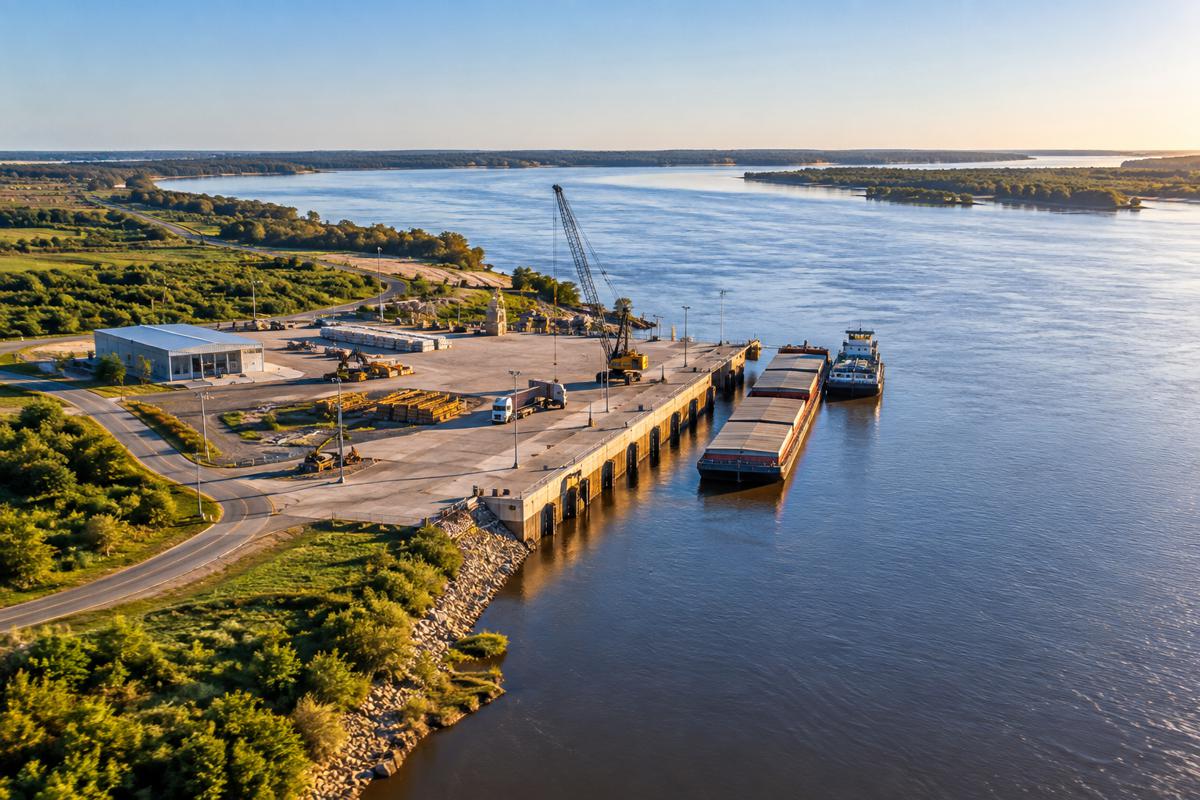
A 140-metre quay on the Paraná River could change how agricultural and forestry products from southern Corrientes reach domestic and export markets.
The Central American Bank for Economic Integration (CABEI) has approved investment of up to US$34 million for the first phase of the Lavalle Port Project in Argentina. The development will establish a new multipurpose river port serving the Río Santa Lucía Microregion.
The initial works are relatively compact. Alongside the quay, designed for barges and river vessels, the project includes 3,360 m² of port and auxiliary infrastructure and 1.6 kilometres of new road access. CABEI estimates that the investment will directly benefit more than 271,000 people and almost 4,000 businesses in the microregion, with its wider economic reach extending across Corrientes Province.
Its strategic value comes largely from where those 140 metres of quay lead. Lavalle sits on the Paraná, giving regional producers access to the Paraná-Paraguay Waterway and a river transport system extending through five South American countries.
Briefing
- CABEI has approved investment of up to US$34 million for the Lavalle Port Project in Corrientes, Argentina.
- Phase one includes a 140-metre quay for barges and river vessels.
- The scheme provides 3,360 m² of port and auxiliary infrastructure and 1.6 kilometres of new road access.
- Rice and forestry supply chains are expected to be among the principal users of the new logistics connection.
- CABEI expects 100 temporary direct jobs during construction and 25 permanent direct jobs once the port is operating.
A Port Planned Around the Paraná
Lavalle is not a port project that suddenly appeared with the latest financing decision. Argentina’s federal government was already dealing with the development several years ago, exempting works for the Nuevo Puerto de Lavalle from certain administrative charges in 2022.
The federal decree provides considerably more engineering detail than the latest financing announcement. It places the development near kilometre 117.5 of Provincial Route 27 and kilometre 990 on the left bank of the Paraná. Earlier environmental documentation covered a 140-metre-long, 24-metre-wide quay founded on 96 piles with a diameter of 700 mm, together with riverbank protection and hydraulic works.
The government described the port at the time as a strategic node intended to serve production corridors around Goya, Lavalle, San Isidro, Carolina, Santa Lucía, Gobernador Martínez, Cruz de los Milagros and Yataytí Calle. It also explicitly linked the location with the Paraná-Paraguay Waterway, Alto Paraná and the Bioceanic Corridor.
CABEI’s approval adds financing to a logistics project that has already spent several years moving through Argentina’s administrative and technical processes.
Connecting Regional Production to River Freight
Corrientes has a production base that makes the geography particularly relevant. Agriculture includes rice alongside crops such as tobacco, yerba mate and tea, while CABEI specifically identifies rice and forestry as supply chains expected to benefit from Lavalle.
The Paraná-Paraguay Waterway extends for more than 3,400 kilometres through Argentina, Bolivia, Brazil, Paraguay and Uruguay, carrying agricultural commodities, minerals, fuels, industrial cargo and containerised freight through the wider River Plate basin. Lavalle would give regional producers a point at which suitable cargo could transfer from road to river much closer to its origin.
Trucks remain essential for collecting products from farms, forests, processing facilities and warehouses, but the port introduces another transport mode for the longer leg of the journey. The inclusion of 1.6 kilometres of new access roads reflects that intermodal role, connecting local and regional road freight with the river system rather than replacing it.
The Scale of the Waterway
Lavalle will enter a transport system far larger than the port itself. The Argentine government has described the Paraná-Paraguay system as fundamental to the country’s export economy, with the Ministry of Economy stating in 2025 that approximately 80% of Argentina’s exports were channelled through the Paraná waterway system. That national figure should not be interpreted as a forecast of traffic through Lavalle.
The navigable corridor links the interior of the continent with downstream ports and the Río de la Plata, allowing barge convoys to move bulk commodities between production areas and maritime export terminals.
Conditions on the river nevertheless impose engineering and operational constraints. Studies of the Paraná between Santa Fe and its confluence with the Paraguay describe variable widths and depths and identify shallow sections that require dredging to maintain navigation. Barge convoys on this part of the system carry commodities including soybeans, wheat, iron ore, manganese, clinker, cement, petroleum products and oils.
Lavalle will consequently depend not only on what happens at the quay, but on navigable depths, dredging, waterway maintenance and the economics of moving barges through the wider system.
Building a Regional Logistics Node
The first phase of Lavalle is modest compared with Argentina’s major river and maritime terminals, reflecting its intended role as a regional connection into the larger river network. Its immediate task is to provide a practical interface between regional production and the Paraná.
CABEI estimates that approximately 100 direct temporary jobs will be created during implementation, followed by 25 permanent direct positions during operation. Those numbers are relatively small compared with the population figures attached to the project, reinforcing that its wider economic case rests primarily on logistics rather than direct employment.
For the nearly 4,000 businesses CABEI identifies within the Río Santa Lucía Microregion, the eventual value of the project will depend on cargo volumes, handling costs, road connections and whether river transport offers a competitive route to downstream markets.
Construction can provide the physical connection. The commercial test will come once producers and freight operators decide whether it is worth using.
Key Industry Questions
- What is being built at Lavalle Port? The first phase comprises a multipurpose port on the Paraná River with a 140-metre quay, 3,360 m² of port and auxiliary infrastructure and 1.6 kilometres of new road access.
- How much is CABEI investing? CABEI has approved investment of up to US$34 million for the project.
- Where is the port located? The development is at Lavalle in Corrientes Province, on the left bank of the Paraná River and close to Provincial Route 27.
- Which industries are expected to use the port? CABEI specifically identifies the regional rice and forestry production chains as expected beneficiaries.
- What is the Paraná-Paraguay Waterway? It is a river transport corridor extending for more than 3,400 kilometres through Argentina, Bolivia, Brazil, Paraguay and Uruguay.
- Will the project replace road freight? No. The port depends on road connections for the collection and delivery of cargo. Its first phase includes 1.6 kilometres of new road access, allowing freight to transfer between road and river transport.
- Is Lavalle a completely new project? No. Federal records show the Nuevo Puerto de Lavalle was already progressing through administrative and technical processes by 2022, with earlier environmental documentation covering the quay and associated river works.
- How many jobs are expected? CABEI forecasts 100 temporary direct jobs during implementation and 25 permanent direct jobs during operation.
- What will determine whether the port succeeds commercially? Cargo volumes, handling capabilities, road access, river navigability, barge and vessel availability, operating costs and the economics of competing freight routes will influence utilisation.
Strategic Takeaways
- Lavalle has already spent several years moving through Argentina’s administrative and technical processes, with CABEI financing providing another step towards delivery.
- The port’s commercial case is based primarily on connecting regional production to an established international river corridor rather than generating large numbers of direct jobs.
- Rice and forestry provide identifiable cargo bases around which initial port activity could develop.
- The 1.6 kilometres of road infrastructure is integral to the project because the terminal functions as an intermodal transfer point rather than an alternative to local trucking.
- Long-term utilisation will depend on freight economics and reliable navigation on the Paraná-Paraguay system.