AMP Secures $70m for AI-Powered Waste Infrastructure
AMP has secured $70 million in project debt financing for the next stage of a waste-processing network in Portsmouth, Virginia, designed to handle more than half a million tons of municipal solid waste each year.
Led by Galvanize, the financing will fund a new sortation facility and an associated organics-processing system forming part of AMP’s 20-year agreement with the Southeastern Public Service Authority (SPSA). At full scale, the regional system is intended to process more than 1,400 tons of waste each day and divert at least half of the material away from landfill.
AMP has been operating AI-assisted sorting equipment for years, but the financing structure surrounding the technology takes the Portsmouth project into different territory. Automated sorting plants, long-term municipal contracts, performance commitments and predictable waste volumes are beginning to give advanced waste processing some of the characteristics of conventional infrastructure.
Briefing
- AMP has closed $70 million in project debt financing led by Galvanize.
- The capital will support another Portsmouth sortation facility and an adjacent organics-processing system.
- The wider SPSA system is designed to process more than 500,000 tons of municipal solid waste annually.
- AMP and SPSA have a 20-year operating relationship covering eight communities and approximately 1.2 million residents.
- Recovered organic material is planned to be converted into biochar, alongside the recovery of plastics, metals and fibre.
Sorting the waste people actually throw away
Conventional recycling infrastructure generally starts with some degree of separation. Residents or businesses place recyclable material into dedicated containers, after which a material recovery facility separates the mixed recyclable stream into individual commodities.
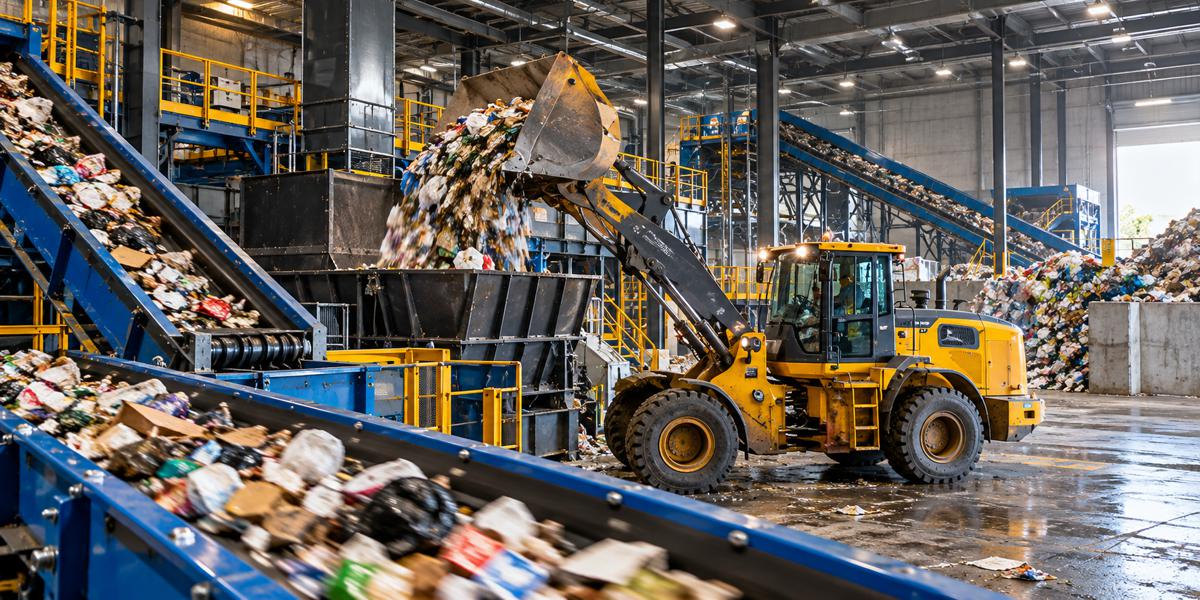
AMP moves that process further upstream. Its Portsmouth system is designed to accept raw municipal solid waste, including sealed rubbish bags, and identify recoverable material within the general waste stream. Cameras and machine-learning systems classify objects moving through the plant, while automated equipment including robotics and pneumatic separation systems directs material into different streams.
Instead of relying entirely upon households correctly identifying and separating recyclable material, recovery can therefore take place after collection. The technology is being deployed against a very conventional infrastructure problem: diminishing landfill capacity.
According to AMP’s SPSA case study, the authority had projected that its existing landfill disposal capacity would last until around 2060 and faced limited opportunities for expansion. SPSA subsequently sought an alternative waste-disposal mechanism and selected AMP following a procurement process.
The resulting system uses multiple processing sites rather than relying upon a single central facility. AMP already operates in Portsmouth following its 2025 acquisition of RDS of Virginia’s local operations, which included municipal solid waste and single-stream recycling facilities. The new investment substantially expands that footprint.
From technology risk to project finance
The $70 million debt package is particularly relevant because infrastructure lenders tend to approach emerging industrial technologies differently from venture investors.
Venture capital can finance product development and early deployment while accepting considerable technology and market risk. Project debt normally depends much more heavily upon identifiable assets, contractual revenues and confidence that the underlying operation will continue generating cash over the financing period.
Galvanize has described a financing gap that can emerge as industrial and decarbonisation technologies move from venture-backed development towards repeatable, capital-intensive deployment. Traditional project finance is well suited to large contracted infrastructure assets, but can be harder to apply to newer business models without long operating histories or conventional credit profiles.
AMP’s Portsmouth arrangement contains several characteristics that can help bridge that gap. There is an established municipal customer, a 20-year agreement, large and comparatively predictable waste volumes and operating experience from an existing Portsmouth facility. AMP also operates and maintains the sorting infrastructure rather than simply selling equipment to the authority. Its commercial model includes per-ton processing arrangements and guaranteed diversion performance.
AMP says more than two years of operation at its original Portsmouth facility provided the commercial-scale track record behind the subsequent SPSA agreement. The company describes the new financing as evidence that the model can now be combined with long-duration project capital.
That remains a company interpretation rather than proof that automated waste sorting has broadly crossed into conventional infrastructure finance. A single financing package does, however, provide a useful test of whether the model can support substantially larger deployments without relying predominantly upon corporate equity.
Organics become another infrastructure stream
The second Portsmouth sorting facility will also separate organic material from the incoming waste stream. AMP plans to process that material in an adjacent facility using indirect heating to produce biochar, with the second sortation facility expected to come online in early 2028.
Biochar is a carbon-rich material produced through thermal processing of organic feedstocks. AMP initially intends to use the Portsmouth output as daily landfill cover, while identifying possible future uses in construction and cement applications.
The process also introduces another potential revenue stream. In March 2026, Google agreed to purchase carbon removal associated with 200,000 metric tonnes of CO2e by 2030 from an AMP affiliate, with AMP saying the agreement will help finance additional biochar production capacity associated with the Virginia project.
Exactly how much carbon benefit the Portsmouth system ultimately delivers will depend upon actual waste composition, recovery rates, biochar production, landfill conditions and the accounting methodology used for the resulting carbon removals.
A different model for municipal waste infrastructure
SPSA serves approximately 1.2 million residents across eight member communities, and the Portsmouth project is fundamentally about increasing the amount of useful capacity available within that regional waste system.
Under the 20-year arrangement, AMP and SPSA expect at least 20% of the authority’s waste to be recycled while at least half of the material entering AMP’s facilities is diverted from landfill. AMP says this would extend the regional landfill’s operating life into the next century.
Much of the technological and operational responsibility sits with the supplier. AMP designs and operates the sorting facilities, maintains the equipment and can modify sorting parameters as the composition and value of the waste stream changes. SPSA retains its existing transfer and disposal infrastructure while buying access to additional processing capability.
The arrangement begins to resemble other infrastructure service models in which a public authority procures an outcome rather than acquiring the machinery required to produce it. Municipalities facing diminishing landfill capacity often confront capital-intensive choices involving new landfill cells, transfer infrastructure, waste-to-energy facilities or transporting waste increasingly long distances. Automated recovery adds another option, particularly where enough material can be extracted from mixed waste to change the economics of disposal.
Whether Portsmouth becomes a widely repeatable model will depend on considerably more than the performance of its AI. Commodity prices, processing costs, residual disposal charges, organics yields, carbon-credit revenues and the reliability of heavily automated plants will all influence the economics.
The $70 million financing puts those questions into a different setting. AMP is no longer asking whether cameras and machines can recognise rubbish on a conveyor. Portsmouth is testing whether an AI-controlled waste-processing system can operate for decades as part of the physical infrastructure of a region.
Key Industry Questions
- How much waste will the Portsmouth system process? The regional system is designed for more than 500,000 tons of municipal solid waste annually, equivalent to more than 1,400 tons per day.
- Does waste have to be separated before entering the plant? No. AMP’s system is designed to process mixed municipal solid waste, including material arriving in sealed rubbish bags.
- What materials can the system recover? AMP targets recyclable commodities including plastics, metals and fibre, while the Portsmouth expansion will also recover organic material.
- What happens to the recovered organics? AMP plans to use indirect thermal processing to convert them into biochar, initially intended for use as landfill cover.
- Why is project debt significant? Debt financing places greater emphasis on contracted revenues, operating performance and repayment than conventional venture investment. In this case, it supports physical processing infrastructure associated with a 20-year municipal arrangement.
- How much waste is expected to avoid landfill? AMP and SPSA are targeting diversion of at least 50% of the waste processed through the facilities.
- Who operates the facilities? AMP provides operations and maintenance under its agreement with SPSA rather than transferring operation of the processing technology to the authority.
- When will the expanded system begin operating? AMP’s September 2026 announcement says the second sortation facility is expected online in early 2028.
Strategic Takeaways
- Project debt introduces another source of capital for scaling automated waste-processing facilities beyond venture-backed technology deployment.
- A 20-year municipal agreement provides a contractual foundation against which expensive processing infrastructure can be financed and operated.
- Sorting mixed municipal waste expands the addressable waste stream beyond material successfully separated by residents and businesses.
- Recovering organics connects waste processing with landfill-capacity management and potentially carbon-removal markets.
- Long-term operating performance in Portsmouth will provide a more useful measure of the model’s replicability than headline sorting accuracy alone.