From the Hudson to Mexico: 10 Infrastructure Projects to Watch Across North America
At the end of September 2026, a machine weighing 1,680 tonnes began cutting into the Palisades west of Manhattan.
More than 500 ft long and carrying a cutterhead almost 29 ft in diameter, the tunnel boring machine is excavating the first major drive of the Hudson Tunnel Project. It is expected to advance at around 30 ft per day, installing concrete lining behind it as it creates one of two new railway tubes towards the Hudson River.
Trains meanwhile continue running beneath the river through the North River Tunnel, a connection opened in 1910 that remains critical to passenger rail between New York and New Jersey.
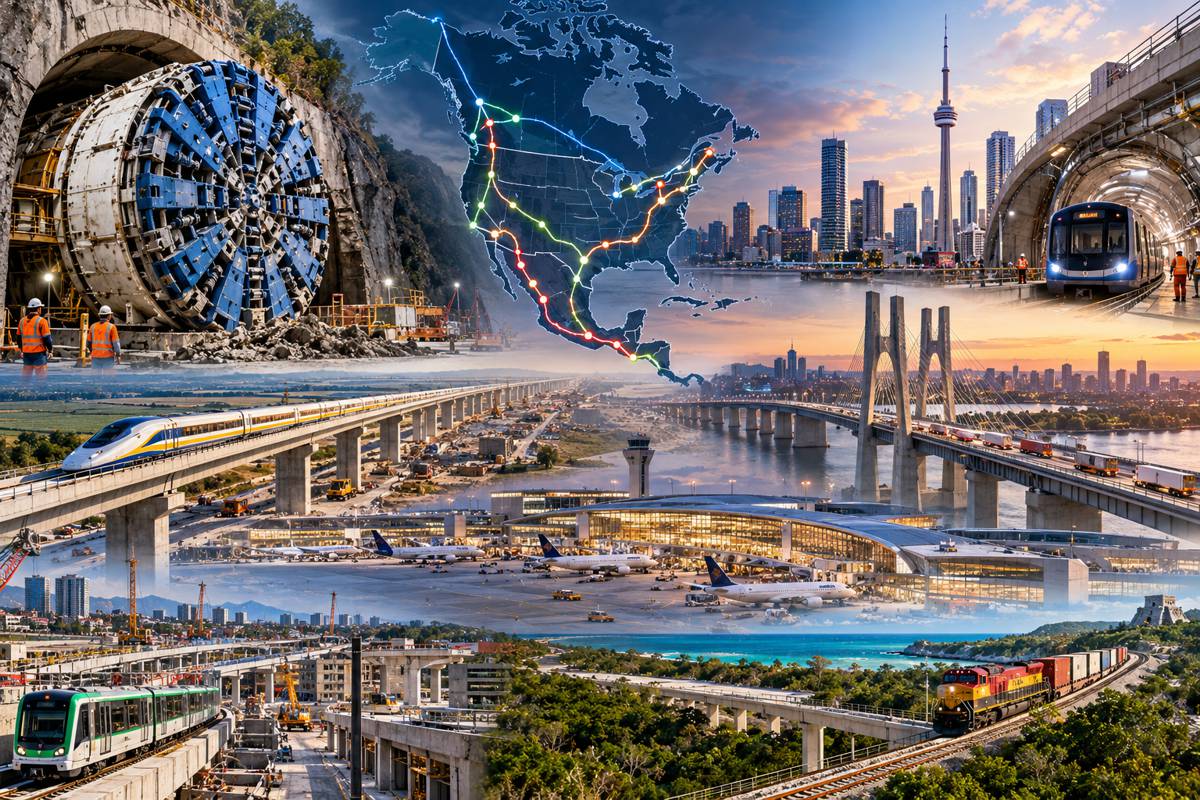
Across North America, infrastructure inherited from an earlier era is being rebuilt alongside networks previous generations never completed. California is preparing to install track and systems for the continent’s first true high-speed railway. In Canada, Toronto is boring a new subway beneath its downtown, Calgary is constructing a new light-rail spine, and Vancouver has moved from tunnelling to testing trains on its Broadway Subway extension.
Mexico is pursuing an infrastructure programme of a different scale. Intercity passenger railway construction has returned between Mexico City and Querétaro, new lines are advancing towards the country’s northern industrial regions, and Tren Maya is being extended from a passenger railway into a freight and logistics system.
Bridges, airports and highways are changing too. A new crossing is rising beside the Brent Spence Bridge between Ohio and Kentucky, while New York’s JFK Airport is being reconstructed around passengers and aircraft movements that cannot simply stop while the work takes place.
Briefing
- The Hudson Tunnel Project has begun TBM excavation beneath the Palisades as a new railway connection is built beside the century-old North River Tunnel.
- California High-Speed Rail is moving from major civil construction towards track, electrification, signalling and communications across its initial 119-mile Central Valley section.
- Toronto’s 15.6 km Ontario Line has entered full-scale tunnelling, while Vancouver’s Broadway Subway is completing track and testing trains ahead of its planned 2027 opening.
- Mexico reports 31% progress on the Mexico City-Querétaro passenger railway and 67% on the Tren Maya freight programme as national passenger and freight rail investment accelerates.
- Highway, airport and urban-transit projects including the Brent Spence Bridge Corridor, JFK redevelopment and Calgary Green Line show the breadth of the current construction cycle.
1. Hudson Tunnel Project, New York and New Jersey
Few pieces of American transport infrastructure carry as much responsibility as the railway tunnels beneath the Hudson River.
The existing North River Tunnel connects New Jersey with Pennsylvania Station in Manhattan and carries Amtrak and NJ Transit services on the Northeast Corridor. Its age, intensive use and damage from Hurricane Sandy have made construction of a second crossing one of the most consequential railway projects in the United States.
The Hudson Tunnel Project will build two new tubes beneath the river and rehabilitate the existing tunnel once additional capacity is available.
Construction now extends across multiple sites in New York and New Jersey, but September’s start of TBM excavation beneath the Palisades provides the clearest evidence of the project’s transition into major underground construction.
The Palisades package involves two parallel tunnels approximately 5,100 ft long, each with an internal diameter of 25 ft 2 in, together with six cross-passages. Two single-shield TBMs will excavate the tubes and install waterproofed concrete linings behind them as they advance.
Each machine weighs around 1,680 tonnes. Their 28 ft 8 in cutterheads are followed by approximately 500 ft of gantries carrying the equipment needed to remove excavated material, install tunnel segments and support the excavation process.
The project has not been insulated from political and financial risk. Construction was interrupted temporarily in early 2026 amid uncertainty over federal funding disbursements before work resumed.
The existing North River Tunnel cannot simply be removed from service while its replacement is constructed. New capacity must be built first, allowing the century-old infrastructure to be rehabilitated without severing one of the busiest passenger railway connections in the United States.
2. California High-Speed Rail
In California’s Central Valley, a railway project debated for decades is approaching a different threshold.
The California High-Speed Rail Authority reports 171 miles between Merced and Bakersfield under design and construction. More than 80 miles of guideway and over 60 major structures have been completed, with additional structures continuing across Madera, Fresno, Kings and Tulare counties.
In 2026, the programme is beginning to move beyond viaducts, grade separations and earthworks into the systems required to create an operating railway.
In June, the Authority approved an American-led consortium of Kiewit, Stacy Witbeck and Herzog to begin installing track and railway systems on the initial 119-mile Central Valley section. The work covers track, overhead electrification, traction power, train control, communications and systems integration. The railway is being designed for trains capable of operating at up to 220 mph.
At the southern end of the initial construction section, a 150-acre railhead in Kern County has been prepared as the logistics base for the installation programme. It connects with the national freight railway network, allowing rail, sleepers, ballast and other materials to arrive by train before being distributed along the high-speed alignment.
California has also moved towards direct procurement of long-lead railway materials rather than waiting for every civil package to finish before beginning systems work.
Concrete structures and earthworks that have dominated construction for years must now become a railway in which track geometry, overhead power, train control, communications and rolling stock ultimately function as a single system.
The wider programme remains enormous, expensive and politically contested. The immediate engineering task is more tangible: turning 119 miles of Central Valley civil works into electrified high-speed railway infrastructure.
3. Ontario Line, Toronto
Toronto is building new rapid-transit capacity through some of the most intensively developed parts of Canada’s largest city.
The Ontario Line will run 15.6 km from Exhibition Place through downtown Toronto towards the Don Valley, with 15 stations and connections to existing subway, GO rail and streetcar services.
TBMs Libby and Corkie are driving nearly 6 km of twin tunnels from Liberty Village towards the Don Yard portal. Behind the machines, crews at the launch shaft manage excavated material, precast tunnel segments, logistics and the continuous supply chain needed to keep both drives moving beneath downtown Toronto.
Other sections are progressing through different delivery packages. In August, Metrolinx signed a C$4.32 billion target-price agreement with Pape North Connect for the Pape Tunnel and Underground Stations package. The scope includes 3 km of twin tunnels beneath Pape Avenue, underground stations at Pape and Cosburn, two portals, three emergency exit and service buildings and a crossover within the tunnel system.
The package also has to interface with the existing TTC Line 2 subway. Elsewhere, bridges, elevated structures, station works and utility relocations are advancing as the route moves between tunnelled, surface and elevated sections.
Tunnels, surface structures and elevated sections must ultimately connect with railway, subway, road and utility infrastructure already occupying the same ground.
4. Mexico City-Querétaro Passenger Railway
Mexico’s return to intercity passenger rail is now visible in earthworks, bridge foundations and railway formation north of the capital.
The Mexico City-Querétaro route is part of a much larger federal programme to rebuild passenger railway connections between the capital, the Bajío and northern Mexico.
Construction began in 2025 and had reached a reported 31% overall progress by September 2026.
The work is distributed across multiple fronts rather than concentrated in a single spectacular structure. Current construction includes railway embankments, viaduct piles around La Trinidad, formation near San Juan del Río, road bridges, drainage structures, service roads and crossings for livestock and wildlife.
Earlier project reporting identified 14 active construction fronts and a programme involving 363 transverse drainage structures, 22 road bridges, 43 livestock crossings and 20 wildlife crossings.
The railway is planned with stations including Buenavista in Mexico City, Huehuetoca, Tula de Allende, San Juan del Río, El Marqués and La Corregidora in Querétaro.
Its reach also extends beyond the first route. Mexico City-Querétaro is being developed as part of a wider passenger railway system that will ultimately continue towards Guadalajara and northern Mexico.
For decades, long-distance passenger rail played little part in Mexican intercity transport. The embankments and structures now appearing between Mexico City and Querétaro mark a physical return to railway construction at national scale.
5. Brent Spence Bridge Corridor, Ohio and Kentucky
At Cincinnati, the infrastructure problem is not the absence of a river crossing. It is the amount of traffic being forced through the one already there.
The Brent Spence Bridge carries Interstates 71 and 75 across the Ohio River between Cincinnati and Covington, Kentucky. The corridor is one of the most important north-south road freight routes in the United States.
The current programme does not simply replace the existing bridge. A new companion bridge will be built alongside it, allowing traffic to be reorganised between the two structures while extensive motorway reconstruction takes place on both sides of the river.
After years of planning, the project entered heavy construction in 2026. Demolition began in April and the formal groundbreaking for the companion bridge followed on 8 May.
The wider corridor involves reconstruction of motorway interchanges, bridges, ramps and local road connections through northern Kentucky and Cincinnati. Building the river crossing is therefore only one component of a much larger attempt to remove a bottleneck embedded in an operating interstate network.
Traffic cannot simply be diverted for several years while the infrastructure is rebuilt. The existing Brent Spence Bridge will remain part of the completed system, while the companion structure provides additional capacity and allows local and through traffic to be separated more effectively.
Construction is expected to continue into the next decade, with the new bridge currently scheduled to open in 2031.
6. Broadway Subway, Vancouver
Vancouver’s Broadway Subway demonstrates what happens after the tunnel boring machines have left.
The project extends the Millennium Line 5.7 km west from VCC-Clark to Arbutus Street. Approximately 5 km runs through tunnels beneath Broadway, with six new underground stations and around 700 m of elevated guideway connecting the extension with the existing network.
By September 2026, track installation across the extension was reaching completion. Testing had already begun months earlier. In May, SkyTrain vehicles started dynamic testing on completed sections, initially running over approximately 2 km of new track from VCC-Clark through sections of the tunnels and elevated guideway.
The testing programme checks clearances, train positioning, signalling, communications and the behaviour of multiple trains operating on the infrastructure. Driver-operated testing will eventually transition towards the automatic train-control system used by Vancouver’s SkyTrain network.
Above ground, construction is moving in the opposite direction.
Temporary traffic decks installed over station excavations are being removed, utilities reinstated and Broadway reconstructed. At Broadway-City Hall Station, crews have been backfilling above the station box and restoring streets and pavements while railway systems work continues below.
Passenger service is scheduled for autumn 2027. The tunnelling is finished, but thousands of individual components now have to work together reliably enough for an automated railway to carry passengers while the city above is put back together.
7. Tren Maya Freight, Mexico
The passenger railway around Mexico’s Yucatán Peninsula is being extended into something substantially different.
Tren Maya Freight is adding freight infrastructure, terminals and logistics connections to the passenger railway already operating through southeastern Mexico.
By 23 September, the Mexican government reported the freight programme at 67% progress.
The first 12 freight locomotives arrived in July. Rather than waiting for commercial operations, they were put to work transporting materials for construction of the freight system itself.
The wider programme is intended to connect railway freight with ports, airports and logistics facilities across the southeast. Government reporting describes approximately 250 km of freight works when the connection towards Puerto Progreso is included.
Freight infrastructure introduces terminals, cargo handling, intermodal connections, industrial users and relationships with the rest of Mexico’s railway network.
Palenque is particularly important because it provides the route towards the wider national rail system and the Interoceanic Corridor, while the Yucatán connections create potential interfaces with maritime trade through Gulf and Caribbean ports.
The freight works now under construction will help determine whether Tren Maya develops into a broader logistics network for southeastern Mexico rather than remaining principally a passenger transport project.
8. JFK Airport Redevelopment, New York
At John F. Kennedy International Airport, New York is attempting something comparable to rebuilding a city district without closing the roads into it.
The airport is undergoing a $19 billion transformation centred on new terminals, redesigned road infrastructure and supporting transport systems while JFK remains one of the principal international gateways to the United States.
The two largest terminal projects are the $9.5 billion New Terminal One and $4.2 billion Terminal 6. The New Terminal One will eventually cover approximately 2.4 million sq ft, while Terminal 6 adds another 1.2 million sq ft of terminal infrastructure. The first new gates are scheduled to open during 2026.
The logistics extend well beyond cranes and concrete. The Port Authority has used industrial barges to bring construction material into JFK and remove waste from the redevelopment sites, an operation it estimates will eliminate more than 330,000 diesel truck journeys through surrounding neighbourhoods.
Construction logistics become infrastructure in their own right. Materials, workers and waste have to move through a site already occupied by aircraft, passengers, baggage systems, security zones, roads and operating terminals.
JFK’s transformation is being assembled in stages. Existing facilities remain in service while new terminal capacity, gates and roads are built beside them, after which airlines and operations can migrate into the new infrastructure and release other areas for redevelopment.
It is less a single construction project than a carefully sequenced replacement of an operating airport.
9. Calgary Green Line LRT, Alberta
Calgary’s Green Line has spent years changing shape on paper. In southeast Calgary, it is now becoming physical infrastructure.
Construction on the first section began in June 2025 and has expanded significantly through 2026.
The southeast segment will provide 16 km of LRT infrastructure and ten stations between Shepard and the future Event Centre/Grand Central Station, together with two park-and-ride facilities, a maintenance and storage facility, roads, transit connections and 28 light-rail vehicles.
Several distinct pieces are under construction simultaneously.
At Blackfoot Trail, six major girders were installed over two nights during May as work advanced on the new LRT bridge. In Ogden, utilities and road infrastructure are being moved to create space for the railway alongside the existing CPKC corridor.
Farther south, a 570 m elevated guideway is being constructed across 114 Avenue and Barlow Trail. The structure requires piers, girders, a reinforced deck, retaining walls and approaches that bring the railway back to ground level. Site mobilisation continued through September ahead of major structural work.
The Shepard Maintenance and Storage Facility is advancing at the same time, with foundations, utilities and structural steel among the packages under construction. Track, signalling, communications, traction power, elevated stations and additional guideway works are being procured separately as the civil programme advances.
After years of redesign and debate, foundations, bridges, guideway and railway facilities are now establishing the route through southeast Calgary.
10. Saltillo-Nuevo Laredo Passenger Railway, Mexico
North America’s final project runs towards one of its busiest international borders.
The Saltillo-Nuevo Laredo passenger railway is being built through Coahuila, Nuevo León and Tamaulipas, eventually connecting Saltillo and Monterrey with Nuevo Laredo on the United States border.
By 23 September 2026, Mexico reported physical progress of approximately 10%.
That places the railway considerably earlier in its construction cycle than Mexico City-Querétaro, but work and procurement are now moving across multiple packages.
The project forms part of Mexico’s wider strategy to create dedicated intercity passenger railways capable of operating at maximum speeds of around 160 to 200 km/h. Mexico’s passenger railway programme ultimately envisages thousands of kilometres of new routes extending north from the capital.
Saltillo and Monterrey sit within one of Mexico’s most important manufacturing regions. Nuevo Laredo, farther north, is a principal land gateway for trade with the United States.
The railway is being built for passengers rather than freight, but it crosses an industrial geography dominated by North American manufacturing and cross-border trade.
North America’s railway map is therefore changing from the south as well as the north.
Rebuilding and Building Again
The ten projects reflect very different infrastructure problems. Some add resilience and capacity to networks built generations ago. Others are creating transport systems that cities and regions have spent decades discussing but not building.
The distinction is rarely clean. New infrastructure still has to connect with existing cities, railways, roads, airports and industrial corridors, often while those systems continue operating around the construction site.
North America spent much of the twentieth century building infrastructure at extraordinary scale. Roads, airports, bridges, railways and metropolitan transport systems helped shape where its cities grew and where its industries developed.
The current construction cycle is working with that inheritance rather than starting again. Sometimes that means boring another tunnel beside one opened in 1910. Sometimes it means constructing an entirely new railway across the Central Valley or returning passenger trains to routes between Mexican cities.
Across the continent, infrastructure built for one era is being rebuilt alongside networks designed for the next.
Key Industry Questions
- What is the Hudson Tunnel Project? The Hudson Tunnel Project is building a new two-tube passenger railway tunnel between New Jersey and New York before rehabilitating the existing North River Tunnel used by Amtrak and NJ Transit.
- How much California High-Speed Rail is under construction? The California High-Speed Rail Authority reports 171 miles between Merced and Bakersfield under design and construction, with the initial 119-mile Central Valley section moving towards track and railway systems installation.
- How long is Toronto’s Ontario Line? The Ontario Line will run 15.6 km across Toronto with 15 stations, using a combination of tunnels, surface infrastructure and elevated sections.
- How advanced is the Mexico City-Querétaro railway? The Mexican government reported the passenger railway at 31% progress in September 2026.
- What is being built at the Brent Spence Bridge? A new companion bridge is being constructed beside the existing Brent Spence Bridge across the Ohio River as part of a wider reconstruction of the I-71/I-75 corridor through Cincinnati and northern Kentucky.
- When will Vancouver’s Broadway Subway open? The 5.7 km Millennium Line extension is scheduled to open in autumn 2027. Track installation was reaching completion in September 2026 and dynamic train testing is already under way.
- What is Tren Maya Freight? The programme adds freight railway infrastructure and logistics connections to the existing Tren Maya passenger network in southeastern Mexico. The Mexican government reported it at 67% progress in September 2026.
- How large is the JFK Airport redevelopment? The wider transformation represents approximately $19 billion of investment and includes the $9.5 billion New Terminal One, $4.2 billion Terminal 6 and extensive supporting transport infrastructure.
- What is Calgary’s Green Line? The first southeast section is a new 16 km light-rail corridor with ten stations, a maintenance and storage facility, bridges and elevated and surface guideway.
- Why is Mexico building new passenger railways? The federal programme is re-establishing intercity passenger rail on dedicated routes between major cities. Mexico plans approximately 2,400 km of passenger railway construction during the current administration.
Strategic Takeaways
- North America’s current infrastructure cycle combines replacement of ageing strategic assets with construction of entirely new transport networks.
- Rail has returned to the centre of major infrastructure investment, from new Hudson capacity and California high-speed rail to Canadian urban transit and Mexico’s intercity passenger railway programme.
- Building around operating infrastructure remains a defining delivery challenge, particularly at JFK, beneath the Hudson and through the centres of Toronto and Vancouver.
- Major projects are increasingly divided into civil, systems and specialist packages, placing greater emphasis on procurement, interfaces and systems integration.
- Mexico’s expanding passenger and freight railway programme is changing the geographical balance of large-scale rail construction across the continent.