Vietnam’s Chu Lai Airport Expansion Plan Targets Major Aviation and Logistics Hub
Da Nang has requested authority to develop Chu Lai International Airport through a public-private partnership (PPP), advancing a proposed VND 81.61 trillion investment programme that would expand aviation capacity along Vietnam’s central coast. The latest planning proposals envisage facilities capable of handling 30 million passengers and 1.5 million tonnes of cargo annually by 2050, alongside new runways, passenger terminals and aircraft maintenance infrastructure.
The request forms part of the detailed planning process for Chu Lai Airport covering the period to 2030, with a longer-term vision extending to 2050. Da Nang’s Department of Construction has asked Vietnam’s Ministry of Construction to consider recommending that the Prime Minister designate the municipal government as the competent authority for the airport’s investment and operation, together with associated airport-related economic and urban development.
According to Vietnamese financial publication Đầu tư Chứng khoán, the proposal builds on an earlier submission from the former Quang Nam provincial administration and seeks to establish a framework for implementing the development through a PPP.
The proposed investment is substantial, although it remains an indicative planning estimate rather than an approved construction budget. Its eventual delivery will depend on the completion of the masterplan, decisions over public and private investment responsibilities, and the commercial development of the surrounding region.
Briefing
- Investment: VND 81.61 trillion proposed through 2050, including approximately VND 20.66 trillion in the first phase to 2030.
- Passenger capacity: Five million passengers annually by 2030, rising to 30 million by 2050.
- Runways: A proposed 4,000-metre runway in the first phase and a further 3,800-metre runway in the longer-term plan.
- Cargo: Facilities designed for up to 1.5 million tonnes annually by 2050, alongside aircraft maintenance infrastructure.
- Delivery: Da Nang is seeking authority to implement the airport and associated development through a PPP arrangement.
Expanding Chu Lai’s Airfield and Terminal Infrastructure
The September 2026 planning proposal would substantially alter the layout and operating capacity of Chu Lai Airport, which currently has a 3,050-metre concrete runway designated 14/32.
Under the proposed first phase, the existing runway would remain operational while a new 4,000-metre runway, designated 14L/32R, is constructed to the east. The new runway would be 45 metres wide and positioned approximately 1,380 metres from the centreline of the existing runway, providing additional capacity for larger aircraft and future traffic growth.
By 2050, the plan envisages construction of another runway measuring 3,800 metres to the west. The September configuration would convert the existing runway into a parallel taxiway, supported by additional taxiways and airfield infrastructure designed for ICAO Code F aircraft.
This arrangement differs from an earlier planning version that contemplated retaining three operational runways. The change illustrates how the detailed airfield configuration has evolved during the planning process, with the latest proposal seeking to balance long-term capacity against investment requirements and land use.
Aircraft parking would also expand in stages. The September proposal identifies 23 passenger aircraft stands by 2030, increasing to 51 by 2050. The longer-term arrangement comprises 31 stands for Code C aircraft, 16 for Code E and four for Code F, with separate apron facilities serving cargo operations and aircraft maintenance.
These figures are more precise than the previously circulated total of 68 stands, which appeared in earlier planning coverage and should not be treated as directly equivalent to the latest passenger apron configuration.
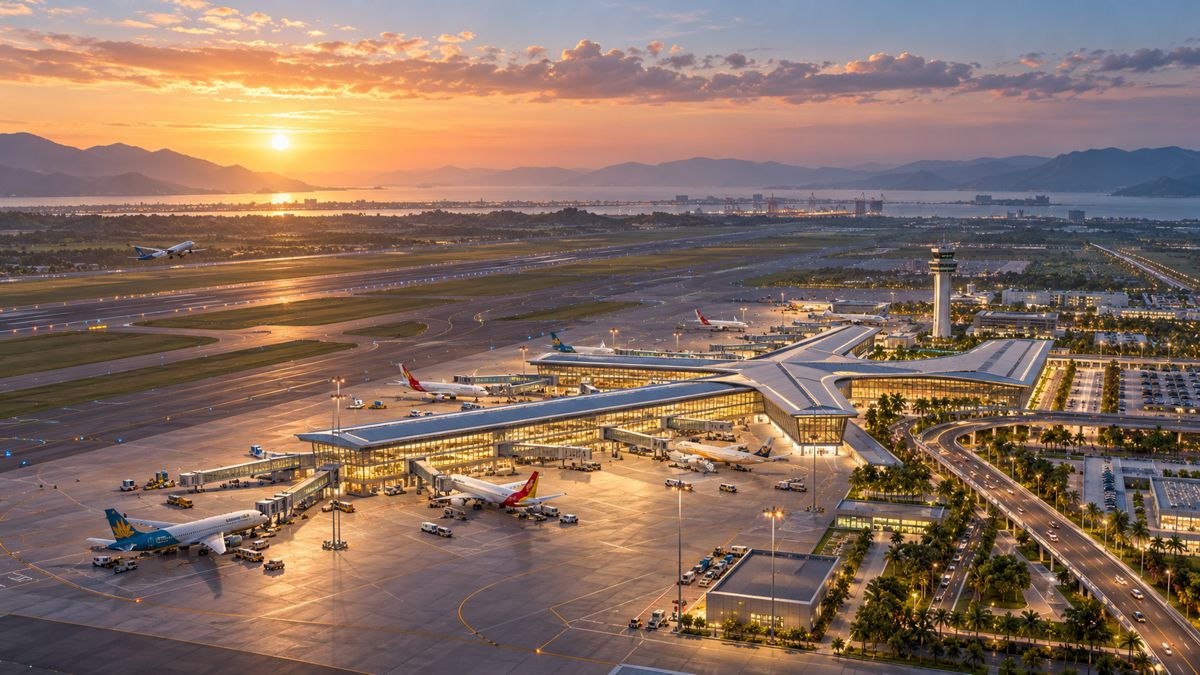
The passenger terminal concept centres on a new Terminal 2, initially designed for five million passengers annually. The proposed H-shaped layout would allow the terminal wings to be extended in stages as demand increases, ultimately providing capacity for 30 million passengers by 2050. The existing Terminal 1 would eventually be removed to provide additional apron space.
According to the September planning report published by Thời báo Tài chính, the proposed airport site covers approximately 2,097 hectares, including land allocated to civil aviation, shared military use and defence operations. Passenger facilities would be concentrated towards the northern side of the airport, while cargo handling, maintenance and repair activities would occupy areas to the south.
The civil-military designation introduces additional planning requirements, particularly where runway operations, land allocation and construction phasing must accommodate both civilian and defence activities.
Two Airports with Complementary Roles
Chu Lai’s development is closely connected to the administrative merger of Da Nang and the former Quang Nam province in July 2025. The reorganisation brought Chu Lai and Da Nang International Airport within the same municipal administration, allowing the authorities to consider their development as part of a coordinated regional aviation strategy.
Da Nang International Airport serves an established passenger market associated with tourism, business travel and the city’s wider economy. Its location within the urban area provides convenient access but also constrains the space available for major expansion.
Chu Lai offers a different development environment. Located further south, near established industrial and manufacturing areas, the airport has the potential to accommodate larger airfield facilities and dedicated logistics operations.
The Civil Aviation Authority of Vietnam examined the coordinated development of both airports in July 2025, including their future operating roles, land requirements and capacity.
The emerging approach would see Da Nang continue serving major passenger markets while Chu Lai develops additional passenger capacity and a stronger emphasis on cargo, industrial logistics and aircraft-related services. The airports would operate within the same regional economy, although their eventual commercial relationship will depend on airline networks, passenger demand and the development of freight services.
Investment is also continuing at Da Nang International Airport. In August 2026, the Ministry of Construction approved the investment policy for improvements to runway 17R/35L and associated taxiways, with an estimated cost of VND 1.696 trillion and an implementation period from 2026 to 2028.
The Civil Aviation Authority’s announcement identifies the objective as supporting Code E aircraft operations, including aircraft such as the Boeing 787 and Airbus A350.
Developing an Industrial Air Cargo Centre
The proposal to accommodate 1.5 million tonnes of cargo annually by 2050 would establish substantial freight-handling capacity at Chu Lai. The planned infrastructure includes dedicated cargo terminals, aircraft aprons and maintenance facilities, with separate access arrangements intended to support industrial operations.
The capacity target represents a revision from an earlier masterplan. In June 2026, the Vietnamese Government Portal reported that the Civil Aviation Authority was reviewing a proposal which envisaged 10 million passengers and 50,000 tonnes of cargo annually by 2030, increasing to 30 million passengers and three million tonnes of cargo by 2050.
The September proposal reduces the initial passenger capacity target to five million and the long-term cargo capacity target to 1.5 million tonnes. The revisions follow official requests for further examination of the airport’s development requirements, with particular attention to investment efficiency and avoiding unnecessary expenditure.
The cargo programme is closely associated with the Chu Lai Open Economic Zone and the manufacturing economy of central Vietnam. Industrial activity in the surrounding region provides a potential market for freight services, particularly for high-value, time-sensitive or specialised goods that benefit from air transport.
However, cargo terminal capacity and actual freight demand are different considerations. Air freight requires sufficient volumes to support scheduled or charter services, together with reliable customs clearance, warehousing, ground handling and onward distribution. Many industrial products are more economically transported by road or sea, making the composition of the region’s manufacturing output an important factor in the airport’s commercial prospects.
Chu Lai’s relationship with nearby seaports adds another dimension. The region is developing maritime infrastructure and industrial logistics facilities that could complement airport operations, particularly where manufacturers require access to different transport modes.
The airport’s freight role will therefore depend as much on the development of regional supply chains as on the physical capacity of its cargo terminals.
Road and Rail Connections
The airport’s proposed expansion would place additional demands on the transport network connecting Chu Lai with Da Nang, surrounding industrial estates and the central Vietnamese coast.
National Highway 1 and the North-South Expressway provide important road corridors through the region. Improved connections between these routes, the airport and nearby industrial areas would be necessary to accommodate additional passenger movements and freight traffic.
Da Nang has also requested consideration of longer-term rail connectivity, including potential integration with Vietnam’s proposed North-South high-speed railway and urban rail services. These connections remain planning proposals rather than confirmed construction projects, and their alignments, funding and delivery schedules would require separate decisions.
The distinction between passenger and freight access is particularly relevant to the proposed airport layout. Passenger terminals would generate concentrated movements associated with flight schedules, while cargo operations would require dependable connections for heavy goods vehicles, warehousing and industrial distribution.
Airport development on this scale also requires substantial supporting infrastructure. Airfield drainage, pavement construction, fuel systems, power distribution, water supply, telecommunications and security facilities would all need to be coordinated with the runway and terminal programme.
The planned separation of passenger facilities in the north and cargo and maintenance activities in the south would influence internal roads, service corridors and access points. Construction sequencing would also need to accommodate continued operations at the existing airport.
Financing a Long-Term Development Programme
The September masterplan places the preliminary investment requirement at VND 81.61185 trillion through 2050. Approximately VND 20.66 trillion is allocated to development up to 2030, with a further VND 60.96 trillion envisaged for the subsequent period.
The detailed estimate includes approximately VND 38.14 trillion for construction, VND 20.48 trillion for equipment, VND 5.86 trillion for project management, consultancy and other costs, and VND 17.12 trillion for contingencies.
These figures come from the detailed planning proposal and should not be confused with an approved project budget or a final PPP financing arrangement.
An earlier planning estimate reported in July 2026 placed the investment requirement at approximately VND 55.03 trillion. The September estimate is around 48% higher, although the available reporting does not establish whether the two figures cover precisely the same scope, contingencies and infrastructure assumptions. It would therefore be premature to characterise the difference as a direct cost increase.
The latest proposal envisages financing from a combination of public investment, other state resources, local government funding, private enterprises, borrowing and additional sources. The allocation of those contributions remains to be determined.
Da Nang’s request to act as the competent authority is an important part of that process. The proposal would allow the municipal government to coordinate airport investment with the surrounding economic and urban development programme, subject to approval by national authorities.
The PPP structure itself has not been finalised. Decisions will still be required on the division of responsibilities between public authorities and private investors, the treatment of existing aviation assets, operating rights and the allocation of commercial risks.
The September report in Đầu tư Chứng khoán confirms that the municipal authorities are seeking to advance the approval process and establish the arrangements needed for investment preparation.
Coordinating Airport and Regional Development
Chu Lai forms part of Vietnam’s wider programme of airport infrastructure development. The revised national airport system plan published in July 2026 envisages 36 airports by 2030, including 20 international airports, and 37 airports by 2050. The strategy also places greater emphasis on aviation logistics, aircraft maintenance and multimodal transport connections.
For central Vietnam, the Chu Lai proposal brings together several strands of infrastructure investment. The airport’s planned runways and terminals would provide aviation capacity, while the surrounding industrial areas, seaports and transport corridors would influence how that capacity is used.
The immediate challenge is to move from detailed planning to an approved and financially deliverable programme. The airport’s civil-military status, extensive land requirements and proposed PPP structure add complexity, particularly where investment responsibilities and construction phases overlap.
The Civil Aviation Authority’s earlier request to review capacity assumptions and avoid waste provides a useful context for the latest revisions. The reduction in proposed cargo capacity and the lower initial passenger target suggest a more measured approach to development, while retaining substantial room for long-term expansion.
Da Nang’s request for investment authority is therefore an early step in a programme extending across several decades. The airport’s eventual scale will depend on the commercial demand that emerges, the investment arrangements approved by government and the ability of the surrounding transport network to support its growth.
Key Industry Questions
- What is the proposed investment in Chu Lai Airport? The September 2026 planning proposal estimates investment at VND 81.61 trillion through 2050. The figure is preliminary and has not been established as an approved construction budget.
- What passenger capacity is planned? The latest proposal provides for five million passengers annually by 2030, rising to 30 million by 2050.
- How many runways would Chu Lai have? The September configuration proposes a new 4,000-metre runway by 2030 and a further 3,800-metre runway by 2050. The existing 3,050-metre runway would eventually be converted into a parallel taxiway.
- What aircraft could use the expanded airport? Chu Lai is planned as an ICAO Code 4F civil-military airport, with infrastructure intended to accommodate large wide-body aircraft, including Code F types.
- How much cargo capacity is proposed? The September masterplan envisages facilities capable of handling up to 1.5 million tonnes annually by 2050. This represents design capacity rather than a confirmed forecast of freight throughput.
- Who would develop and operate Chu Lai Airport? Da Nang is seeking designation as the competent authority for implementing the development through a PPP. The final investment and operating arrangements remain subject to approval.
- How will the airport connect with the regional transport network? Existing road corridors include National Highway 1 and the North-South Expressway. Additional road improvements and potential high-speed and urban rail connections are being considered as part of longer-term regional planning.
- Has construction been approved? The latest development programme remains within the planning and investment preparation process. The proposed infrastructure, financing arrangements and delivery schedule require further approvals.
Strategic Takeaways
- Industrial demand will influence the airport’s commercial development. Cargo facilities need to be supported by manufacturers, logistics operators and reliable freight volumes.
- The latest planning revisions reduce some capacity assumptions. Passenger and cargo targets have been adjusted as authorities review investment requirements and development efficiency.
- The PPP structure remains unresolved. Decisions on public and private investment responsibilities will determine how the programme advances.
- Regional transport connections are part of the development challenge. Road access and potential rail integration will need to be coordinated with airport construction.
- Civil-military operations add planning complexity. Land allocation, runway use and construction phasing must accommodate both aviation functions.