Zimbabwe Links Gold Mining Reform to Finance and Cleaner Technology
Zimbabwe has presented a new roadmap for bringing artisanal and small-scale gold miners into the formal economy, proposing changes to mining legislation, financial access and processing technology as the country seeks to reduce mercury pollution and improve operating conditions.
The guide was formally launched at the planetGOLD Zimbabwe Annual Stakeholders Conference, held in Harare on 28–29 October 2026. Its recommendations address a longstanding weakness in Zimbabwe’s mining framework: smaller operators contribute substantially to national gold production but frequently lack the legal recognition, finance and technical resources needed to operate within the regulated sector.
The problem has already reached Parliament. In October 2025, Zimbabwe’s Parliamentary Legal Committee issued an adverse report on the Mines and Minerals Bill, identifying the failure to recognise artisanal miners as potentially discriminatory under the Constitution. The committee’s findings have added another dimension to a reform debate that extends well beyond the administration of mining licences.
Briefing
- Zimbabwe formally launched its artisanal gold mining reform guide during the 28–29 October 2026 planetGOLD stakeholders conference.
- The programme aims to support approximately 7,500 miners across 11 districts.
- Planned interventions target the prevention of 4.85 tonnes of mercury emissions during and following the project lifecycle.
- Proposed reforms include distinct legal recognition for artisanal miners, improved financing and access to mercury-free processing technologies.
- The wider programme has a reported value of US$23.8 million, including a US$5 million Global Environment Facility grant and co-financing.
Bringing Artisanal Mining into the Legal Framework
The publication, A Guide to Reforming Formalization of the Artisanal and Small-Scale Gold Mining Sector in Zimbabwe, was introduced at the conference by planetGOLD Zimbabwe Project Manager Nyaradzo Mutonhori, who argued that regulatory reform must reflect the circumstances under which smaller mining operations function.
“We cannot continue to talk about formalization as if it is simply a matter of miners acquiring licenses and registration for their operations. Formalization must be about creating a system in which artisanal and small-scale gold miners have both an incentive and a practical ability to operate legally, responsibly, and productively,” she said.
The distinction between artisanal and small-scale mining is central to the proposals. Although the terms are frequently used together, they can describe substantially different operations, ranging from individuals using basic hand tools to established businesses operating mechanised extraction and processing equipment.
Zimbabwe’s proposed Mines and Minerals Bill [H.B. 1, 2025] recognises small-scale mining but has been criticised for failing to provide sufficiently for artisanal operators. In its adverse report of 1 October 2025, the Parliamentary Legal Committee argued that the Bill’s definition of small-scale mining was not broad enough to include artisanal miners and that their exclusion raised concerns under Section 56 of the Constitution, which addresses discrimination.
The committee also identified constitutional concerns elsewhere in the proposed legislation. Its objections placed the recognition of artisanal miners within a wider debate about mineral rights, administrative powers and access to the mining economy.
The planetGOLD reform guide recommends establishing a distinct legal category for artisanal mining, supported by proportionate licensing requirements and transitional arrangements. These would allow operators to enter the formal system while working towards environmental, technical and safety standards appropriate to their activities.
Developed through consultations with miners, government institutions, Parliament and civil society, the publication is intended to inform Zimbabwe’s ongoing legislative reforms. Its recommendations were publicly outlined in August 2026 before the formal conference launch in October.
Finance and Equipment Remain Major Barriers
Legal recognition would address only part of the problem. Many smaller mining operations have limited access to capital, reliable geological information, appropriate machinery and established gold markets, making investment in more productive or environmentally responsible methods difficult.
A miner who cannot demonstrate secure operating rights or predictable access to a recognised gold market may struggle to justify a substantial equipment purchase. Commercial lenders face similar difficulties where an operation lacks formal records, reliable production data or legally recognised mineral rights.
The guide therefore links formalisation with financial inclusion, proposing credit arrangements, guarantee mechanisms and financial products suited to artisanal mining. Improved geological information and technical training are also recommended to help operators manage production and investment decisions.
Access to processing infrastructure presents a further challenge. Individual miners may be unable to finance crushers, concentration equipment or complete recovery plants, even where better technology could improve productivity and reduce environmental harm. Shared processing facilities, cooperative ownership arrangements or commercial processing services could offer alternative routes to mechanisation, provided operating costs and gold recovery rates remain competitive.
The suitability of these arrangements depends on local production volumes, ore characteristics and the availability of technical support. Equipment that performs well under controlled conditions may be difficult to maintain or operate economically where power supplies, spare parts and skilled technicians are limited.
For mining equipment manufacturers and processing specialists, the development of a more formal operating environment could eventually support demand for appropriately scaled machinery, training and maintenance services. That opportunity will depend on whether miners can obtain the finance and regulatory certainty needed to invest.
Reducing Mercury Use in Gold Processing
Environmental management is another major element of the programme, particularly the use of mercury in recovering gold from mined material.
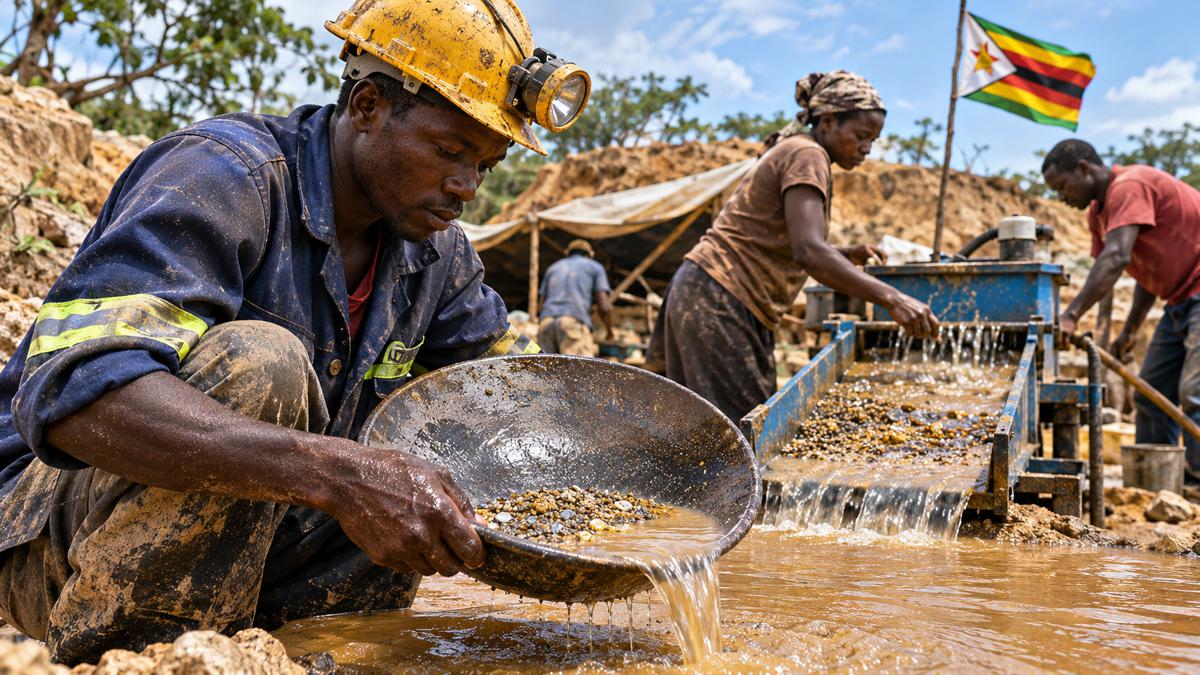
Mercury amalgamation remains common in artisanal mining because it provides a relatively accessible method of collecting gold using simple equipment. However, the practice exposes miners and surrounding communities to serious health risks, especially when mercury-containing amalgam is heated and toxic vapour is released.
According to the planetGOLD Zimbabwe country assessment, approximately 96% of artisanal gold mine sites use mercury, with annual releases from the sector estimated at more than 24 tonnes. Contamination can extend beyond processing areas through atmospheric emissions and pollution of soil and water.
The Zimbabwe programme aims to prevent 4.85 tonnes of mercury emissions during and following its lifecycle through technical assistance, improved processing methods and the adoption of mercury-free recovery technologies. Its wider environmental objectives also include improved management of approximately 76,000 hectares of land.
These measures support Zimbabwe’s commitments under the Minamata Convention on Mercury, an international agreement addressing mercury pollution and its consequences for human health and the environment.
Replacing mercury is not simply a question of substituting one machine for another. Recovery performance depends on mineralogy, particle size, ore preparation and the characteristics of the gold being processed. Gravity concentration and other mercury-free recovery methods can offer alternatives, although their effectiveness varies between deposits and processing arrangements.
The project is working to identify suitable technologies for different ore types. Reporting ahead of the October conference indicated that laboratory testing of ore samples was being used to inform equipment selection for potential demonstration sites, alongside plans for technical training in processing, environmental management and occupational safety.
Shared facilities could become particularly useful where individual operators lack the capital or technical skills to install and maintain more sophisticated recovery systems. Their commercial viability would depend on transparent processing charges, reliable operations and competitive recovery rates.
A Five-Part Reform Programme
The guide sets out five interconnected areas intended to make legal participation more accessible while strengthening oversight of mining activities.
The first concerns data-driven legal reform, including differentiated licensing and recognition of artisanal mining as a distinct activity. Capacity building follows, covering geological knowledge, mining skills, technical training and environmental management.
Financial inclusion forms the third component, with proposed credit and guarantee arrangements designed to improve access to equipment and safer processing methods. The fourth addresses formal gold markets, traceability and coordination between regulatory institutions.
The final component concerns monitoring and enforcement. Rather than relying exclusively on penalties, the guide recommends proportionate compliance measures supported by education, technical assistance and progressive improvements in operating standards.
These measures would require coordination between mining regulators, financial institutions, equipment providers and gold purchasers. Licensing arrangements must be practical enough to encourage participation, while the financial and technical support available to miners must allow them to meet the resulting obligations.
Gold Markets and Regulatory Coordination
The reform proposals also intersect with Zimbabwe’s established gold purchasing and refining arrangements.
Fidelity Gold Refinery occupies a central position in the formal gold supply chain, but access to recognised purchasing channels depends on more than the existence of an official buyer. Pricing, payment arrangements, transport distances and the administrative requirements imposed on miners can all influence whether formal sales are commercially attractive.
Improved traceability may create opportunities for responsibly produced gold, particularly among buyers seeking stronger evidence of legal origin and environmental management. However, systems developed for larger mining businesses may impose costs or administrative requirements that smaller operators struggle to meet.
Zimbabwe’s artisanal and small-scale mining sector has accounted for more than 60% of official gold deliveries in recent years, according to planetGOLD, while an estimated 500,000 people participate directly and indirectly in related activities. More than 300,000 are estimated to work directly in artisanal and small-scale gold mining.
Its economic importance gives the proposed reforms considerable reach. Changes to licensing, gold marketing and technical support could affect mining communities, mineral-processing businesses, equipment suppliers and the wider domestic supply chain.
The guide’s emphasis on coordination reflects the number of institutions involved. Mining authorities oversee mineral rights and operations, environmental agencies enforce pollution controls, financial organisations provide capital, and gold buyers determine how production enters the formal market. Requirements that are individually reasonable can become difficult for smaller miners to satisfy when they are administered independently.
International Support for Mining Reform
The planetGOLD Zimbabwe programme is supported by the Global Environment Facility, implemented through the United Nations Environment Programme and executed by IMPACT in partnership with Zimbabwean institutions.
According to the UNEP project record, the initiative runs from October 2024 to October 2029. Its financing package comprises a US$5 million Global Environment Facility grant and approximately US$18.8 million in co-financing, giving a total reported value of US$23.8 million.
The programme combines regulatory development with financial inclusion, technical assistance, responsible gold supply chains and environmental improvements. It is intended to reach approximately 7,500 direct beneficiaries across 11 districts in Zimbabwe’s eight mining provinces.
The targets provide a basis for measuring progress, although reductions in mercury emissions and improvements in formal participation will depend on sustained adoption of new practices rather than the initial distribution of equipment or completion of training programmes.
Translating Reform into Mining Operations
Implementing the guide will require arrangements that work across a highly varied mining sector. Some artisanal miners operate independently using basic equipment, while others work in established groups or alongside mechanised mining and processing businesses. Production volumes, operating conditions and financial resources differ considerably.
A workable regulatory framework would need to accommodate those differences without weakening responsibilities for worker safety, environmental protection and mineral ownership. Equally, miners must have access to the technical and commercial services required to comply with the rules.
The legal recognition of artisanal miners is therefore closely connected to the availability of finance, machinery, processing infrastructure and formal gold markets. Progress in one area will be constrained if the others remain inaccessible.
Zimbabwe’s artisanal gold miners already make a substantial contribution to national production. The new guide sets out how that activity could be brought more effectively within the legal and commercial framework, with the practical test coming at individual mining sites where the costs and benefits of formal participation will ultimately be determined.
Key Industry Questions
- What is artisanal and small-scale gold mining? Artisanal and small-scale gold mining, commonly abbreviated to ASGM, covers mining activities conducted by individuals, groups and smaller businesses using varying levels of mechanisation, capital and technical equipment.
- Why is Zimbabwe reforming its artisanal gold mining sector? The reforms aim to address barriers to legal participation, improve access to finance and recognised gold markets, strengthen safety and environmental management, and reduce mercury use in gold processing.
- How many miners could benefit from the planetGOLD Zimbabwe programme? The programme targets approximately 7,500 direct beneficiaries across 11 districts. Zimbabwe’s wider artisanal and small-scale gold mining workforce is estimated to exceed 300,000 people.
- What changes are proposed to Zimbabwe’s mining laws? The guide recommends clearer legal recognition of artisanal miners, differentiated licensing arrangements, transitional safeguards and compliance requirements suited to different operating scales. These remain proposals rather than enacted provisions.
- Why is mercury used in artisanal gold mining? Mercury combines with gold to form an amalgam, allowing recovery using relatively simple equipment. Its toxicity, particularly when mercury vapour is released during heating, creates serious health and environmental risks.
- What alternatives to mercury are available? Options include gravity separation, improved ore concentration and other mercury-free processing methods. Their suitability depends on ore characteristics, recovery performance, available infrastructure and operating costs.
- How could formalisation improve access to mining equipment? Recognised operating rights, improved financial records and access to regulated markets can strengthen the basis for commercial lending. Dedicated equipment finance and suitable credit products could help smaller operators overcome capital constraints.
- Who is financing planetGOLD Zimbabwe? The Global Environment Facility provides a US$5 million grant, with approximately US$18.8 million in reported co-financing. The initiative is implemented through UNEP and IMPACT alongside Zimbabwean partners.
Strategic Takeaways
- Legal recognition must reflect operational scale. Artisanal miners need licensing and compliance arrangements appropriate to their equipment, financial resources and production methods.
- Equipment investment depends on regulatory certainty. Recognised mineral rights and access to established gold markets can improve the commercial viability of financing machinery and processing facilities.
- Mercury reduction requires viable processing alternatives. Technology deployment must be supported by training, affordable operating arrangements and acceptable gold recovery performance.
- Gold marketing influences formal participation. Accessible purchasing channels, competitive terms and proportionate traceability requirements can strengthen incentives to operate legally.
- Implementation depends on institutional coordination. Mining regulators, financial institutions, environmental authorities and gold buyers will need to align their requirements and support mechanisms.