Geo Week 2027 to Explore the Digital Preservation of Fallingwater
Nearly 90 years after its construction, Frank Lloyd Wright’s Fallingwater remains an unusually demanding building to preserve. Its cantilevered concrete terraces have required major structural reinforcement, while persistent moisture and seasonal temperature changes continue to test the materials from which it was built. Now, a digital preservation initiative is applying modern geospatial technology to a building with an exceptionally complex engineering history.
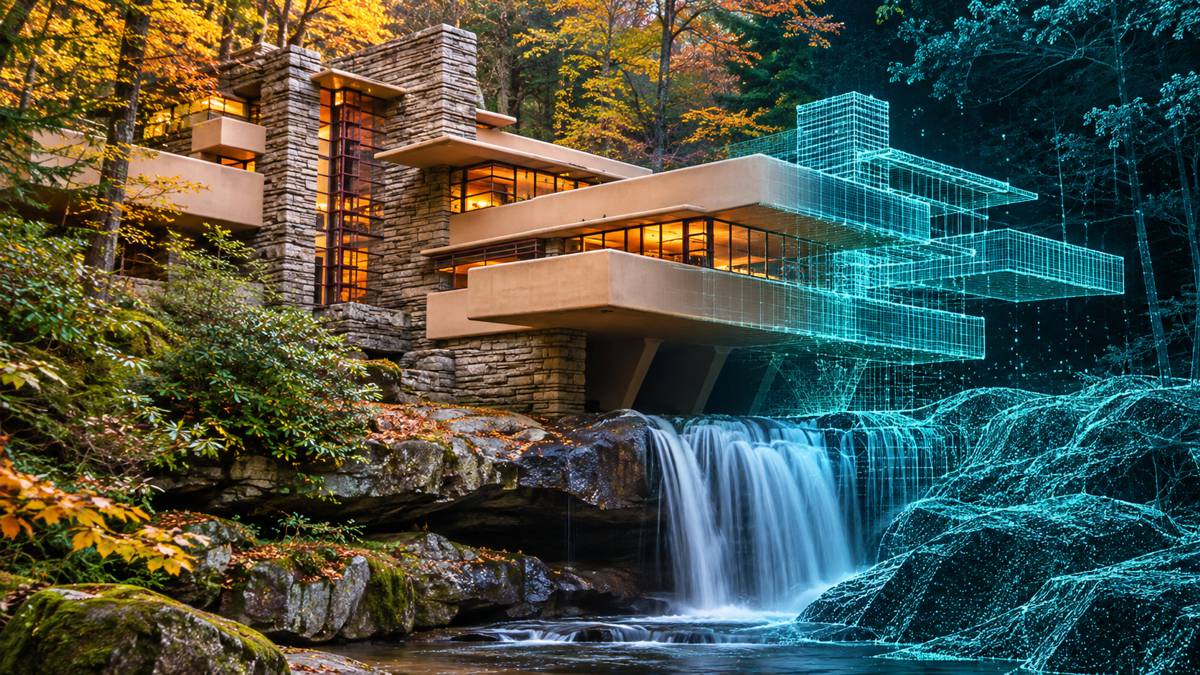
The project will provide the opening keynote at Geo Week 2027, taking place from 23 to 25 February at the Salt Palace Convention Center in Salt Lake City, Utah. Entitled From Legacy to Longevity: Digitally Preserving 90 Years of Fallingwater, the presentation will explore how 3D scanning, Building Information Modelling (BIM), Geographic Information Systems (GIS) and digital twin technologies are being combined to document the landmark and support its long-term conservation.
Constructed during the 1930s above a waterfall in southwestern Pennsylvania, Fallingwater combines reinforced concrete cantilevers, locally quarried sandstone, steel, glass and timber in a design that deliberately blurs the boundary between architecture and landscape. Preserving it requires an understanding of the building’s geometry, materials, structural behaviour and relationship with the surrounding environment.
Briefing
- Geo Week 2027 opens on 23 February with a keynote examining Fallingwater’s digital preservation.
- The initiative combines 3D scanning, BIM, GIS and digital twin technologies.
- Fallingwater’s reinforced concrete cantilevers have required extensive structural investigation and strengthening.
- The digital model is intended to support documentation, interpretation and long-term conservation.
- Representatives from the Western Pennsylvania Conservancy and Case Technologies will present the project.
Preserving a Building Designed Around Its Environment
Designed by Wright in 1935 for the Kaufmann family of Pittsburgh, Fallingwater’s main house was constructed between 1936 and 1938, with the guest house completed in 1939. Its terraces extend over Bear Run, creating the impression that the structure emerges naturally from the surrounding sandstone formations.
The building became the responsibility of the Western Pennsylvania Conservancy in 1963 and was included in the UNESCO World Heritage List in 2019 as one of eight properties forming The 20th-Century Architecture of Frank Lloyd Wright.
Wright’s architectural approach created considerable engineering challenges. The reinforced concrete terraces project beyond their principal supports, while the building’s close relationship with the waterfall exposes its materials to persistent moisture, seasonal temperature changes and the effects of freezing and thawing.
According to Fallingwater’s preservation history, deterioration of the reinforced concrete was apparent by the 1950s, and sections of the original material required reconstruction. Water infiltration, cracking and corrosion-related deterioration have remained recurring conservation concerns.
The most substantial structural intervention took place in 2001 and 2002, following investigations into the progressive deflection of the cantilevered terraces.
Historical records showed that the terraces had already moved downwards by approximately four inches during the Kaufmann family’s occupation. Research undertaken in 1994 subsequently established that movement had continued, with one terrace having deflected by almost seven inches from its original position.
Engineers from Robert A. Silman Associates investigated the structural behaviour and identified problems associated with the original reinforcement design. The concrete and steel were overstressed, leaving the cantilevers unable to perform as intended.
Temporary supports were installed beneath the living room terraces before a permanent strengthening programme introduced high-strength steel post-tensioning cables anchored into the building’s concrete piers. The cables were connected to three of the four principal reinforced concrete beams beneath the living room, providing additional support while remaining largely concealed within the historic structure.
The work also required the removal of 557 individually numbered flagstones from the living room floor. Each was carefully stored before being returned to its original position, allowing the structural intervention to proceed without permanently altering one of the building’s most recognisable interior features.
The project remains a useful example of the demands placed on conservation engineers, who must accommodate existing materials, historic construction methods and strict architectural requirements while addressing structural deficiencies.
From Reality Capture to a Digital Twin
The new digital preservation initiative approaches Fallingwater through a coordinated digital representation of the building and its surroundings.
The workflow described by Geo Week begins with 3D scanning, progresses through BIM and incorporates GIS within a digital twin environment. Together, these technologies provide a means of recording complex geometry, organising information about individual building elements and relating the structure to its wider landscape.
For Fallingwater, accurate spatial documentation is especially valuable. Irregular stonework, projecting terraces, curved concrete elements and complicated interior spaces make conventional surveying and documentation difficult. Three-dimensional scanning can record accessible surfaces and features in considerable detail, providing a reference against which later surveys and conservation work can be compared.
BIM offers a structure for organising that geometry alongside information about the building. Where suitable records are available, individual elements can be associated with material specifications, repair histories, inspection findings and other documentation accumulated during previous conservation campaigns.
GIS adds a further dimension by connecting the building to its surroundings. Fallingwater’s position within a wooded valley, immediately above a watercourse, means that topography, drainage and environmental exposure are integral to understanding the site.
A digital twin can extend this information framework by incorporating updated measurements and records as the physical asset changes. However, the distinction between a detailed three-dimensional model and a continuously maintained digital twin depends on the information being connected to it and how that information is used.
The extent to which Fallingwater’s new model incorporates historical monitoring data, live instrumentation or automated analytical functions has not yet been disclosed. The Geo Week keynote is expected to provide a closer examination of the methodology and the technical capabilities being developed.
Building on Decades of Structural Monitoring
Fallingwater already has an extensive history of engineering investigation, providing a substantial body of information that could complement its digital documentation.
Following the strengthening of the main cantilevers, the preservation team continued monitoring movement within the structure. Cracks identified in the reinforced concrete piers in 2011 led to further instrumentation in 2013, including twelve crack meters monitoring the master bedroom terrace and supporting piers, together with four tilt meters installed around the terraces.
The Western Pennsylvania Conservancy’s published records indicate that movement remained limited following the post-tensioning intervention, with approximately one-hundredth of an inch recorded during the subsequent monitoring period.
For conservation specialists, the ability to relate such measurements to accurately surveyed structural elements could make decades of engineering information easier to interpret. Original drawings, photographs, inspection reports and records of previous interventions can potentially be organised around a common spatial reference, rather than remaining scattered across separate archives and technical documents.
There are limitations to what digital modelling can establish. Laser scanning records visible geometry but does not reveal every concealed structural condition. Embedded reinforcement, internal deterioration and hidden defects may still require specialist investigations, material testing or other diagnostic techniques.
Likewise, a digital model cannot compensate for incomplete historical records or unreliable survey information. Its long-term usefulness depends on the quality of the underlying data and the arrangements made for keeping it current.
These are familiar problems in infrastructure asset management, where structures remain in service for many decades while engineering teams, contractors and information systems change. Fallingwater presents many of the same challenges, although its architectural significance places additional restrictions on how the physical building can be investigated and repaired.
Preserving More Than the Structure
The Fallingwater project also addresses an aspect of architectural preservation that extends beyond engineering measurements.
Wright designed the house around the relationship between its occupants and the surrounding landscape. The sound of moving water, the positioning of terraces, the arrangement of interior spaces and the use of natural materials all contribute to the building’s character.
Geo Week’s keynote will examine how the preservation team has approached these qualities alongside the physical documentation of the structure.
Touf Hassoun, President and CEO of Case Technologies, described the personal significance of the assignment: “Throughout our years of work on historic preservation projects, Fallingwater has held a particularly special place in our hearts. Our involvement in its preservation has been a deeply meaningful experience.”
He added: “Preserving Fallingwater was never just about capturing the building. It was about capturing what makes it extraordinary.”
The project therefore encompasses both technical conservation and the interpretation of cultural heritage. Detailed digital documentation can support education, remote exploration and future research, particularly for buildings where public access or physical intervention must be carefully controlled.
The scope of any public-facing resources being developed as part of Fallingwater’s digital preservation initiative has not yet been specified, although the combination of spatial information and interpretative material offers possibilities beyond conventional drawings and photographic records.
Fallingwater at Geo Week 2027
The opening keynote will bring together three people directly involved in the preservation and digital documentation initiative.
Justin Gunther, Vice President of the Western Pennsylvania Conservancy and Director of Fallingwater, will represent the organisation responsible for the building’s stewardship. He will be joined by Mark Dietrick, Director of Services at Case Technologies, and Touf Hassoun, the company’s President and CEO.
Their presentation will trace the process from initial scanning through BIM development to the creation of the digital twin, examining the challenges encountered and the methods used to document the building’s architectural character.
Carla Lauter, Senior Content Manager at Geo Week, said: “Fallingwater is one of architecture’s most iconic landmarks, and we’re excited to open Geo Week 2027 with the incredible story of how it’s being preserved for generations to come.”
The wider Geo Week conference programme covers geospatial applications across construction, infrastructure, surveying and asset management, with sessions exploring reality capture, mapping, digital workflows and the integration of spatial information into engineering operations.
The Fallingwater presentation is scheduled for 23 February 2027, from 12:00 to 13:00 Mountain Time, at the Salt Palace Convention Center in Salt Lake City. Further details are available through the official keynote session page.
Long-Term Value of Digital Preservation
Fallingwater presents an unusually demanding environment for digital preservation. Its complicated geometry, structural history and exposure to environmental conditions require continuing attention from specialists working across architecture, engineering and conservation.
The building has already passed through several generations of investigation and repair, leaving a substantial collection of technical knowledge that future conservators will need to understand. A coordinated digital record offers a way of maintaining that information alongside the physical structure it describes.
Similar considerations apply to historic bridges, railway stations, industrial facilities and other infrastructure assets where original construction records must be reconciled with decades of maintenance, modification and structural monitoring.
The challenge will be ensuring that these digital records remain accessible, accurate and useful long after the technologies used to create them have changed.
For Fallingwater, the immediate task is more specific. The house has survived almost 90 years through a combination of engineering intervention and careful conservation. Its new digital representation is intended to help those responsible for its next century understand both the building Wright designed and the work undertaken to keep it standing.
Key Industry Questions
- What technologies are being used to document Fallingwater? The initiative combines 3D scanning, Building Information Modelling, GIS and digital twin technologies to create an integrated record of the building and its surroundings.
- How can a digital twin support historic building conservation? It can bring together spatial information, inspection records, structural measurements and maintenance documentation to support conservation planning and long-term asset management.
- What makes Fallingwater difficult to preserve? Its exposed reinforced concrete cantilevers, irregular stone masonry, complex geometry and proximity to a waterfall create demanding structural and environmental conditions.
- Has Fallingwater previously required major structural repairs? Yes. Its main cantilevers underwent substantial strengthening in 2001 and 2002 using a post-tensioning cable system installed to address progressive deflection.
- Can 3D scanning identify deterioration inside concrete? Conventional surface laser scanning cannot directly reveal concealed reinforcement or internal defects. Specialist inspection and testing methods may be required to investigate hidden structural conditions.
- What is the difference between BIM and a digital twin? BIM provides a structured digital representation of an asset and associated information. A digital twin extends this approach by connecting the representation to information about the asset’s condition, operation or changes over time.
- Who is responsible for preserving Fallingwater? The Western Pennsylvania Conservancy has owned and maintained the property since 1963.
- Can digital preservation methods be applied to infrastructure? Yes. Similar approaches can document bridges, tunnels, railway assets and other structures requiring accurate spatial records and coordinated maintenance information.
- Does Fallingwater’s digital twin include live structural monitoring? The publicly available project announcement has not confirmed whether live monitoring or historical instrumentation data is integrated into the model.
- When and where will the Fallingwater keynote take place? The presentation is scheduled for 23 February 2027 at the Salt Palace Convention Center in Salt Lake City, Utah, during Geo Week 2027.
Strategic Takeaways
- Heritage structures can benefit from coordinated digital information management approaches already used in modern infrastructure.
- Historical structural measurements become more accessible when linked to accurate spatial documentation.
- Surface scanning must be complemented by appropriate engineering investigations where concealed structural conditions are involved.
- The long-term value of a digital twin depends on data quality, regular updates and continuity of access.
- Fallingwater demonstrates how conservation engineering and digital documentation can work together without compromising the character of a historic structure