






Did Curiosity Invent Engineering?
Long before engineering qualifications, technical standards or professional institutions, people were experimenting with the world around them. The instinct to ask why something works, and whether it could work differently, may be the oldest engineering skill of all.
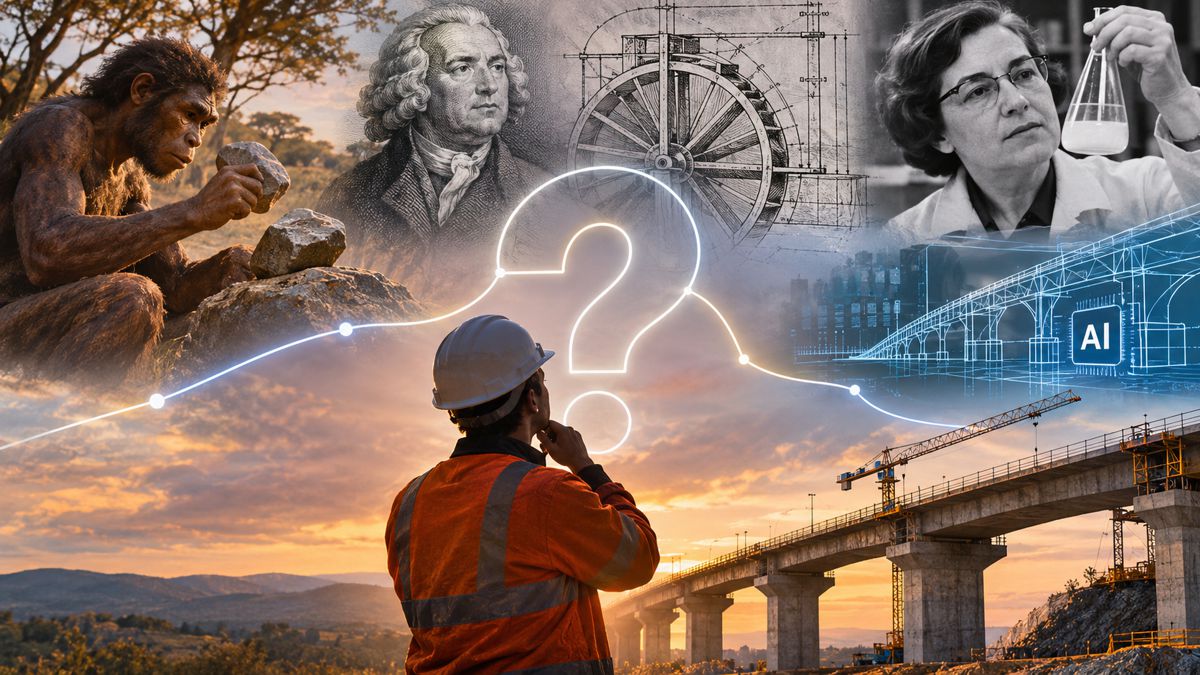
Some 3.3 million years ago, long before modern humans appeared, early toolmakers in what is now Kenya were striking stones to produce cutting edges and other useful implements. The surviving artefacts suggest deliberate manipulation of materials, exploiting the way stone fractures under impact.
The discovery of these artefacts at Lomekwi 3, near Lake Turkana, pushed the reported history of stone toolmaking back by approximately 700,000 years. Published in Nature in 2015, the finds suggested that tool production had begun well before the emergence of the genus Homo. The dating and archaeological context have subsequently attracted debate, including questions about the association between the artefacts and the deposits in which they were found.
Nobody can establish what motivated those early toolmakers. Practical necessity, observation, imitation and experimentation may all have played a part. The evidence nevertheless suggests that early hominins were finding ways to manipulate the physical world to produce useful results, long before scientific theories or formal engineering methods existed.
Those activities would eventually develop into metallurgy, construction, mechanical engineering and the extraordinary range of technologies supporting modern civilisation. Formal engineering disciplines arrived much later, bringing mathematics, scientific understanding, professional standards and systematic methods of testing.
Yet the underlying behaviour remains familiar. Someone notices a problem, questions an established arrangement or wonders whether a different approach might work. Across construction sites, quarries, workshops and research laboratories, that instinct continues to generate new ideas. Perhaps curiosity did not emerge from engineering. Perhaps curiosity was one of the forces that created it.
Briefing
- Archaeological evidence from Kenya suggests stone toolmaking may date back approximately 3.3 million years, although aspects of the site’s interpretation have been disputed.
- One influential psychological theory explains curiosity through the desire to close gaps between existing knowledge and desired understanding.
- John Smeaton’s experiments overturned assumptions about waterwheel performance, demonstrating that overshot wheels could produce roughly twice the useful effect of undershot designs.
- Stephanie Kwolek’s discovery of Kevlar illustrates the value of investigating unexpected experimental results rather than dismissing them.
- Engineering education and practical construction experience both contribute to problem-finding, experimentation and the development of new ideas.
Before There Were Engineers
The history of engineering is usually told through its achievements. Ancient irrigation systems, Roman roads, medieval cathedrals, steam engines, railways and modern skyscrapers demonstrate humanity’s growing ability to manipulate materials and physical forces. Behind those achievements lies a long process of observation, practical experimentation and accumulated knowledge.
Early toolmakers had no access to material science, technical drawings or calculations. Their capabilities developed through interaction with the physical world, with useful techniques preserved, copied and refined across generations.
The Lomekwi discoveries predate the oldest widely accepted fossils of the genus Homo, potentially extending deliberate tool production into a period previously considered beyond the established history of stone technology. However, the archaeological evidence cannot establish whether a particular implement resulted from curiosity, immediate need or accidental discovery.
Those motivations are difficult to separate even in contemporary engineering, where practical problems frequently encourage further investigation. A problem provides a reason to act, experimentation establishes whether an alternative works, and experience allows useful techniques to be reproduced and improved.
Ancient builders developed ways of distributing structural loads, managing water and moving heavy materials. Metalworkers learned to alter material properties through heating, cooling and alloying, while millwrights experimented with mechanical arrangements to convert water and wind into useful power.
Much of this knowledge emerged from craftspeople whose expertise developed through observation, apprenticeship and repeated experimentation rather than formal academic study. Engineering existed as an activity long before engineers became a recognised profession, with knowledge accumulated through practical experience eventually providing a foundation for scientific and technical disciplines.
Curiosity and the Information Gap
A machine operator notices an unfamiliar vibration. A site engineer discovers cracking where none was expected. A maintenance technician investigates a component that repeatedly fails despite apparently operating within its specified limits.
The immediate responsibility may be to make the equipment safe or correct the defect, although understanding the cause requires more than following an established procedure. An unexpected result creates a gap between what someone expects and what actually happens, and that gap can become a powerful motivation to investigate.
Psychologist George Loewenstein examined this behaviour in his influential 1994 paper, The Psychology of Curiosity: A Review and Reinterpretation. His information-gap theory proposes that curiosity arises when people recognise a difference between what they know and what they want to understand. Awareness of missing information can motivate an effort to resolve the uncertainty.
The same process is familiar in engineering. A designer may investigate why a structure behaves differently from a simulation, while a quarry operator might question why one material fractures more readily than another. A construction worker may wonder why an installation process requires several separate operations when a simpler method appears possible.
Sometimes the investigation reveals a constraint that was not initially apparent. On other occasions, it exposes an opportunity to improve performance, simplify a process or develop something entirely new.
Curiosity is not unique to engineers. Scientists, artists, inventors and philosophers share the desire to explore unfamiliar possibilities, although the outcomes they seek may differ considerably.
Engineering adds the requirement that an idea must eventually function within the physical world. Materials must withstand real loads, machines must operate reliably, and structures must remain safe under conditions that cannot be negotiated away. A question may begin with curiosity, but the answer must survive examination, calculation and testing.
John Smeaton and the Value of Experiment
Waterwheels had been used for centuries before John Smeaton began investigating their performance in the eighteenth century. Their designs reflected generations of practical experience, but the relationship between water flow, wheel configuration and useful mechanical output was not always well understood.
According to the Institution of Civil Engineers, Smeaton began investigating model waterwheels and windmills in 1752, conducting experiments under different operating conditions rather than relying exclusively on established practice.
Overshot wheels use water delivered near the top of the wheel, exploiting its gravitational potential as it descends. Undershot wheels are driven primarily by the force of flowing water striking blades near the bottom.
Smeaton’s experiments demonstrated that overshot wheels could produce roughly twice the useful effect of undershot wheels under comparable conditions of water quantity and fall, contrary to prevailing expectations about their relative performance.
He presented his findings in An Experimental Enquiry Concerning the Natural Powers of Water and Wind to Turn Mills, published in Philosophical Transactions in 1759.
The experiments provided quantitative evidence that influenced waterwheel design and contributed to the adoption of more efficient arrangements where local conditions permitted. Machinery already familiar to generations of millwrights could deliver more useful work through a better understanding of its operating principles.
Smeaton’s research earned him the Royal Society’s Copley Medal in 1759. His work also contributed to scientific debate about mechanical power and the relationship between force, motion and useful output.
The same methodical approach was apparent in his civil engineering projects, including the reconstruction of the Eddystone Lighthouse. Completed in 1759, the lighthouse employed carefully designed interlocking masonry intended to withstand severe marine conditions.
In 1771, Smeaton helped establish the Society of Civil Engineers, providing an early professional forum for engineers working outside the military tradition. His experiments and practical projects contributed to the emergence of civil engineering as a distinct profession grounded in scientific investigation and practical experience.
The waterwheel was not a new invention, but its performance could still be understood and improved through controlled experimentation. Better understanding influenced how machinery was designed and built, allowing an established technology to deliver more useful work.
Stephanie Kwolek and Kevlar
Not every important innovation begins with a clearly defined problem and a predetermined objective. Sometimes the most valuable discovery occurs when an experiment produces an unexpected result.
In 1965, DuPont chemist Stephanie Kwolek was investigating synthetic polymers capable of producing lightweight, high-strength fibres. During her research, she encountered an unusual polymer solution that behaved differently from the materials normally processed into fibres.
Instead of the expected thick, relatively transparent liquid, the solution was thin and cloudy. Its appearance raised concerns because suspended particles could obstruct the tiny openings in equipment used to spin synthetic fibres.
Charles Smullen, the technician responsible for the spinning equipment, was initially reluctant to process the material. Kwolek continued investigating the solution, including filtering it, and eventually persuaded him to attempt the spinning operation.
The resulting fibres exhibited exceptional strength and stiffness at low weight. Further research and development led to Kevlar, which entered commercial production in 1971.
The Smithsonian’s Lemelson Center for the Study of Invention and Innovation documents Kwolek’s determination to investigate the unusual material despite its appearance. Her own recollections, preserved by the Science History Institute, provide further detail about the difficulties involved.
Kevlar subsequently found applications in protective equipment, industrial reinforcement, cables, tyres and numerous specialist engineering products. Its commercial development required further research, repeated testing and production engineering, building on Kwolek’s scientific expertise and willingness to investigate an observation that appeared inconsistent with expectations.
The discovery was neither a simple accident nor the achievement of curiosity alone. Smeaton had questioned the performance of an established technology, while Kwolek pursued an unexpected result from experimental research. Both demonstrated the value of examining something that others might have accepted as normal or unsuitable.
Engineering Habits of Mind
The relationship between curiosity and engineering raises an educational question. Are people attracted to engineering because they already enjoy investigating how things work, or does engineering education develop that tendency?
Individual interests influence career choices, while training and experience shape how people investigate problems. Separating those influences is difficult, particularly when curiosity and practical achievement reinforce one another over a working lifetime.
The Royal Academy of Engineering’s 2014 report, Thinking Like an Engineer, identified six characteristic engineering habits of mind: systems thinking, adapting, problem-finding, creative problem-solving, visualising and improving.
These extend beyond technical knowledge, describing approaches that can be developed through education and practical experience. Many formal assessments begin with a defined problem and ask students to calculate or design a solution, whereas professional engineering frequently begins with a problem that has not yet been properly identified.
A machine may be unreliable for reasons that are not immediately apparent. A construction method may involve inefficiencies that have become accepted practice, while a material may possess useful characteristics that nobody has yet recognised. Identifying what needs investigation can require as much imagination as developing the eventual solution.
The Royal Academy’s subsequent Learning to Be an Engineer research examined approaches to developing engineering habits through practical challenges, experimentation and engagement with real problems.
The educational challenge is to encourage curiosity alongside the technical competence required to turn ideas into reliable solutions. Mathematics, physics, standards and professional judgement remain indispensable. A bridge cannot be designed safely through imagination alone, and a promising invention must withstand verification, regulation and the practical demands of production.
Education focused exclusively on predetermined answers, however, may overlook the value of students who are particularly good at identifying questions that nobody has yet asked.
Practical Experience and Construction Innovation
An equipment designer may understand every component of a machine, the calculations behind its structure and the operating limits established during development. Someone who has operated that machine for twenty years possesses a different kind of knowledge, developed through repeated exposure to changing materials, working conditions and operational demands.
The designer understands constraints that may be invisible to the operator, while the operator encounters behaviour that cannot always be anticipated during development. Bringing those perspectives together can expose opportunities for improvement that neither group would necessarily identify independently.
Construction sites, quarries, workshops and manufacturing plants are environments in which practical problems continually reveal themselves. Equipment wears, materials behave unexpectedly, and established processes often require considerable physical effort.
During construction of the Springfield Interchange in Virginia, reinforcing steel installation involved extensive repetitive manual work. The concrete bridge deck connecting westbound Interstate 495 to southbound Interstate 95 required workers to tie reinforcing bars, often while bending over for prolonged periods.
In February 2003, the vice-president of Genesis Steel Services requested a health hazard evaluation from the US National Institute for Occupational Safety and Health. The contractor wanted investigators to assess the risks associated with manually tying reinforcement and determine whether battery-powered tying equipment could provide a safer alternative.
The investigation examined three tying methods, measuring wrist and forearm movements and analysing workers’ body postures. NIOSH found that manually tying reinforcement at ground level using pliers involved sustained deep trunk bending and rapid, repetitive, forceful movements of the hands and wrists, raising concerns about work-related musculoskeletal disorders.
Battery-powered tying equipment significantly reduced rapid and repetitive wrist and forearm movements, while an extension handle allowed workers to tie reinforcement while standing upright.
The findings were documented in the 2005 NIOSH Health Hazard Evaluation of Genesis Steel Services, which recommended powered tying equipment and ergonomic improvements to reduce exposure to harmful movements.
Rather than documenting an individual worker inventing a new machine, the investigation demonstrated how a contractor could question a familiar working method, investigate its physical consequences and evaluate available alternatives against measurable criteria.
The structural function of the reinforcement remained unchanged. The opportunity was to improve the way it was installed, reducing physical demands through a different approach to an established task.
Similar possibilities arise throughout construction, where equipment operators, tradespeople and maintenance technicians develop detailed knowledge of processes that designers may encounter only under controlled conditions.
The challenge is creating a practical route for those observations to become properly investigated ideas. Workers need opportunities to explain problems, technical specialists need access to operational knowledge, and management must be willing to examine alternatives without compromising safety or delivery obligations.
Existing methods may also reflect constraints that are not immediately apparent. An installation procedure that appears unnecessarily complicated could incorporate important safety requirements or lessons learned from previous failures. Questioning those arrangements remains useful when the investigation respects the evidence behind the original decision.
Procurement, Pilots and Managed Failure
Construction businesses operate under considerable commercial and operational pressure. Projects must meet programmes, comply with regulations, maintain safety standards and control costs, leaving limited opportunity to investigate every unconventional suggestion.
Some persistent inefficiencies nevertheless survive because they have become routine. An installation sequence may have been developed around machinery that is no longer used, while a procurement specification might exclude alternatives unavailable when it was written. Maintenance procedures can also remain unchanged despite improvements in materials or inspection technology.
Reviewing these arrangements requires a willingness to examine both technical requirements and assumptions embedded in established practice.
Construction clients and procurement authorities influence the opportunities available for innovation. Specifications that define required performance rather than unnecessarily prescribing particular products or methods can create room for alternative solutions.
Pilot projects, prototype testing and controlled demonstrations allow unfamiliar technologies to establish their capabilities under realistic operating conditions. Independent evaluation can help distinguish genuine improvement from claims that fail to survive practical use.
Failure remains part of that process, although its consequences need to be managed. An unsuccessful prototype may eliminate an unsuitable approach or reveal something unexpected about a problem, provided the results are investigated and the lessons retained.
Established engineering standards frequently reflect knowledge gained from earlier failures and must be understood before being challenged. Innovation cannot depend on treating every existing requirement as unnecessary, particularly where structural integrity or public safety is involved.
The objective is to maintain an industry capable of recognising when established arrangements no longer provide the most effective solution, while retaining the discipline necessary to protect safety and performance.
Curiosity in the Age of Artificial Intelligence
Artificial intelligence is making some technical answers easier to obtain, potentially increasing the value of knowing which questions are worth asking.
AI systems can assist with calculations, coding, design exploration, documentation, simulation and the analysis of large datasets. Activities that once demanded considerable time may become faster and more accessible, allowing engineers and inventors to investigate more alternatives and test preliminary ideas earlier.
When routine modelling and information retrieval become easier, identifying worthwhile problems and challenging the assumptions behind them may take on greater importance. An AI system can optimise a design against specified requirements, but those requirements may be incomplete or poorly chosen. A technically efficient solution may perform badly in practice if the original problem has been misunderstood.
Human judgement remains essential to establishing priorities, evaluating unexpected results and understanding the physical, commercial and social conditions in which technology must operate. AI can assist with technical analysis, but questions of safety, responsibility and practical suitability still require informed human oversight.
There is also an opportunity to make early-stage technical exploration more accessible. Someone with practical construction experience but limited access to specialist design resources could use digital tools to investigate an idea, develop preliminary concepts and communicate more effectively with engineers and manufacturers.
Such tools cannot replace formal verification, specialist competence or safety assessment. They may, however, reduce some of the barriers between recognising a problem and beginning to investigate a possible solution.
Curiosity and Construction Innovation
Construction Innovation Month naturally concentrates on machinery, materials, software, production methods and the companies developing them. Better equipment, advanced materials and digital engineering tools can improve how infrastructure is designed, built and maintained, but the finished products rarely reveal the questions that initiated their development.
Someone noticed that a task required unnecessary effort, that a material behaved unexpectedly or that an established process no longer satisfied changing requirements. Investigation followed, assumptions were challenged, and a potential alternative began to emerge.
The history of engineering suggests that curiosity, necessity and practical experience have always been closely connected. New knowledge emerges through observation and experimentation, while engineering turns that knowledge into structures, materials and technologies capable of performing useful work.
Modern engineers have access to extraordinary analytical tools and centuries of accumulated knowledge. Yet innovation still depends on recognising that something is not understood, does not work as intended or might be done differently.
A better installation method may reduce injuries, a redesigned component might extend equipment life, and a revised specification could allow an unfamiliar but effective technology to compete. Creating opportunities for those improvements requires curiosity and engineering discipline, supported by procurement arrangements that permit alternatives, controlled trials that establish performance and organisations willing to learn from unsuccessful experiments.
Engineering may not have been invented by curiosity alone. Practical necessity, accumulated experience and cooperation also contributed to its development, while the willingness to investigate the unfamiliar remains a recurring feature of technological progress.
The questions themselves are straightforward: Why does something work this way? What if the arrangement were changed? How could the alternative be made to work?
Curiosity begins the investigation, imagination opens the possibilities, and engineering establishes what can actually be delivered. The opportunity for construction lies in ensuring that worthwhile questions, wherever they originate, have a route towards practical testing and adoption.
Key Industry Questions
- Is curiosity an important characteristic of engineers? Curiosity can motivate investigation, learning and the identification of problems. Engineering also requires technical knowledge, analytical ability, judgement and disciplined testing.
- Did engineering exist before formal engineering education? Yes. Humans developed tools, buildings, water systems and mechanical devices long before engineering became a recognised profession. Knowledge accumulated through observation, experimentation, practical experience and apprenticeship.
- What are engineering habits of mind? The Royal Academy of Engineering identifies systems thinking, adapting, problem-finding, creative problem-solving, visualising and improving as characteristic engineering approaches.
- How does curiosity contribute to construction innovation? It encourages workers, designers and researchers to investigate unexpected behaviour, question inefficient processes and explore alternatives to established products or methods.
- Can engineering curiosity be developed through education? Research suggests that practical challenges, experimentation, design activities and structured problem-solving can help students develop engineering habits of mind.
- Why was John Smeaton’s waterwheel research important? His experiments established that overshot wheels could produce roughly twice the useful effect of undershot designs under comparable conditions, challenging established expectations and influencing machinery design.
- What did the Springfield Interchange rebar investigation demonstrate? A contractor-initiated NIOSH investigation found that battery-powered tying equipment reduced repetitive wrist and forearm movements, while an extension handle allowed reinforcement to be tied without sustained deep bending.
- How might AI affect engineering creativity? AI can assist with research, modelling and design exploration, allowing more alternatives to be investigated. Human expertise remains essential for defining requirements, evaluating results and ensuring safety.
Strategic Takeaways
- Engineering innovation frequently begins with recognising a problem or unexpected observation before a technical solution has been identified.
- Practical experience in construction, maintenance and manufacturing can reveal operational inefficiencies that are not always apparent during formal design.
- Historical examples demonstrate how curiosity becomes useful engineering knowledge through controlled experimentation and measured performance.
- Performance-based specifications and managed pilot projects can create opportunities to evaluate unfamiliar construction technologies without compromising safety.
- AI may expand access to early technical exploration, increasing the importance of identifying useful problems and critically evaluating proposed solutions.