Komatsu and TIER IV Target 2027 Deployment of Autonomous Quarry Dump Trucks
Komatsu and Japanese autonomous driving specialist TIER IV have begun joint development of autonomous driving systems for three dump truck models, targeting deployment at quarry and civil engineering sites in Japan and North America during 2027. The programme covers rigid and articulated haulers with maximum payloads ranging from 42 to 93.9 tonnes, bringing vehicle automation together with fleet management technology being developed by Komatsu subsidiary EARTHBRAIN.
Announced on 13 November 2026, the latest phase builds on a collaboration established in September 2025. The original programme concentrated on the HD785 rigid dump truck and HM400 articulated hauler, with Japan as its initial market. The addition of the HD605 and the inclusion of North America expand the range of machines and operating environments under consideration.
Komatsu already has extensive experience with autonomous haulage in large-scale mining and has introduced a separate solution for smaller North American quarry operations. Its work with TIER IV adds another development programme aimed at bringing driverless haulage into environments where fleet sizes, site layouts and operating conditions differ considerably from those of major surface mines.
Briefing
- Komatsu and TIER IV are developing autonomous driving systems for three dump truck models, targeting deployment in Japan and North America during 2027.
- The programme covers the HD785 rigid dump truck with a 93.9-tonne payload, the HD605 at 64.1 tonnes and the HM400/460 articulated hauler at 42 tonnes.
- Development will address autonomous operation during loading, hauling and dumping activities at working sites.
- Komatsu subsidiary EARTHBRAIN is developing fleet management capabilities to coordinate vehicle movements across jobsites.
- The initiative builds on a September 2025 collaboration and complements Komatsu’s established autonomous mining and quarry technologies.
Three Haulers for Different Operating Conditions
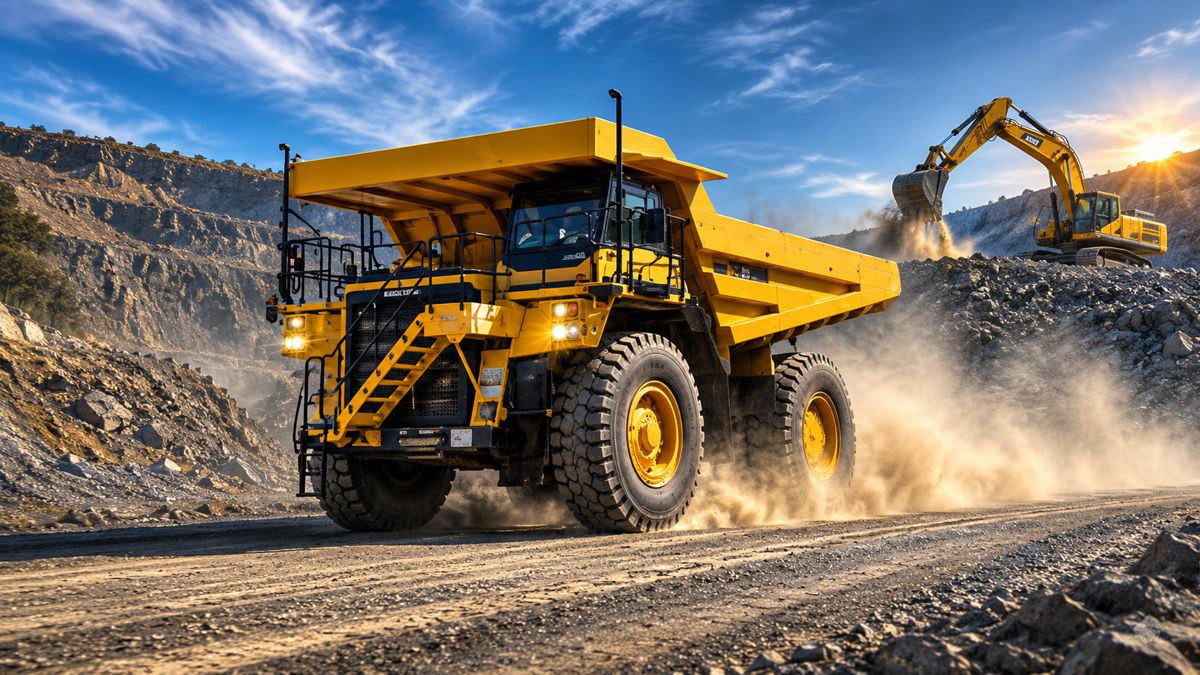
The machines selected for development cover a substantial range of earthmoving and materials-handling applications. At the upper end is the Komatsu HD785, a rigid-frame dump truck with a maximum payload of 93.9 tonnes. The smaller HD605 carries up to 64.1 tonnes, providing another option for operations where haul road dimensions, production requirements or loading equipment favour a different vehicle capacity. Both machines are suited to transporting bulk materials along established haul routes, including those found at quarries, large earthmoving projects and industrial sites.
The HM400/460 articulated dump truck, with a stated maximum payload of 42 tonnes, addresses a different operating environment. Articulated haulers are commonly selected for earthworks involving uneven ground, temporary haul roads and conditions where the manoeuvrability and traction characteristics of a rigid vehicle may be less suitable. Their ability to negotiate difficult terrain makes them useful on construction projects where access routes and working areas change as excavation and earthmoving progress.
That variation creates different demands for autonomous operation. A rigid dump truck travelling repeatedly between established loading and dumping points may encounter relatively consistent routes, while an articulated hauler working on a civil engineering project could face changing gradients, ground conditions and access arrangements. Developing systems for both configurations will require the partners to accommodate differences in vehicle dynamics, manoeuvrability and the surrounding operating environment.
Komatsu will contribute vehicle engineering, system integration and machine control technologies, while TIER IV supplies autonomous driving expertise. The development programme will examine how the combined systems perform across loading, transportation and material discharge operations, including coordination with other equipment working nearby. Detailed specifications for the sensing equipment, computing hardware and autonomy architecture have not been published, and the companies have not confirmed whether the eventual systems will be offered through factory integration, retrofit packages or a combination of approaches.
Autonomous Driving and Fleet Coordination
TIER IV is closely associated with the development of Autoware, an open-source autonomous driving software platform supporting functions such as vehicle localisation, environmental perception, route planning and control. Although the company brings considerable experience in autonomous vehicle technology, the partners have not specified which software architecture or Autoware components will be used in the dump truck programme.
Adapting autonomous driving technology to heavy construction equipment involves operating requirements that differ substantially from those encountered by passenger vehicles. A loaded dump truck must respond predictably to gradients, changing ground conditions and the characteristics of the material being transported. Vehicle mass and braking performance become particularly important when controlling movement along haul roads, especially where loading equipment, support vehicles and personnel share the working environment. Reliable positioning, obstacle detection and route management must also account for the relatively large dimensions and limited manoeuvrability of heavy machinery.
Construction and quarry operations introduce further complications because their physical surroundings can change during a working shift. Excavation advances, stockpiles move and loading locations may be relocated as production progresses. Temporary access roads can be altered or closed, while maintenance activities and other machinery may interrupt established haul routes. Autonomous trucks must operate within defined safety arrangements while accommodating those changes, with appropriate procedures for human intervention when conditions fall outside their approved operating limits.
EARTHBRAIN’s involvement brings fleet coordination into the development programme. The Komatsu subsidiary is developing a management system intended to work alongside the vehicle autonomy technology, extending automation beyond individual trucks to the movement and allocation of equipment across an entire site. The original September 2025 collaboration identified dynamic route optimisation and coordinated vehicle control among its development objectives.
In a conventional haulage operation, production depends on the interaction between loading equipment, haul trucks, travel routes and dumping locations. Trucks arriving faster than an excavator can load them create queues, while insufficient haulage capacity leaves loading equipment waiting. Fleet management software can help balance these activities by allocating vehicles, managing routes and monitoring operations, although its effectiveness depends on the quality of the available information and the ability to respond to changing site conditions.
Integrating that capability with autonomous trucks introduces the possibility of coordinating vehicle movements directly rather than relying entirely on instructions to individual drivers. The practical challenge will be managing interactions with conventionally operated excavators, wheel loaders and support equipment, particularly when people and autonomous machines occupy the same working areas. The companies have yet to describe their intended procedures for mixed operations, human supervision or intervention, but these arrangements will form an important part of bringing the technology into regular use.
Komatsu’s Existing Autonomous Haulage Operations
Komatsu has been operating autonomous haulage technology in the mining sector for nearly two decades. Its FrontRunner Autonomous Haulage System entered commercial service in 2008 and has subsequently been deployed across major surface mining operations. In April 2026, the manufacturer announced that it had commissioned its 1,000th autonomous ultra-class haul truck, a 290-tonne-payload 930E-5AT operating at Nevada Gold Mines in the United States.
The milestone demonstrates the scale of Komatsu’s established mining automation business. According to the company, FrontRunner-equipped trucks had collectively transported more than 11.5 billion tonnes of material by April 2026, operating across a range of commodities and mining conditions. These deployments involve large fleets and established operating arrangements, where autonomous transportation can be integrated into long-term production planning and dedicated mine management systems.
Quarries and civil engineering projects frequently work on a different scale. Smaller fleets, changing production schedules and the movement of equipment between projects can make the infrastructure and support arrangements associated with major mining systems difficult to justify. Even where haulage routes are relatively predictable, the capital cost of automation must be assessed against the number of operating hours available and the volume of material being transported.
Komatsu has already been addressing that market through a separate partnership. In August 2025, its North American business announced a collaboration with California-based autonomy specialist Pronto, introducing Smart Quarry Autonomous for quarry-sized haul trucks. The system uses onboard perception, positioning and control equipment to support driverless operations, with fleet activity monitored through a web-based interface.
Unlike the infrastructure-intensive arrangements often associated with large mining operations, Smart Quarry Autonomous is designed around retrofit installations and relatively low-overhead deployment. Komatsu describes the offering as suitable for smaller fleets, including mixed-manufacturer environments, and its North American dealer network provides installation and support services.
The TIER IV initiative is a distinct development programme, involving different technology partners and a broader selection of rigid and articulated machines. Although both initiatives address quarry operations, Komatsu has not disclosed how their eventual product offerings, geographical coverage or technical architectures will relate to one another. The existing Pronto collaboration also means that the 2027 TIER IV target should not be interpreted as Komatsu’s first commercial entry into autonomous quarry haulage.
Operating Economics and Deployment
The commercial case for autonomous haulage depends heavily on the characteristics of the site. In a large mine with established transport routes and substantial annual production, automation costs can be assessed against high equipment utilisation, workforce requirements and the consistency of daily operations. Smaller quarries may have fewer trucks and more variable production schedules, while civil engineering projects introduce additional costs when equipment and working areas must move between successive phases of construction.
A system requiring extensive site preparation, specialist supervision or repeated recalibration may be difficult to justify where haulage volumes are limited or operating conditions change frequently. Conversely, consistent haul cycles, reduced waiting times and better coordination between loading and transport activities could improve equipment utilisation without requiring substantial changes to the machinery itself. The financial result would depend on installation costs, maintenance requirements, operating hours and the level of human supervision retained.
These considerations place considerable emphasis on the integration between TIER IV’s autonomous driving technology, Komatsu’s vehicle controls and EARTHBRAIN’s fleet management system. A truck capable of navigating a predefined route is only one component of an operational haulage system. Loading equipment must remain productive, dumping areas must be available and vehicles must respond appropriately when routes are obstructed or site conditions change.
Japan and North America will provide different environments for evaluating those capabilities. North America has an extensive quarrying and aggregates industry alongside major earthmoving and civil engineering applications, while Japan’s construction sector presents its own requirements for equipment utilisation and labour availability. Komatsu’s original collaboration with TIER IV identified labour shortages as one of the problems the development programme was intended to address.
The November 2026 announcement identifies deployment during 2027 as the partners’ target, with verification testing and jobsite introduction intended to build operational experience. Specific customer sites, commercial pricing, productivity improvements and detailed deployment schedules have not been announced. The 2027 timetable therefore represents a planned introduction rather than confirmation of general commercial availability.
Komatsu, TIER IV and EARTHBRAIN will need to demonstrate how their combined technology performs during sustained operations, particularly when autonomous trucks interact with manually operated machinery and changing haul routes. Reliability under those conditions, together with installation and supervision costs, will determine how readily the system can be adopted beyond controlled trials.
The most demanding test may be found on ordinary construction projects, where a haul road that worked yesterday may no longer exist tomorrow. Keeping a driverless truck productive as excavation progresses, loading areas move and other equipment enters its path is a considerably more complicated undertaking than repeating a journey along a fixed route.
Key Industry Questions
- Which Komatsu dump trucks are included in the TIER IV development programme? The programme covers the HD785 and HD605 rigid dump trucks and the HM400/460 articulated dump truck, with stated maximum payloads of 93.9, 64.1 and 42 tonnes respectively.
- When will the autonomous dump trucks be deployed? Komatsu and TIER IV are targeting deployment at quarry and construction sites in Japan and North America during 2027. Specific customer locations and general commercial availability dates have not been announced.
- What is TIER IV contributing to the programme? TIER IV is providing autonomous driving technology and integration expertise. The company is also a leading contributor to Autoware, although the precise software architecture for the Komatsu machines has not been disclosed.
- What role does EARTHBRAIN play? EARTHBRAIN is developing fleet management capabilities intended to coordinate autonomous truck movements and support wider jobsite operations, including route management and vehicle allocation.
- Will the trucks operate without human drivers? Autonomous operation is the development objective, but the companies have not specified the final operating restrictions, supervision requirements or safety procedures.
- Can existing Komatsu trucks be converted to autonomous operation? Retrofit availability has not been confirmed for the TIER IV systems. Komatsu separately offers retrofit-oriented autonomous technology through its Smart Quarry Autonomous programme with Pronto.
- How does the programme differ from Komatsu’s FrontRunner system? FrontRunner is an established autonomous haulage system developed for large-scale mining operations. The TIER IV collaboration focuses on quarry and civil engineering applications using smaller rigid and articulated trucks.
- What productivity improvements are expected? The partners aim to improve haulage efficiency, labour utilisation and site safety. Quantified productivity gains and operating cost reductions have not yet been published for the new systems.
Strategic Takeaways
- Developing autonomy for both rigid and articulated haulers requires systems capable of accommodating different terrain, vehicle dynamics and haulage arrangements.
- EARTHBRAIN’s fleet management technology will be important in determining whether autonomous trucks can operate efficiently alongside conventional site machinery.
- Komatsu’s existing Pronto partnership and the TIER IV programme provide separate development routes into quarry-scale automation, although their future commercial relationship remains undefined.
- Installation costs, supervision requirements and adaptation to changing site layouts will influence the commercial viability of autonomous haulage outside major mining operations.
- The planned 2027 deployments will provide an opportunity to evaluate system reliability and operating economics against the demands of working quarries and civil engineering projects.