






One Brain, Many Machines: The Rise of Universal Physical AI
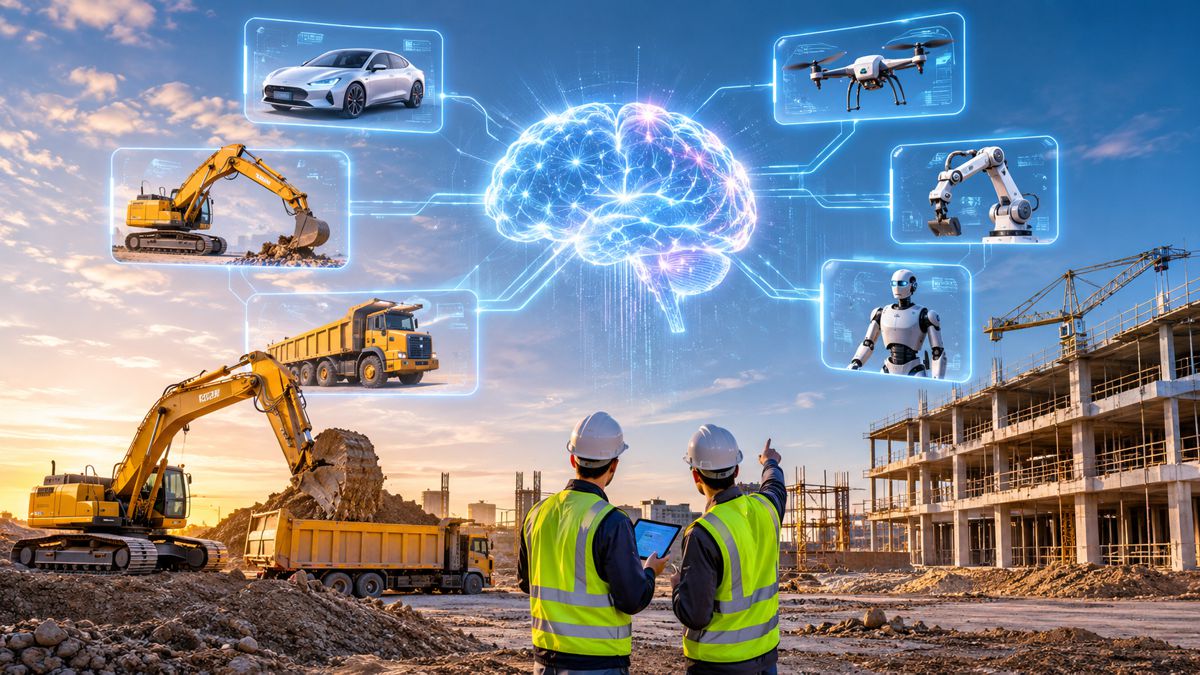
An excavator loading a truck, a robotic arm handling components, a drone navigating around a building and an autonomous car negotiating a busy junction have more in common than their mechanical designs might suggest. Each must interpret its surroundings, understand spatial relationships, anticipate movement and determine how to act. Until relatively recently, developing these capabilities generally meant building artificial intelligence systems around individual machines and their intended applications.
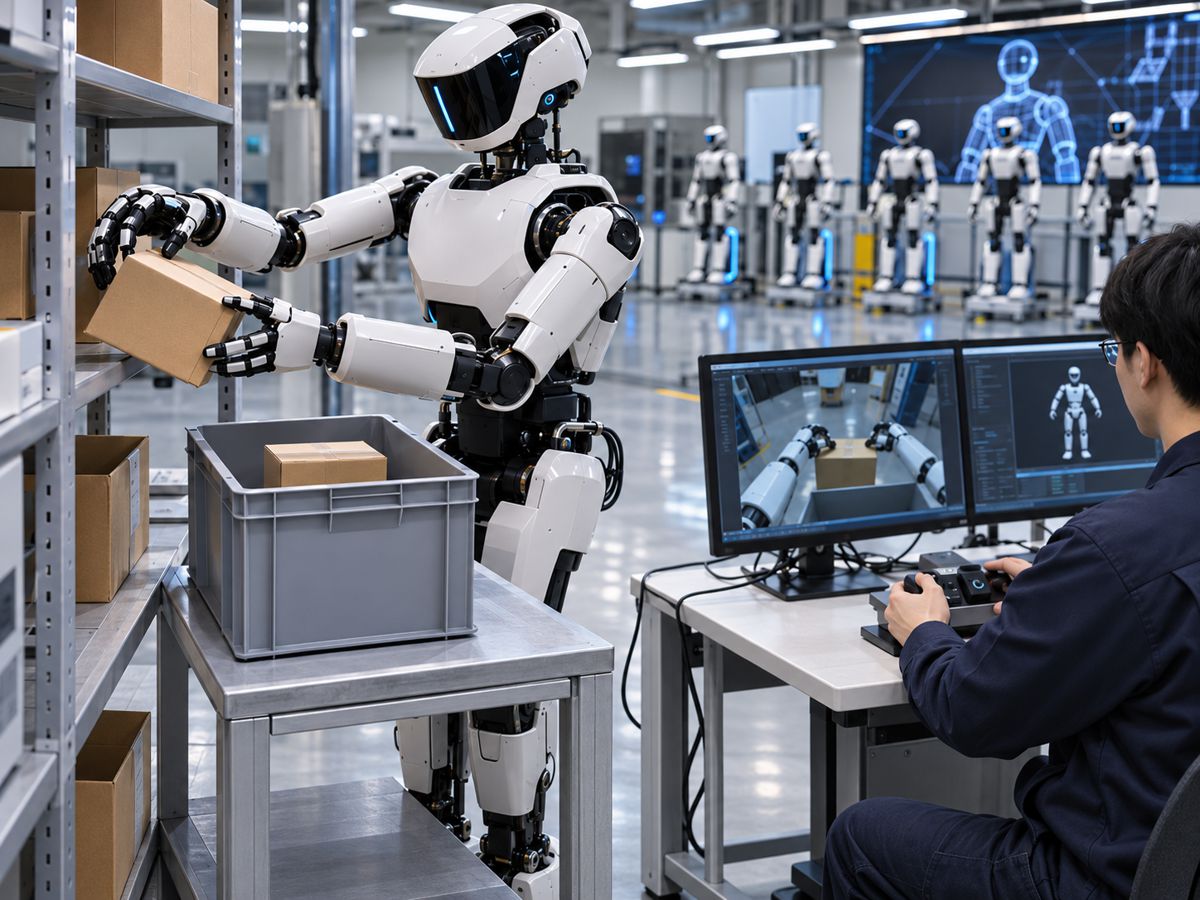
Chinese automotive and robotics developer XPENG is pursuing a different approach. On 24 November 2026, the company unveiled WorldGPT, a physical AI foundation model designed to share learning across six categories of machines: cars, boats, drones, single-arm robots, dual-arm robots and humanoid robots.
The development opens an intriguing avenue for construction, mining, agriculture, manufacturing and logistics. If machines with fundamentally different mechanical architectures can acquire intelligence from a common foundation, manufacturers may no longer need to develop every aspect of machine autonomy independently. An excavator could benefit from spatial reasoning developed through autonomous vehicles, while industrial robots could contribute knowledge that helps construction machinery manipulate unfamiliar objects and materials. Intelligence could gradually become a transferable technology, developed independently of the machinery it controls.
Briefing
- XPENG’s WorldGPT brings together learning across six categories of vehicles and robotic machines within a shared physical AI foundation model.
- Its proposed architecture uses a central cloud-based teacher model to transfer capabilities into smaller, specialised onboard AI systems.
- WorldGPT generates visual predictions of future events, interprets physical environments and develops machine-specific action plans.
- Research by Google DeepMind and NVIDIA has established credible foundations for transferring intelligence between different robotic platforms.
- Shared physical AI could lower development barriers for machinery manufacturers, although specialist training, engineering validation and independent safety systems remain essential.
Developing a Common Understanding of the Physical World
An industrial robot operating within a carefully controlled production cell can perform repetitive tasks with exceptional precision, but transferring that machine into an unfamiliar environment introduces a different set of problems. Objects appear in unexpected positions, lighting conditions change, people move through the workspace and materials respond differently to the forces applied to them.
Construction sites amplify these difficulties. Ground conditions change throughout the working day, temporary structures appear and disappear, vehicles follow irregular routes and machinery operates alongside people performing unpredictable tasks. Even an apparently straightforward operation such as loading aggregate into a truck involves recognising the vehicle, positioning the bucket, judging clearance and adapting to variations in the material being handled.
Developers have traditionally addressed these problems through combinations of sensors, control algorithms, computer vision and application-specific machine learning. Much of that work must be repeated when developing another machine, even where the underlying requirements are similar.
WorldGPT attempts to consolidate part of this learning by incorporating visual information from machines operating across land, water and air. Although a drone’s propulsion commands have little direct relevance to an industrial robot’s joints, both machines encounter objects, obstacles, distances and movement. Camera imagery provides a common means of representing these environments, allowing the model to learn relationships that extend beyond the mechanical architecture of any individual machine.
XPENG’s approach seeks to develop a shared understanding of the physical world before adapting that knowledge to the capabilities and operating requirements of specialist equipment. The breadth of its training environments distinguishes the project from systems developed exclusively for autonomous driving or robotic manipulation.
Teaching Machines to Anticipate the Future
One of the more compelling aspects of WorldGPT is its ability to generate visual representations of how a situation might develop. The WorldGPT technical demonstration website presents examples generated from approximately one second of real camera footage, accompanied by an instruction describing the intended action.
The system produces predicted video sequences alongside information about depth, objects and planned movements. Changing the instruction alters the predicted outcome, allowing different potential actions to be explored within the model before a machine attempts to perform them.
For construction machinery, this approach offers an avenue towards more sophisticated operational planning. Before moving a suspended load, a machine might evaluate alternative trajectories and identify potential obstructions. An autonomous wheel loader could consider different approaches to a stockpile, while a mobile construction robot could assess how to navigate a partially completed building without interfering with other activities.
Experienced machinery operators undertake comparable mental exercises throughout the working day, often without consciously recognising the process. Years of practical experience help an excavator operator anticipate how the machine, material and surrounding environment will respond before committing to a movement. Physical AI developers are attempting to reproduce aspects of that predictive capability computationally.
Generating convincing footage, however, is considerably easier to demonstrate than establishing reliable physical accuracy. A predicted sequence of a suspended load moving through space does not establish that the model understands its weight, centre of gravity, inertia or the structural capacity of the lifting equipment. A learned representation of physical behaviour is fundamentally different from a validated engineering simulation.
Specialist instrumentation, engineering calculations and established safety controls will remain essential, particularly where the consequences of an inaccurate prediction extend beyond the immediate operation.
One Teacher and Thousands of Specialist Machines
Deploying a large artificial intelligence model directly on every excavator, agricultural tractor or industrial robot would introduce considerable computing, energy and cost requirements. Heavy machinery also frequently operates in remote locations where reliable communications cannot be guaranteed.
XPENG proposes retaining WorldGPT as a computationally intensive teacher model running in the cloud, with relevant capabilities transferred into smaller models through a process known as knowledge distillation. These specialist models would be adapted to the requirements of individual machines and the computing resources available onboard.
An autonomous excavator would still require software capable of interpreting its hydraulic system, boom geometry, attachment configuration, operating limits and sensor information. A foundation model could provide capabilities in visual perception, spatial reasoning and action planning that are subsequently adapted to those requirements, reducing the need to develop each capability independently.
The resulting architecture is intended to support local machine operation without requiring continuous consultation with a remote computing platform. Additional operational data could contribute to subsequent training, with improvements incorporated into onboard software following appropriate testing and validation. This would be a managed development process rather than machines automatically acquiring new behaviours from one another during operation.
Over time, manufacturers operating several product lines could establish common intelligence platforms across their machinery portfolios. Lessons acquired through developing autonomous wheel loaders might contribute to material-handling robots, while experience gained from mobile equipment could support navigation capabilities elsewhere in the product range.
The Emergence of Generalist Machine Intelligence
XPENG is entering an area of artificial intelligence research that has been gathering momentum for several years. In 2023, Google DeepMind and its academic partners introduced Open X-Embodiment, bringing together training data from 22 different robotic platforms to investigate whether robots could benefit from experience acquired by other machines.
Experiments demonstrated that models trained across multiple robotic platforms could improve performance on certain tasks and transfer capabilities between different machines. The research challenged the established practice of developing robotic systems largely in isolation and provided evidence that broader training datasets could benefit specialist applications.
NVIDIA’s Isaac GR00T programme has developed along similar lines, providing foundation models, simulation environments and training infrastructure for general-purpose robotics. Developers can adapt pretrained models to particular robot designs and applications, drawing upon existing knowledge rather than beginning with an untrained system.
XPENG extends this approach across a particularly diverse collection of machines, combining terrestrial vehicles, marine platforms, aircraft and robots within one model. The company reports that WorldGPT achieved 12 first-place results across public benchmarks as of 12 November 2026, covering areas including autonomous driving, robotic manipulation, visual understanding and video generation. It also reported an average success rate of 95.2 per cent across 50 single-arm manipulation tasks under benchmark testing conditions.
These results provide encouraging evidence of the model’s versatility, although benchmark performance should not be confused with operational reliability. XPENG’s full technical report was still awaiting publication at the time of the announcement, and the reported results do not establish performance across heavy construction equipment or complex industrial environments.
From Autonomous Machines to Autonomous Construction Sites
Construction equipment manufacturers have already made considerable progress towards autonomous operation, particularly in mining, earthmoving and repetitive material-handling applications. Much of the development has concentrated on individual machine types performing clearly defined operations within controlled environments.
In August 2026, Bedrock Robotics announced autonomous excavator deployments on three American construction projects, including a water treatment facility in Nevada and major earthmoving operations in Texas. Its technology retrofits conventional excavators with sensors and computing equipment, allowing existing mechanical platforms to acquire autonomous operating capabilities.
Such deployments provide a practical foundation for developing coordinated autonomous fleets. An excavator can perform useful work independently, but construction productivity depends heavily upon how effectively different machines and operations interact.
On a major highway construction project, survey drones could continuously update the site’s digital terrain model while autonomous excavators undertake bulk earthworks. Haul trucks would transport material according to changing production requirements, graders prepare formation levels and intelligent compactors monitor the performance of completed layers. Humanoid robots, mobile inspection systems and autonomous delivery platforms could undertake supporting activities within the same working environment.
A shared foundation model could help these machines interpret their surroundings consistently, although fleet coordination would still require communications infrastructure, scheduling software, interoperable data and supervisory systems. With access to common project information, individual machines could adjust their activities around progress elsewhere on the site, accommodating changes in material volumes, vehicle availability and construction sequencing.
The greater productivity opportunity lies in coordinating these operations. An excavator that completes its loading cycle more quickly achieves little if haul trucks are unavailable, while an autonomous grader cannot improve production if the preceding earthworks have fallen behind schedule.
Developing Industry-Specific Intelligence
Universal foundation models need not provide every capability required by every machine. The diversity of industrial operations suggests that several layers of artificial intelligence could emerge, with broadly trained models providing the foundation for increasingly specialised applications.
A general-purpose physical AI model might establish capabilities in object recognition, spatial awareness, movement prediction and environmental interpretation. A construction-specific derivative could incorporate knowledge of surveying, earthworks, construction sequencing, engineering drawings and material handling, while agricultural models could specialise in crops, soil conditions and harvesting operations.
Individual manufacturers would then adapt these capabilities to the mechanical characteristics and operating requirements of their equipment. An excavator, concrete pump and autonomous compactor could share aspects of their construction-specific intelligence while retaining fundamentally different control systems.
This architecture offers considerable scope for collaboration between AI developers, equipment manufacturers, contractors, research institutions and specialist engineering companies. Industrial expertise accumulated over generations could be incorporated into specialist models without requiring each participating organisation to develop an independent foundation model.
The approach also creates opportunities for companies supplying specialised training datasets, simulation environments and validation services. Understanding how machinery operates under real industrial conditions will remain valuable even as general-purpose AI becomes more widely available.
Democratising Autonomous Machinery Development
Developing advanced autonomous machinery requires expertise extending well beyond traditional mechanical engineering. Manufacturers must recruit specialists in machine learning, sensor integration, software development and robotics while maintaining the computing infrastructure and testing facilities needed to train and validate their systems.
For smaller equipment manufacturers, particularly those producing specialised machinery in relatively modest quantities, these requirements represent a formidable barrier to entry. A company may possess decades of engineering experience and manufacture exceptional equipment without having the resources to develop a sophisticated autonomous control platform.
Commercially available physical AI foundation models could alter that equation. A specialist manufacturer of tunnelling equipment, agricultural machinery or road maintenance vehicles could license or adapt existing intelligence, concentrating its resources on mechanical design, application-specific engineering and customer requirements.
The comparison with modern software development is instructive. Relatively small businesses can now create sophisticated AI-enabled applications using foundation models developed by companies with vastly greater research budgets. Access to established intelligence allows them to develop products addressing particular customer requirements without undertaking the foundational research themselves.
A comparable ecosystem could emerge around industrial machinery, supported by independent companies specialising in machine intelligence rather than equipment manufacturing. Open foundation models could further lower barriers to entry, while proprietary platforms might offer commercial support, managed development environments and specialist engineering services.
XPENG has not announced licensing arrangements for construction machinery, and the commercial availability of WorldGPT to third-party equipment manufacturers remains uncertain. Nevertheless, the broader development of adaptable physical AI platforms offers a credible alternative to every equipment manufacturer maintaining an entirely independent artificial intelligence research programme.
A New Relationship Between Machinery and Software Manufacturers
For much of the history of industrial machinery, competitive advantage has been associated with mechanical performance, durability, fuel consumption, manufacturing quality, dealer networks and aftermarket support. Autonomous capabilities introduce another dimension, as mechanically comparable machines may deliver different operational performance depending upon their ability to interpret site conditions, organise tasks and adapt to unfamiliar situations.
An intelligent excavator might develop more efficient loading cycles, minimise unnecessary movements or adapt its operating strategy to reduce energy consumption. Improvements could continue throughout the working life of the machine through validated software updates, potentially extending its commercial usefulness without significant mechanical modification.
Manufacturers will face decisions about which capabilities to develop internally and which to obtain from technology partners. Proprietary systems offer greater control over product development, intellectual property and customer relationships, but require sustained investment. Licensing external intelligence could accelerate development while introducing dependence upon another company’s technology, pricing and commercial policies.
Foundation models may reduce certain development costs while introducing others, including computing hardware, software licensing, specialist training data, cybersecurity, system integration and safety validation. Autonomous machinery will not necessarily become inexpensive, although the distribution of development costs could change considerably.
The automotive industry has already encountered similar questions around software platforms, computing hardware and autonomous driving technology. Construction equipment manufacturers could find themselves negotiating comparable relationships with companies that have little history of manufacturing heavy machinery. Equally, a construction machinery manufacturer could develop specialist intelligence with commercial applications extending into agriculture, mining or manufacturing.
Mechanical expertise would remain indispensable, but ownership of the intelligence controlling equipment could become an increasingly valuable commercial asset.
Data Ownership and the Value of Experience
A shared machine intelligence platform derives much of its potential from the diversity and quality of its training data. Additional operating environments expose models to conditions, materials and situations that would be difficult to reproduce comprehensively through laboratory testing.
Construction and mining companies collectively possess an enormous reservoir of operational experience. Their machinery encounters geological variations, changing weather conditions, equipment configurations and working practices that could contribute to developing more capable industrial intelligence. As autonomous machinery becomes widespread, the data generated during routine operations may acquire commercial value extending beyond the management of individual projects.
Equipment manufacturers could use operational data to improve their products, while independent AI developers could incorporate relevant information into foundation models serving multiple industries. Contractors supplying that data will need clarity over how it is used, who benefits from subsequent improvements and whether commercially sensitive information is being transferred outside their organisations.
Data ownership, confidentiality, intellectual property and access rights could consequently become more prominent considerations in machinery procurement contracts. Contractors may also need to consider whether they can transfer operational data between equipment suppliers or retain access to it when replacing machinery.
The long operational lifespan of construction equipment introduces additional complications. Manufacturers and contractors purchasing expensive capital equipment will need confidence that essential software, security updates and technical support remain available throughout its working life. An otherwise serviceable excavator should not become commercially obsolete because its intelligence provider discontinues a product or changes its licensing arrangements.
Engineering Safety Into Intelligent Machines
The consequences of an incorrect prediction by a physical AI system are fundamentally different from those associated with conventional generative AI. An inaccurate written response can usually be reviewed before it is acted upon, whereas a poorly judged movement by a 40-tonne excavator may offer no comparable opportunity for intervention.
Construction machinery must contend with substantial mechanical forces, variable ground conditions, limited visibility and people working in close proximity. Its control systems must respond reliably even when sensors become contaminated, communications fail or operating conditions move outside the machine’s intended capabilities.
A foundation model capable of recognising objects and anticipating movement could contribute to safer operation, but established engineering safeguards remain essential. Independently functioning emergency stops, defined operating envelopes, collision prevention systems, mechanical limits and appropriate supervisory arrangements must prevent unsafe machine behaviour regardless of the decisions made by the AI system.
Standards such as ISO 17757:2019, which addresses autonomous and semi-autonomous machine system safety in earthmoving and mining, provide an established engineering framework for addressing these responsibilities.
Shared intelligence also introduces potential common-mode failures. If several different machines rely upon related models trained on similar information, an underlying weakness could affect multiple equipment categories. A defective software update or an inadequately understood operating condition could therefore have consequences extending beyond an individual machine, requiring rigorous procedures for validating model updates and restricting unapproved changes.
Construction also presents challenges that cannot reliably be resolved through visual information alone. Underground utilities, internal material defects, groundwater conditions and excavation stability may require specialist instrumentation, engineering assessments and information unavailable to a camera. Physical AI must operate within these engineering realities, however convincing its understanding of the visible world becomes.
When Universal Physical AI Could Become Practical
The foundations of shared machine intelligence are already being established. Cross-embodiment robotics research, pretrained foundation models and autonomous construction equipment are progressing along complementary paths, although their integration into a commercially mature industrial ecosystem remains at an earlier stage of development.
Manufacturing facilities, warehouses, mines and controlled earthmoving projects offer attractive environments for initial applications. They allow developers to collect substantial quantities of operational data while maintaining clearly defined tasks and operating boundaries. General building projects, road maintenance and urban infrastructure introduce greater variability and more complex interactions between machinery and people.
In the nearer term, foundation models may prove most useful in accelerating equipment development. Manufacturers can use transferable capabilities to improve object recognition, generate training scenarios and develop machine behaviours, potentially reducing the time and data required to adapt robotic systems to particular tasks.
The next stage would involve adapting shared intelligence across additional equipment categories and establishing greater interoperability between autonomous machines. Progress will depend upon demonstrable improvements in reliability, training efficiency, deployment costs and the ability to operate safely under changing conditions.
Commercially available, transferable machine intelligence that allows equipment manufacturers to develop autonomous products without substantial independent AI research programmes represents a longer-term ambition. Current demonstrations provide evidence that aspects of machine intelligence can be transferred, but there is insufficient evidence to establish when genuinely general-purpose industrial autonomy will become commercially practical.
The Separation of Intelligence and Machinery
Construction has historically benefited from technologies developed elsewhere. Satellite positioning, industrial electronics, telecommunications, computer vision and advanced manufacturing have all found applications far removed from their original markets. Physical AI foundation models could follow a similar course, bringing intelligence developed through automotive engineering and robotics into the machinery used to build roads, bridges, railways and cities.
The separation of intelligence from mechanical design could also encourage greater experimentation in equipment manufacturing. Machines need not resemble established designs if alternative configurations offer better productivity, energy efficiency or access to confined environments. Manufacturers could adapt shared intelligence to unconventional mechanical architectures, creating opportunities for specialist equipment developers and entirely new market entrants.
For generations, machinery manufacturers have developed equipment around the capabilities of mechanical, hydraulic and electrical systems. Physical AI introduces the possibility of intelligence becoming a transferable technology in its own right, developed independently of any particular machine and adapted to the requirements of different industries.
The excavator of the future may owe some of its capabilities to experience acquired by a car navigating a city, a drone inspecting a bridge or a robot working on a production line. The opportunity for machinery manufacturers will be to turn that shared intelligence into equipment that understands its surroundings, performs useful work and operates safely in the physical world.
Key Industry Questions
- What is physical AI? Physical AI describes artificial intelligence systems designed to interpret and interact with real-world environments through machines such as robots, autonomous vehicles and industrial equipment.
- What is a physical AI foundation model? A physical AI foundation model is a broadly trained artificial intelligence system whose capabilities can be adapted to different machines, environments and tasks without developing an entirely new model for each application.
- What is XPENG WorldGPT? WorldGPT is a physical AI foundation model developed by XPENG that combines learning across cars, boats, drones, single-arm robots, dual-arm robots and humanoid robots. It supports visual perception, prediction, reasoning and action planning.
- Can artificial intelligence learn from different types of machinery? Cross-embodiment robotics research has demonstrated that certain capabilities can be transferred between different robotic platforms. Machine-specific training remains necessary to accommodate differences in mechanical design, sensors and operating conditions.
- How could physical AI reduce the cost of autonomous construction equipment? Pretrained foundation models could reduce the independent research, data collection and initial training required for each equipment category. Manufacturers would still need to undertake hardware integration, specialist development and safety validation.
- Could autonomous construction machinery operate without an internet connection? Yes, provided the necessary intelligence and control systems operate locally. Cloud-based platforms can support training and software development without being required for continuous machine control.
- Can existing construction equipment be upgraded with physical AI? Some conventional machinery can already be retrofitted with autonomous control technology. Compatibility depends upon the machine’s control architecture, sensors, mechanical condition and the intended application.
- What are the safety risks associated with shared machine intelligence? Risks include inaccurate predictions, unfamiliar operating conditions, sensor failures, cybersecurity vulnerabilities and weaknesses shared across related AI models. Independent safety systems and application-specific validation remain essential.
- Will construction equipment manufacturers be able to license physical AI? Adaptable robotics foundation models already exist, although commercially available universal intelligence platforms specifically designed for heavy construction machinery remain an emerging opportunity. Manufacturers would still need to integrate, train and validate the technology for individual equipment categories.
Strategic Takeaways
- Shared physical AI foundation models could make autonomous machinery development commercially accessible to smaller and more specialised equipment manufacturers.
- Industry-specific foundation models offer opportunities to combine general-purpose intelligence with decades of accumulated construction and engineering expertise.
- Contractors should consider the ownership, confidentiality and commercial value of operational data generated by autonomous machinery.
- Equipment procurement will increasingly need to address software licensing, interoperability, technology supplier dependency and long-term digital support.
- Independent engineering safeguards and rigorous machine-specific validation will remain essential regardless of the sophistication of shared artificial intelligence.