Nextpower Pushes Solar Integration Deeper into the Power Plant with NX PowerMerge
A single patent on a direct current connector rarely shifts an industry, yet United States patent 12,712,292 tells a pointed story about where margin and defensibility are collecting in utility-scale solar. The grant covers Nextpower’s NX PowerMerge electrical balance of systems (eBOS) trunk connector, and it lands next to a project award from the engineering, procurement and construction (EPC) contractor BUILD Renewables that has carried the product’s order backlog beyond two gigawatts.
Read on their own, a patent number and a backlog figure are routine corporate housekeeping. Read together, they mark a former tracker specialist turning a part of the plant the market long treated as plumbing into protected intellectual property, and doing it just as the electrical layer becomes the component buyers scrutinise hardest.
The weight of the announcement comes from the company behind it rather than the connector itself. In November 2025 Nextracker, for years the leading name in solar tracking, changed its corporate identity to Nextpower and its legal name to Nextpower Inc., keeping the Nasdaq ticker NXT and its founding management under Dan Shugar.
The rebrand was not cosmetic, and it formalised a multi-year shift from selling the steel and motors that tilt panels toward the sun into supplying an integrated platform of structures, electrical hardware, software and, from this year, power conversion equipment. The eBOS patent is the clearest evidence so far that the platform strategy is producing defensible, revenue-bearing products rather than slideware, which is why an item easily dismissed as a component release deserves closer reading by anyone buying, building or financing large solar plants.
Briefing
- The United States Patent and Trademark Office has granted Nextpower patent 12,712,292 covering its NX PowerMerge trunk connector, a core component in the DC collection layer of utility-scale solar plants.
- A project award from the EPC contractor BUILD Renewables has lifted the NX PowerMerge order backlog beyond two gigawatts, up from more than 850 megawatts of cumulative bookings the company reported earlier in 2026.
- The patent follows Nextracker’s November 2025 rebrand to Nextpower, marking a shift from tracker specialist to integrated platform supplier spanning structures, electrical systems, software and, from 2026, power conversion.
- Nextpower now sells both trunk bus and combiner box DC collection architectures, allowing it to capture the eBOS decision regardless of which approach an EPC or owner selects.
- The move lands as utility-scale solar transitions toward 2,000-volt DC systems and as labour scarcity and data-centre demand push developers toward prefabricated, faster-installing electrical designs.
From Tracker Leader to Integrated Power Platform
Nextpower’s expansion has been built through acquisition as much as engineering. The eBOS business began with the roughly 78 million dollar all-cash purchase of Bentek Corporation, which brought pre-assembled electrical harnessing and combiner expertise into a company that had previously sold almost exclusively above ground level.
This year the group added the power conversion assets of Zigor Corporation and its United States subsidiary Apex Power in a transaction valued at about 80.5 million dollars, giving it UL-certified inverters for the American market, IEC-certified products elsewhere, and central and modular configurations rated up to 5.2 megavolt-amperes. A new line of utility-scale power conversion systems is due to begin shipping during 2026, extending the company’s reach from the DC field into the equipment that connects a solar plant to the grid.
The financial ambition attached to that breadth is substantial. At its November 2025 capital markets day the company set a revenue target of 4.8 billion to 5.6 billion dollars by its 2030 financial year, with roughly a third expected to come from products and services outside solar tracking. That is a demanding mix for a business whose revenue has grown from 1.9 billion dollars in its 2023 financial year to around 3.4 billion on a trailing basis, and which reported a company-wide backlog above 5.5 billion dollars.
With more than 150 gigawatts of systems shipped worldwide and installations in over 40 countries, Nextpower has the customer base to cross-sell electrical hardware into projects that already carry its trackers, and the patent and the BUILD Renewables award are early proof points that the cross-sell is working.
Why eBOS Has Stopped Being an Afterthought
For most of solar’s industrial history, the electrical balance of systems was a procurement footnote. Modules and inverters attracted the engineering attention and the capital, while the cables, connectors and combiners that move direct current from thousands of string terminations to the inverter were specified late and bought on price. That habit has become expensive. Balance of system components now account for roughly 40 to 50 per cent of a utility-scale project’s cost, and field inspection data has repeatedly identified cable jackets and connectors as frequent sources of degradation and failure, which makes the cheapest option a poor proxy for the lowest lifecycle cost.
The category is now treated as an architectural choice rather than a parts list, and the trade-offs are becoming quantifiable. Analysis from Wood Mackenzie frames three competing approaches: conventional combiner boxes, which carry the lowest equipment cost but the highest labour intensity; field-installed insulation-piercing connector systems, which cut equipment cost by around 13 per cent while preserving layout flexibility; and factory-prefabricated trunk bus systems, which prioritise installation speed and reliability at a higher upfront price.
The consultancy estimates that installation and commissioning for a traditional system can run about 25 per cent higher than for a prefabricated one, a gap that bites hard on sites competing for scarce electrical labour. With eBOS costs across all three architectures forecast to fall only around 6 per cent by 2034, competition is shifting from price toward reliability, speed and design flexibility, which is precisely the territory a patented connector is meant to defend.
The Patent as a Competitive Moat
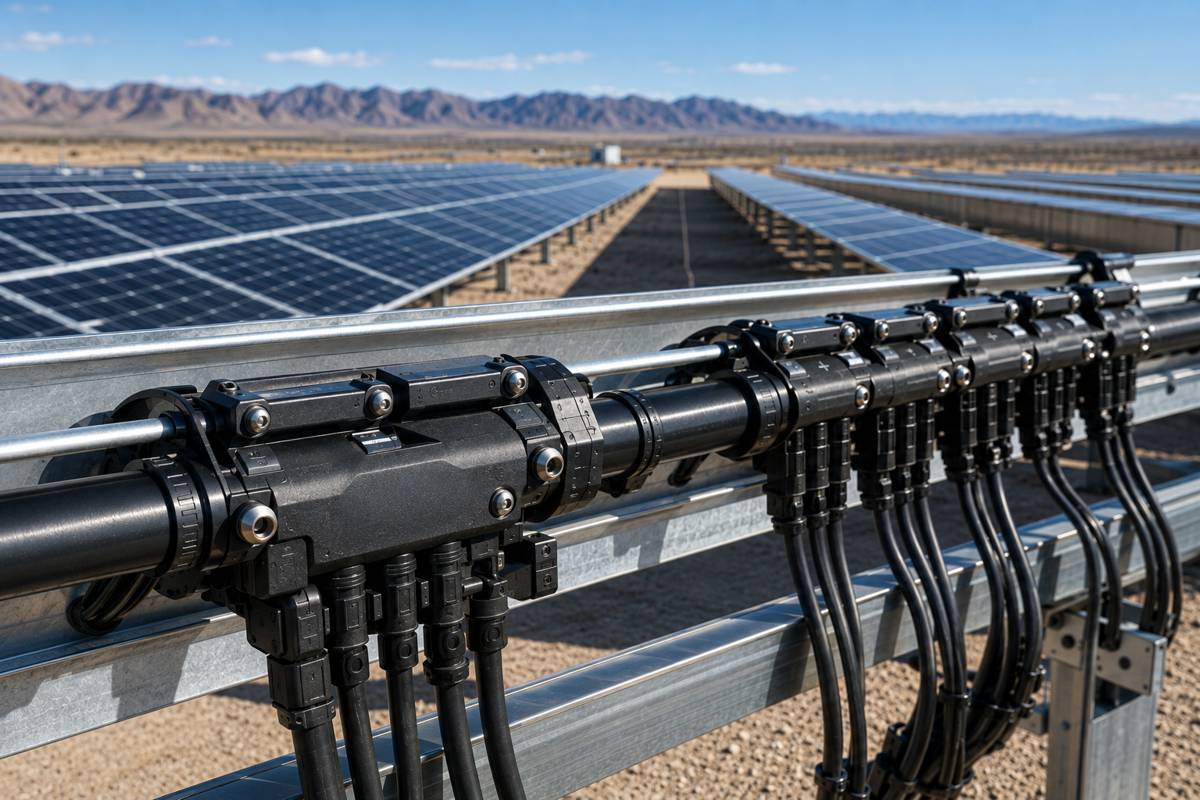
NX PowerMerge is a trunk connector designed to combine the reliability of factory-moulded components with the flexibility of field-installed ones, and the patent protects the specific engineering that makes that combination work. The product uses a single trunk cable connection point and an installation tool that verifies clamping pressure on every termination, removing a common source of latent field faults, while a universal connector body fits across trunk cable sizes so that late design changes do not force a change of hardware. Those features address the two failure modes that most trouble owners of large DC arrays, namely inconsistent field workmanship and the difficulty of adapting a fixed electrical design to a site that shifts during construction.
Ryan Schofield, vice president for electrical eBOS at Nextpower, tied the grant directly to customer feedback. “What we consistently hear from customers is that NX PowerMerge sets a new bar for robust field-installed design,” he said, noting that buyers “point to the single trunk cable connection point and an installation tool that verifies pressure every time, so there is no more guesswork in the field. The connector body is universal across trunk cable sizes, giving EPC teams the flexibility to handle design changes as projects evolve. This patent recognizes these innovations, and with demand already exceeding 2 GW, our customers are validating the value it brings to solar installation.”
The commercial significance is that the product has moved from launch in September 2025 to UL certification and a backlog beyond two gigawatts, up from more than 850 megawatts of cumulative bookings, inside a single year. A patent placed around a product accelerating at that rate raises the cost of imitation exactly when rivals would most want to copy it.
Selling Both Sides of the Architecture Decision
The more durable strategic move is that Nextpower now sells both principal DC collection methods rather than betting the business on one. Its portfolio spans trunk bus solutions built around NX PowerMerge and traditional combiner box systems, the two differing mainly in where protection sits. Trunk bus designs place external fusing in the over-moulded harnessing and perform all combining at the trunk connector, whereas combiner box systems house their fuses inside an enclosure.
By offering both, the company captures the architecture decision whichever way an EPC or owner leans, and can steer each project toward the approach that best fits its labour market, site complexity and reliability targets rather than defending a single product line.
The BUILD Renewables award illustrates how that breadth converts into orders. BUILD Renewables is a nationwide United States EPC contractor specialising in utility-scale solar and battery storage construction, led by the industry veteran Craig Sandeen, and its endorsement carries the weight of a firm that installs this hardware for a living.
“BUILD Renewables is excited to be partnering with Nextpower on their NX PowerMerge eBOS product, which provides exemplary safety, installation velocity, and performance features. We also appreciate the integrated design with the tracker and other solar power plant components,” Sandeen said. The reference to integration is the telling part, because it points to the value an EPC places on buying trackers, foundations and electrical collection from one vendor whose components are engineered to fit together, reducing interface risk and the finger-pointing that follows when separately sourced parts fail to align.
The 2 kV Transition and the Demand Behind It
The timing of Nextpower’s electrical push aligns with a change in how utility-scale plants are wired. The industry standard of 1,500 volts direct current is giving way to 2,000-volt systems, a shift that lowers balance of system cost per watt by pushing more power through the same conductors, but which requires new component designs and fresh safety certification. NX PowerMerge is specified as 2 kV-ready, and the broader market is moving with it, illustrated by suppliers such as ABB bringing 2,000-volt switch-disconnectors to market. Vendors that certify for the higher voltage early gain an advantage as developers standardise on it, and the electrical portfolio Nextpower has assembled is aimed squarely at that transition.
Behind the voltage change sits a demand curve steepened by artificial intelligence. The International Energy Agency projects that United States data centres will consume more electricity than all of the country’s energy-intensive manufacturing combined by 2030, and solar has become the cheapest and fastest source of new generation to meet that load.
American utility-scale deployment remains strong, with tens of gigawatts installed annually, although balance of electrical system costs have risen partly because of new tariffs on imported commodities. That cost pressure, combined with policymakers’ emphasis on domestic supply chains, favours suppliers with local manufacturing, and Nextpower has offered a United States-made option for NX PowerMerge alongside more than a decade of investment in domestic steel, electronics and component production.
Where the Value Is Concentrating
The clearest signal in this announcement is directional. As module prices continue to fall and that part of the value chain commoditises, differentiation and margin are migrating toward the integrated electrical architecture of the plant and toward the vendors able to de-risk its execution. For EPCs and owners, the practical implication is that eBOS deserves the same early-stage engineering scrutiny as module and inverter selection, because the electrical architecture now drives a meaningful share of both installed cost and long-term reliability.
Buying collection hardware engineered to integrate with the tracker, and protected by patents that signal a supplier’s commitment to the category, is a hedge against the interface failures and field-quality problems that erode returns over a 30-year asset life.
For investors, the milestone is a test of whether platform breadth can outperform point-product competition in a market where the underlying components are cheapening. Nextpower’s wager is that owning the structural, electrical and digital layers of a solar plant, and increasingly its power conversion, produces stickier customer relationships and higher-value orders than trackers alone.
The patent, the UL certification and the two-gigawatt backlog are evidence in favour of that thesis, though the company’s own target of drawing a third of revenue from non-tracker lines by 2030, set against continued exposure to United States policy and tariff shifts, shows how much still rests on execution. What has already changed is the status of eBOS itself, which has graduated from an afterthought bought on price into a strategic, standardised and increasingly defensible layer of the modern solar plant.
Key Industry Questions
- What is eBOS and why does it matter in utility-scale solar? Electrical balance of systems covers the components that move direct current from module strings to the inverter, including cables, connectors, combiners, harnessing and fusing. In a utility-scale plant these terminations number in the thousands, so small choices in design and workmanship compound into large effects on installed cost, construction schedule and long-term reliability. The category now represents a significant share of a project’s balance of system spend, which itself accounts for roughly 40 to 50 per cent of total cost. Because connectors and cable jackets are common points of field failure, eBOS has moved from a late-stage purchasing decision to an early engineering one that materially shapes a plant’s lifetime performance and its levelised cost of electricity.
- How does a trunk bus system differ from a combiner box, and when is each used? Both aggregate DC power, but they differ in where combining and protection occur. A combiner box gathers multiple strings inside an enclosure with the fuses housed internally, an approach with low equipment cost but high on-site labour. A trunk bus system performs the combining at the trunk connector itself and places external fusing within over-moulded harnessing, trading a higher upfront price for faster, more repeatable installation and fewer connection points. Combiner boxes tend to suit smaller or more irregular sites, while trunk bus designs favour large, repetitive layouts where standardisation pays off. Suppliers offering both, as Nextpower now does, can match the architecture to each project rather than forcing a single method.
- Why is the shift to 2,000-volt DC significant for eBOS suppliers and EPCs? Raising system voltage from 1,500 to 2,000 volts lets more power flow through the same conductors, reducing the quantity of copper, aluminium and hardware needed per watt and lowering balance of system cost. The change is not free, because higher voltages demand redesigned connectors, disconnects and protection rated and certified for the new level. Suppliers that certify early gain a commercial edge as developers standardise on 2 kV, while those that lag risk designing out of contention. For EPCs, the transition means specifying components that are genuinely 2 kV-ready rather than nominally compatible, since field safety and insurance requirements hinge on proper certification.
- What does the patent actually protect, and how much of a barrier is it to competitors? The patent covers the specific engineering of the NX PowerMerge trunk connector, including its single trunk cable connection point, the pressure-verifying installation tool and the universal connector body that fits multiple cable sizes. Its commercial function is to raise the cost and legal risk of copying a product that has scaled quickly, rather than to lock competitors out of trunk connectors as a class, since rivals can pursue alternative designs. For buyers, a patent signals that a supplier intends to invest in and defend the category, which matters when selecting hardware expected to perform for decades. The strength of any single patent depends on its claims, and competitors will test its boundaries as the trunk bus market grows.
- Why did Nextracker rebrand to Nextpower, and what does it change for customers? Nextracker changed its name to Nextpower in November 2025 to reflect a transition from a solar-tracking specialist into an integrated supplier of structural, electrical, digital and, increasingly, power conversion technology. The company kept its Nasdaq ticker NXT and its leadership, so for existing customers the immediate change is one of scope rather than continuity. The practical consequence is that trackers, foundations, eBOS, software and power conversion can now be bought under one brand and engineered to integrate, which the company argues reduces interface risk and simplifies procurement. The rebrand also sets an expectation, backed by financial targets, that a growing share of revenue will come from products beyond tracking.
- How significant is a 2 GW backlog for a product launched in 2025? For a connector launched in September 2025, a backlog beyond two gigawatts within a year indicates rapid market acceptance rather than a pilot-stage product. The figure rose from more than 850 megawatts of cumulative bookings reported earlier in 2026, showing acceleration rather than a one-off order, and it arrived alongside UL certification, which is a prerequisite for deployment on most American utility-scale sites. Backlog is a forward indicator of revenue, so a fast-growing one supports the company’s forecast that eBOS will become a material contributor. It also gives the product the installation volume needed to prove reliability in the field, which is the currency that wins repeat specification from EPCs.
- What should EPCs and owners weigh when choosing an eBOS architecture? The decision turns on the balance between equipment cost, labour intensity, site complexity and reliability. Combiner box systems minimise hardware spend but demand more skilled field labour, a constraint where electrical crews are scarce. Trunk bus systems cost more upfront but install faster and with fewer connection points, which lowers the risk of field faults and can shorten schedules. Owners should also weigh integration with the tracker and structures, the credibility of the supplier’s certification, and the total lifecycle cost rather than the purchase price alone. Increasingly, co-designing the electrical and structural systems early, rather than specifying eBOS late, avoids downstream cost and constructability problems.
- How do tariffs and domestic-content rules affect eBOS procurement in the United States? United States tariffs on imported commodities have pushed balance of electrical system costs higher, and federal policy has emphasised domestic supply chains through content-linked incentives. That combination favours suppliers with local manufacturing and penalises those reliant on imported hardware, affecting both price and eligibility for certain project subsidies. For procurement teams, the implication is that country of origin and certification now sit alongside performance and price as selection criteria. Suppliers offering a domestically manufactured option, as Nextpower does for NX PowerMerge, can help projects qualify for incentives and reduce exposure to tariff volatility, which is becoming a decisive factor in awards.
Strategic Takeaways
- Value in utility-scale solar is migrating from commoditised modules toward the integrated electrical architecture of the plant, making eBOS a strategic engineering decision rather than a late procurement item.
- Patenting a fast-scaling connector shows suppliers are now willing to defend eBOS as intellectual property, raising the cost of imitation and signalling where competition will concentrate next.
- Offering both trunk bus and combiner box architectures lets a supplier win the DC collection decision regardless of an EPC’s preference, a more durable position than betting on a single product.
- The move to 2,000-volt DC systems will reward vendors that certify early and integrate across trackers, structures and power conversion, and will pressure single-component suppliers.
- For investors, Nextpower’s platform strategy is a live test of whether breadth and integration can outperform point-product competition as underlying solar hardware continues to cheapen.