Turning Drone Inspections into a Long-Term Memory for Bridges
Bridge inspection has always produced a great deal of data and very little memory. Every routine survey captures cracks, spalling and water leakage in fine detail, yet each inspection has tended to stand alone, a snapshot taken from whatever angle and distance the inspector or drone happened to use that day. The commercial consequence has been quietly significant. Owners can describe what a structure looks like now, but they struggle to prove how quickly it is deteriorating, which is exactly the information needed to decide what to repair, when to intervene and how to defend a maintenance budget.
A framework developed at Seoul National University of Science and Technology, known as SEOULTECH, sets out to close that gap by making successive drone inspections directly comparable across months and years.
The development matters less as a laboratory result than as a marker of where value in the inspection business is moving. Drone flights, high-resolution cameras and defect-detection algorithms have become close to commodities, deployed across tens of thousands of assets by contractors large and small. What remains scarce, and therefore valuable, is the ability to turn a sequence of disparate inspections into a single continuous record of an asset’s condition, then to model how that condition is likely to change. The SEOULTECH team, led by Assistant Professor Hyunjun Kim in the Department of Civil Engineering, has attacked precisely that bottleneck, and the timing is notable given how much capital is now flowing into the companies that own inspection data rather than the ones that merely collect it.
Briefing
- Researchers at SEOULTECH have published a computer-vision framework in the journal Structural Health Monitoring that tracks and measures the progression of bridge damage using drone images gathered during routine inspections.
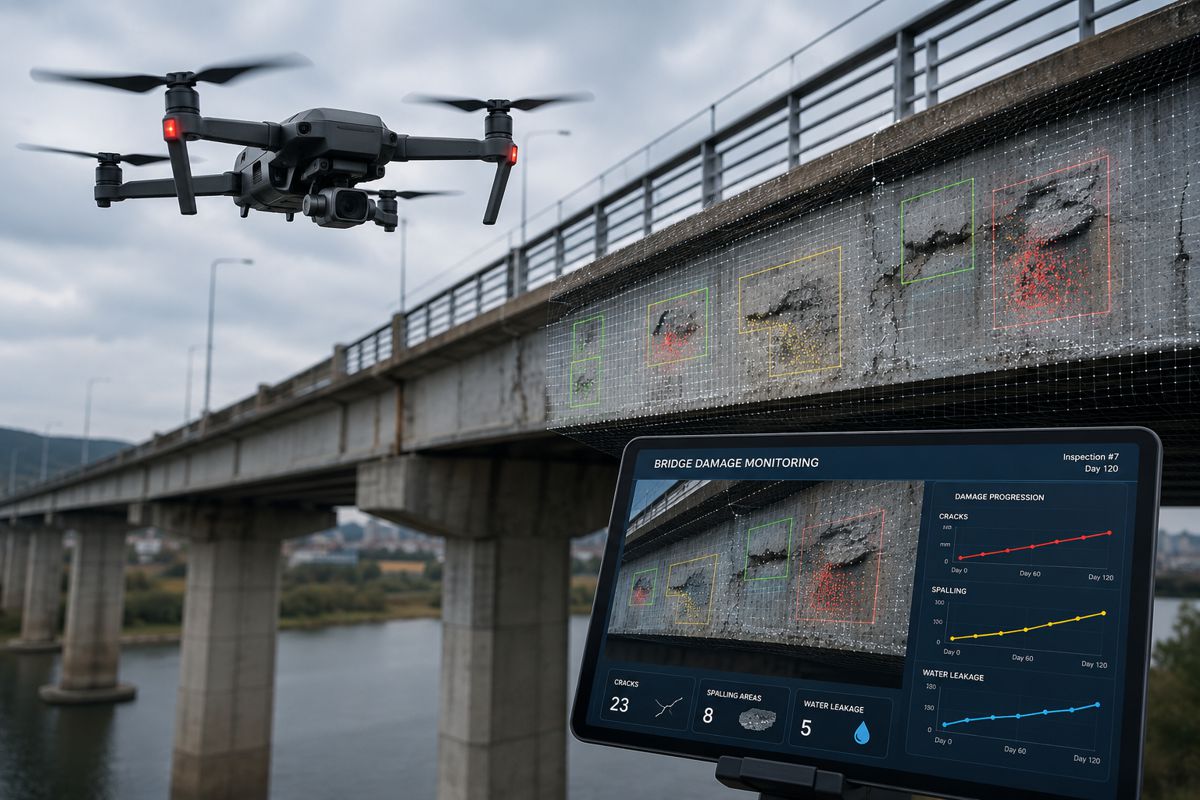
- The system builds a three-dimensional model of a bridge at the first inspection, then automatically aligns later images to that single reference model using hierarchical localisation and image clustering, so the same defect can be compared even when photographed from different positions.
- Global Navigation Satellite System data is used to convert image measurements into real-world dimensions, and in a 120-day trial on an in-service prestressed concrete bridge the framework measured damaged areas to within a maximum error of 4.61 per cent against manual measurement.
- Reusing one reference model rather than rebuilding a three-dimensional model at every inspection improves consistency and cuts the computational effort required for long-term assessment, though accuracy may fall on highly curved surfaces.
- The advance lands as commercial value in the sector concentrates around proprietary inspection data and analytics, underlined by Ondas Holdings’ roughly 125 million dollar acquisition of drone-inspection specialist Cyberhawk, completed in August 2026.
The Value Is Moving From the Survey to the Record
For most of the past decade, the story of automated bridge inspection has been a story about access. Drones removed the need for rope-access teams, under-bridge inspection units and lane closures, and computer vision made it feasible to flag cracks and corrosion without a human examining every frame. Those gains were real, but they addressed the cost and safety of capturing a single inspection rather than the harder problem of comparing one inspection with the next.
Because photographs taken months apart are almost never shot from the same position or viewing angle, matching a crack seen in spring to the same crack seen in autumn has remained stubbornly manual, and manual comparison does not scale across a portfolio of hundreds or thousands of structures.
This is the gap the SEOULTECH framework is designed to fill, and its commercial logic is straightforward. An owner who can measure how a defect has grown between two visits can distinguish a stable hairline crack from an actively propagating one, prioritise intervention accordingly and justify the spend to a finance director or a regulator.
As Dr Kim puts it: “Long-term structural monitoring requires more than simply detecting damage, it requires understanding how that damage evolves.” That distinction, between detection and evolution, is where the economic value of inspection increasingly sits, because deterioration rate rather than a point-in-time condition rating is what drives the timing and cost of maintenance.
How the Framework Turns Routine Flights Into a Comparable Record
The technical mechanism is what makes the approach practical rather than merely aspirational. Images from the first inspection are used to reconstruct a three-dimensional model of the bridge, and every subsequent set of drone images is then automatically registered to that same model through hierarchical localisation and image clustering.
In effect, the reference model becomes a fixed coordinate system against which any later photograph can be positioned, so a defect recorded from one angle in January can be located and measured from a different angle in April. Satellite positioning data anchors the model to real-world scale, converting pixel measurements into millimetres and square metres that an engineer can act on.
The results reported from the trial give the method commercial credibility. Over 120 days of monitoring an in-service prestressed concrete bridge, the framework tracked cracks, spalling and water leakage through changing viewpoints and measured damaged areas to within a maximum error of 4.61 per cent of conventional manual measurement, a tolerance that is workable for condition assessment. Just as important for anyone running inspections at scale is the efficiency argument.
Conventional workflows either analyse damage at a single moment or rebuild a three-dimensional model for every inspection, both of which are computationally heavy and inconsistent across time. Anchoring everything to one reference model reduces that computational burden and keeps measurements consistent from visit to visit, which is the difference between a research demonstration and something an asset owner can run repeatedly across a network.
Longer Inspection Intervals Have Raised the Value of Comparability
The regulatory backdrop has quietly made this kind of longitudinal capability more valuable than it would have been a decade ago. When the United States Federal Highway Administration overhauled the National Bridge Inspection Standards in a final rule that took effect in June 2022, it did two things that bear directly on the SEOULTECH work.
It formally recognised the use of unmanned aircraft systems in inspection, and it moved the country from a broadly uniform two-year inspection cycle to risk-based intervals that allow many routine inspections to be extended to as long as 48 months, with certain categories stretching further. The intent was to concentrate scarce inspector time on the structures that need it most rather than inspecting every bridge on the same clock.
Longer gaps between inspections change the economics of what happens in between. If a structure is now examined every four years rather than every two, the ability to extract maximum insight from each visit, and to compare it reliably with the one before, becomes more consequential, not less. A framework that can quantify how far a defect has advanced across a multi-year interval is well matched to a regime that is deliberately widening those intervals.
The same pressure applies in Britain, where authorities manage roughly 72,000 council-maintained road bridges and around 3,000 of them, close to one in 25, are classed as substandard and unable to carry the heaviest 44-tonne lorries. Many of those structures sit under programmes of enhanced monitoring precisely because there is not enough capital to rebuild them, which makes accurate tracking of their decline a budgeting tool rather than an academic nicety.
Where Commercial Value Is Concentrating
The clearest signal of where the market is heading came in August 2026, when Ondas Holdings completed its acquisition of Cyberhawk, a Scottish-founded pioneer of drone-based industrial inspection, in a deal valued at around 125 million dollars and structured largely in cash. What Ondas was buying is instructive. Cyberhawk operates in more than 40 countries and brings its iHawk visual asset-management platform, a reported backlog of about 95 million dollars, and a proprietary data layer built from more than 500,000 infrastructure assets inspected and over 200 terabytes of accumulated inspection data. The advantage sits not in the drones or the flights but in the software and the historical record, the very assets that a comparability framework like SEOULTECH’s is designed to strengthen.
That transaction is part of a broader pattern rather than an isolated bet. Industrial software groups including Bentley Systems and Hexagon have been folding drone-captured imagery into their digital-twin platforms, positioning the inspection itself as a feed into a continuously updated model of the asset. Market estimates put global structural health monitoring at around four billion dollars in 2026, with bridges and dams the largest application segment and civil infrastructure accounting for close to half of demand, while the narrower category of drone bridge inspection services, though still modest in absolute terms, is growing at more than 20 per cent a year off a low base.
The common thread across acquisitions, platform strategies and forecasts is that purchasing power is shifting from the act of capturing an image toward the ability to interpret a sequence of images over time. Academic advances that make repeat inspections directly comparable feed straight into that thesis, because they raise the analytical value of the historical data that platforms are now paying to accumulate.
The Economics of an Ageing Bridge Stock
The demand side of this market is defined by a large, ageing and expensive-to-maintain asset base. The United States alone has 623,218 bridges with an average age of about 47 years, and roughly 45 per cent have already exceeded the 50-year design life they were built to. About 6.8 per cent, more than 42,000 structures, are rated in poor condition, and around a third of the entire inventory needs repair or replacement, a bill the American Road and Transportation Builders Association has put north of 400 billion dollars. The 2021 Infrastructure Investment and Jobs Act directed tens of billions toward bridges, but the funding covers a fraction of the identified need, which forces owners to triage and to justify every intervention on evidence.
This is where predictive maintenance stops being a slogan and becomes a spending strategy. An owner who can show, with measured tolerances, that a given defect is growing faster than its neighbours can move that structure up the queue and defer work on others without raising the risk profile of the network. Dr Kim frames the ambition in exactly those terms, arguing that: “We believe this framework can help engineers make more informed maintenance decisions and contribute to extending the service life of critical infrastructure.”
In Britain, the recently announced one billion pound Structures Fund for bridges, tunnels and flyovers points the same way, channelling limited money toward the structures where intervention delivers the most benefit. In both markets the constraint is not the willingness to spend but the ability to spend precisely, and precise spending depends on knowing not just which bridges are damaged but how quickly the damage is advancing.
From Bridges to the Wider Asset Base
The framework’s stated limitations are worth taking seriously rather than glossing over, because they define where it can be deployed today. The method performs best on relatively flat structural components, and its accuracy may differ on highly curved surfaces, which means it is well suited to the decks, girders and piers that make up the bulk of routine bridge inspection but less immediately applicable to complex geometries.
That is a reasonable boundary for a first published system, and it maps neatly onto the elements engineers most often need to track. The more interesting question for owners is how quickly the underlying approach, anchoring repeat imagery to a single georeferenced reference model, extends beyond the road bridge.
The researchers see clear adjacencies, suggesting the technique could be adapted to monitor tunnels, dams and elevated rail systems, all of which share the same fundamental challenge of comparing condition across long intervals and awkward access. For infrastructure owners, contractors and investors, the strategic implication is consistent across all of those asset classes.
The competitive advantage is accruing to whoever holds the longest, most consistent and most measurable record of an asset’s condition, because that record is what turns raw inspection into a defensible forecast of remaining life. The SEOULTECH work does not create that shift on its own, but it removes one of the practical obstacles that has slowed it, and it arrives at a moment when the market has already started paying a premium for exactly the capability it delivers.
Key Industry Questions
- What problem does the SEOULTECH framework actually solve that existing drone inspection does not? Existing drone inspection is very good at capturing and detecting defects within a single visit, but it struggles to compare inspections taken months apart because the images are shot from different positions and angles. The SEOULTECH framework aligns every later inspection to one three-dimensional reference model built at the first visit, so the same crack or spall can be located and measured over time. That turns a series of one-off surveys into a continuous, measurable record of deterioration, which is what owners need to judge how fast a structure is declining rather than simply what condition it is in on a given day.
- How accurate is the measurement, and is that good enough for real decisions? In a 120-day trial on an in-service prestressed concrete bridge, the system measured damaged areas to within a maximum error of 4.61 per cent compared with conventional manual measurement, while tracking cracks, spalling and water leakage through changing camera viewpoints. For condition assessment and prioritisation, that tolerance is workable, particularly because the value lies in measuring change over time rather than establishing a single absolute figure. Owners are usually more interested in whether a defect is growing, and how quickly, than in a precise one-off dimension, and consistency between repeat measurements is where the approach is strongest.
- Why does this matter commercially rather than just technically? Because the money in inspection is moving from capturing images to interpreting sequences of them. Drones and defect-detection algorithms are now widely available, so margins in flying and detecting are compressing, while proprietary historical data and the analytics that sit on top of it command a premium. Ondas Holdings’ roughly 125 million dollar purchase of Cyberhawk, built around a software platform and a data layer covering more than 500,000 inspected assets, shows where buyers see value. Anything that makes repeat inspections directly comparable raises the analytical worth of that accumulated data.
- How does the change in inspection regulations affect the case for this technology? The United States moved in 2022 to risk-based inspection intervals that let many routine bridge inspections extend from two years to as long as four, and it formally recognised drones as an inspection tool. Longer intervals raise the importance of extracting maximum insight from each visit and comparing it reliably with the last. A framework that can quantify how far a defect has advanced across a multi-year gap fits a regime that is deliberately widening those gaps, which strengthens the commercial rationale for adopting comparable, longitudinal monitoring rather than treating each inspection in isolation.
- Which asset owners stand to benefit first? Owners of large, ageing portfolios with constrained budgets have the most to gain, because they cannot repair everything and must triage on evidence. In the United States that means state departments of transportation managing inventories where roughly 45 per cent of bridges have passed their design life. In Britain it means councils overseeing around 72,000 bridges, some 3,000 of which are substandard and under enhanced monitoring. For these owners, accurate tracking of deterioration is a budgeting instrument that helps direct limited funds, such as Britain’s new one billion pound Structures Fund, toward the structures where intervention delivers the most value.
- What are the limitations engineers should be aware of? The method works best on relatively flat structural components such as decks, girders and piers, and its accuracy may differ on highly curved surfaces, so it does not yet suit every geometry. It also depends on the quality and coverage of the drone imagery captured during routine inspections, and on reliable satellite positioning to anchor measurements to real-world scale. These are reasonable constraints for a newly published system and align with the elements most commonly inspected, but owners should scope deployments around the components the method handles well rather than assuming universal coverage from the outset.
- Can the approach extend beyond road bridges? The researchers suggest the underlying technique could be adapted to tunnels, dams and elevated rail systems, all of which face the same core difficulty of comparing condition across long intervals and difficult access. The essential idea, anchoring repeat imagery to a single georeferenced reference model, is asset-agnostic, so the principal work in each new asset class is handling its particular geometry and inspection constraints. That adjacency is commercially significant because it widens the addressable market for comparability tools well beyond the road bridge, into the broader base of civil and transport infrastructure that owners must monitor over decades.
- What should industry leaders do with this information now? Leaders should treat inspection data as a long-term asset rather than a disposable output, and prioritise systems and contracts that preserve comparable, georeferenced records over time. When commissioning drone inspections, it is worth specifying that imagery and models be captured and stored in a way that supports future comparison, not just present-day defect reporting. On the investment side, the pattern of recent acquisitions suggests value is accruing to owners of proprietary inspection data and analytics platforms, so procurement and partnership decisions should weigh who will control the historical record, because that record is what ultimately converts inspection into a defensible forecast of remaining service life.
Strategic Takeaways
- The commercial centre of gravity in bridge inspection is shifting from capturing individual surveys to owning a comparable, longitudinal record of an asset’s condition, and advances that make repeat inspections directly comparable feed straight into that shift.
- Deterioration rate, not a point-in-time condition rating, is the metric that drives maintenance timing and cost, which is why the ability to measure how a defect grows between inspections has outsized budgeting and regulatory value.
- Regulatory moves toward longer, risk-based inspection intervals and formal acceptance of drones increase the payoff from extracting and comparing high-quality data at each visit, favouring owners who invest in continuous monitoring capability.
- Recent deal-making, led by Ondas Holdings’ roughly 125 million dollar acquisition of Cyberhawk and the folding of drone imagery into digital-twin platforms by groups such as Bentley Systems and Hexagon, confirms that buyers are paying a premium for proprietary inspection data and analytics rather than for flights alone.
- With large shares of the United States and United Kingdom bridge stocks past or near their design lives and repair backlogs measured in hundreds of billions of dollars and billions of pounds, precise, evidence-led triage is becoming a spending strategy, and comparable long-term monitoring is the tool that enables it.