ASTM Proposed Asphalt Cracking Standard Strengthens Balanced Mix Design
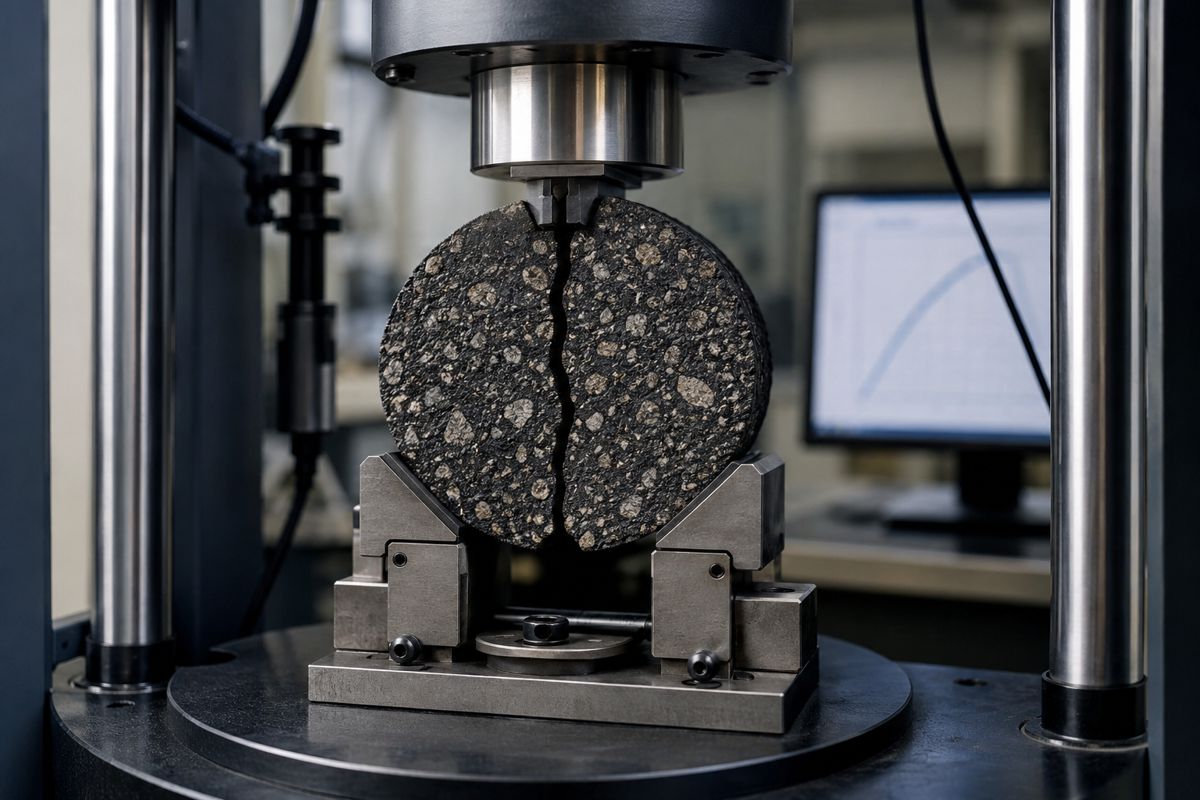
ASTM International’s road and paving materials committee, D04, is developing a proposed test method for evaluating load-induced cracking in asphalt mixtures at intermediate temperatures. Catalogued as WK89666 and based around the Superpave indirect tension test, the work could easily be regarded as another specialist addition to an already extensive library of pavement-testing standards. Its importance is broader than that. It arrives as highway authorities are moving further away from specifying asphalt primarily by recipe and towards purchasing mixtures on the basis of how they are expected to perform in service.
Cracking remains one of the more difficult parts of that transition. Rutting resistance has been accommodated comparatively comfortably within modern mixture design, whereas cracking covers several different failure mechanisms and has proved harder to reduce to a practical specification that laboratories, producers and road authorities can use consistently. That matters commercially because cracking drives resurfacing programmes, contributes to maintenance backlogs and can sit at the centre of arguments over whether premature pavement deterioration is attributable to materials, construction or design. A repeatable measure that can be written confidently into a specification therefore does more than improve laboratory analysis: it gives durability greater contractual weight.
For asphalt producers, that changes the competitive equation. If cracking resistance can be demonstrated rather than inferred from a prescribed mixture, producers have more scope to optimise binder, aggregate, reclaimed asphalt and additives around an outcome. Testing laboratories and equipment manufacturers gain from the additional demand for performance verification, while suppliers of rejuvenators and modifiers gain a more defensible means of showing what their products contribute. The eventual value of WK89666 will depend on how the proposed method develops and how widely it is adopted, but it sits squarely within a much larger change in how road authorities define what constitutes good asphalt.
Briefing
- ASTM committee D04 is developing WK89666 to measure tensile creep compliance and tensile failure limits in asphalt mixtures using the Superpave indirect tension test at intermediate temperatures, providing another means of assessing load-induced cracking.
- The approach combines the rate at which damage accumulates, expressed through creep compliance rate, with a failure limit representing the energy required to initiate or propagate a crack.
- The proposal arrives as more than 30 US states have begun moving towards Balanced Mix Design, where rutting and cracking performance are considered alongside, or increasingly instead of relying solely upon, traditional volumetric requirements.
- Cracking remains a more complicated specification problem than rutting because different mechanisms, materials, climates and pavement structures can produce very different failure behaviour.
- ASTM is seeking participation from highway agencies, universities, laboratories, equipment manufacturers, asphalt producers and consultants, giving industry an opportunity to help determine how the proposed method develops.
Closing the Gap in Balanced Mix Design
The movement towards Balanced Mix Design has been building for years, driven by a fairly straightforward limitation in conventional asphalt specification. Volumetric properties such as air voids, binder content and aggregate structure remain valuable controls, but they cannot by themselves describe everything that happens to a pavement under years of traffic, temperature cycling, oxidation and environmental exposure. An asphalt mixture can satisfy its recipe perfectly and still not deliver the durability an owner expected.
The development of Superpave across the United States during the 1990s was heavily influenced by the need to improve resistance to permanent deformation. Over time, however, pavement research and field experience demonstrated the need to consider cracking resistance alongside rutting rather than allowing one performance objective to dominate mixture optimisation. Balanced Mix Design emerged from that experience, bringing performance testing into the mixture-design process so that resistance to the two principal modes of deterioration can be considered together. More than 30 states have now begun integrating BMD into their specifications, supported by AASHTO guidance and industry resources.
Cracking is the awkward part because there is no single cracking problem to solve. Repeated traffic loading, low temperatures, ageing and reflection from underlying pavement features can each create different forms of distress, while aggregate, binder grade, recycled material and pavement structure influence how quickly those failures develop. Survey work compiled by the National Center for Asphalt Technology has shown a greater level of agency adoption for rutting tests than cracking tests, illustrating the imbalance that remains within performance-based mixture design.
WK89666 is relevant because it addresses a particular part of that problem: load-induced cracking at intermediate temperatures. It will not make the other cracking tests redundant, nor does it need to. What it could provide is another standardised piece of evidence that agencies can use when deciding whether a mixture is likely to retain sufficient cracking resistance once it moves from the laboratory into a heavily trafficked pavement.
Measuring Damage Before the Pavement Fails
The proposed method is interesting because it does not attempt to compress the behaviour of the asphalt mixture into one convenient headline number. Instead, it considers two properties that describe different parts of the failure process.
David Hernando, assistant professor of applied engineering at the University of Antwerp and an ASTM member involved in the work, explains the distinction: “One distinguishing feature of this standard is the combination of a material property indicative of the rate at which damage accumulates, called creep compliance rate, with a failure limit that quantifies how much energy is required to initiate or propagate a crack.”
That difference is important in practice. Two asphalt mixtures can appear broadly comparable if attention is concentrated on peak strength or the point at which a laboratory specimen finally fails, yet reach that point by quite different routes. A mixture that progressively accumulates damage under sustained loading may behave differently over its service life from one that resists that deterioration for longer, even where their eventual failure measurements appear similar.
Bringing creep behaviour and the energy associated with fracture together is intended to provide a more complete description of that process. It reflects established fracture-mechanics thinking in pavement engineering and could be particularly useful where engineers want material properties capable of supporting deeper pavement analysis rather than simply deciding whether a production sample passes or fails.
There is also a practical attraction in the Superpave indirect tension configuration. Familiar equipment and test principles can make a new method easier for laboratories to accommodate than an entirely unfamiliar testing regime, although the real test of its suitability for widespread specification will be whether different laboratories can reproduce results consistently without creating excessive cost or delay. For performance testing to migrate successfully into routine procurement, sophistication has to be matched by repeatability and workable throughput.
There Will Not Be One Cracking Test
The asphalt sector is not short of ways to investigate cracking. ASTM already publishes methods including the indirect tensile cracking test under D8225, the semi-circular bend method under D8044, the disk-shaped compact tension fracture-energy test under D7313 and thermal cracking testing under D8303. Their continued coexistence reflects the reality that pavement cracking cannot sensibly be reduced to a single mechanism.
Hernando acknowledges precisely that point: “There are already several standard methods for evaluating the cracking performance of asphalt mixtures, and for good reason.” Climate, traffic, pavement structure and locally available materials all influence which form of deterioration matters most, leaving agencies to select tests that correspond with the problems experienced on their own networks.
The more useful distinction may eventually be between the depth of information required at different stages of the asphalt process. Fast index tests have obvious value where a plant or quality-control laboratory needs to process specimens routinely and make decisions quickly. More fundamental measurements become attractive when a mixture is being designed, an unfamiliar material is being assessed, a pavement failure is being investigated or competing formulations need to be understood in greater depth.
WK89666 appears well suited to that latter territory. Reporting damage accumulation alongside a failure property gives engineers information that can potentially travel further into mechanistic analysis than a single index. Rather than triggering a contest in which one cracking test eventually eliminates all the others, the direction of travel points towards a hierarchy of testing: practical methods for everyday production and more detailed characterisation where the engineering or commercial consequences justify it.
That is a healthier model for pavement procurement. The objective is not to maximise the amount of testing attached to every tonne of asphalt, but to use enough meaningful evidence to control the risks that actually threaten pavement life.
Recycled Asphalt Makes the Performance Question More Urgent
Perhaps the strongest reason for improving cracking measurement is the growing importance of reclaimed asphalt pavement. RAP is already one of road construction’s most valuable secondary materials because it contains both aggregate and residual bituminous binder. Increasing its use can reduce demand for virgin resources and lower material costs, but the aged binder contained within reclaimed pavement also changes mixture behaviour.
That creates a familiar design tension. Increasing recycled content can contribute additional stiffness, while excessive stiffness can reduce cracking tolerance unless the overall mixture is adjusted appropriately. Rejuvenators, softer virgin binders, polymers and changes to aggregate structure provide engineers with several ways of managing that balance, but a prescriptive specification can only accommodate so many variables before it begins to restrict the very optimisation it is intended to control.
Performance testing offers another way through. Instead of assuming that a certain proportion of reclaimed material is acceptable and another proportion is inherently risky, the producer can design the complete mixture and demonstrate whether it meets the required cracking and rutting thresholds. This does not mean recycled content can be increased without limit; it means the engineering decision can increasingly be based on the behaviour of the finished material rather than a percentage viewed in isolation.
For suppliers of rejuvenators and binder modifiers, that is particularly important. A product that promises to improve flexibility or restore properties affected by aged binder is commercially much stronger when its contribution can be demonstrated through a recognised performance test. Producers likewise gain more freedom to work with locally available RAP stockpiles and optimise virgin binder consumption if they can prove that the resulting mixture remains durable.
ASTM links the work with United Nations Sustainable Development Goals 9 and 12, covering infrastructure and responsible consumption and production. The more immediate relevance for road authorities is lifecycle economics. If better mixture design extends the interval between resurfacing interventions, the owner consumes less aggregate and bitumen, requires fewer construction operations and exposes road users to fewer maintenance closures. In that context, additional laboratory testing is not simply another production cost; it becomes part of the investment case for extracting more service from each tonne of pavement material.
Performance Specifications Redistribute Commercial Advantage
Whenever procurement moves from prescribing inputs towards specifying outcomes, competitive advantage moves with it. Asphalt is unlikely to be different.
Testing laboratories are an obvious part of that change because more performance-led specifications mean more specimens, more sophisticated measurements and greater demand for reliable interlaboratory results. Equipment manufacturers supplying indirect tension systems, environmental conditioning equipment and deformation instrumentation are exposed to the same trend. The opportunity is unlikely to come from WK89666 alone; it comes from the accumulation of performance requirements across mixture design, validation and potentially production quality assurance.
For asphalt producers, the effect is more fundamental. Recipe-led procurement tends to narrow differentiation because compliant suppliers are largely being asked to manufacture variations of a mixture already defined by the client. Performance-led procurement can give technically capable producers more room to develop their own route to the required result. Aggregate grading, binder selection, RAP content, modifiers and production parameters become variables that can be optimised within the boundaries of measured performance.
That freedom carries responsibility. A producer proposing an unconventional mixture cannot rely simply on assurances that it should work; laboratory evidence becomes part of the proposition. Firms with strong technical teams, good historical data and reliable testing capacity should consequently be better placed to exploit performance specifications than businesses built primarily around producing established recipes at the lowest possible cost.
Standardisation also has implications once something goes wrong. A published and reproducible method gives the contractor, producer and road authority a shared basis for examining whether material properties were within specification, rather than relying on proprietary tests or incompatible laboratory procedures. That cannot eliminate disputes over pavement failure (workmanship, structural design, drainage, loading and numerous other factors remain relevant), but a common measurement framework can narrow the area of uncertainty.
The broader commercial direction is therefore towards evidence. Suppliers able to quantify what their materials contribute, producers able to demonstrate what their mixtures can withstand and laboratories able to reproduce those measurements reliably all become more important as performance carries greater weight in the purchasing decision.
The Standard is Still Being Shaped
There is a temptation to treat standards as something that simply arrives one morning and is then implemented by industry. In reality, the period before publication can be commercially important because the participants help determine whether the eventual method reflects real materials, laboratory constraints and field conditions.
ASTM is actively seeking broader involvement in WK89666. Hernando makes the case directly: “ASTM road and paving standards are strengthened through broad participation from highway agencies, universities, testing laboratories, equipment manufacturers, asphalt producers, and consultants.”
That breadth matters. A highway authority approaches a test from the perspective of network risk and contractual enforcement; a producer is concerned with variability and production practicality; a laboratory understands throughput and repeatability; an equipment manufacturer sees the limitations of measurement systems; while researchers can challenge whether the property being measured genuinely describes the mechanism of interest. A useful standard has to survive all of those perspectives.
There is also a strategic reason for companies to participate rather than waiting for the finished document. Testing procedures influence equipment investment, product development and the evidence suppliers will eventually need to enter particular markets. Organisations involved early gain visibility of that direction and an opportunity to contribute operational experience before requirements become embedded in procurement.
For road authorities already moving towards Balanced Mix Design, the development of cracking standards should also encourage a broader review of how performance is incorporated into contracts. A cracking threshold has limited value if specimen preparation, laboratory competence, sampling frequency and dispute procedures remain unclear. Conversely, once those elements mature together, performance specification becomes considerably more powerful because the owner can define the outcome without having to dictate every component used to achieve it.
Buying More Pavement Life, Not Simply More Asphalt
The deeper change behind WK89666 is therefore not a new laboratory procedure but a gradual redefinition of what road authorities purchase. Asphalt has traditionally been procured through a combination of material requirements, mixture recipes, workmanship standards and price. Performance testing adds another dimension by making some of the properties that determine future service life measurable before years of traffic reveal whether the mixture was actually durable.
That does not make conventional specifications obsolete. Volumetric design, material controls and production quality assurance remain important precisely because pavement performance is affected by far more than laboratory cracking resistance. What changes is the amount of confidence that agencies can place in the behaviour of the finished mixture, particularly when producers want to introduce more reclaimed material, different binders or additives that sit outside familiar recipes.
For the supply chain, the opportunity is equally clear. Performance-based procurement gives technically capable businesses more scope to compete on engineering rather than simply tonnes and price. Laboratories become part of the value proposition, material suppliers gain better ways of demonstrating contribution, and producers can potentially extract greater value from formulation expertise and recycled resources.
WK89666 is only one proposed method within that much larger transition. Yet the problem it addresses is central to whether Balanced Mix Design fulfils its promise. Rutting resistance and cracking resistance have to work together if a mixture is genuinely to be balanced, and road authorities need enough confidence in both measurements to put money and contractual responsibility behind them.
As that confidence improves, the asphalt market moves incrementally away from buying an approved recipe and towards buying evidence of expected performance. For infrastructure owners facing large maintenance liabilities, and for producers looking to distinguish better mixtures from merely cheaper ones, that may ultimately matter far more than the number assigned to the standard.
Key Industry Questions
What is Balanced Mix Design, and why does cracking testing matter? Balanced Mix Design evaluates an asphalt mixture using performance tests alongside conventional mixture-design controls, with particular emphasis on achieving sufficient resistance to both rutting and cracking. The balance matters because improving one property can adversely affect another; making a mixture stiffer, for example, may improve resistance to permanent deformation while reducing tolerance to cracking. A credible cracking test gives agencies a measurable means of controlling that side of the equation. It also gives producers evidence with which to demonstrate that changes involving reclaimed asphalt, binder selection or additives have not compromised expected durability.
How does the proposed method differ from tests such as IDEAL-CT or SCB? The principal distinction is the information it is intended to provide. Faster index-style tests are attractive for quality control because they condense mixture behaviour into a practical metric that can be compared with an acceptance threshold. WK89666 instead combines creep compliance rate, describing damage accumulation, with a failure limit associated with the energy required to initiate or propagate cracking. That places the method towards the more fundamental or mechanistic end of asphalt characterisation. The approaches need not compete directly: relatively quick tests can remain valuable for production control while more detailed methods support mixture design, investigation and engineering analysis.
Will WK89666 replace existing ASTM asphalt cracking tests? There is little reason to expect a single method to replace the existing toolbox because asphalt cracking occurs through several mechanisms. ASTM already has methods addressing indirect tensile cracking, semi-circular bend behaviour, fracture energy and thermal cracking, among others. WK89666 is aimed specifically at load-induced cracking at intermediate temperatures and therefore addresses a particular engineering requirement. Agencies are likely to continue selecting methods according to climate, traffic, pavement construction, available laboratory capability and the forms of distress experienced on their networks. In some specifications, a simple production test may also sit alongside a more detailed design or characterisation method.
How could improved cracking testing affect reclaimed asphalt use? Reclaimed asphalt introduces valuable aggregate and residual binder into new mixtures, reducing demand for virgin materials, but aged binder can increase stiffness and affect cracking behaviour. Performance testing gives producers a way to evaluate the complete mixture after variables such as RAP content, virgin binder grade, rejuvenator dosage and aggregate structure have been adjusted. Rather than treating recycled content alone as a proxy for risk, an agency can increasingly examine whether the finished mixture meets the required performance threshold. That could support greater use of reclaimed materials where engineering evidence demonstrates that durability has been maintained.
What is the lifecycle argument for performance-based cracking specifications? Premature cracking can shorten resurfacing intervals and bring forward expenditure on materials, plant, labour and traffic management. If performance testing helps agencies identify mixtures with greater resistance to the cracking mechanisms affecting a particular network, the potential benefit extends throughout the pavement lifecycle. Longer intervals between interventions reduce demand for bitumen and aggregate and can also reduce disruption and emissions associated with repeat construction. The economic case therefore depends on whether the additional cost of mixture characterisation contributes to longer and more predictable service life. On heavily trafficked or strategically important roads, even modest extensions to maintenance intervals can have value beyond the direct paving cost.
Who benefits commercially from greater use of asphalt performance testing? The clearest opportunities fall to businesses capable of producing, measuring or improving demonstrable pavement performance. Independent and contractor laboratories can see greater testing demand, while equipment and instrumentation manufacturers supply the systems required to generate reliable results. Binder modifiers, rejuvenators and other material suppliers gain recognised measurements against which their contribution can be assessed. Asphalt producers with sophisticated mixture-design and laboratory capability may have more freedom to optimise formulations and distinguish themselves in tenders. The corresponding challenge is that performance-based procurement demands stronger evidence, meaning technical capability and data become more important competitive assets.
Why is international participation relevant to an ASTM asphalt standard? Pavement materials, testing methods and design practices increasingly cross national boundaries even where specifications themselves remain jurisdiction-specific. Researchers and laboratories outside the United States work with Superpave-derived methods, fracture mechanics and similar performance questions, while equipment manufacturers and material suppliers frequently operate internationally. Participation from different markets can expose a proposed method to a wider range of aggregates, binders, climates and laboratory practices. David Hernando’s involvement from the University of Antwerp illustrates that broader technical community. It does not make the eventual standard universal, but wider participation can strengthen its evidence base and reveal practical limitations before publication.
How can asphalt companies and road authorities influence the proposed standard? ASTM is seeking participation in development through its road and paving materials committee. Highway agencies, universities, laboratories, equipment manufacturers, producers and consultants can therefore contribute experience with testing procedures, materials and field performance while the method is still being developed. For commercial organisations, involvement also provides insight into the direction of future testing requirements and the laboratory capability that may be needed if the method gains adoption. Participation should not be regarded simply as an opportunity to influence thresholds in a company’s favour; broad technical scrutiny is what gives a standard sufficient credibility for agencies and contractors eventually to rely upon it.
Strategic Takeaways
- The importance of WK89666 extends beyond another asphalt laboratory procedure. Better cracking measurement strengthens the performance side of Balanced Mix Design and could give durability greater weight in procurement decisions.
- Performance specifications favour technical capability. Producers, laboratories and material suppliers able to demonstrate measurable improvements in mixture behaviour have more scope to compete on engineering value rather than price and recipe compliance alone.
- Different cracking tests will continue to serve different purposes. Faster index tests suit routine production, while more fundamental measurements can provide the depth required for mixture development, engineering analysis and failure investigation.
- Reclaimed asphalt increases the value of credible performance testing. As producers optimise RAP, binder and rejuvenator combinations, measuring the behaviour of the finished mixture offers a more sophisticated way of managing durability risk.
- Standards development is part of market development. Agencies and companies participating while WK89666 is being shaped can contribute practical experience before testing procedures become established within specifications and investment decisions.