NVIDIA Opens Alpamayo 2 Super for Commercial Autonomous Driving
NVIDIA has made its 34-billion-parameter Alpamayo 2 Super autonomous-driving model available for commercial use, giving vehicle developers permission to fine-tune, modify and redistribute one of the company’s most capable reasoning models rather than confining it to research and development.
The change goes considerably further than another improvement in autonomous-driving benchmark performance. Alpamayo 2 Super combines full-surround visual perception, driving reasoning and trajectory generation within the same foundation model, while producing outputs that allow engineers to examine the connection between what the system has observed, the decision it has reached and the path it intends to take. Developers can now build commercial systems from that foundation, including models adapted using proprietary fleet data.
Released under the Linux Foundation’s OpenMDW-1.1 licence, Alpamayo 2 Super can be fine-tuned and used to create derivative models, which can themselves be commercially redistributed. NVIDIA says model outputs carry no additional licence conditions. Earlier Alpamayo releases were positioned primarily for R&D, while the OpenMDW licensing framework is now being extended across the Alpamayo family.
Briefing
- Alpamayo 2 Super is an open 34-billion-parameter vision-language-action model for autonomous vehicle development.
- The model is released under the permissive Linux Foundation OpenMDW-1.1 licence for commercial use, modification and redistribution.
- It processes 360-degree visual information from up to seven cameras and can generate vehicle trajectories alongside reasoning traces and high-level driving actions.
- NVIDIA reports a LingoQA score of 79.2, ranking Alpamayo 2 Super first among 37 models evaluated in its testing.
- The model is intended primarily as a powerful development and teacher model, with distilled models subsequently capable of running in vehicles.
From Foundation Model to Driving Policy
Alpamayo 2 Super is built around NVIDIA’s 32-billion-parameter Cosmos 3 Super Reasoner, coupled with a 2-billion-parameter diffusion-based Action Expert. The reasoner processes multi-camera video, language context and the vehicle’s previous movement, while the Action Expert converts the resulting representation into a future trajectory.
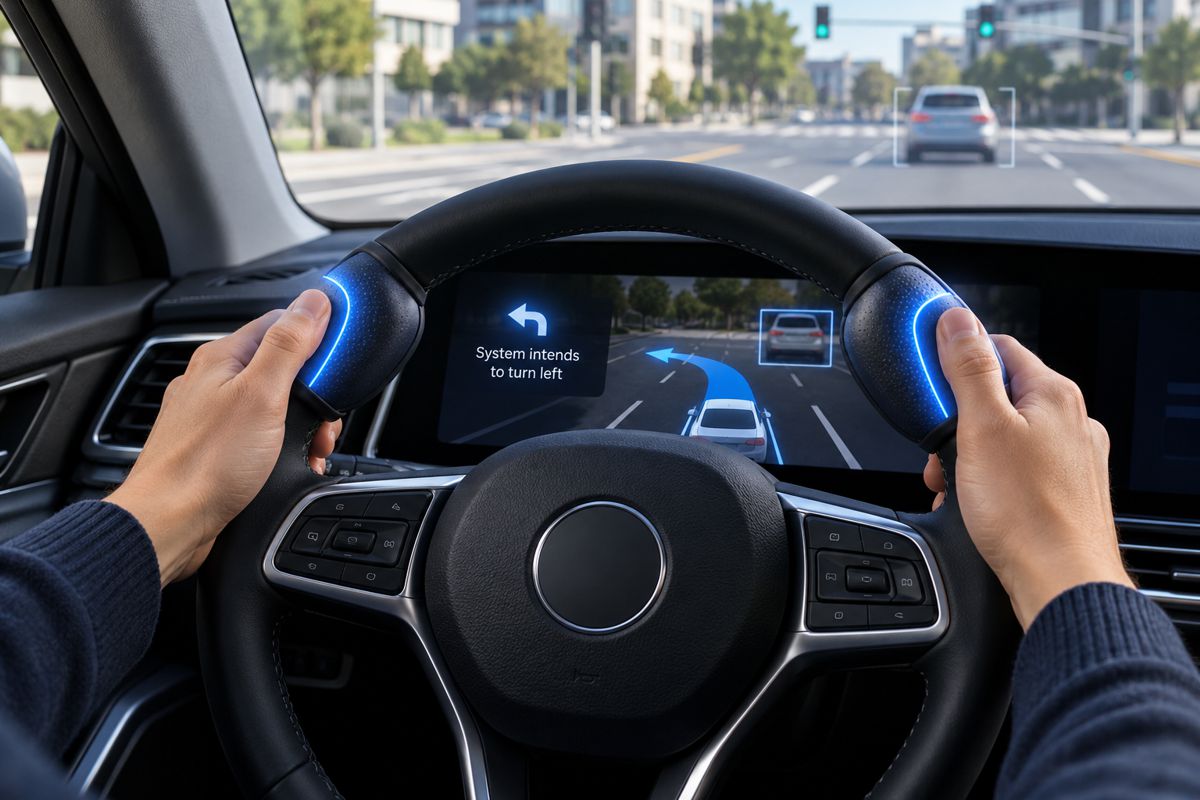
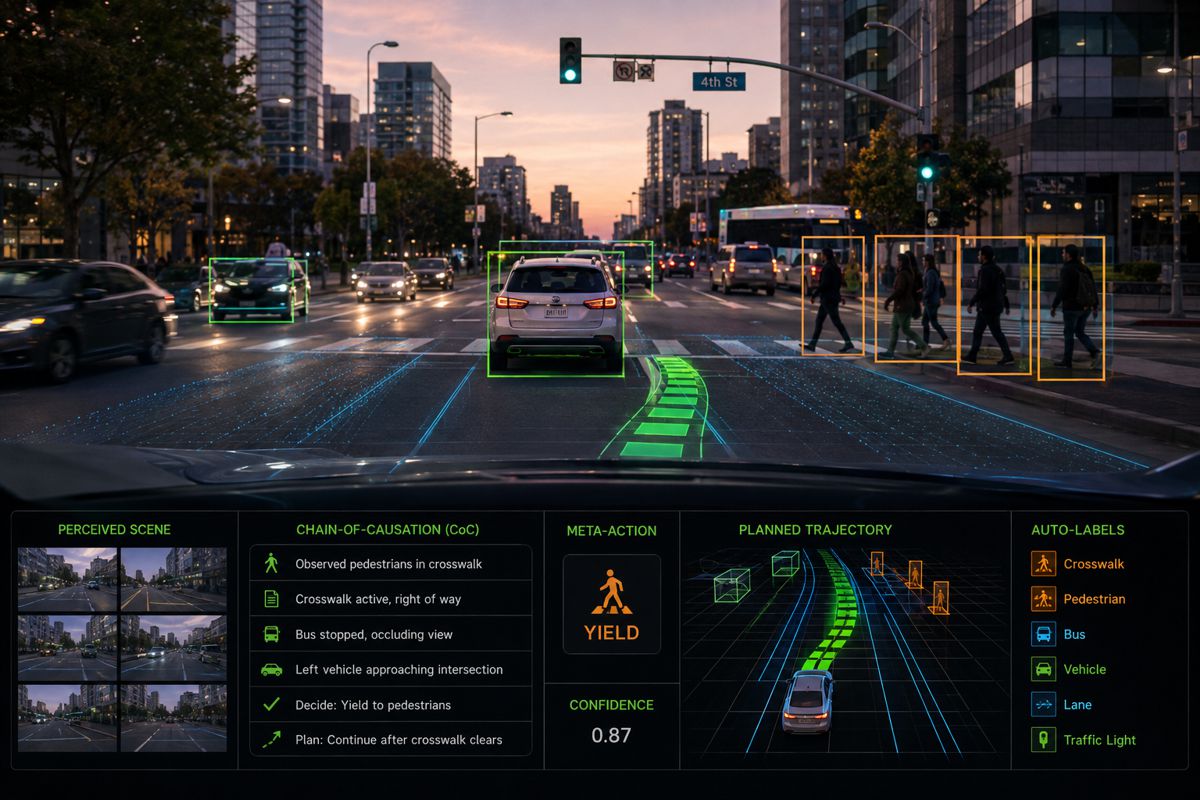
The architecture brings together tasks that have traditionally been handled by separate parts of an autonomous-driving development environment. The model can generate a planned trajectory, a Chain-of-Causation reasoning trace explaining the decision, a high-level “meta-action” such as yielding, stopping or changing lanes, visual question-and-answer responses grounded in the camera imagery, and reasoning auto-labels for training and validation data.
These outputs are tightly related rather than being produced as isolated analytical tools. An engineer examining a difficult traffic interaction can look at the scene perceived by the model, its interpretation of what is happening, the high-level manoeuvre it has selected and the resulting vehicle trajectory.
The approach is particularly relevant to the long-tail situations which remain among the harder problems in autonomous driving. Routine lane following and predictable junction behaviour can be represented extensively in training data. Unusual roadworks, partially obscured vehicles and interactions where the intentions of other road users are ambiguous present a different problem.
Commercial Freedom Around the Model
The licensing change gives autonomous-driving companies considerably more room to decide where NVIDIA’s technology ends and their own intellectual property begins.
OpenMDW-1.1 was released by the Linux Foundation in May 2026 as a licensing framework specifically designed for AI model distributions. Unlike conventional software licences applied to model weights and related artefacts, it can cover architecture, trained parameters, code, documentation, datasets and evaluation material supplied as part of a model distribution. The framework grants broad rights to use, modify and distribute covered model materials without field-of-use restrictions.
An AV developer can take the Alpamayo foundation model, fine-tune it against proprietary fleet information, create derivative models and retain the specialised knowledge produced through that work. Alpamayo can also be used as an offline teacher or labelling system without requiring commercial vehicles to depend on a remote proprietary model service.
Autonomous driving remains a capital-intensive business in which data accumulated over millions of kilometres can represent a substantial competitive asset. Companies building their own driving systems have good reason to retain control of that information and avoid placing critical capabilities behind technology they cannot sufficiently modify, inspect or deploy independently.
Permissive licensing does not remove dependence on NVIDIA’s broader computing ecosystem, particularly where developers choose DRIVE hardware and NVIDIA’s simulation and development tools. It does give engineering teams much greater control over the model itself.
Reasoning That Engineers Can Examine
NVIDIA calls its explanatory output Chain-of-Causation, or CoC. Rather than producing only a steering or trajectory command, Alpamayo can generate a trace connecting observations within the driving scene to the action it proposes.
An explanation generated by an AI system should not automatically be treated as proof of the internal mechanism by which every neural computation occurred. Within an engineering workflow, however, a consistent reasoning output linked to visual grounding, vehicle intent and trajectory provides another artefact for testing and validation.
The same capability can be applied to fleet data. Alpamayo 2 Super can operate as an auto-labeler, generating reasoning annotations from recorded driving clips and grounding its responses in particular areas of the camera image. NVIDIA says this can reduce annotation processes that previously took months to days.
That could make the model useful even where it never directly controls a production vehicle. Autonomous fleets generate enormous quantities of sensor data, but rare scenarios still have to be found, classified and understood before they can improve the next generation of the driving system. A large foundation model can sit behind the fleet as a teacher, data engine and evaluator.
From the Data Centre to the Vehicle
The size of Alpamayo 2 Super makes that division particularly relevant. A 34-billion-parameter reasoning model represents considerably more computation than developers will generally want to place directly into every production vehicle.
NVIDIA’s proposed workflow uses Alpamayo 2 Super at frontier scale during development, including the generation of reasoning traces, synthetic training information and teacher outputs. Knowledge can then be distilled into smaller specialised models optimised for real-time vehicle inference, including deployment on NVIDIA DRIVE AGX Thor.
The Alpamayo family spans different computational requirements. Alpamayo 1 and Alpamayo 1.5 are 10-billion-parameter models, while the 34-billion-parameter Super version provides the highest reasoning and driving performance in the range.
The separation between the intelligence used to develop a driving system and the intelligence ultimately deployed in the vehicle resembles a broader pattern emerging across physical AI. Large models can perform expensive reasoning, simulation, data generation and supervision in the data centre while smaller models inherit enough of that capability to operate within the power, latency and hardware constraints of a machine.
For robotaxis, autonomous trucks and eventually other highly automated vehicles, it provides a practical alternative to treating the largest available model as the production runtime.
Testing the Model
NVIDIA reports that Alpamayo 2 Super achieved 79.2 on the LingoQA autonomous-driving reasoning benchmark using the Lingo-Judge metric, placing first among 37 models evaluated. Its reported score was 17 points higher than Qwen2.5-VL 72B, 15.1 points above Gemini 2.5 Pro and 23.2 points above GPT-4o.
Recorded-data tests have an inherent limitation for autonomous driving. A vehicle’s actions change the environment it subsequently has to interpret, so a trajectory that appears reasonable against a prerecorded future may produce a different sequence of events once the vehicle actually takes that action.
NVIDIA has also evaluated Alpamayo 2 Super in closed-loop simulation using AlpaSim. Across 913 reconstructed scenes, it reported a score of 1.50 ± 0.13, compared with 1.37 ± 0.10 for Alpamayo 1.5 Nano. Here the simulated environment responds to the model’s driving decisions, allowing collisions, road departures, close encounters and other problems to emerge in ways that static comparisons can miss.
These remain NVIDIA-reported results using a mixture of established and NVIDIA-developed datasets and evaluation systems. They provide evidence of the model’s capabilities, but are not equivalent to certification of an autonomous-driving system or proof of safety in unrestricted real-world operation.
Safety Engineering and Inspectable AI
More inspectable driving models are arriving as autonomous-vehicle safety assurance becomes increasingly formalised.
ISO/PAS 8800:2024 addresses safety and artificial intelligence in series-production road vehicles, including risks arising from insufficient AI outputs, systematic errors and random hardware errors. NVIDIA says Alpamayo’s CoC traces can be incorporated into its Halos safety-validation workflows in support of AI safety engineering aligned with the standard.
A reasoning trace does not solve the validation problem, but it gives safety engineers another source of evidence when investigating behaviour, particularly when combined with closed-loop simulation, recorded fleet data and reconstructed rare events.
Building an Autonomous-Driving Development Stack
Alpamayo is increasingly one component of a larger NVIDIA development environment rather than a standalone model. AlpaSim provides closed-loop simulation, while AlpaGym supplies a high-throughput reinforcement-learning framework. NVIDIA’s Physical AI datasets provide training and evaluation material alongside open training recipes and auto-labelling workflows.
Together, the components support a continuous development cycle. Fleet data can reveal difficult events, recorded scenes can be reconstructed or labelled, large reasoning models can examine them, simulation can explore alternative outcomes, reinforcement learning can improve policies and distilled models can return to the vehicle.
Opening the commercial rights around the reasoning model makes that architecture available to companies that want to build proprietary systems on top of NVIDIA’s foundations rather than simply consume an NVIDIA product.
There remains a considerable distance between benchmark leadership and a driverless vehicle negotiating public roads safely for years at fleet scale. Autonomous driving has provided enough reminders that demonstrations, simulation results and development milestones should not be confused with that final standard.
Alpamayo 2 Super changes where some of that development work can begin. A robotaxi or autonomous-vehicle developer no longer necessarily has to build every foundation capability itself to retain ownership and control of the specialised driving system it eventually deploys.
The competitive work can move further up the stack, into fleet data, fine-tuning, safety engineering, validation and the thousands of operating decisions that distinguish a capable autonomous-driving model from a commercially deployable vehicle.
Key Industry Questions
- What is NVIDIA Alpamayo 2 Super? Alpamayo 2 Super is a 34-billion-parameter vision-language-action foundation model designed for autonomous vehicle and robotaxi development. It combines visual reasoning with vehicle trajectory generation and other driving-related tasks.
- Can Alpamayo 2 Super be used commercially? Yes. NVIDIA has released it under the Linux Foundation’s OpenMDW-1.1 licence, which permits commercial use, modification, fine-tuning and the creation and redistribution of derivative models subject to the licence terms.
- Does Alpamayo 2 Super run directly in autonomous vehicles? Its primary role is as a large development and reasoning model. NVIDIA envisages it being used as a teacher model from which smaller specialised models can be distilled and optimised for real-time deployment on vehicle hardware such as DRIVE AGX Thor.
- What is Chain-of-Causation reasoning? It is NVIDIA’s system for generating a trace connecting observations within a driving scene with the model’s proposed driving decision. It can be examined alongside the vehicle’s intended meta-action and trajectory.
- How many cameras can Alpamayo 2 Super process? NVIDIA says the model supports 360-degree perception using up to seven cameras.
- Can developers train it using their own vehicle data? Yes. The commercial licence permits fine-tuning, allowing companies to adapt Alpamayo using proprietary fleet data and their own driving policies.
- How is the model tested? NVIDIA reports results from open-loop trajectory and reasoning benchmarks as well as closed-loop testing using AlpaSim, where the simulated environment responds to the model’s driving decisions.
- Does using Alpamayo make an autonomous vehicle compliant with safety standards? No. The model is one component within a much larger vehicle development, validation and safety-assurance process. NVIDIA says its reasoning traces can support safety workflows aligned with ISO/PAS 8800, but use of the model does not itself establish compliance or vehicle safety.
Strategic Takeaways
- Commercial licensing allows AV developers to use a frontier-scale foundation model while retaining proprietary fleet data, specialised models and deployment knowledge.
- Alpamayo 2 Super’s value extends beyond vehicle control into data labelling, evaluation and knowledge distillation.
- Large cloud-based reasoning models paired with smaller in-vehicle models could provide a practical architecture where latency, power and hardware constraints prevent frontier models running directly on machines.
- Inspectable reasoning outputs provide additional evidence for safety engineering, although they should not be confused with proof that a neural model’s internal decision process has been completely explained.
- Open foundation models could move more autonomous-driving competition towards proprietary data, validation, operating policy and fleet execution rather than basic model development.