Miller and Hobart Raise the Stakes in High Deposition Submerged Arc Welding
Heavy fabrication rarely makes headlines, yet it underpins almost every major infrastructure programme in motion today. From offshore wind towers and LNG storage tanks to petrochemical pipe racks and long span bridges, the global construction ecosystem depends on the ability to deposit high quality weld metal quickly, consistently and at scale. When productivity improves in this segment, ripple effects are felt across project timelines, capital expenditure and ultimately national competitiveness.
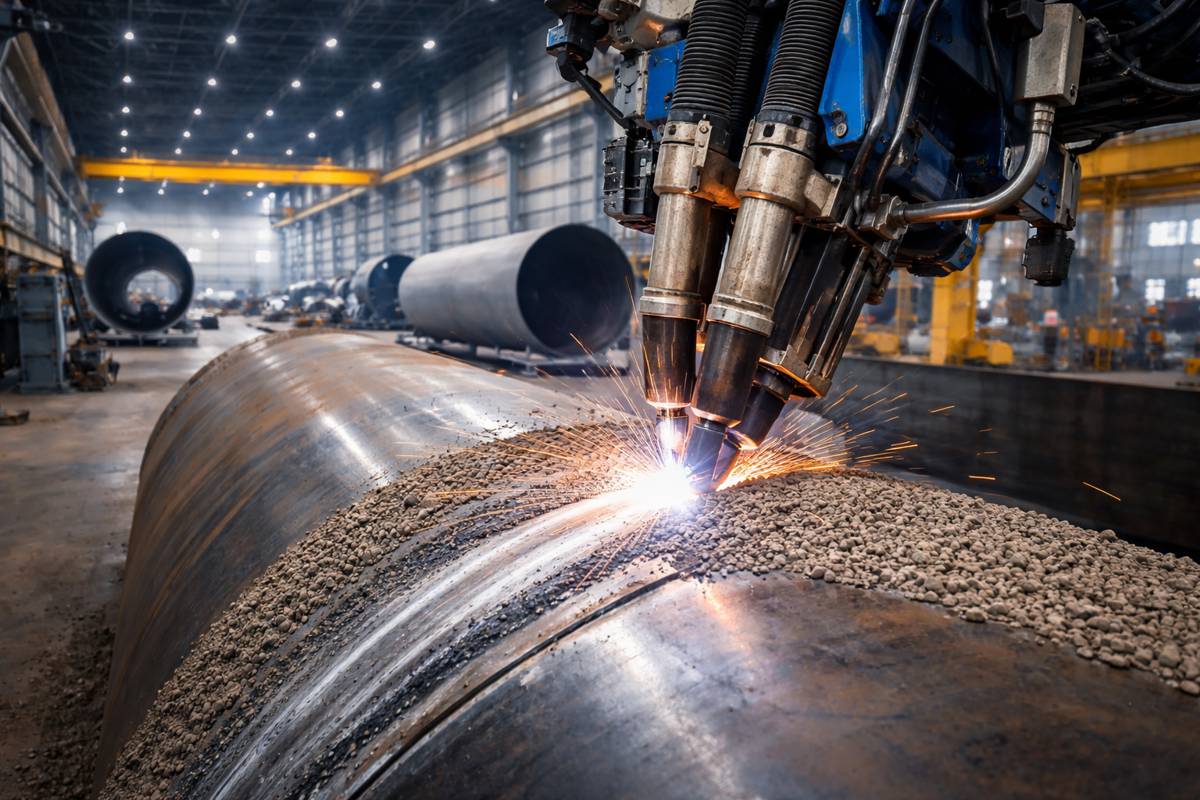
It is against this backdrop that Miller Electric Mfg. LLC and Hobart Brothers LLC have introduced the SubArc Hercules system. Combining a modified power source, a purpose-built torch and a metal-cored wire, the system is designed to increase deposition rates and reduce welding time by an average of thirty percent. In an industry where margins are tight and labour is scarce, that claim is more than incremental. It speaks directly to throughput, cost control and delivery certainty.
Productivity Pressure In A Capital Intensive World
Global infrastructure demand continues to accelerate. The OECD estimates that trillions of dollars in annual investment are required to modernise energy, transport and water systems over the coming decades. Meanwhile, the energy transition is driving a surge in fabrication of wind towers, pressure vessels, hydrogen storage systems and process piping. Each of these relies heavily on submerged arc welding for long, multi-pass welds and thick section joints.
However, the heavy fabrication sector faces persistent challenges. Skilled welders are in short supply across North America and Europe, and large projects are increasingly exposed to schedule risk. Welding, particularly on large groove welds and circumferential seams, often sits on the critical path. If deposition rates can be increased without compromising mechanical properties, contractors gain more than speed. They gain breathing room in project planning and more predictable cost structures.
The SubArc Hercules system is positioned squarely within this reality. It targets applications in pressure vessels, process pipe, structural steel, shipbuilding and wind tower manufacturing. These are not niche markets. They represent core segments of the global industrial and infrastructure economy.
What Makes The System Different
At the heart of the new system is the XMT 450 SubArc Hercules power source. This secondary 450 amp submerged arc unit features modified software that generates lower voltage, between one and ten volts, and provides an electrical current to condition the wire during the Hercules process. It is designed to integrate with existing Miller SubArc DC or AC DC digital power sources and legacy 14 pin SubArc machines, allowing fabricators to upgrade without replacing their installed base.
The conditioning of the wire is a defining element of the process. Once activated via a dedicated switch kit, operators can alternate between the Hercules process and a standard submerged arc setup. This flexibility matters on mixed fabrication lines where not every joint or material calls for the same parameters.
The torch itself is air cooled and incorporates two contact tips. An upper preheat contact tip, standard for Miller OBT 600 MIG guns, and a lower contact tip, standard for Miller OBT 1200 MIG guns, work in tandem. This configuration provides resistive conditioning of the wire before it enters the arc. The preheating and contact tip combination are intended to enable higher deposition rates while maintaining smooth wire feeding at elevated temperatures.
On the consumables side, the system uses Hobart SubCOR metal-cored wire, formulated specifically for this process. It is available in five American Welding Society classifications in 1/8 and 5/32 inch diameters, with tensile strengths ranging from 70 to 110 ksi. According to Hobart, the wire maintains arc stability under high deposition conditions, a characteristic that can be problematic with some competitive wires over extended runs.
Performance Without Sacrificing Weld Integrity
In heavy fabrication, productivity gains are meaningless if weld quality deteriorates. Codes governing pressure vessels, structural components and shipbuilding are stringent. Mechanical properties, penetration profiles and bead consistency are non negotiable.
The SubArc Hercules system is described as delivering consistent weld beads with robust mechanical properties while increasing throughput. The process is suited to long, multi-pass welds, large groove welds, high speed fillet welds and lap joints. It is also positioned for weldments sensitive to high heat input, a critical consideration in thick section steel and high strength alloys.
Louise Gasper, product manager at Miller, said: “The SubArc Hercules system is an excellent fit for operations looking to gain higher deposition rates and faster travel speeds without compromising weld quality. The system consistently outperforms standard DCEP and AC solid wire submerged arc welding, allowing for improved efficiency.”
From Hobart’s perspective, consumable performance plays a central role. Ellis Blevins Jr., product manager, Critical Segment at Hobart, added: “In addition to its arc stability, SubCOR metal-cored wire brings the benefit of a better penetration profile compared to solid wire. It also reduces rework, adding to the efficiency of the entire SubArc Hercules system.”
Reduced rework is not a trivial benefit. Industry studies consistently show that weld repair and rework can account for a significant share of fabrication costs, particularly in pressure vessel and energy sector projects. By improving penetration profile and arc stability, fabricators can potentially reduce grinding, gouging and re-welding, all of which consume time and labour.
Implications For Wind, Shipbuilding And Energy Infrastructure
The wind tower industry provides a clear example of why higher deposition matters. Towers require long circumferential welds on thick plate sections, often in repetitive production environments. Increasing deposition rates by thirty percent on these joints could translate into meaningful reductions in cycle time per tower section. At scale, that impacts plant capacity and delivery schedules for utility scale renewable projects.
Shipbuilding faces similar pressures. Large hull sections and stiffened panels demand consistent, high deposition submerged arc welding. With global naval and commercial ship orders rising, yards are under pressure to modernise processes and maximise throughput without expanding workforce numbers.
In the pressure vessel and process pipe segments, weld integrity is paramount due to safety and regulatory requirements. Here, the promise of robust mechanical properties alongside faster travel speeds is particularly relevant. As hydrogen, carbon capture and LNG projects expand, fabricators will be tasked with producing thicker, higher strength components in greater volumes.
Commercial And Strategic Context
Both Miller and Hobart are wholly owned subsidiaries of Illinois Tool Works Inc., an industrial conglomerate with a significant footprint in welding and cutting equipment. By combining power source, torch and consumable into a unified system, the companies are effectively offering an integrated productivity platform rather than a standalone component.
For fabricators, system level optimisation can be more attractive than piecemeal upgrades. Integration between power source software, torch design and wire formulation reduces the risk of mismatched components and inconsistent results. It also simplifies training and process qualification.
From a competitive standpoint, submerged arc welding has long been valued for its high deposition potential compared to processes such as gas metal arc welding in thick section applications. However, incremental gains in deposition have historically required trade offs in arc stability or weld profile. By focusing on wire conditioning and metal-cored consumables, the SubArc Hercules approach seeks to shift that balance.
The Construction Ecosystem
Infrastructure delivery depends not only on design and financing but on the gritty realities of fabrication. Steel modules for bridges, offshore platforms, refineries and energy plants are often manufactured far from the project site, then transported and assembled. Delays in fabrication propagate through logistics, installation and commissioning phases.
If deposition rates increase and welding time falls by an average of thirty percent, as stated, the potential impact extends beyond the workshop floor. Faster fabrication can shorten lead times, improve contractor cash flow and reduce exposure to material price volatility. In a market where steel prices and energy costs fluctuate, compressing production cycles can mitigate financial risk.
Moreover, improved process efficiency aligns with broader sustainability goals. Higher deposition rates can reduce arc time per joint, potentially lowering overall energy consumption per tonne of fabricated steel. While detailed lifecycle data would be required to quantify such benefits, efficiency gains are generally consistent with decarbonisation objectives in industrial manufacturing.
A Step Forward In Process Optimisation
The introduction of the SubArc Hercules system reflects a broader trend in heavy industry. Rather than relying solely on new materials or radical process overhauls, manufacturers are refining established technologies with smarter integration and targeted engineering improvements.
Submerged arc welding is a mature process. Yet, as this development suggests, there is still room for meaningful optimisation. By focusing on wire conditioning, arc stability and system integration, Miller and Hobart are addressing a pain point that resonates across shipyards, wind tower plants and pressure vessel shops worldwide.
For construction professionals, investors and policymakers tracking the health of the industrial supply chain, such advances are worth noting. They may not grab public attention, but they shape the speed and reliability with which infrastructure can be delivered. In a decade defined by energy transition, industrial reshoring and ambitious capital programmes, that capability carries weight.