Smarter Ore Crushing Could Transform Global Mineral Processing
Across the global mining industry, crushing and grinding ore remains one of the most energy-hungry steps in mineral extraction. Known collectively as comminution, the process is essential for liberating valuable minerals such as copper and gold from the surrounding rock. Yet it comes with a steep price. Grinding circuits can consume vast quantities of electricity, often accounting for the majority of a mine’s operational energy demand.
According to widely cited industry research, comminution can represent up to 80 percent of total site power consumption at many mining operations. At a global level, the sector’s grinding and crushing activities are estimated to consume more than one percent of the world’s electricity supply. For an industry under increasing pressure to reduce emissions, improve efficiency and operate in more remote locations, the energy cost of breaking rock has become an urgent problem.
A new crushing technology emerging from Australia is attracting serious attention. Developed by the Adelaide-based company Gyratory Roller Solutions Pty Ltd (GRolls), the system has been designed to dramatically reduce the need for conventional grinding and milling while delivering substantial savings in energy and operating costs.
Researchers at the University of Adelaide’s Future Industries Institute are now investigating the technology, and early modelling suggests it could reshape the way mining companies approach ore processing.
Rethinking Comminution for a Low Carbon Mining Future
The GRolls system is designed to tackle a long-standing inefficiency in mineral processing. Traditional grinding technologies, such as ball mills and SAG mills, rely on tumbling steel media to fracture ore particles. While effective, the approach is inherently energy intensive and often inefficient at converting power into useful particle breakage.
GRolls Director and University of Adelaide PhD candidate Mark Drechsler has been investigating alternative approaches to comminution that could achieve similar or better liberation results with far less energy input.
“Ore crushing and grinding are traditionally one of the most energy-intensive processes in mining, accounting for more than 1% of global energy use and up to 80% of a mine’s site power consumption,” he explained.
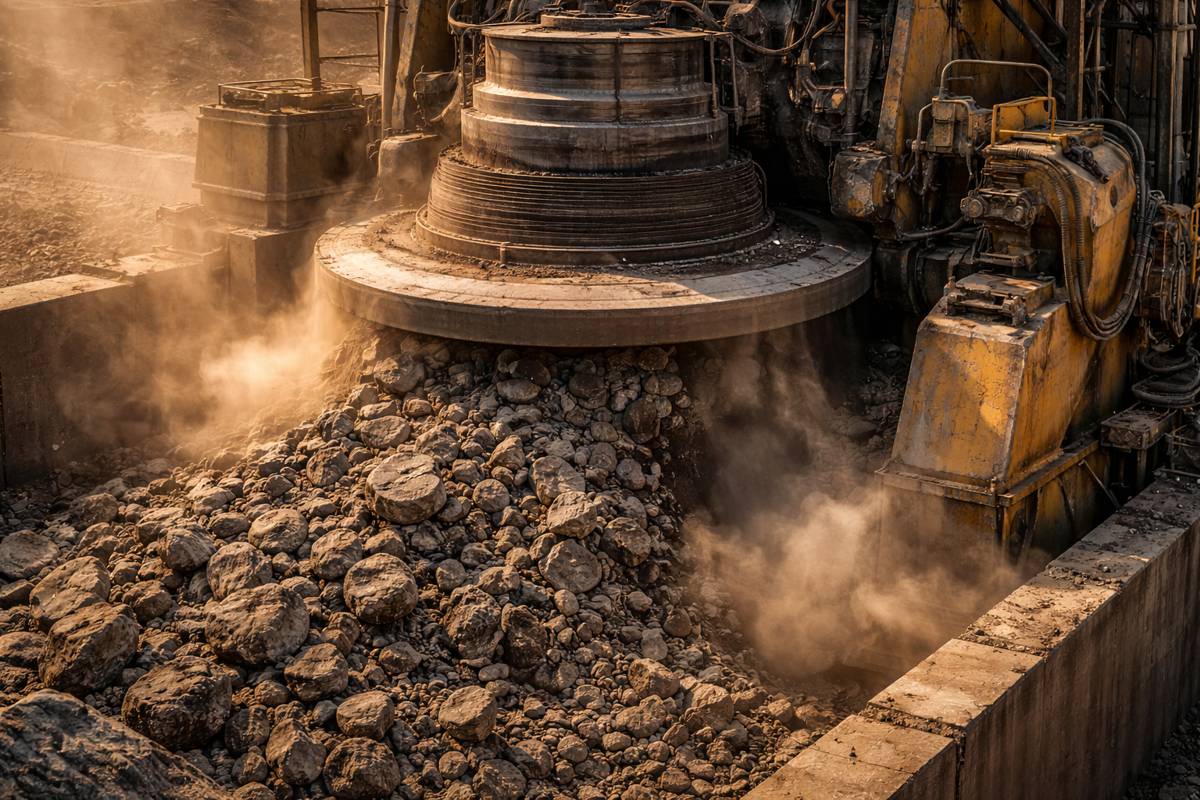
Rather than relying solely on impact and abrasion forces typical of conventional mills, the GRolls technology introduces a different mechanical approach to breaking ore. The system combines pulsed compression, tension and shear forces to fracture particles more efficiently.
By applying these forces in a controlled sequence, the crusher targets natural weaknesses within the rock structure, allowing minerals to break apart more readily. This technique reduces the need for extensive downstream grinding and produces particle sizes suitable for further processing in a single pass.
Promising Results in Copper and Gold Ore Processing
Early testing of the GRolls system has focused on copper-gold ores, particularly those associated with porphyry deposits. These large, low-grade deposits are among the most important sources of copper worldwide, supplying metals essential for infrastructure, renewable energy and electrification technologies.
Porphyry ores are also notoriously challenging to process. They often require extensive grinding to liberate copper and gold minerals, which translates into large grinding circuits and significant energy consumption.
Testing carried out during the research programme shows the GRolls system performing particularly well with fine feed material under 2.36 millimetres. The crushing configuration is capable of reducing more than 40 percent of particles to sizes below 425 microns in a single pass while generating less than 14 percent ultra-fine material below 75 microns.
Such particle size control is significant because excessive fines can hinder downstream recovery processes such as flotation. Producing fewer ultra-fine particles therefore improves processing efficiency while maintaining optimal mineral liberation.
Drechsler emphasised the operational advantages demonstrated during testing: “Our testing shows that GRolls can process hard porphyry copper-gold ores while using significantly less energy and no grinding, making it more sustainable and cost-effective.”
Lower Energy Demand and Reduced Processing Costs
Beyond laboratory testing, researchers have also modelled the performance of the GRolls circuit against an existing conventional grinding operation at a copper-gold mine in New South Wales.
The results suggest notable operational benefits. When incorporated into a processing flowsheet, the GRolls approach reduced total energy consumption by approximately 20 percent compared with the existing grinding configuration. At the same time, overall comminution costs were almost halved.
For mining companies facing rising electricity prices and increasing environmental scrutiny, these figures carry real commercial significance.
“These are significant savings,” Drechsler said. “Not only do you reduce power use, but you eliminate the cost of grinding minerals. There are also potential savings in water usage and a reduction in greenhouse gas emissions.”
Reducing water consumption is particularly important in arid mining regions such as Australia, Chile and parts of Africa where water scarcity already constrains project development. Technologies capable of operating with dry crushing methods can therefore provide both economic and environmental advantages.
Efficient Comminution for the Mining Industry
The timing of this innovation coincides with major structural shifts in global mining. Ore grades across many established deposits are declining, meaning more rock must be processed to produce the same quantity of metal. At the same time, new deposits are increasingly located in remote or environmentally sensitive regions where energy supply and infrastructure can be limited.
Copper, in particular, sits at the centre of the energy transition. The International Energy Agency has repeatedly warned that demand for copper could double by mid-century as electrification, renewable energy systems and electric vehicles expand worldwide.
Meeting this demand will require massive investment in new mines and processing facilities. Yet energy consumption during mineral processing remains a major contributor to both operating costs and emissions.
Researchers therefore see improvements in comminution efficiency as one of the most important opportunities for reducing the environmental impact of mining operations.
Dr George Abaka-Wood, a metallurgist at the Future Industries Institute who supervised the GRolls research project, believes innovations in dry crushing could play an important role in modern mineral processing flowsheets: “The team is committed to showing the downstream benefits of using dry crushing technology in collaboration with other innovative technologies to address the need for more energy-efficient and higher processing efficiencies within mineral processing flowsheets.”
Simpler Circuits and Scalable Processing Systems
Beyond energy efficiency, the GRolls system also offers potential benefits in plant design and operational flexibility. Traditional grinding circuits can be large, complex and expensive to build, requiring multiple milling stages, classification systems and extensive supporting infrastructure.
Professor Bill Skinner, Research Leader for Minerals and Resource Engineering at the Future Industries Institute and co-author of the study, highlights the simplicity of the GRolls approach.
“This could be a game changer for mineral processing,” he said. “It offers an opportunity to simplify processing circuits while improving sustainability across the board”.
The system’s compact design allows it to be deployed as a standalone crushing unit or integrated into existing processing plants. It can also operate under dry or wet conditions, providing flexibility across different mineral processing environments.
For mining companies considering plant expansions or brownfield upgrades, the ability to integrate new comminution technologies without completely rebuilding processing infrastructure could significantly reduce capital expenditure.
Moving Toward Commercial Deployment
While the technology is still undergoing research and validation, commercial development is already underway. GRolls is aiming to bring the crushing system to market within the next twelve months.
The project has received support from the South Australian Government through a Seed-Start grant worth AU$300,000. Funding programmes such as this are designed to accelerate the development of emerging technologies that have the potential to strengthen Australia’s innovation ecosystem and industrial competitiveness.
Australia’s mining sector has long served as a testing ground for new processing technologies, thanks to its extensive mineral resources and strong research collaboration between industry and universities. Many technologies now used globally were first developed and trialled within the country’s mining operations.
If the GRolls system performs as anticipated during larger scale trials, it could join a growing list of innovations reshaping mineral processing.
A Step Toward More Sustainable Mineral Production
Mining will remain essential to global development for decades to come. Metals such as copper, gold, lithium and nickel are fundamental to infrastructure, electrification and renewable energy technologies.
Yet the industry must find ways to extract these resources more efficiently and with lower environmental impact. Improving the energy efficiency of comminution represents one of the most direct ways to achieve that goal.
Technologies such as the GRolls crushing system demonstrate how targeted engineering innovation can address long-standing operational challenges. By reducing reliance on energy-intensive grinding circuits, mining operations may be able to lower costs, cut emissions and simplify processing flowsheets at the same time.
For an industry under growing pressure to balance resource extraction with environmental responsibility, smarter crushing technology could prove to be a valuable piece of the puzzle.