Jacobs Designing the Future of Sydney Underground Transport
The expansion of high-capacity rail networks continues to redefine how major cities grow, and in Australia, few projects capture that shift more clearly than the Sydney Metro West programme. The appointment of Jacobs, GHD and WSP in a joint venture to design five new underground stations marks a significant step forward in one of the country’s most consequential transport investments.
Stretching 24 kilometres between Greater Parramatta and Sydney’s central business district, Sydney Metro West is not simply a rail line. It is a long-term urban strategy, intended to unlock housing supply, improve labour mobility and rebalance economic activity across the metropolitan region. The western stations package, led by Gamuda, sits at the heart of that ambition, translating high-level planning into physical infrastructure that will shape daily life for decades.
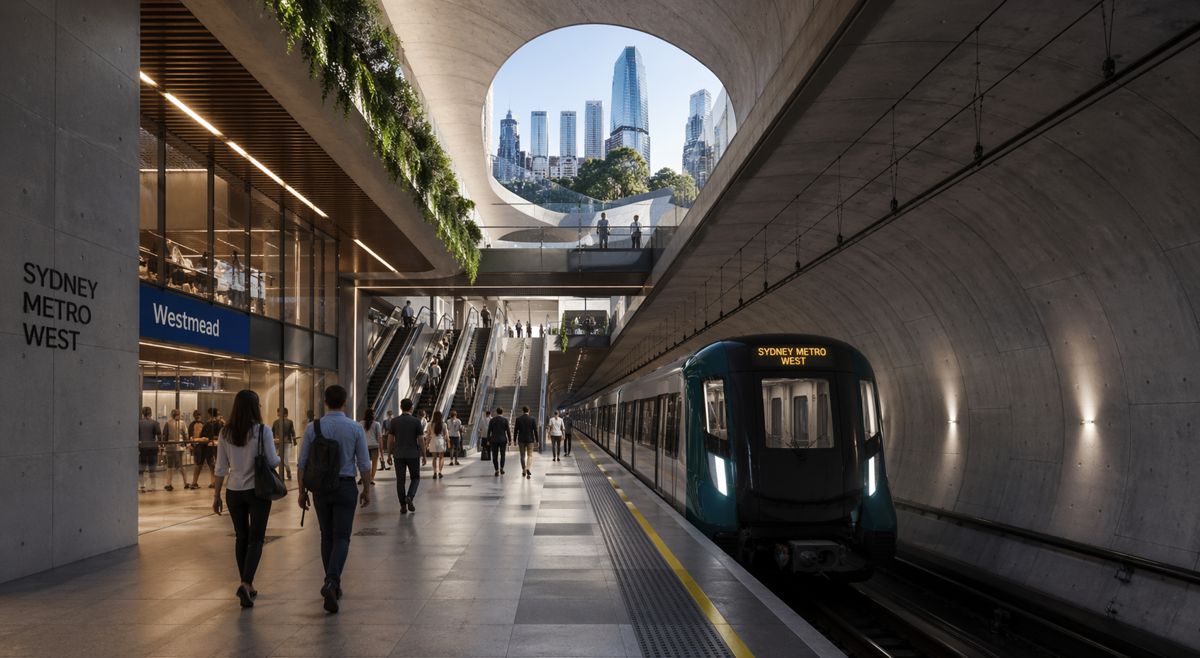
At stake is more than connectivity. With population growth accelerating in Western Sydney and infrastructure often struggling to keep pace, the delivery of fast, reliable mass transit has become a defining challenge. These five stations, located at Westmead, North Strathfield, Burwood North, Five Dock and The Bays, will form critical nodes in a system designed to shift travel patterns, reduce congestion and support a more distributed urban economy.
Briefing
- Jacobs, GHD and WSP have formed a joint venture to design five underground stations for Sydney Metro West
- The 24 km line will connect Greater Parramatta with Sydney’s CBD, reshaping urban mobility
- Stations Package West is being delivered by Gamuda as lead contractor
- Designs are targeting a 6-Star Green Star As Built rating, emphasising sustainability
- The project supports housing growth, economic development and long-term infrastructure resilience
Engineering the Backbone of a Growing Metropolis
Large-scale metro systems are often judged by their tunnels and trains, yet it is the stations that define their success. They are where infrastructure meets the public, where accessibility, safety and urban integration are tested in real-world conditions. In this case, the design responsibility handed to the joint venture goes well beyond structural engineering.
Each station must function as a transport hub, an urban catalyst and a community interface. That means balancing passenger flow, integrating multimodal connections, and ensuring seamless access to surrounding developments. In rapidly growing areas such as Westmead, where healthcare, education and residential expansion are converging, the station design will influence how effectively the district evolves.
The involvement of three global consultancies reflects the scale and complexity of the task. Each brings experience from major rail programmes worldwide, combining technical expertise with lessons learned from dense urban environments. The challenge lies in adapting that knowledge to Sydney’s specific conditions, from geological constraints to regulatory frameworks and community expectations.
Strengthening Economic Corridors Through Transport Investment
Transport infrastructure has long been a lever for economic growth, but Sydney Metro West takes that principle a step further by actively shaping where growth occurs. By linking Parramatta, often described as Sydney’s second CBD, with the traditional city centre, the line aims to redistribute economic activity and reduce pressure on established hubs.
Improved connectivity typically translates into shorter commute times, broader employment opportunities and increased business investment. For developers and policymakers, the presence of high-capacity rail can unlock land value and accelerate housing delivery. In this context, the stations are not isolated assets but anchors for wider urban regeneration.
The Bays, for instance, is already earmarked for significant redevelopment, with plans to transform former industrial land into a mixed-use precinct. A well-designed metro station will be instrumental in attracting investment and ensuring that growth is both sustainable and accessible. Similar dynamics are expected along the rest of the corridor, particularly in areas undergoing population expansion.
Sustainability Moves From Aspiration to Requirement
Sustainability targets are no longer optional extras in major infrastructure projects. The commitment to achieving a 6-Star Green Star As Built rating places Sydney Metro West among the more ambitious rail developments globally in environmental terms.
This rating framework, widely used in Australia, assesses factors such as energy efficiency, water use, materials selection and operational performance. Achieving the highest rating requires a holistic approach, integrating sustainability into every stage of design and construction rather than treating it as an afterthought.
For the joint venture, this translates into practical design decisions. Energy-efficient systems, durable materials and construction methods that minimise environmental impact will all play a role. Over the lifecycle of the stations, these choices are expected to reduce operating costs and carbon emissions, aligning with broader climate objectives.
Globally, metro systems are increasingly seen as part of the solution to urban emissions challenges. By encouraging a shift away from private vehicles, they contribute to lower congestion and improved air quality. The sustainability credentials of the infrastructure itself add another layer to that impact, reinforcing the case for investment.
Delivering Complexity Through Integrated Teams
The scale of Sydney Metro West demands a level of coordination that goes beyond traditional project structures. With Gamuda leading delivery and a multi-partner design team in place, integration becomes a critical success factor.
Modern infrastructure projects rely heavily on digital engineering tools, including Building Information Modelling, to manage complexity and reduce risk. These systems enable real-time collaboration, allowing designers, contractors and stakeholders to identify issues early and optimise solutions before construction progresses too far.
The joint venture model also reflects a broader trend in the industry. As projects grow in size and technical sophistication, no single organisation can cover all aspects effectively. Collaborative approaches bring together complementary strengths, though they also require clear governance and communication to function smoothly.
The appointment builds on prior involvement in the Sydney Metro programme. Jacobs, for example, has contributed to earlier packages, including environmental and climate advisory work and the design of tunnel and station excavation components completed in 2025. Continuity of expertise can reduce learning curves and improve overall project efficiency.
Global Expertise Applied to Local Challenges
The firms involved in the joint venture are not new to major rail infrastructure. Jacobs has worked on programmes such as the Grand Central Madison and the Elizabeth line, both of which required navigating dense urban environments and complex stakeholder landscapes.
Similarly, WSP and GHD bring extensive experience across transportation, water, energy and urban development sectors. Their combined global footprint provides access to a wide pool of technical knowledge, which can be adapted to the specific demands of the Sydney project.
However, applying international experience is not a straightforward exercise. Local conditions, from soil composition to planning regulations, require tailored solutions. Community expectations also vary, particularly in areas where infrastructure development intersects with existing neighbourhoods.
Balancing global best practice with local sensitivity is often where projects succeed or falter. In this case, the design of the stations will need to reflect both international standards and the unique character of Sydney’s western suburbs.
Infrastructure That Shapes Daily Life
Transport projects of this scale inevitably influence how people live, work and move. Once operational, Sydney Metro West is expected to significantly reduce travel times between Parramatta and the CBD, making public transport a more attractive option for commuters.
The ripple effects extend beyond travel. Improved accessibility can change residential patterns, allowing people to live further from traditional employment centres without sacrificing convenience. Businesses, in turn, gain access to a broader talent pool, supporting economic growth.
For policymakers, the project represents a tangible response to long-standing challenges around congestion and urban sprawl. By providing a high-capacity alternative to road travel, it supports a shift towards more sustainable and efficient transport systems.
The stations themselves will be the visible face of this transformation. Their design will influence user experience, from ease of navigation to perceived safety and comfort. Done well, they can encourage greater public transport use and contribute to a more cohesive urban environment.
A Defining Chapter in Sydney’s Infrastructure Story
Major infrastructure projects rarely unfold in isolation. Sydney Metro West forms part of a broader pipeline of transport investments aimed at modernising the city’s network and preparing it for future growth.
The appointment of Jacobs, GHD and WSP to deliver the western stations package highlights the level of expertise required to bring such ambitions to life. It also underscores the importance of integrated design in achieving outcomes that extend beyond basic functionality.
As construction progresses, attention will inevitably turn to delivery timelines, cost management and community impact. Yet the longer-term significance lies in how effectively the project reshapes connectivity and supports sustainable urban development.
In the end, infrastructure is judged not only by what it builds, but by what it enables. Sydney Metro West, and the stations now entering the design phase, will play a central role in defining the city’s next chapter.