Compact Sand 3D Printing with ExOne and voxeljet’s First Joint Product
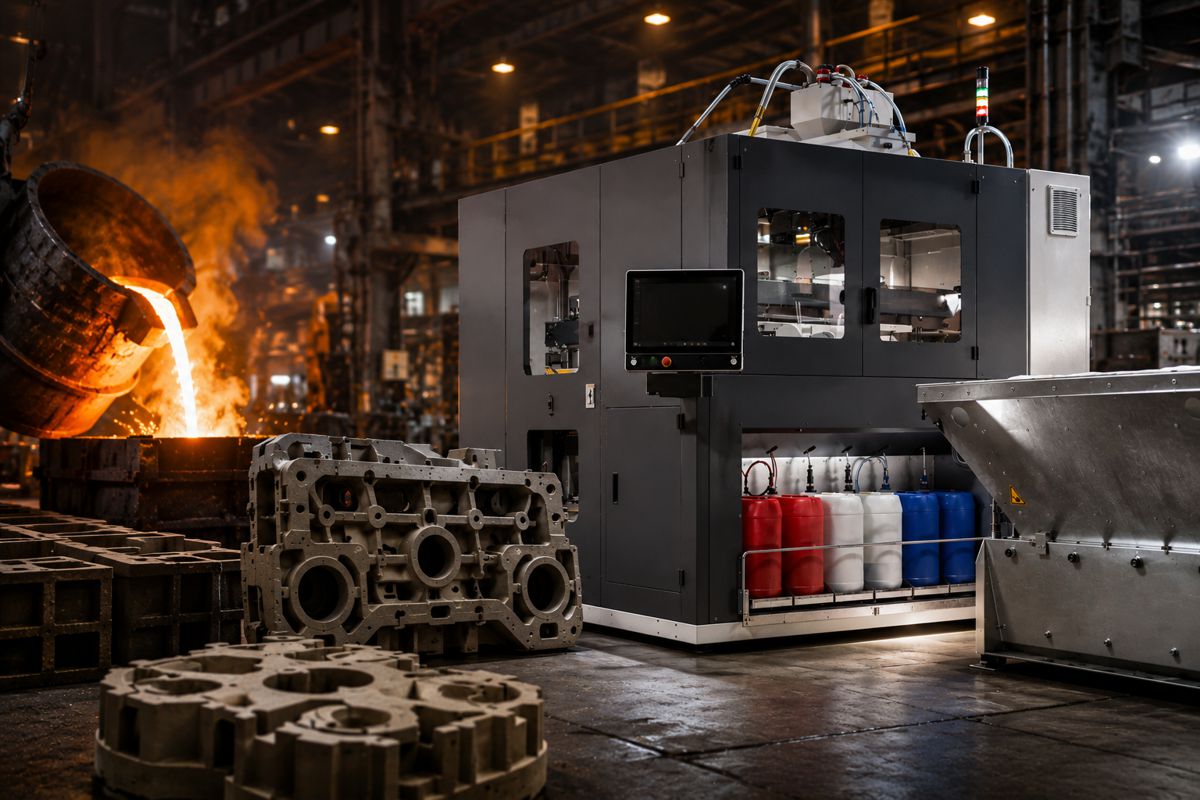
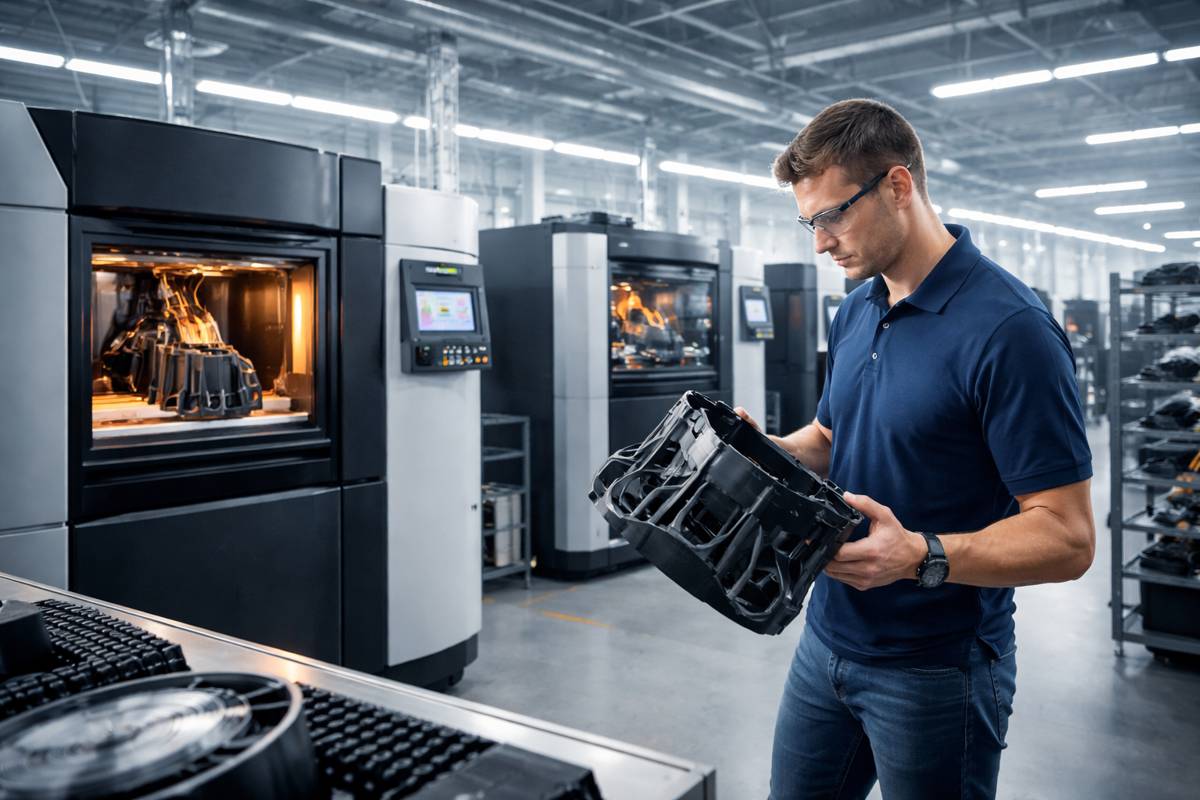
ExOne has launched the S-Print Pro, a compact industrial sand 3D printer built to bring production-grade binder jetting within reach of the small and mid-sized foundries that account for most of the world’s casting capacity.
The system runs in under 12 square metres of floor space and is positioned around acquisition and operating cost rather than headline build size, a deliberate attempt to widen the customer base for tooling-free casting beyond the larger, better-capitalised plants that have dominated digital sand printing so far. It is also the first significant product launch since ExOne and its long-time rival voxeljet were brought together under a single owner, which gives the announcement a strategic weight that extends well past the specification sheet.
For construction and infrastructure, the relevance is less obvious than a new excavator or paving machine, yet arguably more foundational. Sand castings sit inside almost every piece of heavy plant, hydraulic system, pump, valve and pipe fitting in service, and the way foundries produce the moulds and cores for those parts shapes lead times, spare-part availability and the resilience of industrial supply chains.
A machine that lowers the barrier to digital, tooling-free casting therefore matters to anyone who depends on cast components, from equipment manufacturers to the utilities and contractors maintaining ageing assets. The S-Print Pro is aimed squarely at the shops that compete on cost and flexibility, handling low-volume casting, contract work, spare-part production and niche alloys, often with limited automation already in place.
Briefing
- ExOne has launched the S-Print Pro, a compact industrial sand binder jet printer designed for small and mid-sized foundries, pattern shops and print service providers.
- The machine occupies under 12 square metres and carries the build quality of ExOne’s established S-Max platform at a lower acquisition and operating cost.
- It is the first major product from ExOne Global Holdings since Anzu Partners combined ExOne and voxeljet in October 2025, following Desktop Metal’s bankruptcy.
- Core features include a 400 dpi CoreBoost printhead, optional StepX in-situ surface smoothing and a configurable module that trades print speed against running cost.
- Deliveries begin in the second half of 2026, starting with selected beta partners and the earliest reserved production slots.
A First Product Forged by Consolidation
The S-Print Pro arrives at a pointed moment for its maker. ExOne was acquired by Desktop Metal in 2021 in a deal valued at around 575 million dollars, only for Desktop Metal to file for Chapter 11 bankruptcy in July 2025. In the restructuring that followed, the US industrial technology investor Anzu Partners acquired voxeljet through an asset deal worth roughly 20 million euros and separately took on ExOne’s German and Japanese operations, then placed both brands under a new parent, ExOne Global Holdings, in October 2025.
The two businesses had spent some 25 years competing in binder jetting, so combining them under one roof ended a long rivalry and a period of considerable uncertainty for customers of both.
That history matters to how the launch should be read. The combined group reports an installed base of more than 500 industrial printers and now spans subsidiaries in Germany, the United States, Japan, China and India, giving it the kind of service footprint that smaller foundries weigh heavily before committing to capital equipment.
Eric Bader, chief executive of ExOne Global Holdings, framed the product as the direct result of that integration: “The S-Print Pro is the product foundries have been asking us for: quality industrial sand printing in a system that’s affordable to acquire, install, and run. Since the ExOne and voxeljet merger, our teams have been focused on combining the best engineering, application knowledge, and customer insight to solve this real production challenge. This launch reflects that work — and our commitment to making industrial binder jetting more accessible to foundries worldwide.”
For a group working to regain commercial momentum after a turbulent ownership chapter, a lower-cost system that broadens the addressable market is a logical opening move.
Built for the Foundries That Hold the Industry Together
The economic case rests on a structural fact about the casting industry, which is that it is dominated by small operations rather than the large plants that tend to feature in technology announcements. Independent market analysis values the global foundry sector in the low hundreds of billions of dollars, with construction equipment among the larger consumers of iron and steel castings for components such as excavator parts, crane structures and material handling systems.
Adoption of digital sand printing, however, has been uneven. Industry estimates suggest only around a third of mid-to-large foundries have taken up 3D printing for pattern making and prototyping, which leaves the far more numerous smaller shops largely reliant on conventional tooling.
That gap is precisely what ExOne is targeting. Aldo Randazzo, the company’s director of application management, expressed the rationale: “Most of the world’s foundries are small operations, many with fewer than 100 employees. They are the backbone of the manufacturing industry, yet industrial binder jetting has rarely been built for their scale or budget. We aim to close that gap with the new S-Print Pro.”
The commercial logic is that lowering the entry point unlocks a long tail of casting businesses that have wanted the flexibility of tooling-free production but could not justify the footprint, capital outlay or running costs of premium systems. For those shops, digital cores and moulds offer faster turnaround on bespoke and low-volume work, a meaningful advantage when the competition is built on speed and customisation rather than scale.
The Technology Behind the Smaller Footprint
Beneath the positioning sits a machine that borrows heavily from ExOne’s premium line while trimming cost and complexity. The S-Print Pro uses a new generation of the company’s CoreBoost printhead at 400 dpi resolution, paired with an optional StepX feature that smooths surfaces in situ during printing to reduce the stair-stepping effect common to layered processes.
A configurable printhead arrangement lets operators run the same unit in different module setups, choosing higher throughput where print speed is critical or lower operating costs where it is not. User-replaceable printhead modules, a two-canister change system and service-friendly construction are intended to keep maintenance straightforward and downtime short, while the interface carries over from the established S-Max family to limit retraining.
The working numbers are modest by design but practical for the target shops. The build volume measures 1,200 by 750 by 500 millimetres, with layer thickness adjustable between 0.10 and 1.00 millimetres and a standard setting of 0.28 millimetres, and the system is rated to complete a full job box in less than a single shift. It processes furan binder with silica sand as standard, with CeraBeads or silicon carbide available as options, and is built to slot into existing foundry workflows rather than demand new ones.
The printer itself measures 5,250 by 2,255 by 3,100 millimetres and weighs around 4,000 kilograms, yet its sub-12 square metre footprint is the figure most likely to register with shops where floor space is as constrained as capital. ExOne is offering tailored return-on-investment and total-cost-of-ownership assessments through its representatives, an acknowledgement that the purchasing decision for this segment turns on operating economics as much as on capability.
Why Digital Casting Matters to Infrastructure
The wider significance lies in what tooling-free casting does to supply chains for cast components, which remain stubbornly central to construction and infrastructure even as much attention shifts to digital and electric technologies. Castings appear throughout heavy equipment, in pumps and valves across water and wastewater networks, in pipeline fittings and in the structural and mechanical parts of plant that contractors and utilities must keep running for decades.
Producing those parts without bespoke tooling shortens lead times and makes short-run and legacy components more economical, which carries real weight for operators maintaining ageing assets where original patterns may no longer exist. Distributed, on-demand mould and core production also reduces dependence on long and sometimes fragile supply chains, a consideration that has risen up the agenda across industrial sectors since the disruptions of recent years.
There is an efficiency and sustainability dimension as well. Modern sand printing integrates with closed-loop sand reclamation and digital design workflows, helping foundries cut waste and respond more quickly to varied demand, and the same digitisation helps address the persistent shortage of skilled labour by reducing reliance on manual pattern making.
None of this removes the structural pressures bearing on the sector, where energy costs and tightening environmental rules continue to weigh on smaller operators in particular. What a lower-cost industrial printer offers is a route for those operators to modernise incrementally rather than be left behind, keeping a broader base of regional casting capacity viable at a time when resilient, localised supply is increasingly prized.
The Road to Foundry-Floor Adoption
Whether the S-Print Pro delivers on its promise will become clearer as it reaches the floor. Deliveries are scheduled to begin in the second half of 2026, starting with selected beta partners and the earliest reserved production slots, which gives the combined company a measured runway to prove reliability and operating economics in real foundry conditions before any wider rollout.
The choice to lead its post-merger product strategy with an accessibility play, rather than a flagship aimed at large plants, says a good deal about where ExOne Global Holdings sees its growth, namely in the wide base of smaller shops that have so far sat outside the digital casting market.
For the foundry sector more broadly, the launch is a marker of how binder jetting is maturing from a technology concentrated among early and well-resourced adopters into one positioned for everyday production at smaller scale.
If the economics hold up, the effect over time could be a steady broadening of digital casting capability across the regional and contract foundries that quietly supply so much of the construction and infrastructure base. That would be a meaningful shift, achieved not through a single dramatic breakthrough but through making proven industrial technology affordable enough to belong on an ordinary foundry floor.