Empa Turns Steel Crack Repair into a Design Problem
Fatigue cracking is one of the quiet, expensive realities of owning steel infrastructure, and it rarely arrives at a convenient moment. Much of Europe’s steel railway and highway stock was built more than half a century ago, and the welded connections that hold these structures together are precisely the points most prone to the stress concentrations where cracks begin.
When a crack opens in a load-bearing member, the owner is left with an unattractive set of choices: monitor it and hope, restrict the load, or replace a component that may be welded into the heart of the structure. Full replacement is costly, disruptive and, on a busy network, politically awkward. Researchers at Empa, the Swiss Federal Laboratories for Materials Science and Technology, are testing a third path that treats the crack not as something to cut out but as something to engineer around.
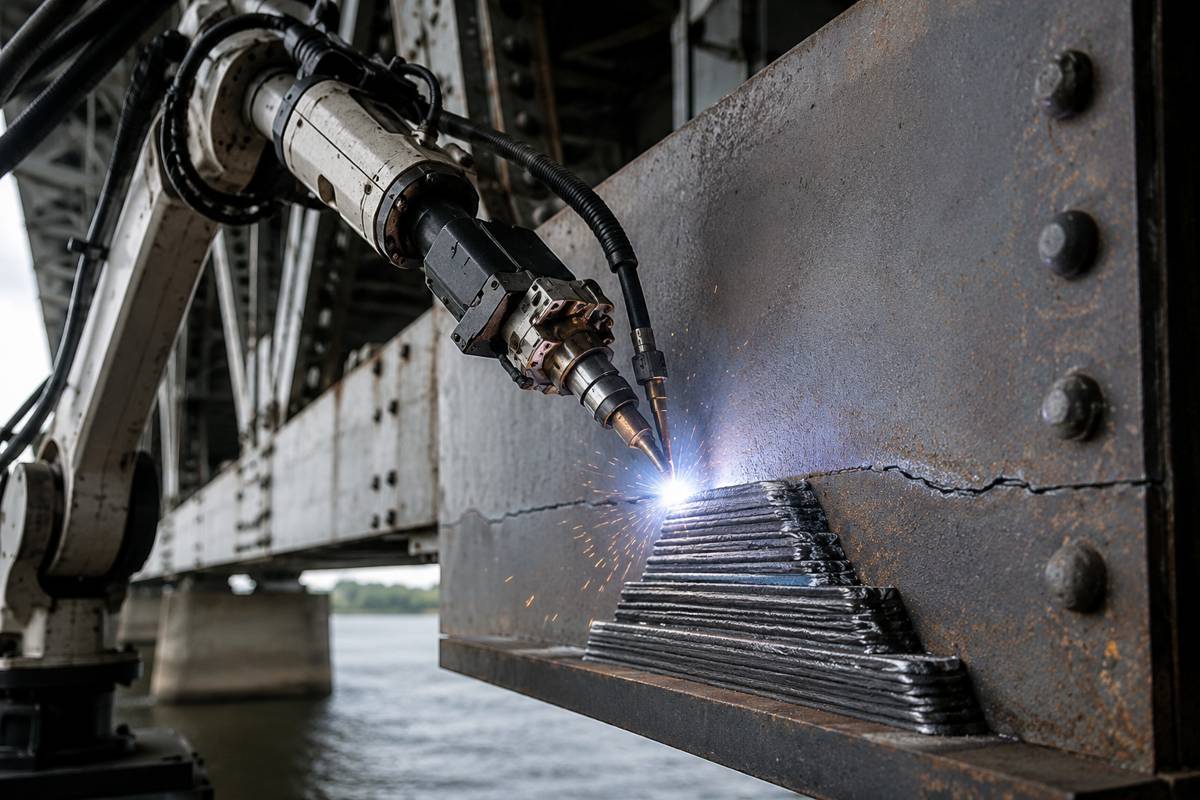
Their method relies on Wire Arc Additive Manufacturing, a process that deposits welding wire layer by layer using an electric arc to build a three-dimensional metal reinforcement directly onto a damaged area. Unlike conventional welding, which mainly joins parts, the technique lets engineers add metal in a deliberately shaped form, reinforcing a weak spot locally rather than swapping out the whole component.
The commercial significance is straightforward, since targeted reinforcement promises to defer the capital cost and the closure time that come with replacing built-in steelwork. The technical surprise sitting underneath it is more interesting, because Empa’s work suggests the performance gain comes from the shape of the added metal rather than the amount of it.
Briefing
- Empa’s WAAM trials extended the fatigue life of cracked steel plates by up to four times compared with unrepaired control samples.
- Two-layer, stepped reinforcement geometries performed best, while poorly chosen shapes created fresh stress concentrations at the joint between old and printed metal.
- The approach reinforces damage locally, avoiding the cost and disruption of replacing components built into a structure.
- On-site deployment is the main obstacle, as current robotic systems are difficult to transport and damaged members are usually fixed within the structure.
- Empa is already extending the work toward earthquake damping elements and shape memory alloys for adaptive steel.
Reinforcing Steel Without Replacing It
The headline result from Empa’s construction hall is a service-life gain that matters in budget terms before it matters in laboratory ones. Working with ETH Zurich on a master’s thesis project, the team fitted cracked steel plates with printed reinforcements of various shapes and subjected them to repeated loading. Every reinforced sample outlasted the unrepaired controls, and the best configurations stretched the fatigue life of the damaged plates by up to four times. Two-layer, stepped reinforcement geometries proved the most effective of those tested, a finding that points toward a repeatable design recipe rather than a one-off success.
For an asset owner, the appeal is the avoided cost of wholesale intervention. Fatigue cracks are among the most common forms of damage in steel construction, and reinforcing them in place is far more efficient than tearing out and replacing the affected member.
“Using 3D printing, we can apply metal reinforcements exactly where they are structurally needed,” says Hossein Heydarinouri of Empa’s Structural Engineering laboratory, adding that “Repairs save material, energy, and costs.” Translated into operational language, that means an owner managing a large bridge or building portfolio could extend the working life of individual components, smoothing replacement spending over a longer horizon instead of facing it in a single disruptive event.
The same logic that makes WAAM attractive for one-off industrial parts applies here, since the value lies in precision rather than volume.
Geometry Does The Structural Work
What distinguishes Empa’s findings from a straightforward repair claim is the emphasis on form. “The key isn’t to apply as much material as possible,” Heydarinouri explains: “The shape is much more important: An optimized geometry distributes stresses in such a way that the propagation of existing cracks is stopped or significantly slowed down.”
The mechanism behind that is well documented in the wider literature on the technique, where the deposited material increases the effective cross-section and introduces compressive residual stresses around the crack tip as the printed metal cools and contracts. Those compressive stresses work against the tensile forces that drive a crack forward, which is why a carefully designed reinforcement can arrest or slow propagation rather than simply bulking out the area.
The flip side is that geometry can work against the engineer just as easily. Empa’s tests showed that a poorly chosen shape can generate new stress concentrations, particularly at the interfaces where the printed metal meets the base material, effectively creating tomorrow’s crack while repairing today’s.
“Our results show how important a targeted design of the reinforcement structure is,” Heydarinouri notes. That reframes WAAM repair as a simulation and design discipline rather than a welding task, and it has practical consequences for how the technology would be adopted. Reinforcement profiles would need to be modelled and validated for each detail, which favours owners and contractors with access to structural analysis capability and pushes the value toward the design stage rather than the shop floor.
The Site Problem That Still Needs Solving
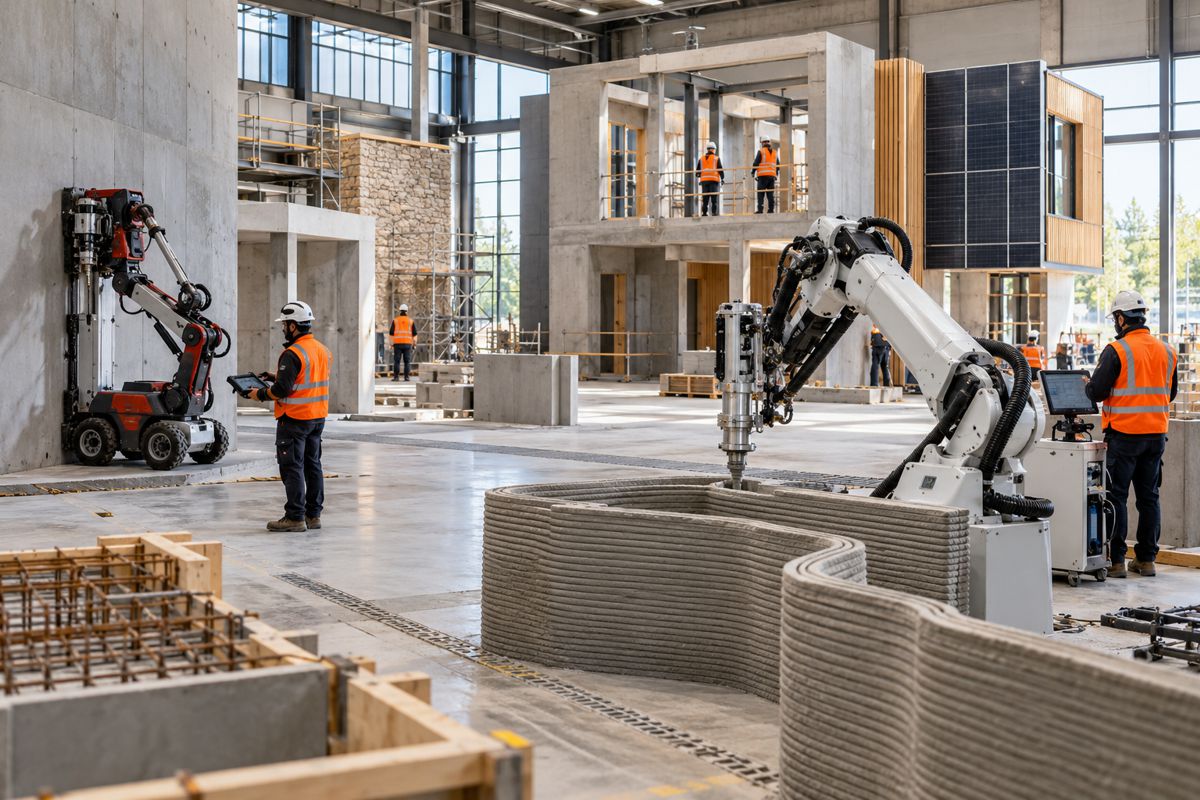
For all the promise in the test data, the route to routine field use remains the hardest part of the story. Metal 3D printing is currently carried out with industrial robotic systems that are heavy, fixed and difficult to move, which sits awkwardly with the reality of bridge and building maintenance.
“Damaged components are usually installed within the structure,” Heydarinouri points out, and the implication is uncomfortable for in-situ repair. “Today, they would have to be taken to a workshop for repair, which isn’t always realistic in practice.” A primary girder welded into a live railway viaduct cannot be unbolted and trucked to a robotics cell, which means the most valuable repair scenarios are also the least accessible ones with today’s equipment.
Mobile and portable robotic systems are emerging, but Empa is candid that they need further development before on-site WAAM repair becomes broadly practical. In the near term, the team sees the clearest opportunities where components are easy to reach or can be removed during scheduled maintenance, such as bearings, secondary members or parts already coming out for inspection.
That phasing matters commercially, because it suggests the first real markets for WAAM repair will be in fabrication yards and maintenance depots rather than on the structure itself. Portability, in other words, is as much a gating factor for adoption as the structural performance, and the supplier that solves transportable, site-ready deposition stands to unlock the larger prize of in-place repair.
Where WAAM Already Sits In Construction
Empa’s repair work lands in a sector that has already had a high-profile encounter with the same underlying technology. MX3D’s stainless steel pedestrian bridge in Amsterdam, printed with four WAAM robots from more than six thousand kilograms of steel and installed over a canal in 2021, demonstrated that the process can produce a full-scale, load-bearing structure rather than a decorative object.
Its sustainability argument rested on shape efficiency, the ability to place metal only where the structure needs it, which is the same principle now being applied at the much smaller scale of a crack repair. The bridge proved the concept at architectural scale, even if it remains a prototype rather than a template for mass production.
It also exposed the obstacle that Empa’s repair application will eventually have to confront, which is codification. No structural design code existed for 3D-printed steel when the Amsterdam bridge was built, so the Steel Structures Research Group at Imperial College London had to characterise the printed material from first principles, since deposited weld metal does not behave identically to rolled or cast steel.
The same gap applies to repairs, because certifying a printed reinforcement on a critical load path will require accepted standards, qualified procedures and inspection regimes that do not yet exist in mature form. Empa’s results strengthen the engineering case, but adoption at scale will depend on standards bodies and asset owners building the assurance framework around it, alongside the hardware that makes field deposition possible.
Beyond Repair Toward Adaptive Steel
Repair is only the entry point for the broader programme Heydarinouri’s group is pursuing. By combining intelligent geometries, metal 3D printing and new materials, the team is exploring metal structures that deliberately yield under extreme loads, absorb energy as they deform and then return as far as possible to their original shape.
Used as metallic damping elements, such components could help bridges, buildings and technical installations ride out earthquakes or persistent vibration, while the same geometric freedom offers gains in mechanical engineering for lightweight but highly stressed parts. “3D printing gives us enormous geometric freedom,” Heydarinouri says. “We can specifically optimize structures – for example, to reduce weight while maintaining or even optimizing load-bearing capacity.”
Running in parallel is Empa’s materials research into shape memory alloys, led by Maryam Mohri, which adds another dimension to the work. These materials can recover their original form after deformation, for instance when heated, and pairing them with optimised printed geometries opens the door to adaptive, material-efficient components that respond to their conditions rather than simply resisting them.
The corresponding shapes are developed through numerical simulation and then verified experimentally, so that printed parts are tested against realistic conditions before any claim of industrial readiness. Taken together, the repair findings and the adaptive-materials work point toward a single direction of travel for structural steel, one in which damage is reinforced by design and resilience is engineered into the geometry itself, provided the industry can build the portable hardware and the standards to match.