Hytera W60 Wearable Targets the Coverage Gaps That Slow Critical Infrastructure
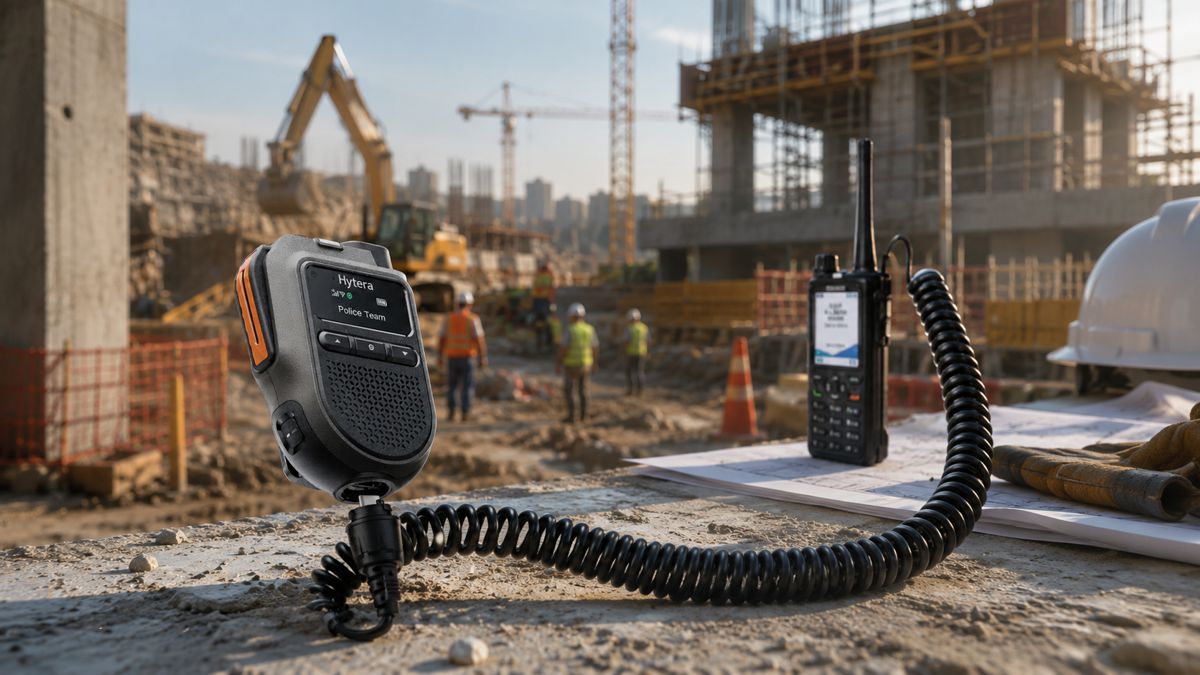
When Hytera unveiled the W60 Wearable MCS Radio at Critical Communications World in London on 23 June 2026, the hardware was almost the smallest part of the story. At roughly 156 grams the device is closer to a clip-on speaker microphone than a radio terminal, and on first inspection it looks like an accessory rather than a product launch worth the attention of infrastructure planners.
The design choices behind it, however, say a great deal about where mission-critical communications are heading, and about the persistent gap between the radio networks operators already own and the broadband services they are being encouraged to adopt. For transport authorities, utilities, energy firms and construction contractors who move people through tunnels, basements, plant rooms and deep underground sites, that gap is not an abstraction. It is the difference between a worker who can raise the alarm and one who cannot.
The W60 is built on a deliberately conservative premise. Rather than asking organisations to remove their established Professional Mobile Radio systems, it connects to an existing radio and behaves, for most of a shift, as an ordinary wired remote speaker microphone. The change happens only when a user moves beyond the reach of their radio network, at which point the wearable carries voice over broadband Mission Critical Services and keeps the worker connected through cellular or private LTE coverage where the radio signal has failed.
Hytera is selling continuity rather than replacement, and for buyers wary of multi-year network migrations that distinction carries genuine commercial weight. It also positions the device squarely within the broader convergence of narrowband radio and broadband data that is now reshaping procurement across public safety and critical infrastructure.
Briefing
- Hytera launched the W60 Wearable MCS Radio at Critical Communications World 2026 in London, alongside the SC700 smart body camera and the PDC580 dual-mode radio.
- The 156-gram unit clips to an existing PMR radio as a wired speaker microphone, then routes voice over broadband MCX when personnel move beyond radio coverage.
- An integrated 8-megapixel camera adds live video streaming and on-site recording, with AES-256 encryption and removable secure storage protecting evidence integrity.
- The launch lands as European operators, the United Kingdom included, prepare broadband MCX rollouts from 2027 and the retirement of TETRA networks by around 2030.
- Hytera arrives in London while still under legal pressure in the United States, where it pleaded guilty in 2025 to felony trade-secret conspiracy and faced a court injunction on two-way radio sales.
Solving Coverage Where Infrastructure Hides It
Communication tends to fail in predictable places. Basements, road and rail tunnels, underground stations, pumping chambers, plant rooms and the lower levels of large structures all defeat conventional radio coverage, and extending a PMR network into each of them is rarely cheap or fast. Building new radio infrastructure for a handful of difficult locations can mean disproportionate capital outlay, planning delays and ongoing maintenance for an area that represents a fraction of an operator’s footprint.
The W60 is pitched at exactly this problem, offering a way to fill localised dead zones without the cost and disruption of expanding the underlying network. For a metro operator with a stubborn signal blackspot below a station concourse, or a utility sending crews into deep service tunnels, the appeal of a wearable that simply extends existing kit is easy to understand.
The technical compromise sits in how that extension is achieved. When the connected radio loses coverage, the W60 relies on broadband to carry the conversation, which assumes that cellular or private LTE service reaches the places the radio network does not. In many modern environments that assumption holds, since in-building cellular systems, neutral-host networks and private 4G and 5G deployments increasingly blanket the very tunnels and basements where two-way radio struggles.
Where neither radio nor broadband reaches, the device cannot conjure a signal, and operators will still need to think carefully about true off-grid scenarios. Hytera has also built in support for priority-based MCX services, so that during periods of network congestion critical voice can take precedence over ordinary traffic, an important safeguard given that public cellular networks are prone to overload during the major incidents when frontline communication matters most.
The Convergence Play Behind a Small Device
The W60 makes more sense when read against the structural shift now under way in critical communications. Across Europe, operators are preparing to move from narrowband radio standards such as TETRA towards broadband Mission Critical Services standardised by the 3GPP, the body whose specifications cover mission-critical push-to-talk, video and data, collectively known as MCX.
The United Kingdom’s long-running Emergency Services Network programme, intended to replace the TETRA-based Airwave system, is the most visible example, and many European authorities have signalled plans to begin MCX deployments from 2027 with the goal of retiring legacy TETRA networks by around the end of the decade. That transition is neither quick nor clean, which is precisely why interim, hybrid products have a market.
The numbers underline the direction of travel. Industry analysts at SNS Telecom & IT have estimated that revenue from mission-critical and broadband push-to-talk services will grow at roughly 11 per cent a year through to 2028, when it could exceed 12 billion US dollars, with the fastest growth coming from standards-compliant MCX. Devices that bridge the old and new worlds, rather than forcing an immediate choice between them, are well suited to a decade-long migration in which most operators will run narrowband and broadband side by side.
Hytera framed its London showing around that theme, and the company’s vice-president, Stanley Song, tied its awards at the event to the same trend, noting that the recognition reflected: “two important trends shaping the industry. The first is the convergence of narrowband and broadband. The second is the adoption of these technologies in real operational environments.” For infrastructure buyers, the practical reading is that extend-and-converge propositions reduce the risk of committing to a full network replacement before the broadband ecosystem, including reliable off-network operation, has fully matured.
Video, Evidence and the Move Toward Connected Command
Voice is only half of what the W60 is designed to carry. The device includes an 8-megapixel camera capable of live video streaming and on-site recording, which turns a communications accessory into a source of situational awareness for control rooms. A supervisor coordinating a response in a location with no radio coverage can, in principle, see what a field worker sees, recording footage that survives as a record of events.
That capability reflects a wider blurring of categories, as body-worn cameras, radios and broadband terminals fold into single devices, and it sat alongside Hytera’s launch of the SC700 smart body camera at the same event. For sectors such as transport enforcement, utilities and site security, the combination of live eyes and prioritised voice in one wearable is operationally attractive.
Data protection is where this convergence becomes a procurement question rather than a feature list. The W60 secures video, audio and operational data with AES-256 encryption and removable secure storage, an arrangement intended to maintain both security and evidential integrity, which matters where footage may later be used in proceedings or investigations. The rugged engineering follows the same logic of field credibility, with an IP68 rating against water and dust, protection against accidental drops, AI-assisted noise cancellation for noisy environments, and up to 24 hours of battery life that can be supplemented by drawing power from the connected radio.
Ray Zhang, product director at Hytera Europe, set out the commercial pitch plainly, arguing that: “many organizations face communications challenges in a limited number of difficult locations, where expanding PMR infrastructure is not always practical. The W60 helps extend connectivity into those areas through broadband MCX services while preserving existing PMR investments. Personnel remain connected, visible to command, and supported wherever operations take them.” The emphasis on preserving existing investment is the message most likely to resonate with budget holders weighing whether to extend or to rebuild.
Where the Coverage Map Goes Next
The W60 is a small device carrying a large argument about how critical communications will be bought over the next decade. Operators in transport, energy, utilities and construction are being asked to modernise towards broadband while keeping narrowband systems running for years, and the products that win procurement attention in that interim are likely to be the ones that reduce the cost and risk of straddling both worlds.
A wearable that extends an existing radio into hard-to-cover spaces, adds video and meets rugged and security expectations, fits that pattern neatly, provided buyers are clear-eyed about its dependence on broadband coverage reaching the places radio cannot. The economics of extend-versus-rebuild will decide how widely such devices are adopted, and for many infrastructure operators the maths will favour extension wherever a credible broadband signal already exists underground.
The wider trajectory points towards converged, data-rich mission-critical communications becoming the norm rather than the exception by the late 2020s, as MCX deployments mature and 5G capabilities for off-network operation reach the field. Within that shift, supplier credibility will count for as much as device specifications, and Hytera’s legal history ensures that its products will be assessed against questions of risk and continuity as well as performance and price.
The W60 is unlikely to settle the convergence debate on its own, but it is a clear marker of where the industry’s commercial energy is now concentrated, in the unglamorous work of keeping people connected in the places where infrastructure has always made that hardest.