Kärcher and STIHL Forge a Shared Battery Standard for Professional Equipment
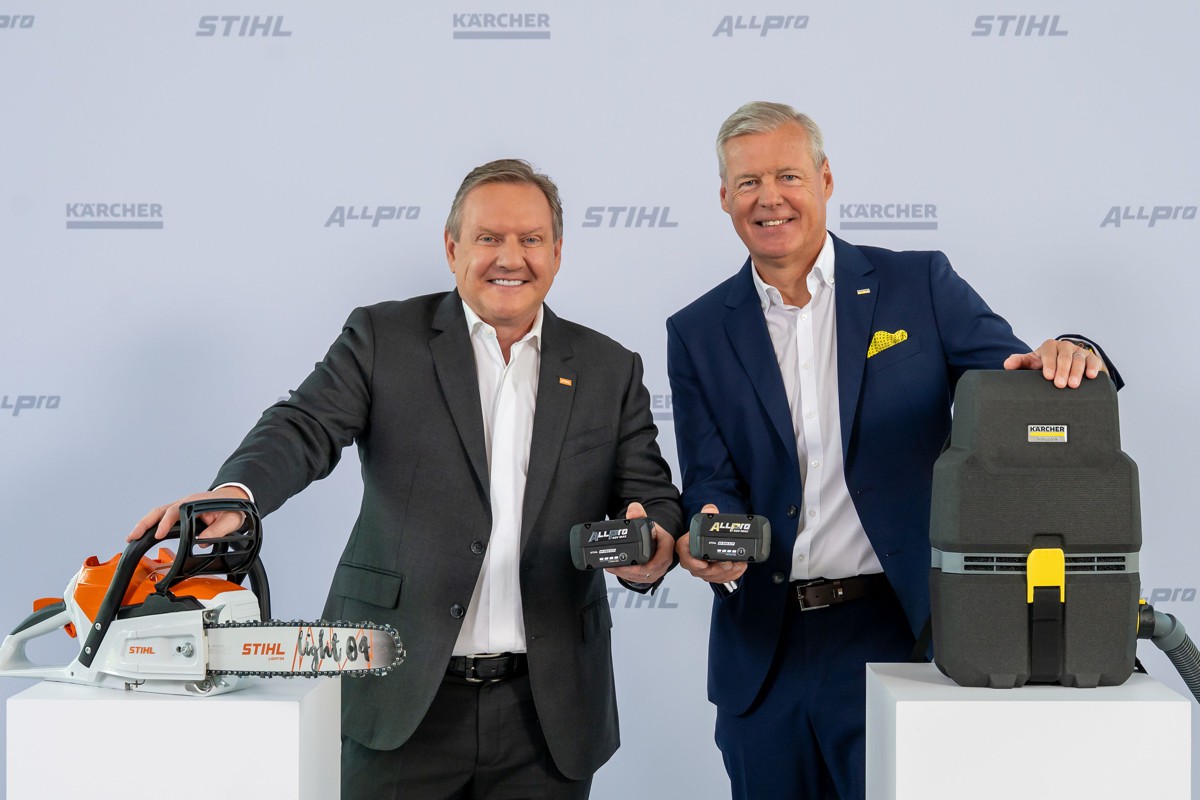
When two of Germany’s largest family-owned equipment manufacturers agree to run their professional machines off the same battery, the significance reaches well beyond the two brands involved. Kärcher and STIHL have confirmed a joint battery alliance built around STIHL’s ALLPRO system, a cross-brand 40V MAX platform that will power professional equipment from both companies.
The tie-up joins two firms whose combined 2025 turnover approaches €9 billion and whose head offices sit barely seven kilometres apart in the same corner of Baden-Württemberg. For contractors, facility managers, grounds teams and forestry operators, the headline is straightforward: one battery pack that runs a STIHL chainsaw can now run a Kärcher cleaning machine.
The commercial reasoning behind that simplicity is what makes the announcement matter to the wider industry. Professional operators have spent the better part of a decade watching their tool fleets electrify one category at a time, each brand arriving with its own battery, charger and management system.
The result on many sites is a cupboard full of incompatible packs, duplicated charging infrastructure and capital tied up in batteries that only ever serve a single machine. By pooling their professional ranges into a single high-voltage standard, Kärcher and STIHL are attacking the cost and logistics of that fragmentation directly, and they are doing so at a scale that competitors and specialist partners will find difficult to ignore.
Briefing
- Kärcher and STIHL have launched a joint battery alliance centred on STIHL’s ALLPRO system, a cross-brand 40V MAX platform spanning more than 120 professional devices.
- The alliance retains full backward compatibility with STIHL’s existing AP battery system, so current AP packs will work in the new Kärcher machines.
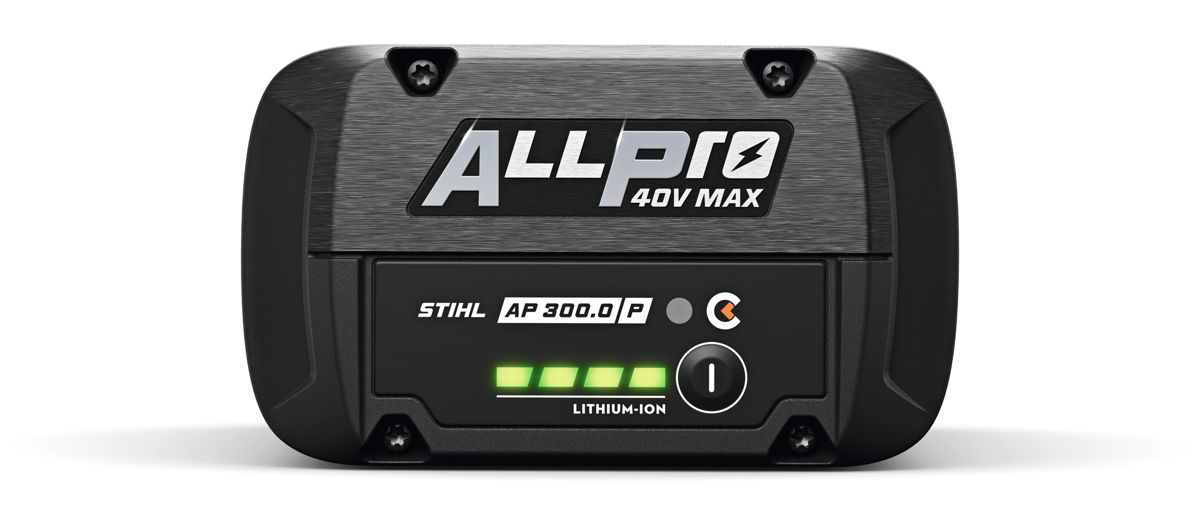
- The high-end Performance series (AP 100 P, AP 200 P and AP 300 P) uses a tabless cell architecture that STIHL says delivers 60% higher peak power, 20% longer runtime, halved charging time and up to 3,000 charge cycles.
- New ALLPRO batteries reach STIHL specialist dealers from 1 August 2026; Kärcher launches its compatible batteries and tools from 1 January 2027.
- Additional partners covering forestry winches, equipment carriers and mobile refuelling systems are adopting ALLPRO, extending the platform beyond the two founding brands.
The economics of a single fleet battery
The core value proposition is a total-cost-of-ownership argument dressed as a convenience story. A landscaping contractor who standardises on ALLPRO no longer needs to specify, buy and maintain separate battery estates for cutting, cleaning and site maintenance.
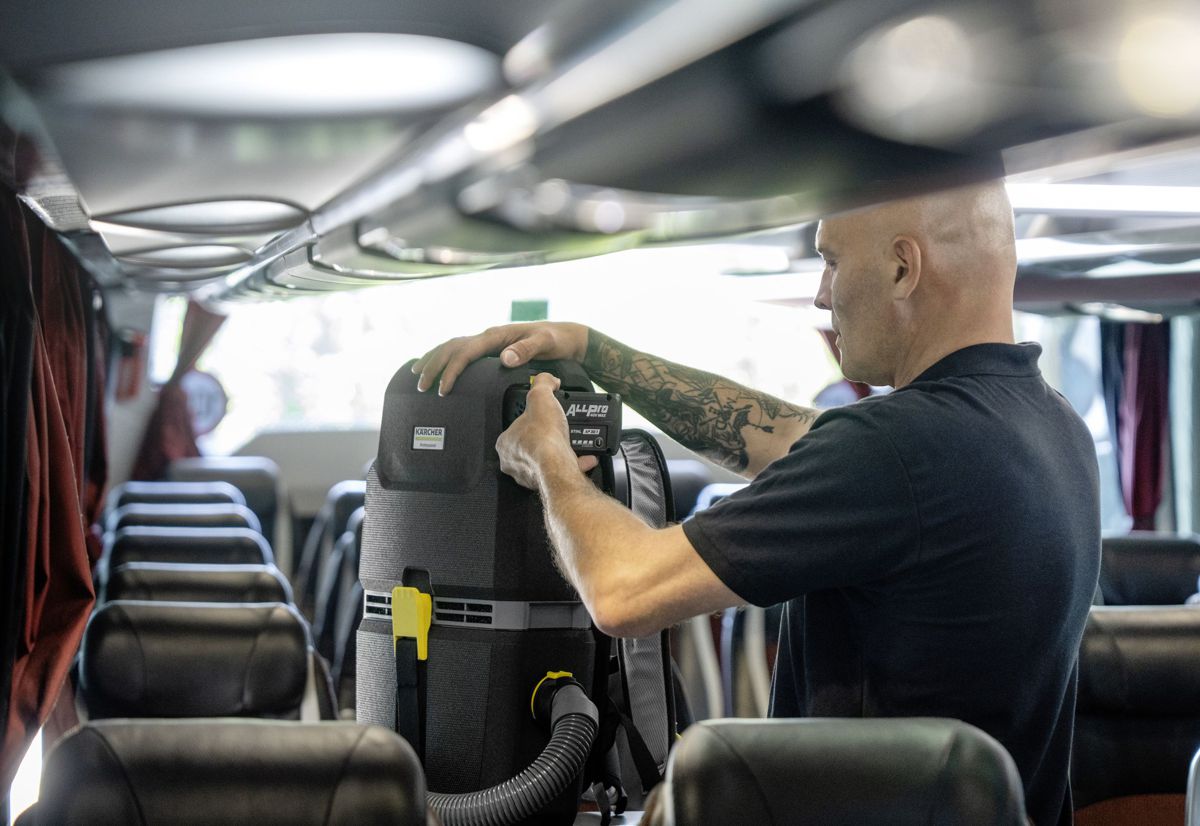
The same packs and chargers move between a STIHL brushcutter and a Kärcher pressure washer or vacuum, which reduces the number of spare batteries a crew must carry, cuts duplicated charging hardware and frees up capital that would otherwise sit idle in single-purpose cells. On larger operations, where batteries are bought in the hundreds, the arithmetic compounds quickly across procurement, storage, logistics and downtime.
Michael Traub, Chairman of the Executive Board of STIHL AG, framed the rationale around the way professionals actually buy and deploy equipment. “Professional users need more than just high-performance tools. They need systems that cover a wide range of tasks, reduce complexity and ensure their investment pays off in the long term,” he said, adding that “this is exactly where ALLPRO comes in. The partnership with Kärcher expands the scope of our battery system to include further professional applications, thereby creating added value in our customers’ day-to-day work.”
The point about long-term payback is the commercially telling one. Batteries are the most expensive consumable in a cordless fleet, and the operators most resistant to electrification have historically been those who could not amortise that cost across enough machines. A shared standard changes the denominator in that calculation.
Where ALLPRO sits in a fragmented battery landscape
The professional power-tool sector has already experimented with shared-battery alliances, and the record is instructive. Bosch’s AMPShare and Metabo’s Cordless Alliance System (CAS) have each assembled coalitions of specialist manufacturers around a common pack, allowing trades to run tools from multiple brands off one battery. Those systems are built on 18V architectures aimed squarely at the construction trades, and crucially they are not compatible with one another, which has produced its own species of confusion as individual manufacturers hedge across competing standards. The lesson for buyers has been that battery ecosystems are a lock-in decision as much as a technical one.
ALLPRO enters that landscape from a different direction. At 40V MAX it targets the higher-power outdoor and cleaning applications, forestry, grounds maintenance and professional cleaning, where 18V trade platforms were never the natural fit. Rather than competing head-to-head with AMPShare or CAS for the drill-and-driver market, Kärcher and STIHL are staking out the heavier-duty segment and inviting adjacent specialists to build on it.
That positioning matters for the industry because it suggests the shared-battery model is maturing from a trades novelty into a structural feature of professional equipment procurement, with distinct standards emerging for distinct power classes rather than a single winner taking all.
The tabless cell architecture doing the heavy lifting
The technical centrepiece is the Performance series, comprising the AP 100 P, AP 200 P and AP 300 P models, which abandon the conventional cell design in favour of a tabless architecture. In a standard lithium-ion cell, current is funnelled through a small metal tab, a bottleneck that concentrates resistance and generates heat. A tabless cell instead allows current to move across the full surface of the electrode, dramatically lowering internal resistance.
STIHL’s own analogy is a wide-necked bottle through which energy can flow in and out far more freely; the underlying physics is the same principle that brought tabless design to prominence in electric-vehicle cells, most visibly Tesla’s 4680 format.
The practical consequences are where the engineering translates into fleet economics. Because so little heat is generated during use and charging, the primary driver of cell ageing is suppressed, which is why STIHL cites a service life of up to 3,000 charge cycles without performance loss. Against a conventional standard battery, the company reports that the tabless AP 300 P offers 60% higher peak power and a 20% increase in runtime, with charging time to full operational readiness halved and cycle life roughly doubled.
For an operator, more cycles per pack and faster turnaround between charges reduce both the number of batteries required to keep machines running and the frequency of replacement, which is precisely where the long-term cost of a cordless fleet is won or lost. The entry-level AP 20.1 and AP 30.1 models, using proven standard cells in the new unified ALLPRO design, round out the range for lighter duty.
Protecting the installed base on both sides
A shared standard is only as attractive as its treatment of the equipment operators already own, and this is where the alliance has been carefully engineered. For STIHL’s professional customers, ALLPRO preserves full compatibility with the existing AP system, meaning the AP batteries already in circulation can be used to their full potential in the new Kärcher machines. That continuity removes the single largest barrier to adoption for STIHL’s professional base, who are not being asked to strand an existing battery investment in order to gain access to Kärcher’s cleaning range.
Kärcher’s position is more complex because ALLPRO represents an entirely new platform for its customers, superseding the earlier Battery Universe. The company has moved to reassure that installed base by guaranteeing continued service, spare parts and battery availability for existing Battery Universe devices, which matters for facility-management contracts and public-sector buyers who plan equipment on multi-year cycles and cannot tolerate orphaned hardware.
Handling the transition this way reflects an understanding that in professional markets, the credibility of a platform rests as much on how it retires the old system as on how it launches the new one. The staggered timing reinforces the point, with ALLPRO packs reaching STIHL dealers from 1 August 2026 and Kärcher’s compatible batteries and tools following on 1 January 2027.
An ecosystem built for more than two brands
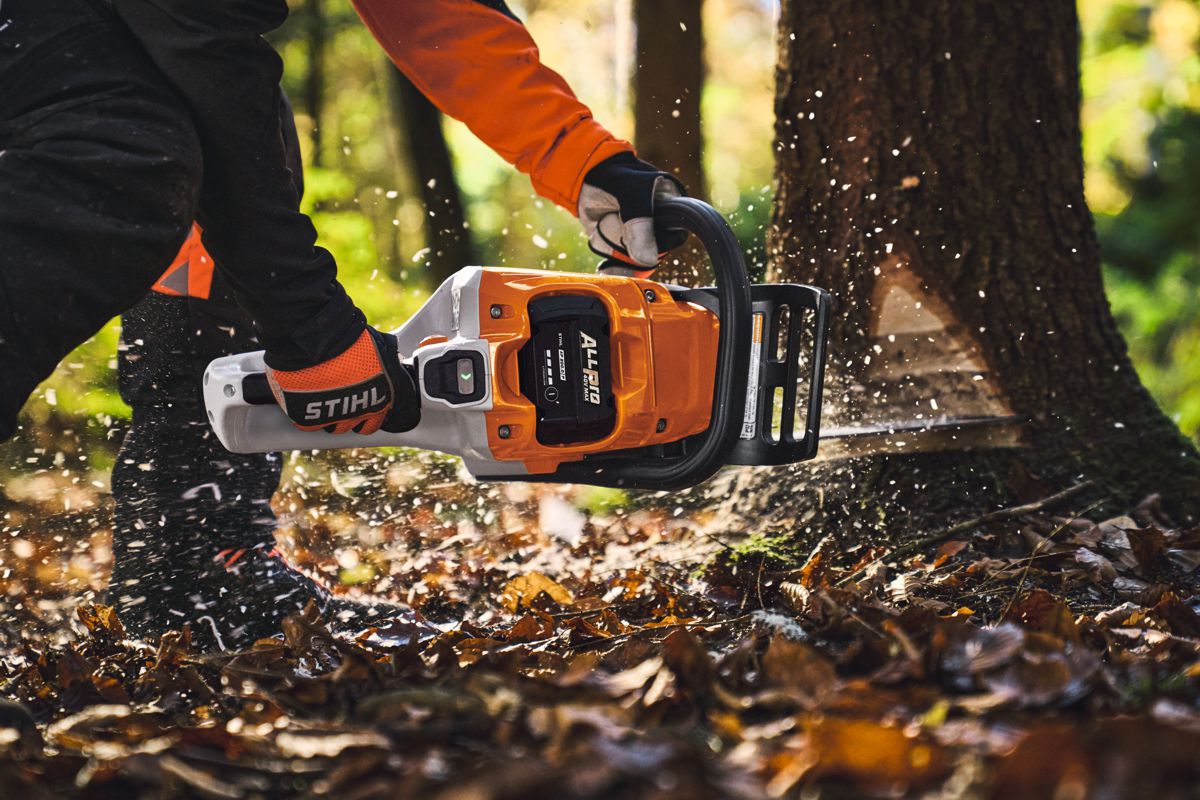
The alliance is explicitly designed to extend beyond its two founders, and that ambition is what elevates it from a bilateral product deal to a platform play. Beyond Kärcher and STIHL, manufacturers of forestry winches, equipment carriers and mobile refuelling systems are already incorporating ALLPRO into their machines, which pushes the ecosystem past 120 devices sharing a common pack.
For end users across forestry, landscaping, the construction sector, facility management and even aid organisations, that breadth means a single battery standard can cover an increasingly wide slice of daily work, backed by a common charging and energy-management system.
For the specialist manufacturers joining the platform, the calculation mirrors what earlier trade alliances demonstrated: adopting an established battery standard lets a smaller brand offer cordless products without shouldering the cost and risk of developing a proprietary pack, while gaining access to the dealer networks and installed base of the founding partners.
STIHL brings a distribution reach of more than 50,000 specialist retailers and a century of brand equity, having sold more chainsaws than any other manufacturer since 1971; Kärcher contributes a global cleaning footprint spanning 87 countries. The combination gives partner brands a route to market that would be difficult to build alone, and it gives buyers confidence that the standard has the commercial weight to endure.
What the alliance signals for cordless professional equipment
The wider read on this announcement is that electrification in professional equipment is moving into its consolidation phase. The first wave was about proving that battery machines could match combustion and corded tools on performance; the question now is whether the economics of running electrified fleets can be made to work at scale, and shared-battery standards are emerging as the mechanism for doing so.
Hartmut Jenner, Chief Executive Officer and Chairman of the Board of Management of Alfred Kärcher SE & Co. KG, positioned the alliance as a strategic rather than merely technical move. “STIHL and Kärcher are two family-owned businesses whose success has always been based on innovative strength and an uncompromising commitment to quality. Through the synergy between our equipment, we are creating far more than just a technical solution: we are consistently driving forward the electrification of professional applications, thereby securing a decisive competitive advantage for our customers,” he said.
For construction and infrastructure operators watching from adjacent sectors, the developments carry a clear procurement signal. Battery standard selection is becoming a strategic decision with long financial tails, comparable to choosing a fuel or a fleet manufacturer, and the emergence of credible high-power platforms like ALLPRO alongside the established 18V trade alliances gives buyers more defined choices at each power class.
The next thing to watch is how quickly the partner ecosystem grows and whether rival manufacturers respond by opening their own high-voltage systems. If they do, the professional equipment market may find itself converging on a small number of durable battery standards, much as the wider electronics industry did with charging and connectivity, with the operators who standardise early capturing the efficiency gains first.
Key Industry Questions
- What is the ALLPRO battery system and who developed it? ALLPRO is a cross-brand 40V MAX battery platform developed by STIHL and now shared with Kärcher under a joint alliance. It is designed for professional applications in forestry, landscaping, construction and cleaning, and spans more than 120 devices from the two founding brands and a growing set of specialist partners. The range is split into two tiers: entry-level AP 20.1 and AP 30.1 packs using proven standard cells, and a high-end Performance series using tabless cell technology. The system includes a common charging and energy-management framework, so the same batteries and chargers move between machines regardless of which brand made them.
- Will existing STIHL AP batteries work with the new Kärcher machines? Yes. A central design principle of the alliance is full backward compatibility with STIHL’s existing AP system. Professional users who already own AP batteries can use them to their full potential in the new Kärcher battery-powered devices, which removes the need to replace an existing battery estate to gain access to Kärcher’s cleaning range. This continuity is one of the most commercially significant aspects of the launch, because it protects the capital that STIHL’s professional customers have already invested in packs and lowers the barrier to adopting the wider platform.
- What happens to existing Kärcher Battery Universe equipment? For Kärcher customers, ALLPRO is an entirely new platform that supersedes the earlier Battery Universe. Kärcher has committed to guaranteeing continued service, spare parts and battery availability for existing Battery Universe devices, so operators running that equipment are not left with orphaned hardware. That assurance matters particularly for facility-management and public-sector buyers who plan equipment over multi-year cycles and need certainty that current machines will remain serviceable through their working lives, even as the new standard takes over future purchases.
- How does tabless cell technology improve performance? A conventional lithium-ion cell channels current through a small tab, which concentrates internal resistance and generates heat. A tabless design lets current flow across the whole surface of the electrode, sharply reducing internal resistance and, with it, heat generation. Because heat is the main driver of cell ageing, suppressing it extends service life. STIHL reports that its tabless AP 300 P delivers 60% higher peak power and 20% more runtime than a conventional standard pack, halves the charging time to full readiness and roughly doubles cycle life to as many as 3,000 charges. The approach mirrors the physics that brought tabless architecture to electric-vehicle cells.
- How does ALLPRO compare with battery alliances like AMPShare and CAS? Bosch’s AMPShare and Metabo’s CAS are established multi-brand alliances built on 18V architectures aimed at the construction trades, and they are not compatible with each other. ALLPRO occupies a different power class at 40V MAX, targeting the heavier-duty outdoor and cleaning applications where 18V trade platforms are less suited. Rather than competing directly for the drill-and-driver market, Kärcher and STIHL are consolidating the forestry, grounds-maintenance and professional-cleaning segment. The parallel with AMPShare and CAS is strategic: all three show shared-battery standards becoming a structural feature of professional equipment, with distinct platforms emerging for distinct power requirements.
- When will the new batteries and tools be available? The rollout is staggered. New ALLPRO batteries reach STIHL specialist retailers from 1 August 2026. Kärcher will launch its compatible batteries and the accompanying tools from 1 January 2027. The phased timing lets STIHL’s existing AP-based professional range absorb the new packs first, while Kärcher aligns its new-platform machines with the start of the following year. Buyers planning fleet purchases around the alliance should factor in that Kärcher’s ALLPRO-powered cleaning equipment arrives roughly five months after the batteries first appear through STIHL’s dealer network.
- Which sectors benefit most from the alliance? The platform is aimed at professional users in forestry, landscaping and grounds maintenance, the construction industry, facility management and aid organisations. These are operators who run a broad mix of cutting, clearing, site-maintenance and cleaning tasks and who therefore stand to gain most from consolidating onto a single battery standard. The inclusion of partner manufacturers making forestry winches, equipment carriers and mobile refuelling systems broadens the addressable work further, meaning a single pack can power an increasingly wide range of daily operations across a site or estate.
- What does the alliance mean for smaller equipment manufacturers? For specialist manufacturers, adopting ALLPRO offers a way to bring cordless products to market without developing a proprietary battery, which is one of the most expensive and technically demanding elements of electrification. Joining the platform also provides access to the dealer networks and installed base of two major brands, including STIHL’s network of more than 50,000 specialist retailers and Kärcher’s presence in 87 countries. In exchange, the alliance gains breadth and credibility. The dynamic echoes earlier trade alliances, where the standard-setter builds scale and partner brands gain reach they could not achieve independently.
Strategic Takeaways
- Battery standard selection is becoming a long-horizon procurement decision for professional equipment fleets, comparable to choosing a fuel or a fleet manufacturer, and early standardisation is where the efficiency and cost gains accrue first.
- Backward compatibility with the existing STIHL AP system, and continued support for Kärcher’s Battery Universe, is the commercial engine of the alliance, because protecting installed battery investment removes the main barrier to platform adoption.
- Tabless cell architecture is migrating from electric vehicles into professional handheld and cleaning equipment, and its impact on cycle life and charging speed is where the total cost of running a cordless fleet is ultimately decided.
- ALLPRO’s 40V MAX positioning stakes out the high-power outdoor and cleaning segment distinct from the 18V trade alliances, signalling that the professional market is likely to converge on several durable battery standards by power class rather than one universal pack.
- The alliance’s platform ambition, drawing in forestry, materials-handling and refuelling specialists, indicates that electrification has entered a consolidation phase in which shared standards, not individual products, will shape competitive advantage.