The Tadano AC 7.450-1 and the Economics of Constrained Lifting
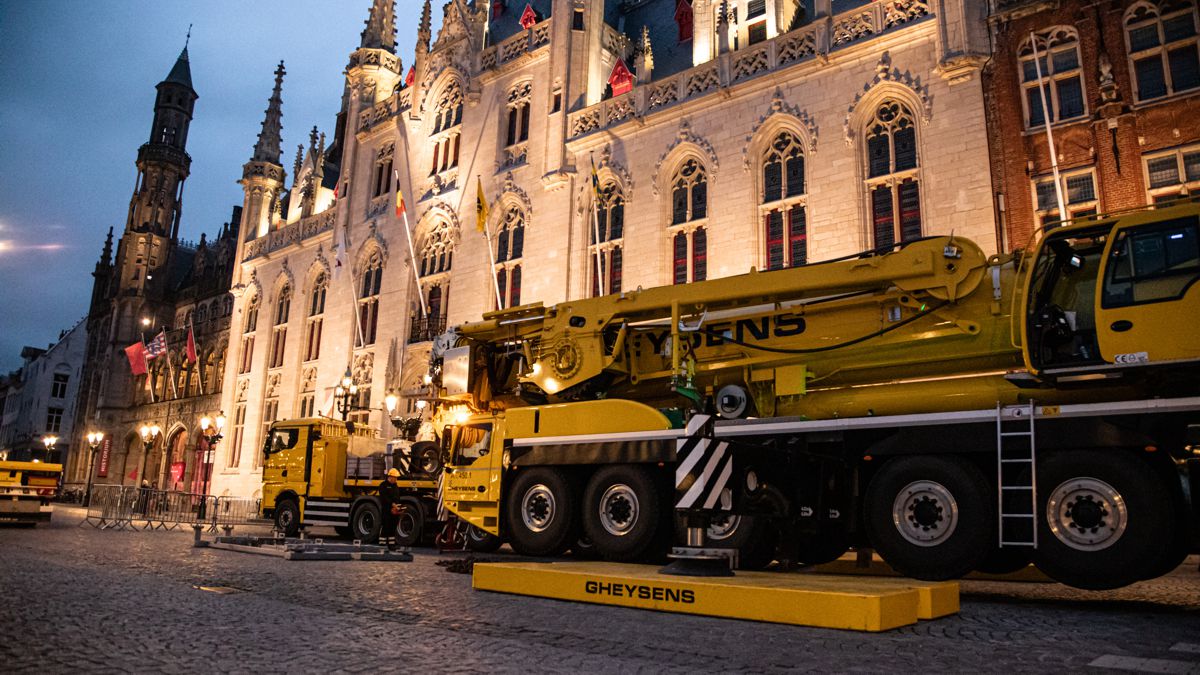
A single lift in the medieval heart of Bruges rarely carries much market significance, yet the operation Belgian crane service provider Gheysens completed with a Tadano AC 7.450-1 is worth reading closely. The job was small in tonnage terms and the decisive problem was never the weight of the load. It was the ground. A 160-tonne crane had ample capacity for the work planned beside the city’s belfry, but the street beneath it could not be trusted to hold the machine, and no amount of lifting capacity fixes a standing position that will not bear the outrigger loads.
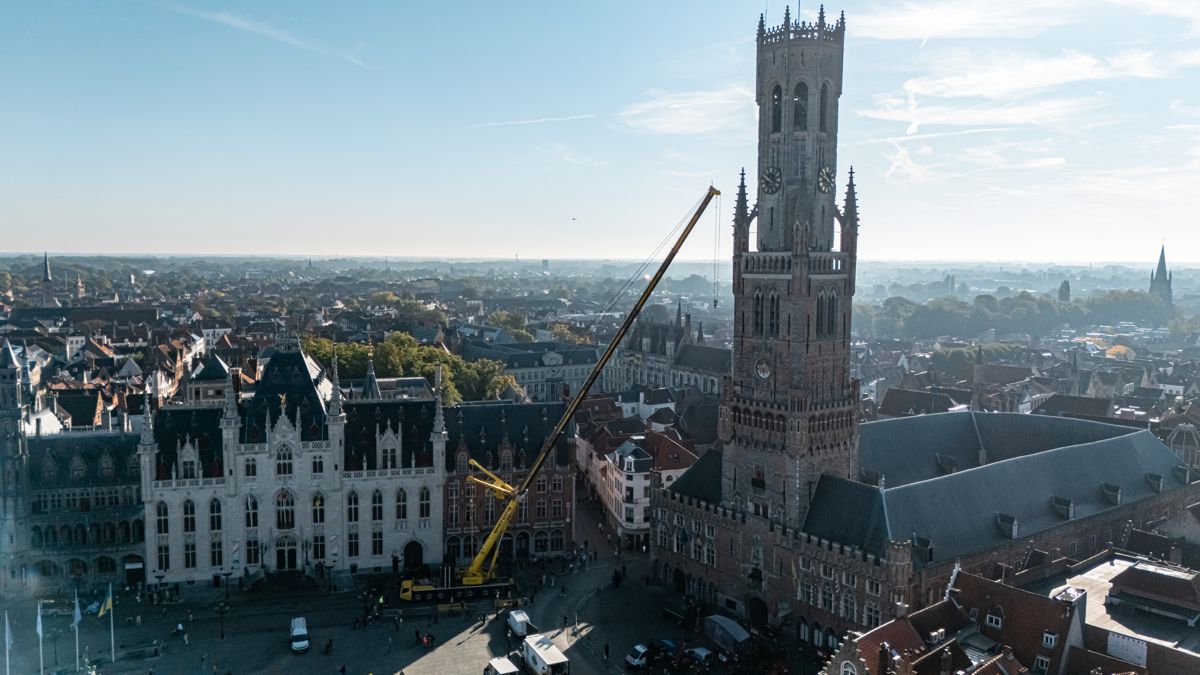
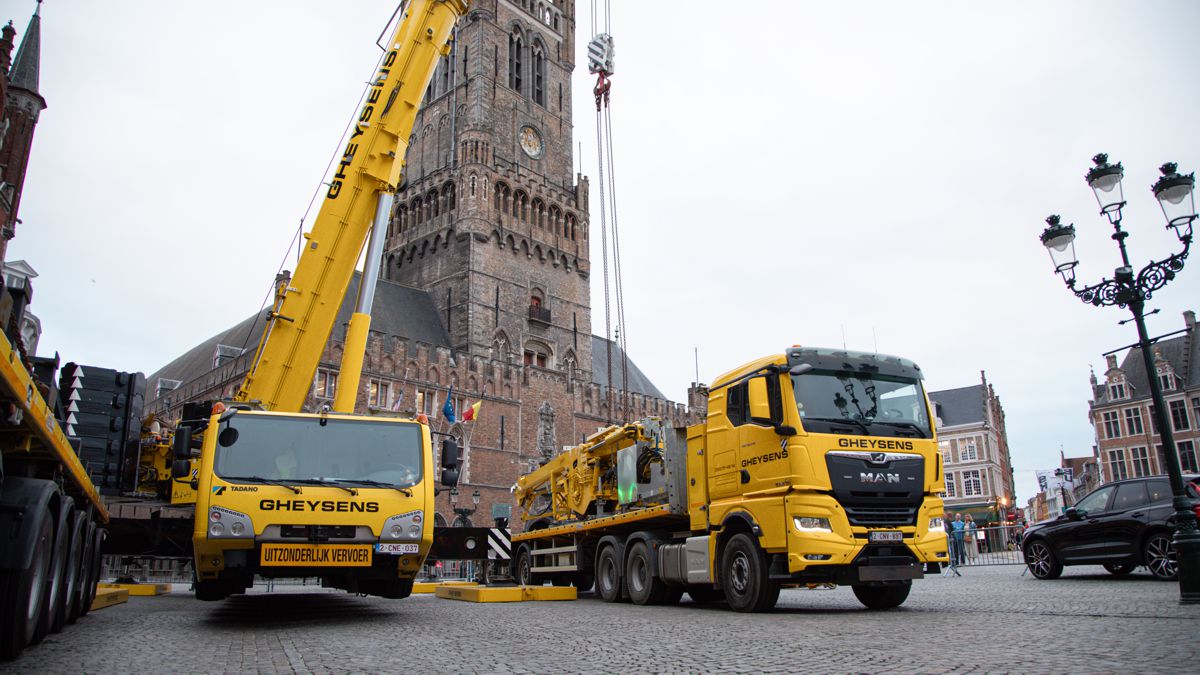
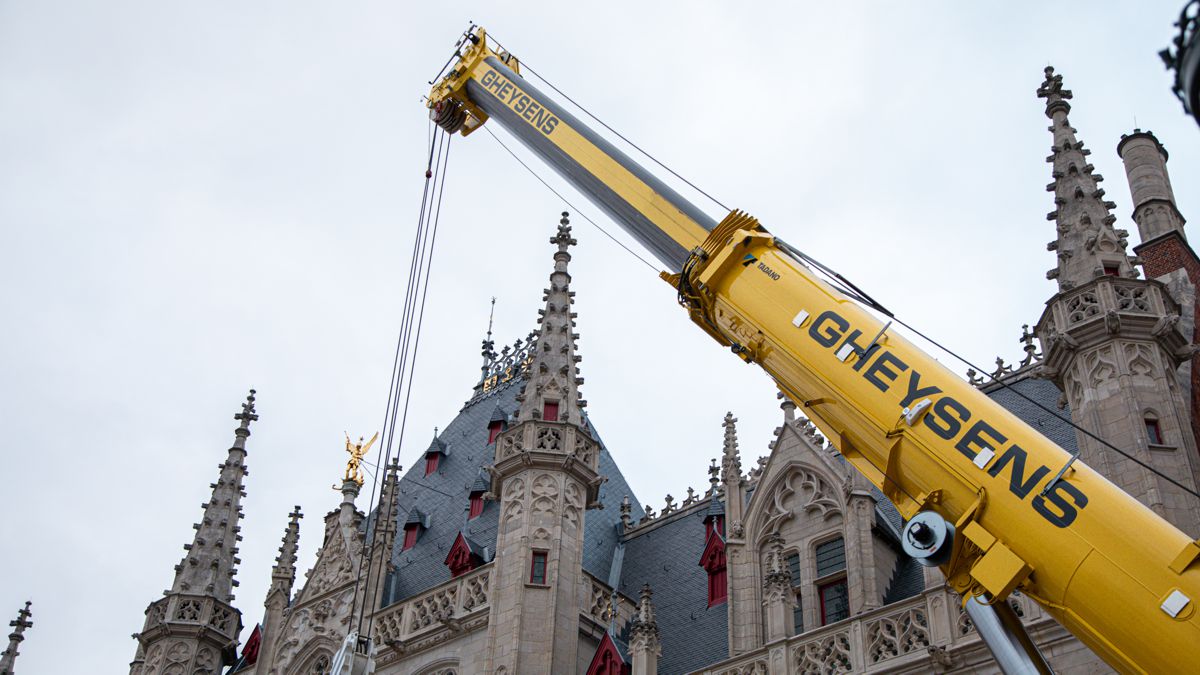
The answer was not a larger lift but a longer arm working from firmer footing further back. Gheysens reached for a 450-tonne, seven-axle all-terrain crane and used its 80-metre main boom to cover a 35-metre working radius at a hook height of 67.7 metres, rigged in the compact Sideways Superlift configuration with 120 tonnes of counterweight. That inversion, where access and ground-bearing capacity override raw tonnage in the selection decision, is precisely the pressure now reshaping where commercial value sits in the all-terrain crane market.
Urban infill, heritage-adjacent work and confined sites are rewarding machines that convert reach and a small footprint into road-legal, permittable, quickly rigged capability, and manufacturers are pouring investment into exactly that trade-off.
For infrastructure owners, rental fleets and equipment buyers, the Bruges operation is a clean field demonstration of a structural shift. The premium is migrating away from the biggest number on the load chart and towards the crane that can stand where the site actually allows, then reach the work from there. Understanding that change matters for procurement, utilisation economics and where the next round of fleet capital should go.
Briefing
- Gheysens abandoned a plan to lift beside the Bruges belfry with a 160-tonne crane after the ground proved too unstable, switching to a 450-tonne Tadano AC 7.450-1 to gain reach from a safer standing position further away.
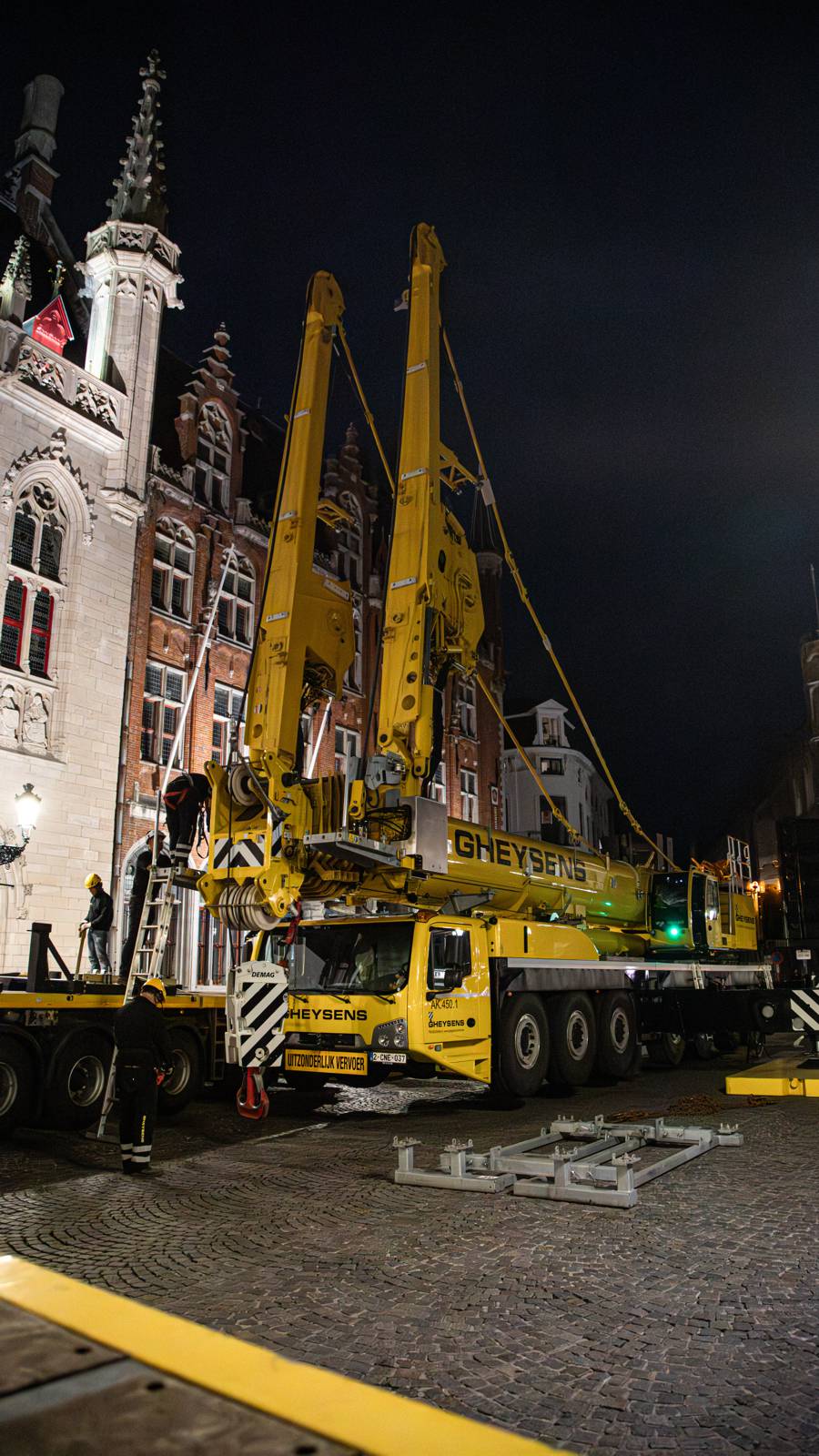
- The seven-axle AC 7.450-1 worked at a 35-metre radius and a 67.7-metre hook height using its 80-metre main boom, rigged overnight in the Sideways Superlift configuration with 120 tonnes of counterweight and ready for action by 9:30 a.m.
- The AC 7.450-1 pairs the footprint of a six-axle crane with power comparable to an eight-axle unit and carries the longest main boom of any six or seven-axle all-terrain crane, giving it strong jobsite accessibility in dense urban settings.
- The 200 to 500 tonne all-terrain band is the fastest-growing capacity segment, forecast to roughly double this decade, as urban complexity, wind energy and data-centre construction reward compact high-reach machines over pure tonnage.
- Tadano, generally ranked among the top three mobile crane manufacturers worldwide, is guiding towards record revenue in 2026 on a strong order backlog, with the AC 7.450-1 positioned as the first model in a new high-efficiency crane family.
When The Ground Decides The Crane
Ground-bearing capacity is the quiet arbiter of most urban lifts, and it decided this one. The original scheme placed a 160-tonne crane on the street immediately next to the belfry, a position that offered a short, efficient reach to the work. The subsoil could not carry the resulting bearing pressures, which meant the ideal geometric solution was structurally impossible before a single load was picked.
Managing Director Miguel Gheysens set out the reasoning plainly: “The original plan was to carry out the job using a 160-tonne crane positioned on the street right next to the belfry. However, the ground there proved too unstable for the crane. We therefore had to work from a greater distance and use a crane with significantly more reach.”
That single constraint reorders the entire selection logic. Moving the crane back to competent ground lengthens the required radius, and a longer radius sharply erodes the capacity of any boom, so the replacement machine needs far more reserve than the nominal load suggests. Gheysens covered a 35-metre radius at a 67.7-metre hook height, figures that a 160-tonne crane could not deliver at working margins but that a 450-tonne class boom handles with room to spare.
The commercial lesson is that capacity on a heritage site is rarely spent on the load itself. It is spent buying the distance between a stable standing position and the work, and that distance is set by soil, buried services and street width rather than by the mass on the hook.
Compact Footprint, Eight-Axle Muscle
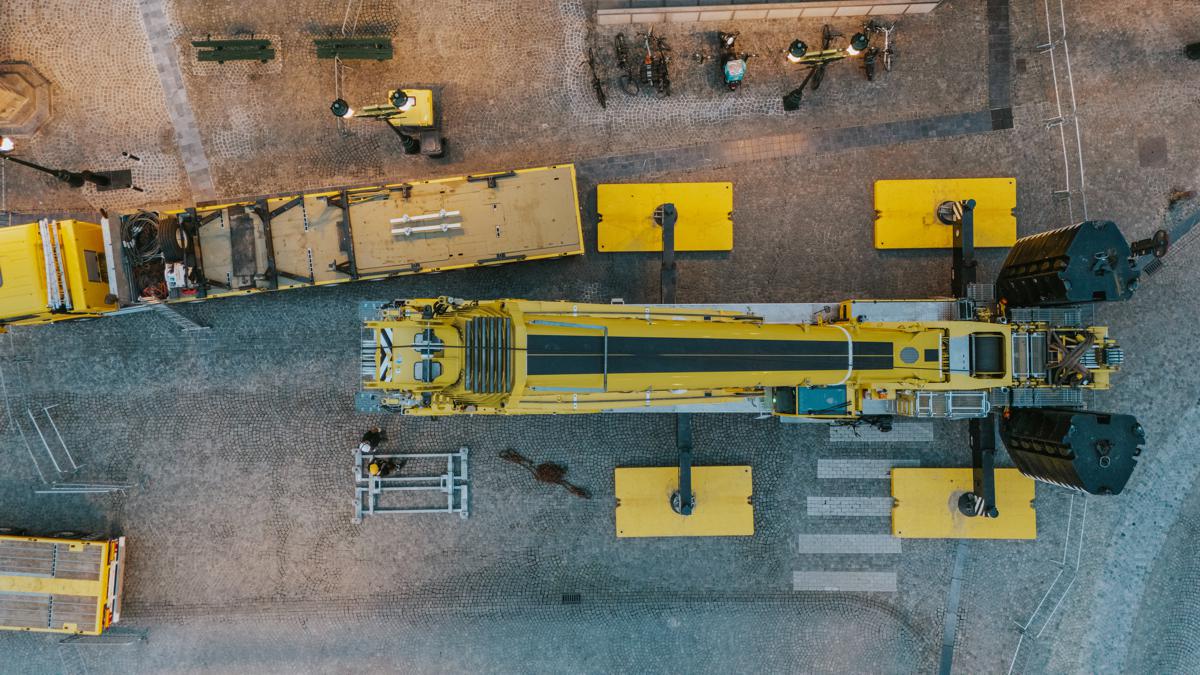
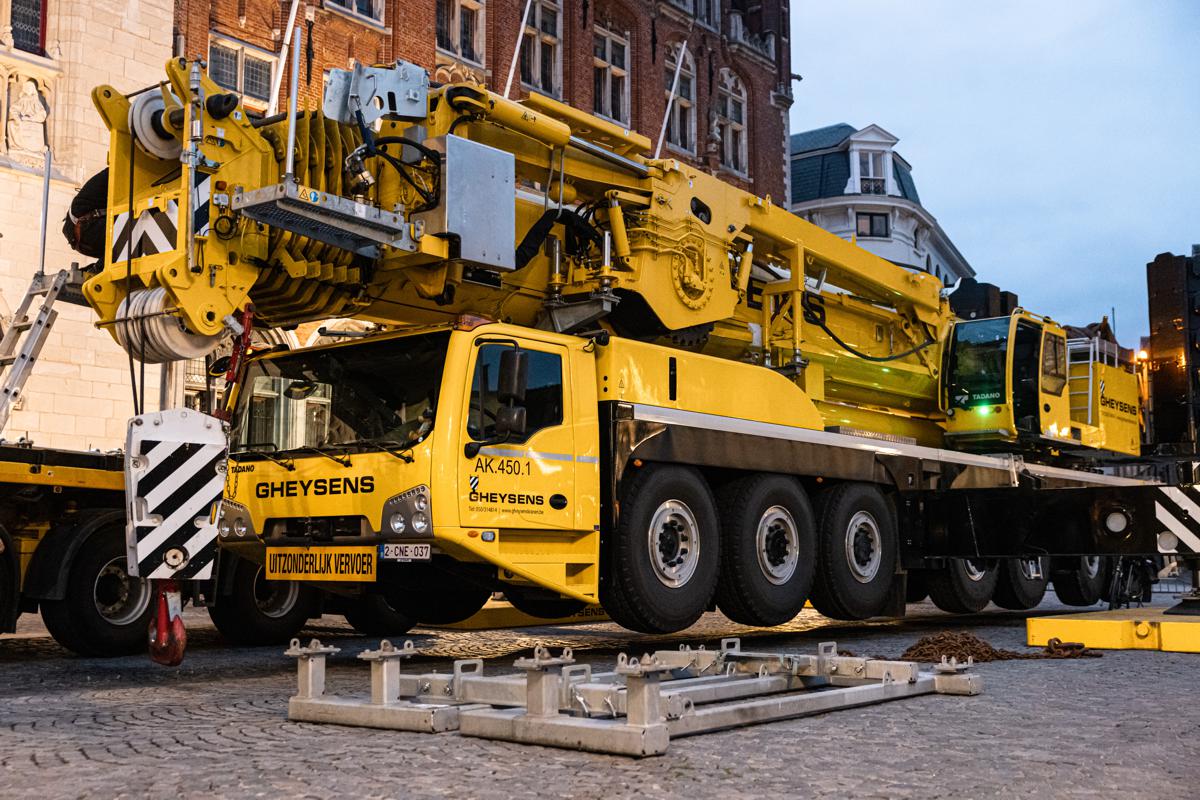
The reason the AC 7.450-1 fitted a problem defined by access is written into its design brief. Tadano built the machine to combine the footprint of a six-axle carrier with lifting performance comparable to an eight-axle unit, and it carries the longest main boom of any six or seven-axle all-terrain crane at 80 metres, with a compact size comparable to 400-tonne six-axle models that gives it strong jobsite accessibility.
In a market where standing space is the scarce resource, that pairing is the whole commercial proposition. A crane that occupies less street while reaching further widens the set of jobs a single asset can service, and it does so without forcing operators into an eight-axle machine that many confined sites and road networks simply cannot accommodate.
Miguel Gheysens credited that configuration directly for the Bruges result: “This allowed us to make the most of the AC 7.450-1’s design advantages: combining the compact dimensions of a 6-axle crane with the power of an 8-axle model, it proved to be the ideal machine for Bruges’ narrow city center. Even setting up the Sideway Superlift system worked perfectly in the confined space.”
The Sideways Superlift arrangement is the pivotal detail, because it extends the counterweight advantage that unlocks reach while keeping the rigged envelope tight enough to build within a cramped street. Practical touches reinforce the same discipline. When Gheysens first specified the crane, it added aluminium rims so the unit could travel within a 12-tonne axle-load limit even with the hook block aboard, a reminder that in urban work the economics of getting the machine legally to site rank alongside what it can lift once there.
Where All-Terrain Value Is Concentrating
Step back from the individual lift and the wider market is bending in the same direction. The all-terrain crane sector was worth around USD 18.3 billion in 2025 and is forecast to reach roughly USD 24.1 billion by 2030 at a compound rate of about 5.6 per cent, but the growth is far from evenly spread. The sharpest expansion sits in the mid-to-upper capacity band that the AC 7.450-1 occupies, with the 200 to 500 tonne segment reaching about USD 1.25 billion in 2025 and forecast to roughly double by the middle of the next decade at a 7.2 per cent annual rate, the strongest growth in the mainstream capacity range as it balances mobility with heavy-lift capability.
Wind installation, petrochemical maintenance, large bridges and the surge in data-centre construction all favour cranes that can travel well and reach hard, which is exactly the brief a compact high-reach 450-tonner answers.
Competition is intensifying around the same trade-off, which validates rather than threatens the category. Liebherr used a May 2026 event in Ehingen to unveil the 400-tonne LTM 1400-8.1, built with active VarioBase Plus supporting-leg control and integrated telematics, a machine aimed squarely at contractors who need heavy capacity delivered from awkward, variable set-ups.
When two of the strongest European manufacturers concentrate their newest engineering on reach, footprint and set-up flexibility in the same capacity band, it confirms that purchasing power is moving there. For fleet owners, the read is that the next replacement cycle should be specified around versatility and accessibility, because that is where utilisation, day rates and resale strength are consolidating.
Tadano’s Quality-Premium Play
The AC 7.450-1 is not a one-off product but the leading edge of a broader strategy. Tadano positions it as the first machine from a new high-efficiency crane family, and the company is investing behind a quality-premium reputation that carries weight in the energy and petrochemical sectors where safety tolerances are tightest. That positioning is backed by momentum in the financials.
Tadano has guided towards revenues near ¥400 billion for 2026, an increase of roughly 14.5 per cent, supported by strong overseas mobile-crane, loader-crane and aerial-lift demand and a robust order backlog, and it is generally ranked among the top three mobile crane manufacturers worldwide, having recovered from the cost of the Demag acquisition and launched its EVOLT electric crane line to target zero-emission urban and indoor lifting work.
The corporate manoeuvring around the product tells the same story. Tadano absorbed the Demag all-terrain and crawler lines from Terex in 2019 and unified them under a single brand by 2021, and has since added the IHI Transport Machinery business in mid-2025 alongside loader-crane assets, broadening the portfolio that surrounds machines such as the AC 7.450-1. Repeat purchasing is the clearest signal that the design is landing with professional buyers.
Gheysens ran the Bruges job on a unit it ordered as part of a three-crane Tadano commitment, while German fleet Wiesbauer took delivery of a second AC 7.450-1 in April 2026 and French specialist ADEKMA added one to its heavy-lift division in early 2026.
Christophe Gheysens tied the loyalty back to service as much as steel: “There is a reason we prefer Tadano cranes: they stand for quality — and that applies to both the products and the service, the reliability of which we particularly value.” In a rental business, reliability and support-network depth are commercial assets, because an idle crane earns nothing and a delayed lift cascades through a client’s programme.
Heritage Streets As A Structural Market
Bruges is not an outlier but an exemplar of a growing class of work. The belfry presides over a historic centre inscribed on the UNESCO World Heritage List, and its surrounding medieval street pattern imposes exactly the conditions that defeat conventional set-ups: narrow carriageways, sensitive and unpredictable ground, restricted daytime access and no tolerance for disruption to a working tourist city.
Europe is dense with such settings, and the pipeline of restoration, re-roofing, plant replacement and services renewal within protected townscapes is steady and largely recession-resistant. That makes heritage and constrained-urban lifting a durable demand driver rather than a novelty, and it rewards contractors who can plan around the constraints rather than fight them.
Gheysens managed the operation with the discipline the setting demanded, rigging the crane overnight so daytime activity was untouched and confirming readiness early. As Miguel Gheysens put it, “We had the AC 7.450-1 set up and ready for action by 9:30 a.m., so we could look forward to the afternoon’s operation with complete peace of mind.”
The firm’s heritage suits the work: founded in Bruges in 1956, Gheysens moved from industrial demolition into crane rental, heavy transport and the handling of specialised loads including works of art, and it has held VCA safety certification since 2000. That combination of local knowledge, safety culture and a fleet built for tight access is what turns a difficult brief into a routine outcome, and it is the operational template that any contractor bidding heritage-city work will need to match.
What Rental Fleets Should Take From Bruges
The strategic message for fleet owners and infrastructure buyers is to specify for the constraint, not the headline. The load chart figure that wins the brochure comparison is often irrelevant on the sites where margins are actually made, because those sites are defined by where a crane can stand and how far it must reach from there.
A machine that carries the reach of a far larger crane while keeping a six-axle footprint and a road-legal axle-load profile does more billable work across a wider job mix, which is the metric that governs return on a capital asset with a long life and a demanding duty cycle. Buyers weighing their next order should therefore test candidates against their most awkward recurring sites rather than their heaviest single pick.
There is a wider industry point in the Bruges result as well. As cities densify, as protected townscapes require continual maintenance and as renewable and data-centre programmes push heavy components into constrained locations, the commercial centre of gravity in the crane market is settling on flexibility delivered from a small footprint.
Manufacturers are responding with concentrated engineering effort, financiers are seeing the fastest value growth in the mid-to-upper capacity band, and rental businesses are validating the shift through repeat orders. The operators who read that signal early, and who build fleets and crews around access-led lifting rather than tonnage-led lifting, will hold the stronger position as the pipeline of complex urban work continues to grow.
Key Industry Questions
- Why did Gheysens replace a 160-tonne crane with a 450-tonne machine when the load did not change? The load was never the limiting factor. The 160-tonne crane could not stand on the unstable ground next to the belfry, so the operation had to be run from firmer footing further away. Moving back lengthened the required radius, and capacity falls steeply as radius increases, which meant a much larger boom was needed to reach the same work at safe margins. The 450-tonne AC 7.450-1 handled a 35-metre radius at a 67.7-metre hook height comfortably. The switch bought reach and reserve rather than lifting weight, which is the defining pattern of constrained heritage lifting where soil, street width and buried services set the standing position.
- What makes the Tadano AC 7.450-1 suited to confined urban sites? Its design pairs the footprint of a six-axle crane with performance closer to an eight-axle unit, and it carries the longest main boom of any six or seven-axle all-terrain crane at 80 metres. That combination lets it occupy less street while reaching further, widening the range of jobs one asset can service in dense settings. The Sideways Superlift system adds counterweight advantage while keeping the rigged envelope tight enough to build in a cramped space, and six mounted cameras assist positioning. For rental fleets, the practical value is a single machine that can be permitted, transported road-legally and rigged where larger cranes cannot go.
- How do ground conditions influence crane selection on historic sites? Ground-bearing capacity often decides the crane before the load is even considered. Outrigger pressures from a mobile crane are concentrated and high, and medieval street build-ups, vaults, cellars and buried services frequently cannot carry them. When the ideal standing position fails a ground assessment, the crane must move to competent ground, which lengthens the radius and demands far greater reserve capacity. Contractors mitigate this with load-spreading mats, ground investigation and, increasingly, by selecting high-reach machines that can work from a safe distance. On protected sites the assessment also has to protect adjacent historic structures, making early engineering and careful planning central to winning and delivering the work.
- Which part of the all-terrain crane market is growing fastest, and why? The 200 to 500 tonne band is the strongest performer, forecast to roughly double this decade at around a 7.2 per cent annual rate, well ahead of the broader all-terrain market’s mid-single-digit growth. This capacity range balances road mobility with genuine heavy-lift capability, making it the natural fit for wind installation, petrochemical maintenance, large bridges and data-centre construction. Urban complexity is a further driver, because constrained sites reward cranes that combine reach with a compact footprint. As a result, both purchasing power and manufacturer investment are concentrating in this segment, which is where day rates, utilisation and resale values are consolidating most strongly.
- How does the AC 7.450-1 compare with rivals such as Liebherr’s LTM 1400-8.1? Both target contractors who need substantial capacity delivered from awkward set-ups, but they emphasise different strengths. The AC 7.450-1 leads on compactness and reach for its class, offering an eight-axle-equivalent performance from a six-axle footprint with the longest boom among six and seven-axle machines. Liebherr’s 400-tonne LTM 1400-8.1, unveiled in 2026, foregrounds active supporting-leg control through VarioBase Plus and integrated telematics for variable ground and set-up conditions. The competition is a healthy signal for buyers, because two leading manufacturers concentrating their newest engineering on reach, footprint and set-up flexibility confirms that this is where the market’s value is moving.
- What is the Sideways Superlift system and why does it matter in tight spaces? Sideways Superlift is a counterweight arrangement that boosts a crane’s lifting capacity and reach by extending the effective counterbalance, allowing a machine to punch above its base configuration. Its significance on urban sites is that it delivers this advantage while keeping the rigged footprint controlled, so an operator can gain the reach of a much larger crane without the sprawling set-up that confined streets cannot accommodate. On the Bruges job the system was rigged overnight in a constrained space, which let Gheysens achieve the necessary radius and hook height from a safe standing position. For confined-site specialists, that capability is often the difference between winning a contract and passing on it.
- What does the Bruges operation tell rental fleets about crane procurement? It argues for specifying to the constraint rather than the headline capacity. The load chart figure that wins brochure comparisons is frequently irrelevant on the sites where margins are made, because those sites are defined by where a crane can stand and how far it must reach. A machine offering the reach of a far larger crane from a compact, road-legal footprint services a wider job mix and earns across more of the calendar, which is the metric that governs return on a long-lived capital asset. Buyers are therefore better served testing candidate cranes against their most awkward recurring sites than against their single heaviest pick.
- Where does Tadano sit in the global crane market? Tadano is generally ranked among the top three mobile crane manufacturers worldwide and trades on a quality-premium reputation that carries particular weight in energy and petrochemical work. It has recovered from the cost of absorbing the Demag all-terrain and crawler lines, unified that portfolio under a single brand, and continued to expand through further acquisitions including loader-crane assets and IHI’s transport-machinery business. The company is guiding towards record revenue in 2026 on a strong order backlog, and it has launched an EVOLT electric crane range to target zero-emission urban and indoor lifting. The AC 7.450-1 sits at the front of a new high-efficiency family that anchors this strategy.
Strategic Takeaways
- On constrained and heritage sites, ground-bearing capacity and access usually decide the crane before the load does, so procurement should be tested against the most awkward recurring sites rather than the single heaviest lift.
- The commercial premium in the all-terrain market is shifting from headline tonnage towards reach delivered from a compact, road-legal footprint, and fleets specified around that trade-off will hold stronger utilisation and resale positions.
- The 200 to 500 tonne capacity band is the fastest-growing value pool in all-terrain cranes, making it the logical focus for the next round of fleet capital as wind, petrochemical, bridge and data-centre work expands.
- Repeat orders from professional buyers such as Gheysens, Wiesbauer and ADEKMA, combined with competing launches from Liebherr, confirm that manufacturer investment and purchasing power are converging on compact high-reach machines.
- Heritage-city maintenance is a durable, recession-resistant demand driver that rewards contractors who combine local knowledge, safety certification and fleets built for tight access, positioning access-led lifting as a lasting competitive advantage.