Dual-Power Equipment the Practical Route for Landscape Electrification
The professional landscaping sector has spent the better part of a decade being told it faces a binary choice between the petrol engines it trusts and the battery power that regulators increasingly demand. ELIET’s decision to build its Prof 6 shredding platform around both, using power systems from Briggs & Stratton’s Vanguard brand, is a quiet rejection of that framing.
The Belgian manufacturer has kept a single machine architecture and offered it in petrol and electric forms that share roughly 90% of their components, and in doing so it has turned the electrification question from a bet-the-factory gamble into a procurement option. That is the development worth paying attention to, because it points to where commercial value in outdoor power equipment is actually concentrating.
Industry analysts put the global outdoor power equipment market at around USD 31 billion in 2024, with commercial applications now accounting for the majority of demand and battery power identified as the primary structural growth driver. The global outdoor power equipment market was valued at USD 31.0 billion in 2024 and is projected to grow toward USD 36.5 billion by 2029, while commercial applications represented 64% of the overall outdoor equipment market in 2025.
Professional contractors, however, will not accept lower throughput in exchange for cleaner operation, which is precisely why so many electrification efforts have stalled at the demonstration stage. ELIET’s answer has been to treat power source as a variable rather than a founding decision, and the enabler that makes this economically viable is not a clever chassis but a supplier able to deliver both a proven petrol engine and a commercial-grade lithium-ion pack as integrated, OEM-ready systems.
The consequence for the wider industry is a gradual shift in where the margin and the differentiation sit. As power systems become the component that determines whether a machine can serve a remote forestry job on Monday and a noise-restricted city park on Tuesday, the strategic advantage moves toward firms that control both combustion and battery technology and can hand an OEM a complete power package. Vanguard has spent several years positioning itself for exactly that role, and ELIET’s Prof 6 is a working example of how a mid-sized manufacturer can adopt it to hedge the transition rather than being forced to choose a side prematurely.
Briefing
- ELIET has extended its Prof 6 ‘On Wheels’ shredder into petrol and battery variants that share approximately 90% of components, including blades, belts and drive systems, removing the parts, training and servicing burden of running mixed fleets.
- The electric Prof 6 ePower runs on Vanguard’s commercial-grade Fi7.0 kWh fixed lithium-ion pack, delivering around 40 to 45 minutes of continuous shredding but roughly 90 minutes of realistic working time, extended by an infrared standby system that idles the machine when no material is present.
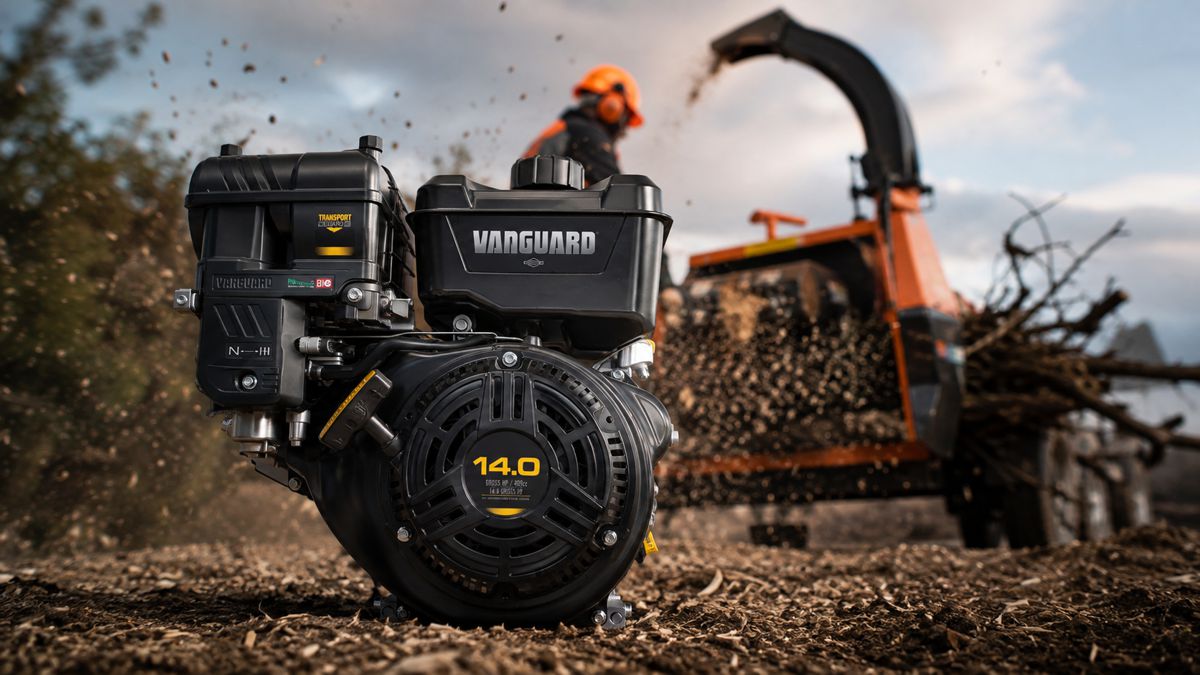
- Petrol variants use the Vanguard 400 single-cylinder engine, with a heavier-duty 18 HP V-Twin ‘Monster’ option, offering extended service intervals and a 3+1 year global commercial warranty.
- EU Stage V emissions rules and the expansion of Low Emission Zones and urban noise restrictions across France, Germany, Spain and the UK are steadily shrinking the zones where petrol equipment can operate freely, strengthening the case for a dual-power platform.
- ELIET is evaluating a future variant based on Vanguard’s Si1.5 swappable battery, which would allow pack rotation and continuous operation, though the concept remains exploratory with no confirmed production plans.
The Complexity Tax Fleets Can No Longer Ignore
The most commercially important feature of the Prof 6 is not its power output but its parts list. By engineering the electric model as a close derivative of the petrol machine rather than as a separate product, ELIET has kept roughly 90% of components common across both variants, spanning the core mechanical systems of blades, belts and drive components.
For a fleet operator, this attacks the hidden cost that has done more than range anxiety to slow professional electrification, namely the complexity of running two parallel equipment ecosystems. Mixed fleets multiply spare-parts inventory, fragment technician knowledge and force operators to relearn machines every time they switch power source, and all of that ties up working capital and creates room for error.
A shared platform collapses those overheads into one. Technicians service both configurations from the same knowledge base, inventory is streamlined rather than duplicated, and operators can move between petrol and battery machines without retraining. This matters commercially because the professional segment does not buy on sticker price, it buys on total cost of ownership and service support, and the analyst consensus is that consolidation among landscaping firms is now driving demand for exactly this kind of standardisation.
Large landscaping firms backed by private investors are increasingly standardising their equipment systems to improve efficiency and data management, which means a manufacturer that lets a fleet electrify incrementally, machine by machine and site by site, without fracturing its maintenance operation is selling into a real and growing procurement priority rather than a marketing narrative.
Where The Value Is Migrating In Off-Highway Power
The deeper story in the Prof 6 is a supplier one. Vanguard, founded in Milwaukee in 1986 and historically known as an engine brand, established a dedicated electrification business unit and has spent several years building out a commercial lithium-ion range spanning fixed and swappable configurations, alongside motors and motor controllers intended to give OEMs a complete integrated system rather than a loose collection of parts.
Briggs & Stratton has developed a line of Vanguard commercial lithium-ion battery packs in both fixed and swappable configurations, and has expanded into motors and motor controllers to offer OEMs a complete system package. The commercial logic is that of a component supplier deliberately making itself indispensable to the machines other companies build, positioning power itself as the differentiator.
For ELIET, that positioning removed a genuine engineering barrier. Professional shredding demands consistent torque, stable operation and the ability to process dense material under continuous load, and matching combustion performance from a battery required the company to move beyond its traditional mechanical focus toward a more electronics-driven design approach. Because ELIET already used Vanguard engines in its petrol machines, it could extend an established relationship rather than qualify a new supplier from scratch, which lowered both the technical and the commercial risk of adding an electric variant.
Guillaume Baronnet, Sales Manager France & Benelux at Briggs & Stratton, frames the appeal in terms familiar to any fleet buyer weighing reliability against emissions pressure: “Professional landscaping equipment demands consistent power, durability, and the flexibility to perform across applications. Vanguard battery systems are designed to deliver stable output and reliable runtime, allowing machines like the Prof 6 to maintain performance under varying load conditions while supporting the transition toward lower-emission operation.” The signal for the wider market is that the OEMs most likely to navigate electrification smoothly are those willing to cede power-system design to a specialist and concentrate on the application they know best.
Regulation Is Setting The Clock
None of this would carry the same urgency without the regulatory backdrop tightening around combustion. The petrol Prof 6 units sit within the scope of the EU’s Stage V framework, set out in Regulation (EU) 2016/1628, which introduced the strictest non-road engine emissions limits in the world and has been phasing in across the bloc since 2019.
The Stage V standards tightened restrictions on non-road engines and set stricter limits on particulate matter, and the regime covers small spark-ignition engines of the type ELIET fits, not only the larger diesels associated with construction plant. Compliance is now a baseline condition of selling into Europe rather than a competitive edge, which pushes the differentiation elsewhere.
The more consequential pressure is spatial. Across Europe, cities are steadily restricting where combustion machinery may operate, and the direction of travel is consistent. Several European countries are rolling out Low Emission Zone access restrictions for machinery, with France’s Mobility Orientation Law and municipal orders tightening access, German Umweltzonen applying similar logic, Spain’s ZBE zones expanding rapidly and Clean Air Zones in the UK following a comparable trajectory.
Layered on top are urban noise ordinances that increasingly favour quieter electric equipment in residential and sensitive settings. The effect is not that petrol becomes obsolete but that its freely addressable territory contracts, city by city, while the electric variant gains access to precisely the high-value municipal and urban contracts where restrictions bite hardest. A platform that carries both power sources therefore functions as a regulatory hedge, letting a contractor bid for work in a restricted city centre and a rural estate from the same product family.
Reading The Runtime Honestly
One of the more credible aspects of ELIET’s positioning is its refusal to inflate battery performance. The Prof 6 ePower, powered by the Fi7.0 kWh pack, is presented around real working conditions rather than a headline maximum. According to ELIET’s field testing the machine sustains roughly 40 to 45 minutes of continuous non-stop shredding, but typical daily use, which mixes shredding with material handling and repositioning, delivers around 90 minutes of active working time on a single charge, extending to as much as four hours under low-load or idle conditions.
For a procurement manager, that honesty is worth more than an optimistic single figure, because it allows realistic scheduling of a working day rather than an unpleasant surprise in the field.
Stretching that envelope is the job of ELIET’s EcoEye system, an infrared sensor that detects when the machine is no longer processing green waste and drops it into standby, then reactivates the instant the operator returns. In a task defined by frequent stops as material is gathered and fed, that intelligent idling meaningfully raises net shredding output per charge without demanding any change in operator behaviour.
Combined with maintenance-free running, low noise and zero local emissions, this is what makes the electric machine viable for a full urban working day within planned workflows. The commercial lesson is that in professional battery equipment, duty-cycle engineering and transparent runtime claims are becoming as important to the buying decision as raw capacity, and the manufacturers that understand this will build more trust than those chasing spec-sheet superlatives.
The Economics That Decide Petrol Versus Battery
The choice between the two variants ultimately comes down to utilisation and location, and ELIET has been careful not to force it. Petrol remains the rational option for remote sites without charging access, for lower annual hours, and for high-intensity work demanding long uninterrupted runtime, and the Vanguard 400 engine is built to reduce the running cost of that choice.
Its extended service schedule, including air-filter replacement intervals of up to 600 hours and oil-maintenance intervals ELIET describes as double the industry standard, lifts uptime while cutting servicing cost and associated downtime, and the 3+1 year global commercial warranty adds a layer of financial predictability. For the heaviest chipping work, the 18 HP Vanguard V-Twin ‘Monster’ variant offers faster, more responsive throughput where the job justifies it.
For higher-utilisation operators, the calculus tilts toward battery over the machine’s life. Contractors running equipment several hundred hours a year can recover the higher upfront cost of the electric model through lower fuel, maintenance and servicing outlay, and that break-even arrives sooner in regulated urban environments where emissions and noise rules increasingly close the door to petrol regardless of its running economics.
This is the same total-cost-of-ownership logic reshaping commercial procurement more broadly, where durability and lifecycle cost, not acquisition price, drive purchasing in the professional segment. By keeping both options on one chassis and one parts list, ELIET lets the buyer make that judgement per application rather than committing an entire fleet to a single answer, which is a materially lower-risk proposition than the all-or-nothing electrification pitch many rivals still present.
What Swappable Power Would Unlock Next
The most forward-looking element sits at the concept stage. ELIET is evaluating a future Prof 6 built around Vanguard’s Si1.5 swappable commercial battery, which would let operators rotate freshly charged packs through an external charging infrastructure and, in principle, run continuously by eliminating the downtime of on-board charging.
This remains exploratory and no production plans have been confirmed, so it should be read as a direction of travel rather than a committed product. The significance lies in what it would remove, since the single largest operational objection to battery equipment in high-utilisation settings is the pause for recharging, and swappable architecture converts that pause into a few seconds of pack exchange.
The swappable model also aligns neatly with the fast-growing equipment rental market, where interchangeable, self-contained packs suit fleets that move constantly between jobs and users. Vanguard’s Si1.5 was designed with exactly this modularity and cross-platform use in mind, which is why a future swappable Prof 6 would slot into an ecosystem the supplier is already building rather than requiring bespoke development.
For infrastructure owners and contractors planning fleet strategy over a five to ten year horizon, the practical takeaway is that today’s fixed-battery machines and tomorrow’s swappable ones are likely to share the same power supplier and much of the same underlying technology, which reduces the risk of investing in a platform that becomes a dead end.
A Template For The Transition
Read as a whole, the Prof 6 is less a product story than a template for how established equipment makers can move through electrification without gambling on its pace. The combination of a unified chassis, a supplier that offers both combustion and battery power as finished systems, and honest performance claims produces a machine that meets tightening regulation without abandoning the reliability professional contractors depend on.
Frederic Lietaer, CEO of ELIET, sums up the intent plainly: “Working with Vanguard has been instrumental in bringing the Prof 6 platform to the next level. The reliability, performance and flexibility of Vanguard power solutions have enabled us to deliver a machine that doesn’t compromise – whether operating in high-intensity environments or transitioning to battery power.”
For industry leaders, the strategic reading is straightforward enough to act on. The competitive advantage in professional outdoor power equipment is shifting toward those who can absorb both power technologies onto shared platforms and toward the power-systems suppliers who make that possible, while the buyers best served are fleets that electrify incrementally rather than all at once.
ELIET has shown that a mid-sized manufacturer does not need to choose between its heritage and the market’s direction, and that the smarter play is to build the choice into the product and let regulation, geography and utilisation decide the rest. As Low Emission Zones spread and commercial fleets consolidate, that pragmatic, platform-led approach looks less like a compromise and more like the model the sector will converge on.
Key Industry Questions
- Why does sharing 90% of components between petrol and electric models matter to a fleet operator? Common components remove what fleets often call the complexity tax of running mixed equipment. When blades, belts, drive systems and the core chassis are shared, a workshop stocks fewer distinct spare parts, technicians service every variant from one knowledge base, and operators need no retraining to switch between machines. That lowers spare-parts inventory, frees working capital and reduces the chance of operator error. For professional buyers who purchase on total cost of ownership rather than headline price, this shared architecture can matter more than the power source itself, because it lets a business electrify gradually, one machine at a time, without fragmenting its maintenance operation or absorbing the servicing overhead that has slowed many commercial electrification programmes to date.
- How does EU Stage V affect small petrol landscaping engines specifically? Stage V, set out in Regulation (EU) 2016/1628, is the EU’s non-road mobile machinery emissions regime and covers small spark-ignition engines, not only large construction diesels. It has phased in across the bloc since 2019 and sets strict limits on pollutants including particulate matter and hydrocarbons. For manufacturers such as ELIET, Stage V compliance is now a baseline requirement for selling petrol equipment into Europe rather than a point of differentiation. The practical effect is that emissions performance has become table stakes, pushing competition toward other factors such as service intervals, running cost and adaptability across power sources. It also reinforces why manufacturers are investing in electric variants, since battery machines sidestep the tailpipe emissions the regulation targets entirely.
- Are Low Emission Zones genuinely changing where petrol equipment can be used? The trend is clear and expanding. Several European countries are rolling out access restrictions for machinery, with France’s Mobility Orientation Law and municipal orders, German Umweltzonen, Spain’s rapidly growing ZBE zones and UK Clean Air Zones all following a similar direction. Layered on top are urban noise ordinances that favour quieter electric equipment in residential and sensitive areas. Petrol is not becoming obsolete, but its freely addressable territory is contracting city by city, particularly for high-value municipal and urban maintenance contracts. This is why a platform offering both power sources works as a regulatory hedge, allowing a contractor to bid for restricted city-centre work and unrestricted rural jobs from the same product family without maintaining two entirely separate fleets.
- How should buyers interpret the Prof 6 ePower’s runtime figures? The figures reward careful reading. ELIET’s field testing indicates roughly 40 to 45 minutes of continuous non-stop shredding, but realistic daily use, which mixes shredding with material handling and repositioning, delivers around 90 minutes of active working time, extending to as much as four hours under low-load or idle conditions. The wide range reflects genuine duty cycles rather than a single optimistic maximum. The EcoEye infrared system stretches this further by idling the machine automatically when no material is present and reactivating on the operator’s return. For procurement planning, the honest framing allows realistic scheduling of a working day, and it signals a manufacturer prioritising credibility over spec-sheet claims, which itself is a useful indicator of reliability in professional battery equipment.
- At what point does the battery model become cheaper than petrol? The crossover depends mainly on annual usage and operating location. Contractors running equipment several hundred hours a year can recover the electric model’s higher upfront cost through lower fuel, maintenance and servicing outlay over the machine’s life. That break-even arrives sooner in regulated urban environments, where emissions and noise rules increasingly restrict petrol regardless of its running economics, effectively adding a compliance value to the electric option. For low-hour or remote operators without charging access, petrol often remains the more rational choice, especially with the Vanguard 400 engine’s extended service intervals reducing its running cost. Because ELIET keeps both options on a shared platform, buyers can make this judgement per application rather than committing a whole fleet to one answer.
- What would a swappable battery version add, and is it available? A swappable version would target the single biggest operational objection to battery equipment in high-use settings, which is downtime for recharging. Built around Vanguard’s Si1.5 swappable pack and an external charging infrastructure, it would let operators rotate freshly charged batteries and run effectively without interruption, converting a recharge pause into a brief pack exchange. It would also suit the rental market, where self-contained, interchangeable packs fit fleets moving constantly between jobs. Importantly, this remains at an exploratory concept stage and ELIET has confirmed no production plans. Buyers should treat it as an indication of direction rather than a purchasable option, though it suggests that current fixed-battery machines and future swappable ones will likely share the same power supplier and underlying technology.
- What does the ELIET partnership reveal about Vanguard’s wider strategy? It illustrates a component supplier positioning power itself as the differentiator. Vanguard has established a dedicated electrification business unit and built a commercial lithium-ion range in fixed and swappable configurations, adding motors and motor controllers so it can offer OEMs complete integrated systems rather than loose parts. The strategy makes Vanguard indispensable to the machines other companies build, spanning both combustion and battery power. ELIET’s Prof 6 is a working proof point, showing how a manufacturer can extend an existing engine relationship into electrification while ceding power-system design to a specialist. For the market, it indicates that value and margin in off-highway equipment are migrating toward suppliers who control the full power stack across both technologies.
- Is this platform approach likely to become an industry norm? The evidence points that way. With commercial applications now the majority of a roughly USD 31 billion global market, battery power identified as the primary growth driver, and landscaping firms consolidating and standardising their fleets, the conditions favour products that let buyers electrify incrementally. A shared chassis carrying both power sources reduces the risk of committing to a single technology before the transition’s pace is clear, which suits both cautious operators and the analysts tracking total cost of ownership. As regulation tightens and rental penetration grows, manufacturers offering this flexibility are better placed than those presenting an all-or-nothing electric proposition. The Prof 6 is an early, coherent example rather than an isolated one, and the underlying logic is likely to shape how much of the sector approaches electrification.
Strategic Takeaways
- Competitive advantage in professional outdoor power equipment is shifting from mechanical design toward integrated power systems, favouring suppliers such as Vanguard that can deliver both combustion engines and commercial batteries as OEM-ready packages.
- Shared-platform design that removes the parts, training and servicing burden of mixed fleets is becoming a stronger purchasing driver than the power source itself, particularly for consolidating, TCO-focused commercial operators.
- EU Stage V compliance is now a baseline rather than a differentiator, while expanding Low Emission Zones and urban noise rules across France, Germany, Spain and the UK are steadily shrinking petrol’s addressable territory and adding compliance value to electric machines.
- Transparent, duty-cycle-based runtime claims are emerging as a trust signal in professional battery equipment, and manufacturers that engineer for real working patterns rather than headline maximums will win credibility with procurement teams.
- Swappable battery architecture is the likely next step for high-utilisation and rental fleets, and buyers planning multi-year fleet strategy should weight platforms whose power supplier and technology roadmap reduce the risk of a dead-end investment.