The Half-Life of Construction Knowledge
The most valuable asset on any construction project has never appeared on a balance sheet. It is the accumulated judgement of the people who design, build and maintain infrastructure: the engineer who has spent three decades on bridges, the plant manager who can diagnose a machine from the sound it makes, the surveyor who understands what a dataset is really saying, the project director who has delivered difficult schemes through several economic cycles.
That intangible asset has now become the object of an expensive acquisition race. Trimble has agreed to buy Document Crunch, an artificial intelligence contract-analysis specialist whose software has already been deployed on more than 10,000 projects. Procore opened the year by acquiring the AI agent developer Datagrid, and Autodesk closed its purchase of the jobsite data firm Rhumbix at the end of March. Each deal points at the same prize, which is turning the industry’s scattered institutional knowledge into something a machine can read, retrieve and act upon.
The money involved is not trivial. On one widely cited forecast the market for artificial intelligence in construction grew from around 864 million US dollars in 2024 to roughly 1.08 billion in 2025, expanding at more than 25% a year, while AI-focused construction technology firms attracted about 2.22 billion dollars in the first three quarters of 2025 alone, close to half of all contech investment.
Vendors including Procore, Autodesk, Trimble, Bentley Systems and Oracle are no longer selling filing systems. They are selling what Procore describes as a system of intelligence, a layer designed to codify a firm’s best builders and surface answers from specifications, requests for information and building codes in seconds.
Underneath that spending sits an assumption worth examining before signing the purchase order. The industry is treating accumulated knowledge as a durable asset that simply needs unlocking, yet knowledge is not durable in the way reinforced concrete is. Some of what construction professionals know with the greatest confidence has quietly expired, and a system that retrieves institutional knowledge instantly will retrieve obsolete knowledge just as fast.
The commercial value in this wave of investment will not accrue to whoever searches an archive quickest. It will accrue to whoever can tell current knowledge apart from historical knowledge, which is a far harder problem than retrieval and a much older one than software.
Briefing
- Knowledge has a lifecycle, and the concept of a half-life describes how accepted professional understanding is progressively refined, superseded or overturned rather than remaining permanently valid.
- Construction is unusually exposed because its assets outlast the tools used to design and maintain them, with engineers routinely committing to infrastructure expected to remain in service for several decades.
- The 2026 contech acquisition wave, led by Trimble, Procore and Autodesk, is racing to convert institutional knowledge into a machine-readable asset, which raises the stakes on whether that knowledge is current.
- Experience remains enormously valuable, but only when continuously updated, because accumulated judgement is strongest when professionals can separate enduring engineering principles from practices created by yesterday’s technical limitations.
- Firms increasingly need systems that maintain organisational knowledge, since training alone cannot dislodge outdated assumptions once they are embedded in specifications, procurement rules, standard details and software workflows.
Contech Is Now Buying the Knowledge Layer
The strategic logic behind the acquisitions is clear enough. A large contractor sits on millions of documents describing thousands of completed projects, and almost none of that corpus is usable at the moment a decision needs making. The platforms racing to consolidate the market are betting that the firm which can interrogate its own history in real time will estimate more accurately, price risk earlier and repeat fewer mistakes.
Document Crunch’s tool scans contracts for hidden obligations, payment-term mismatches and specification non-compliance before they escalate into disputes, and Trimble intends to wire that capability into the core of its project-delivery suite. Mark Schwartz, the company’s senior vice-president for AECO software, framed the acquired ruleset as “the intelligent DNA for the entire TC1 suite”, language that captures how central document intelligence has become to the commercial contest.
For infrastructure owners and contractors, the significance is procurement rather than novelty. Choosing a platform increasingly means choosing whose model of construction knowledge to trust, because the software no longer merely stores what happened but attempts to reason across it. That shifts a familiar buying decision onto unfamiliar ground.
A document management system either holds the file or it does not, whereas a system of intelligence makes claims about what the file means, and the quality of those claims depends entirely on the data underneath. The market is consolidating quickly around a handful of names, and the standalone tools being absorbed today were independent vendors eighteen months ago, which tells buyers something about where pricing power and lock-in are heading.
Knowledge Does Not Expire All at Once
The idea of a knowledge half-life comes from scientometrics, the quantitative study of how knowledge develops, and it was popularised by Samuel Arbesman’s 2012 book The Half-Life of Facts. The terminology can mislead, because facts do not decay like radioactive material on a fixed schedule. Newton’s laws did not become useless when Einstein produced relativity, reinforced concrete did not stop carrying loads when finite-element analysis arrived, and the principles of soil mechanics did not disappear because engineers can now build sophisticated digital ground models.
What changes is subtler, and it concerns what practitioners can economically measure, predict, manufacture and optimise around fundamentals that themselves stay put.
Medicine has documented this pattern more rigorously than most fields, because clinical interventions are repeatedly tested against outcomes. A 2013 analysis in Mayo Clinic Proceedings reviewed a decade of original articles in the New England Journal of Medicine and, among 363 papers testing an established standard of care, found that 146, or 40.2%, reversed the existing practice while 38% reaffirmed it. A larger 2019 review across the New England Journal of Medicine, The Lancet and JAMA identified 396 medical reversals, and a 2022 study confined to gastroenterology and hepatology found 52 reversals over just five years.
The aphorism behind those numbers is usually credited to David Sackett, a father of evidence-based medicine, who warned students that half of what they learned would be shown wrong or outdated within five years of graduation, and that nobody could tell them which half. The figure was deliberately provocative, but the lesson travels well.
Construction has no equivalent evidence machine. Bridges, tunnels and highways cannot be divided into randomised control groups, and the real performance of an asset can take decades to reveal itself. That absence makes the problem more serious rather than less, because outdated assumptions can persist inside professional practice for a very long time without anything forcing a reckoning.
The industry therefore has to hold two categories apart. Fundamental knowledge does not move, since gravity, hydraulics and the chemistry of curing concrete behave as they always have. Contextual knowledge, by contrast, is the set of practices built around the limitations of a particular moment, and it is contextual knowledge that carries an expiry date.
When Yesterday’s Best Practice Becomes Today’s Constraint
Construction is especially vulnerable to knowledge persistence precisely because experience is rightly respected. Someone who has delivered fifty schemes carries hard-won authority into the fifty-first, and much of that judgement is priceless. The trouble begins when the reasoning behind a practice quietly disappears while the practice itself survives.
A construction sequence may reflect equipment limitations from twenty years ago, a survey tolerance may encode instruments long since retired, and an inspection interval may originate from an era when obtaining condition data meant lane closures and specialist access. Eventually the organisation remembers what it does and forgets why it started, and technology frequently removes the original constraint while leaving the procedure standing.
Surveying illustrates the mechanism cleanly. Obtaining accurate information about a large site once required teams to physically occupy points and collect measurements by hand, until total stations and GNSS transformed productivity, followed by terrestrial laser scanning, mobile mapping, drones and photogrammetry.
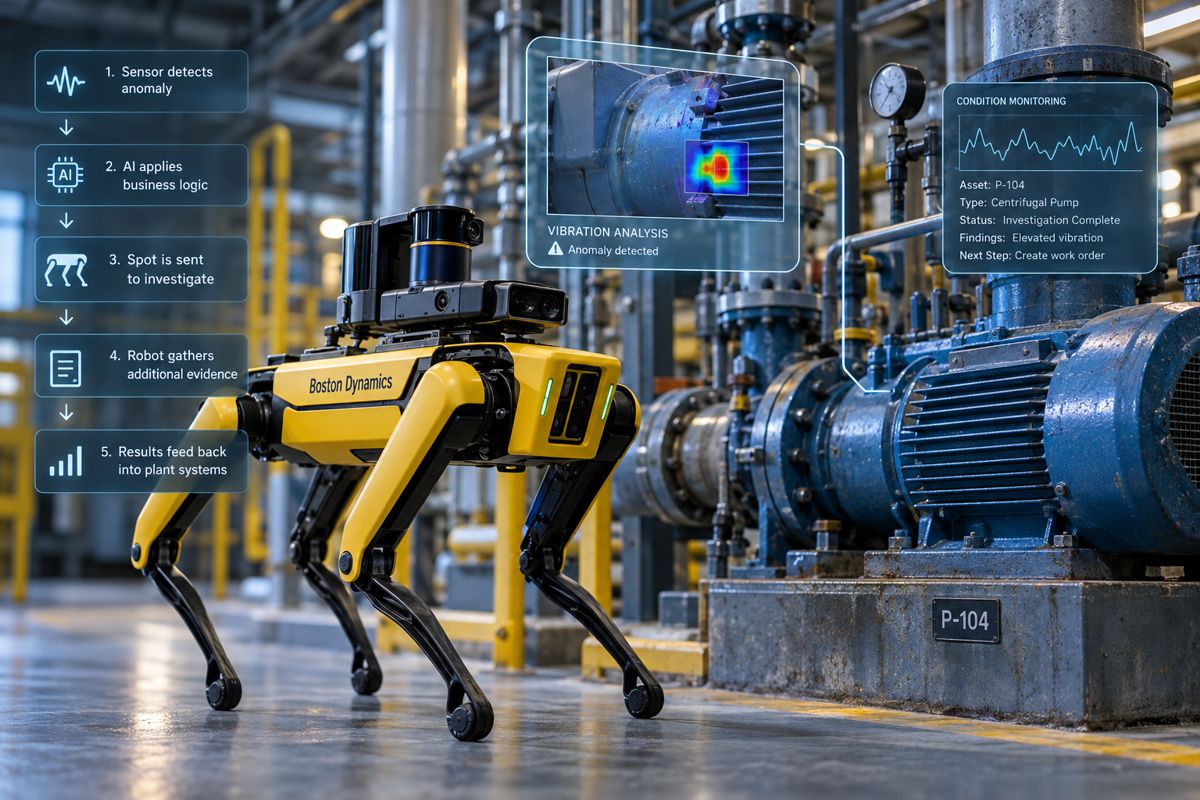
Hensel Phelps, working with Trimble and Boston Dynamics, has run Spot fitted with a laser scanner for autonomous point-cloud collection on live projects, at a monthly cost that can be recovered many times over through avoided claims. The engineering requirement for accurate measurement has not changed at all. The assumption about how difficult and expensive measurement must be has changed completely, and any workflow still built around the old assumption is quietly overpaying.
The same divergence runs through the machines themselves. An excavator built decades ago and a modern one perform recognisably similar physical work, since hydraulics still generate force and the bucket still moves earth. Everything surrounding those movements has changed, with GNSS positioning, machine control, telematics, payload measurement, remote diagnostics and increasingly automated functions layered onto the same basic mechanics.
An operator’s understanding of soil behaviour, machine balance and digging technique can remain valuable across an entire career, while knowledge of the digital systems around that machine may turn over several times in the same span. Physical judgement holds its value, and digital knowledge depreciates, and confusing the two is where firms lose money.
Specifications Are Where Obsolete Knowledge Hides
The most revealing place to look for construction’s expired knowledge is not inside people’s heads but inside documents. Specifications, standard drawings, approved product lists, procurement frameworks and corporate procedures are repositories of institutional memory, and they spare every engineer from rediscovering the same lessons independently.
That is one of the great productivity mechanisms of any technical industry, and it also preserves obsolete assumptions with remarkable efficiency. A clause introduced after a failure a quarter of a century ago outlives the engineer who wrote it, survives successive revisions because removing it feels riskier than leaving it, and eventually commands compliance that nobody can explain.
None of this is bureaucratic incompetence, and infrastructure organisations are rationally conservative because failure carries severe consequences. A road authority cannot adopt every new material or platform on a supplier’s say-so, and that caution is a feature rather than a flaw. The cost appears only when the evidence beneath existing practice is never subjected to the scrutiny demanded of new ideas, which produces a quiet asymmetry. A new method must prove itself extensively, while an established procedure survives largely because it is already established.
The more useful discipline is to test the incumbent practice against the same standard as the challenger, asking whether the evidence that once justified it still holds rather than assuming that age confers validity.
This is also where the emerging information-management standards matter commercially. The ISO 19650 framework for managing information across an asset’s lifecycle exists partly to make provenance and revision explicit, so that a specification carries a traceable relationship to the standards and decisions it depends on. As firms pour money into platforms that promise to codify institutional knowledge, the documents feeding those platforms become the training data for automated reasoning.
Feeding an intelligent system a library of unreviewed standard details does not modernise a business. It industrialises whatever assumptions those details already contain, and it does so at a speed the old paper archive never allowed.
AI Can Shorten the Half-Life or Entrench It
Artificial intelligence introduces a genuine contradiction into all of this. On one side, it can collapse the cost of keeping professional knowledge current, since an engineer no longer needs to read hundreds of pages to learn whether a regulation, standard or manufacturer’s specification has changed. A well-designed system can search large repositories, compare documents, flag revisions and surface what matters at the point of decision, which nudges professional education away from memorising answers and towards understanding principles and interrogating evidence. That capability is exactly what the contech acquisitions are chasing, and in the right hands it makes knowledge more dynamic than any training course ever could.
The opposite risk arrives through the same door. AI systems learn from existing information, and existing information is thick with outdated information, because the internet and every corporate drive are archaeological layers of guidance produced under different assumptions at different times. A model that retrieves knowledge instantly is only useful if it can distinguish the current layer from the historical one, and that makes provenance the decisive factor rather than a technicality.
The questions that determine whether an answer is safe are practical ones: when the information was produced, which standard it referenced, whether that standard has since changed, whether the guidance reflects the current product generation, and whether it applies in the relevant jurisdiction. Speed does nothing to answer any of them.
For buyers, this reframes the entire market. The platforms competing to sell systems of intelligence will ultimately be separated not by how fast they retrieve but by how well they govern, meaning how rigorously they track the age, source and status of the knowledge they act on. A vendor that surfaces a confident answer drawn from a superseded specification has not saved time, it has accelerated a mistake.
The firms that win commercial advantage from this technology will be those that treat provenance and review as core product features, and the buyers that extract value from it will be those that ask about governance before they ask about capability.
Experience Becomes More Valuable When It Can Change Its Mind
None of this diminishes experienced professionals, and the opposite may be closer to the truth. A newly qualified engineer can learn the latest software fairly quickly, whereas judgement takes decades to build, since recognising abnormal behaviour, anticipating how decisions interact and sensing when convincing information does not add up cannot be downloaded.
The combination of deep experience and current knowledge is therefore exceptionally powerful, and it is precisely the combination that automated knowledge tools are meant to support rather than replace. The danger is narrow and specific, and it lies in treating years of experience as evidence that knowledge no longer needs updating.
Medicine faced this directly, because practices can become accepted through logic, repetition and teaching, and later evidence can still overturn them. The value of professional maturity is not measured by the number of things someone knows with certainty, but by the ability to recognise when certainty deserves another look.
An engineer with thirty years behind them who can say that an answer was right in 2006 and may not be right in 2026 holds something more useful than experience alone. That person holds adaptable experience, which is the quality that keeps a career appreciating rather than slowly obsolescing, and it is a quality no software can supply on a professional’s behalf.
Managing Knowledge Like the Asset It Is
This turns the half-life of knowledge from an intellectual curiosity into a management problem with a clear commercial edge. Construction firms already spend heavily to stop physical capability deteriorating, servicing excavators, patching software, calibrating instruments and inspecting safety systems, all on the understanding that capability decays without intervention.
Organisational knowledge rarely receives the same care, even though firms accumulate specifications, estimating assumptions, supplier lists, methods and risk registers over decades, much of it valuable and some of it inevitably out of date. The hard part is telling which is which, and that is exactly the task the current wave of AI investment could either solve or make worse.
Future knowledge systems will need to behave less like filing cabinets and more like maintained infrastructure, with important information carrying ownership, provenance, review dates and explicit links to the standards it depends upon, so that a change to a referenced standard flags every internal document and template that may need attention.
AI makes this feasible for the first time, because vast corporate repositories can now be interrogated computationally rather than by memory. The prize is substantial, since a contractor able to retain the lessons of thousands of completed projects while continuously testing them against new evidence holds something far more powerful than an archive. It holds organisational memory that learns, and in an industry where the physical principles stay stubbornly fixed while the surrounding tools accelerate, the firms that shorten the distance between new knowledge appearing and new knowledge being applied will simply respond faster to shifts in technology, regulation, materials and project economics than those still executing yesterday’s best practice with great efficiency.
That gap, quiet and cumulative, is turning into one of the industry’s more decisive competitive advantages.

Key Industry Questions
- What does the “half-life of knowledge” actually mean for construction? It describes the period over which a substantial share of accepted professional understanding is refined, superseded or shown to be incorrect. The concept does not claim that engineering fundamentals expire, since gravity, hydraulics and the chemistry of concrete are stable. It applies to contextual knowledge, meaning the practices, tolerances, intervals and sequences that were shaped by the technical limitations of a particular era. As those limitations fall away through better measurement, automation and computation, the practices built around them can quietly lose their justification while still being followed. For construction the effect is amplified because assets last far longer than the tools used to create them, so decisions made under one set of assumptions govern infrastructure for decades afterwards.
- Why are Trimble, Procore and Autodesk spending so heavily on AI knowledge tools? Large contractors hold enormous quantities of project information that is almost impossible to use at the moment a decision is made. The acquisitions target that gap, aiming to make a firm’s own history searchable and, increasingly, to reason across it automatically. Trimble’s purchase of Document Crunch brings contract-risk analysis into its delivery suite, Procore’s Datagrid deal adds AI agents, and Autodesk’s Rhumbix acquisition strengthens jobsite data capture. The commercial thesis is that a firm which can interrogate its accumulated knowledge in real time will estimate more accurately, spot risk earlier and repeat fewer mistakes. The competitive question for the wider market is who controls the resulting knowledge layer, because that is where pricing power and customer lock-in are concentrating.
- Can outdated assumptions really become embedded in specifications and standards? Yes, and specifications are among the most efficient places for obsolete knowledge to survive. A clause added after a specific failure can outlive the engineer who wrote it, pass through successive revisions untouched, and eventually command compliance that nobody can explain. This is not incompetence, because infrastructure organisations are rationally cautious about change given the consequences of failure. The problem is asymmetry, where new methods must prove themselves extensively while incumbent procedures survive simply by being established. Documents such as standard details, approved product lists and procurement frameworks act as institutional memory, which is valuable, but they preserve the assumptions inside them just as faithfully as the lessons, and few organisations review the evidence behind existing requirements as rigorously as they scrutinise new proposals.
- Does AI make construction knowledge more reliable or less? It can do either, and the outcome depends on governance rather than raw capability. AI can dramatically lower the cost of staying current by searching large repositories, comparing documents and surfacing revisions at the point of decision. It can also entrench error, because it learns from existing information that is full of outdated material produced under earlier assumptions. A model that retrieves an answer instantly is only useful if it can distinguish current knowledge from historical knowledge. That makes provenance decisive, covering when information was produced, which standard it referenced, whether that standard has changed, and whether guidance reflects the current product generation and jurisdiction. Buyers should treat these questions as product requirements rather than afterthoughts.
- What is the difference between fundamental and contextual engineering knowledge? Fundamental knowledge concerns the physical and chemical realities that do not change, such as load paths, material behaviour and the way water finds weaknesses in drainage. Contextual knowledge concerns how professionals measure, predict, manufacture, automate and optimise around those realities using the tools available at a given time. Fundamental knowledge is durable and rarely needs revisiting, whereas contextual knowledge carries an expiry date because it is shaped by technical limitations that later disappear. The practical skill, and the one worth building into training and knowledge systems, is telling the two apart. Confusing durable principle with perishable convention is how firms end up defending practices whose original justification has long since evaporated.
- Will AI and automation reduce the value of experienced engineers and operators? Not in general, and in several respects the reverse. Judgement built over decades, including the ability to recognise abnormal behaviour and sense when plausible information does not add up, remains difficult to automate and becomes more valuable when paired with current knowledge. The risk is specific rather than broad, and it lies in treating long experience as proof that knowledge no longer needs updating. Physical expertise, such as an operator’s feel for soil and machine balance, tends to hold its value across a career, while knowledge of digital systems depreciates and needs refreshing. The most valuable professionals will be those who combine durable judgement with a willingness to test their own assumptions against new evidence.
- How should a construction firm manage organisational knowledge as an asset? It should treat knowledge the way it already treats physical capability, which deteriorates without maintenance. That means giving important information clear ownership, recording its provenance and review dates, and linking it to the standards and regulations it depends on, so that when a referenced standard changes the firm can identify every document, template and workflow affected. AI now makes this feasible at scale, because large repositories can be interrogated computationally rather than relying on individual memory. The objective is not a bigger archive but an organisational memory that learns, retaining the lessons of past projects while continuously testing them against new information. Firms that build this capability will adapt faster to changes in technology, regulation and materials.
- What should infrastructure owners ask before trusting an AI system of intelligence? The central questions concern governance rather than speed. Owners should ask how the system tracks the age, source and status of the knowledge it acts on, how it handles superseded standards, and whether it can show the provenance behind a given answer. A platform that returns a confident recommendation drawn from an obsolete specification has accelerated a mistake rather than saved time. Owners should also probe how the vendor’s underlying data was assembled, since AI outputs are only as sound as the corpus behind them, and how the system flags jurisdictional and product-generation differences. Capability demonstrations are easy to stage, whereas disciplined provenance and review are harder to fake and far more valuable in practice.
Strategic Takeaways
- The 2026 contech acquisition wave has turned institutional knowledge into a contested commercial asset, so platform selection is becoming a decision about whose model of construction knowledge a firm is willing to trust.
- Value in AI-driven knowledge tools will concentrate around governance rather than retrieval speed, meaning the ability to distinguish current knowledge from superseded knowledge is the feature that actually protects against costly error.
- Specifications, standard details and procurement frameworks are the quiet reservoirs of expired assumptions, and feeding them unreviewed into automated systems industrialises those assumptions rather than modernising the business.
- Physical expertise appreciates while digital knowledge depreciates, so workforce strategy should protect durable operational judgement while continuously refreshing the perishable technical layer around it.
- The firms that shorten the gap between new knowledge appearing and being applied will gain a cumulative competitive edge, making knowledge maintenance a matter of strategy rather than compliance or professional accreditation.