The $1.5 Billion Race to Build the Operating System for Autonomous Machines
A construction company is about to become an AI robotics company. On the surface, that sounds like one of the stranger corporate combinations to emerge from the current rush into artificial intelligence, but the mechanics of the deal reveal something much more interesting about where value is beginning to accumulate across construction, heavy industry and autonomous machinery.
Defence-technology company XTEND and Nasdaq-listed JFB Construction Holdings have agreed a $1.5 billion all-stock combination that will bring together a general contractor with a two-million-square-foot commercial track record and a software-led robotics business. The resulting company will be renamed XTEND AI Robotics and is expected to trade on Nasdaq under the ticker XTND. Completion is anticipated in mid-2026, subject to regulatory approval and customary closing conditions.
For construction and infrastructure, the intriguing part is the direction of the transaction. JFB contributes an established US operating presence, a Tampa production facility, a public listing and general-contracting experience across thirty-six states. XTEND contributes the XTEND Operating System, or XOS, developed to allow a single operator to coordinate multiple air, ground and maritime robotic systems through one interface.
Existing XTEND shareholders are expected to own approximately 70 per cent of the combined business on a fully diluted basis, with JFB shareholders holding around 30 per cent. The construction operation is therefore becoming the public-market and industrial foundation beneath a much larger robotics proposition. It is a useful illustration of how investors are beginning to look at physical industries, where software, autonomy, data and intellectual property increasingly sit alongside conventional measures such as assets, backlog and contracting margins.
Briefing
- XTEND and JFB Construction Holdings have agreed a $1.5 billion all-stock combination that will create Nasdaq-listed XTEND AI Robotics under the ticker XTND, with completion expected in mid-2026 subject to regulatory approval.
- At the centre of the proposition is XOS, a software layer designed to orchestrate multiple air, ground and maritime robots through a single interface rather than being tied to one particular machine.
- Existing XTEND shareholders are expected to hold approximately 70 per cent of the combined company and JFB shareholders around 30 per cent on a fully diluted basis.
- The combined business will be headquartered in Tampa, Florida, with plans to scale NDAA-compliant US manufacturing as part of an operating network spanning Israel, Europe and Singapore.
- Similar thinking is already emerging in construction and heavy industry, where Caterpillar, Komatsu, Volvo and others are moving beyond isolated autonomous machines towards increasingly coordinated, software-defined fleets.
Why a Contractor Became the Vehicle for a Robotics Business
The $1.5 billion headline attracts attention, although the way XTEND intends to reach the public market is arguably more revealing. Rather than pursuing a conventional standalone flotation, it is combining with JFB, gaining a Nasdaq presence alongside committed capital and an established American operating footprint.
Reporting around the transaction describes a $500 million identified pipeline and a $71 million backlog as of the end of 2025, together with approximately $152 million in strategic investor commitments, of which around $42 million had been funded at signing. Taken together, they show what scaling a modern robotics company increasingly involves. Manufacturing capacity still matters, as does access to capital, but both sit behind a software platform capable of being deployed repeatedly across machines, applications and customers.
That economic model is very different from conventional contracting. Construction revenues remain closely connected to projects won and delivered, with growth normally requiring corresponding increases in people, equipment, materials and working capital. Software has a different cost curve. Once an operating platform exists, extending it to another machine, customer or application does not necessarily require anything approaching the physical investment involved in delivering another building or infrastructure project.
JFB’s role in the transaction therefore offers a useful glimpse of a shift already reaching the equipment industry. Physical capability remains essential, but more of the enduring commercial value is being created in the systems that control, connect and extract information from those physical assets.
XOS and the Question of a Machine Operating System
That brings the focus to XOS. XTEND describes the platform as allowing one operator to manage multiple air, ground and maritime robotic systems simultaneously, combining human decision-making with edge AI so operations can continue in environments where connectivity and positioning may be unreliable. Defence and public-safety applications form part of XTEND’s existing market, but the underlying technology raises a much broader industrial question.
Construction has been working towards a similar problem for years: how to make machines from different categories, and potentially different manufacturers, operate within a common digital environment.
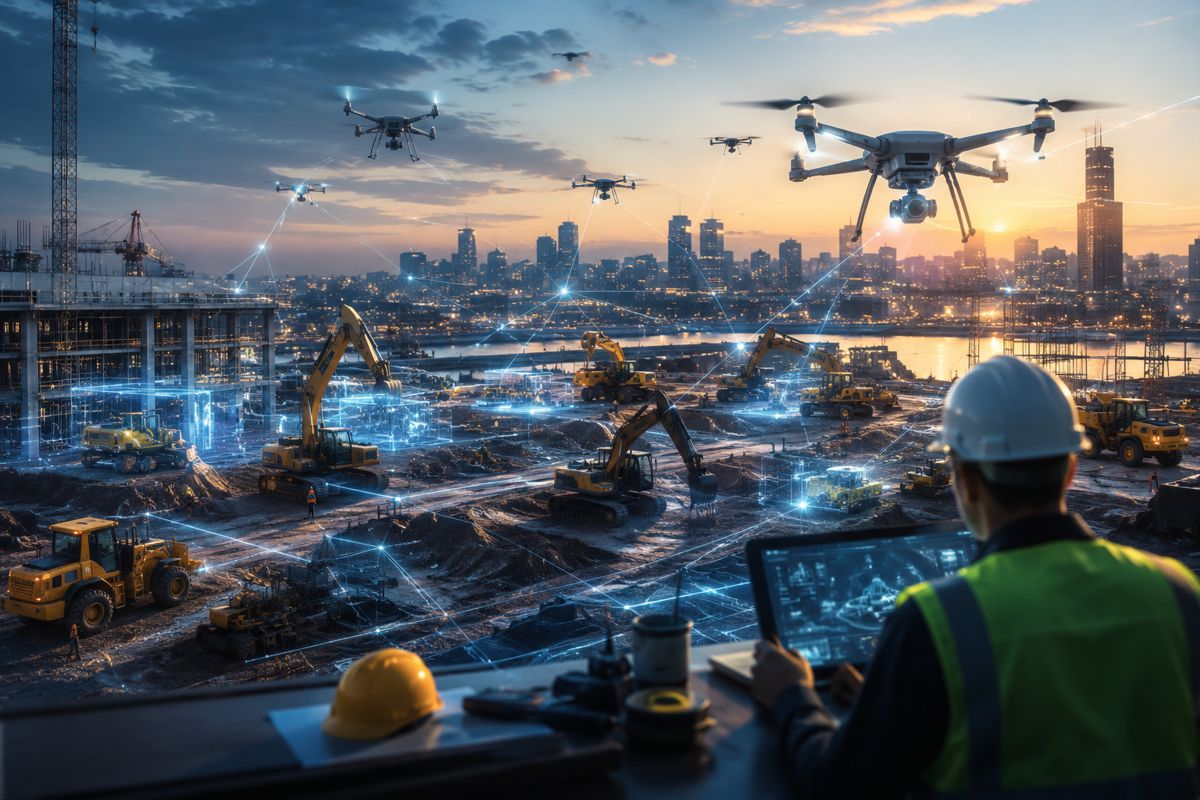
At present, much autonomous equipment still exists in separate technology islands. Survey drones have their own software environments. Excavators operate through machine-control systems. Autonomous haulage fleets use dedicated platforms, while inspection robots, tele-operated equipment and site sensors may sit within still more applications. Contractors can increasingly consolidate the information produced by those systems, but collecting data from different machines after the event is not the same thing as coordinating their behaviour in real time. This is where an orchestration layer becomes commercially significant.
A platform capable of sitting above heterogeneous hardware and coordinating it as a working system occupies a very different position in the technology stack from the manufacturer of an individual robot. In effect, it begins to resemble an operating system for physical machines. The hardware remains indispensable, but the software decides how effectively those assets can work together. It is also where some of the most interesting competition in industrial autonomy is likely to develop.
Construction Is Building Towards the Same Layer
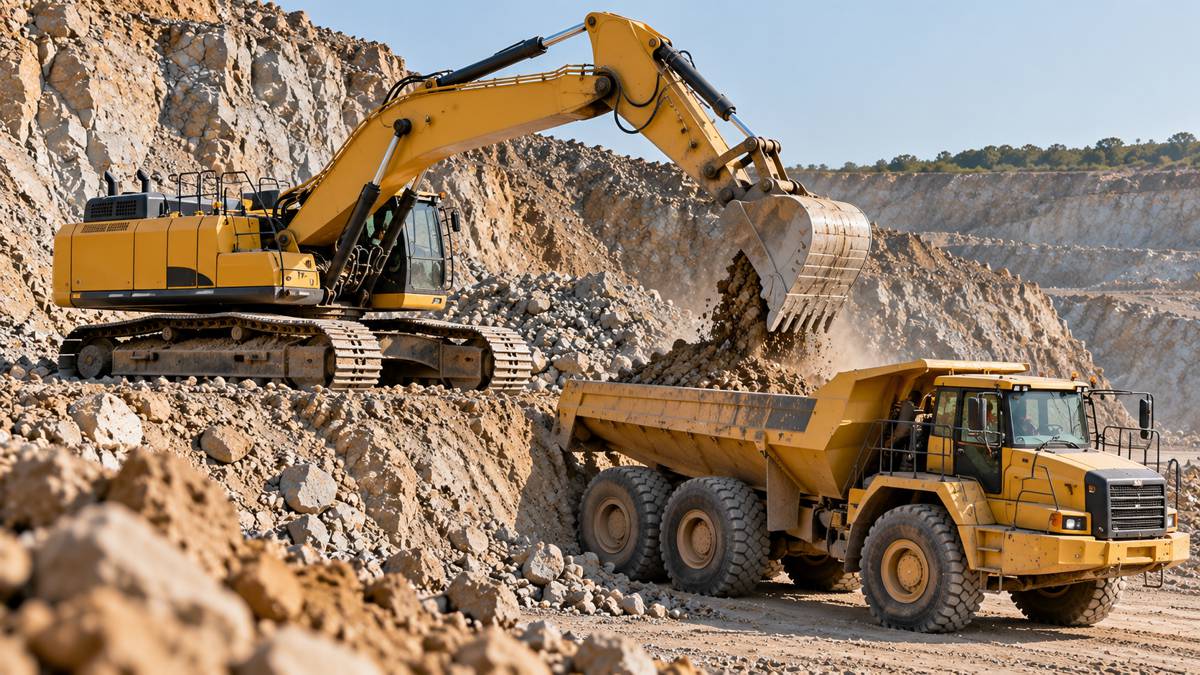
Heavy-equipment manufacturers are already moving in this direction. At CES 2026, Caterpillar presented an intelligent-machine line-up spanning autonomous excavators, loaders, haul trucks, dozers and compactors, drawing on more than three decades of automation development. Its mining fleet now includes nearly 700 autonomous trucks which, according to the company, have moved more than eleven billion tonnes of material without a reported injury.
The individual machines matter, but the more important development is what happens between them. Caterpillar demonstrated an autonomous excavator loading an autonomous truck while a dozer prepared the next working area, with connected site systems including VisionLink and MineStar providing the wider digital environment. Autonomy was no longer being presented simply as a capability installed on one machine. It was becoming part of the workflow of the site.
Mining has provided the proving ground for much of this technology. Komatsu’s FrontRunner and Caterpillar’s MineStar Command have coordinated autonomous haulage fleets for years, while John Deere has now put an autonomous articulated dump truck to work in a quarry. OEM-agnostic systems are developing alongside them. ASI’s Mobius, for example, is intended to provide command and control across mixed fleets incorporating autonomous haulers, tele-operated dozers and conventional trucks.
Below those control systems, standards are gradually making machine data easier to combine. ISO 15143-3 allows feeds from manufacturers including Caterpillar, Deere, Komatsu and Volvo to be brought into a common dashboard, while contractors consolidating fleet information onto a single platform have reportedly achieved utilisation improvements of 15 to 20 per cent.
None of these developments produces a universal operating system for construction machinery overnight. They do, however, show the direction in which the industry is travelling. Data that once remained inside individual machines is becoming accessible at fleet level; fleet management is becoming more active; and autonomous machines are beginning to interact with the work taking place around them.
Seen in that context, XOS is relevant well beyond XTEND’s established markets. Its deployments provide experience of coordinating multiple robotic systems in difficult operating conditions, including environments where communications cannot always be taken for granted. Large civil-engineering, mining and infrastructure sites present their own versions of that challenge.
Where the Capital Is Moving
The investment and manufacturing structure surrounding the XTEND transaction adds another dimension.
Strategic investors include Unusual Machines, American Ventures, Protego Ventures, Aliya Capital and the Agostinelli Group, alongside Eric Trump. At the same time, the combined company is placing considerable emphasis on NDAA-compliant production in the United States, centred on Tampa and supported by a wider network spanning Israel, Europe and Singapore.
Some of that manufacturing strategy reflects the particular markets XTEND serves. There is nevertheless a wider industrial trend at work. Governments and major buyers are paying much closer attention to where critical technologies are manufactured, how their supply chains are structured and whether key components can be sourced from trusted jurisdictions. Similar considerations are increasingly visible in infrastructure procurement through Buy American requirements and other domestic-content provisions.
For emerging autonomy businesses, scalable software alone may consequently be insufficient. Investors and customers also need confidence that the physical systems can be manufactured, supported and supplied at volume.
The XTEND combination puts both sides of that equation into one publicly traded business: software and intellectual property on one side, manufacturing capability and an established US operating structure on the other.
For construction-technology companies developing machine control, inspection robotics, site coordination and autonomous equipment, the valuation provides an interesting public-market reference point. It suggests that robotics businesses with a credible manufacturing base can increasingly be viewed through the economics of a software platform rather than simply as manufacturers adding digital features to machinery.
That distinction could have consequences well beyond valuations. It affects consolidation, recurring revenues, customer relationships and, perhaps most importantly, control of the enormous volumes of operational data autonomous sites will generate.
The Procurement Question
For contractors and infrastructure owners, this emerging software layer creates choices that are likely to last considerably longer than an individual technology cycle. A closed autonomy ecosystem from a single manufacturer can offer obvious advantages, particularly when the equipment, software, support and machine-control systems have been engineered together. The trade-off comes later if the contractor wants to introduce equipment from another manufacturer, move information between platforms or retain independent control of operational data.
Open standards and OEM-agnostic orchestration offer another route. Their attraction is not simply technical neatness. Mixed fleets are normal across construction, and equipment may remain in service for many years. A contractor buying an autonomous excavator today cannot assume that every machine working beside it in five or ten years will carry the same badge.
ISO 15143-3 and the growth of independent fleet platforms reflect that commercial reality. Interoperability preserves options, and options preserve competition between suppliers.
As autonomy progresses from individual machines towards coordinated fleets, procurement teams will increasingly need to examine the software architecture alongside the conventional equipment specification. Questions around APIs, data ownership, platform compatibility, cybersecurity and the ability to change suppliers may ultimately prove as important as payload, cycle time or fuel consumption.
Autonomy Also Changes the Infrastructure Around the Machine
Coordinating multiple machines introduces another dependency: the communications and computing environment that keeps them working. Private LTE and 5G are increasingly being considered for industrial and construction sites because autonomous fleets need reliable connectivity, while edge computing allows more decisions to remain close to the machine rather than depending continuously on remote cloud infrastructure. Researchers have already demonstrated the theoretical disruption of autonomous haulage communications at test facilities, underlining the need to treat these networks as operational infrastructure rather than ordinary site IT.
The scale of the risk changes as more equipment comes under common control. Losing communications with one connected machine is inconvenient; losing the orchestration layer governing a substantial autonomous fleet could affect an entire operation.
Resilience therefore has to be designed into the architecture. Autonomous machines need appropriate fallback behaviour, communications require hardening, and sites need to be able to degrade gracefully when parts of the digital environment become unavailable.
This is one reason the operating-system analogy is useful, but only up to a point. Construction machinery operates in the physical world. Software failure does not simply freeze a screen; it can stop production, strand equipment or create safety implications. The organisations deploying autonomy at scale will have to treat the digital layer with the same seriousness traditionally applied to roads, power, drainage and other essential site infrastructure.
The wider significance of the XTEND–JFB transaction therefore reaches beyond drones, defence or the unusual sight of a construction company becoming part of a robotics business. It offers an early indication of how the autonomous-machine economy may eventually be organised.
For much of the equipment industry’s history, competitive advantage has been visible in steel: engines, hydraulics, payload, durability and the ability to build a better machine. Those things are not disappearing. What is changing is the layer above them.
As fleets become connected and machines gain greater autonomy, some of the most valuable technology on the jobsite may never touch the ground. It will sit between the machines, deciding how they communicate, where they go, what they do next and how the entire operation works together.
The next major contest in autonomous equipment may therefore be considerably larger than the race to build the smartest excavator, truck or robot. It may be the race to decide which operating system they all answer to.
Key Industry Questions
- Why does a construction company merging with a defence-robotics firm matter to the wider infrastructure sector? The significance lies primarily in the structure of the transaction. A general contractor with physical assets, a US operating footprint and a public listing is becoming the vehicle through which a software-first robotics company reaches Nasdaq, with XTEND shareholders expected to retain the majority of the combined equity. It illustrates how autonomy, software, data and intellectual property are becoming increasingly important components of value in physical industries. Construction equipment is already moving in a similar direction as manufacturers develop connected fleets and increasingly sophisticated machine-control environments.
- What is XOS and why is it important to the deal? The XTEND Operating System is designed to allow a single operator to coordinate multiple air, ground and maritime robotic systems while combining human decision-making with edge AI. Its importance lies in the ability to extend a software platform across different machines and applications. That gives it different economics from a business based solely on manufacturing individual robots and places the orchestration layer at the centre of XTEND’s commercial proposition.
- How does this connect to autonomous construction equipment? Major construction-equipment manufacturers are developing towards comparable fleet-level architectures. Caterpillar’s CES 2026 demonstrations included autonomous excavators, trucks and dozers working as part of a coordinated operation, while Komatsu, John Deere and other manufacturers continue to expand autonomous capability. OEM-agnostic platforms such as ASI’s Mobius are approaching the problem from the fleet-management side, and ISO 15143-3 is helping standardise the exchange of machine data. The industries and applications differ, but the underlying challenge is similar: coordinating multiple physical machines through a common software environment.
- Is coordinated autonomous construction already deployed, or is it still experimental? The industry sits somewhere between those two positions. Autonomous haulage has operated at considerable scale in mining for years, with Caterpillar citing a fleet of nearly 700 autonomous trucks and more than eleven billion tonnes moved. During 2026, some of that capability has been moving into quarrying and aggregates, bringing it closer to mainstream construction environments. Automated grading, machine assistance and remote operation are already commercially established, while autonomous excavators and specialist robots remain at varying stages of deployment and piloting. Coordinating heterogeneous autonomous equipment across an entire construction site remains a less mature and highly contested area.
- What does this mean for equipment procurement? Interoperability and data rights are becoming more important. Contractors committing heavily to one manufacturer’s autonomy ecosystem may gain the advantages of tightly integrated hardware and software, but could also restrict future equipment choice. Open standards and OEM-agnostic systems offer the prospect of retaining mixed fleets and preserving competition between suppliers. Procurement teams will increasingly need to understand the software and data provisions attached to autonomous machinery rather than treating them as secondary features bundled with the equipment.
- What role does US-based manufacturing and allied procurement play? The combined company intends to expand NDAA-compliant US production in Tampa within a network that also spans Israel, Europe and Singapore, while targeting the United States, NATO members and other allied markets. Although those priorities partly reflect XTEND’s defence and security activities, they sit within a broader movement towards domestic and trusted supply chains for critical technology. Infrastructure procurement is experiencing similar pressures through Buy American requirements and domestic-content policies, making manufacturing location and supply-chain compliance increasingly important commercial considerations.
- What are the cybersecurity and resilience risks of coordinated autonomous fleets? The potential consequences increase as more machines become dependent on the same orchestration platform. Autonomous fleets require reliable communications, often involving private LTE or 5G, while edge computing can allow critical functions to continue when wider connectivity deteriorates. Research into disruption of autonomous haulage communications demonstrates why these systems need hardened networks, intrusion detection and safe fallback behaviour. The objective is to ensure that a communications or coordination failure reduces capability safely rather than stopping an entire operation or introducing an additional hazard.
- What should equipment manufacturers and construction-technology firms take from the valuation? The transaction offers a visible example of how investors are valuing autonomy when scalable software is combined with credible physical manufacturing. For companies developing machine control, inspection robotics and site-coordination technology, it reinforces the strategic importance of owning the software and data layer rather than treating software simply as another machine feature. As autonomous fleets develop, competition is likely to intensify around the platforms responsible for connecting and coordinating them.
Strategic Takeaways
- Value in autonomous systems is increasingly extending beyond the individual machine into the software platforms capable of coordinating entire fleets.
- Caterpillar, Komatsu, Volvo, John Deere and other manufacturers are already moving towards more connected and software-defined equipment environments, increasing the importance of interoperability.
- Contractors and infrastructure owners will need to balance the immediate benefits of tightly integrated autonomy ecosystems against longer-term considerations around supplier choice and data ownership.
- Manufacturing location, standards compliance and supply-chain resilience are becoming increasingly important alongside software scalability.
- As orchestration platforms assume control of more equipment, communications, cybersecurity and edge resilience become part of the core infrastructure of the autonomous jobsite.