Mastenbroek Refines 20/15 Drainage Trencher for 2026
A machine first introduced in 1981 might seem an unlikely place to look for equipment development, but Mastenbroek’s latest 20/15 drainage trencher makes a good case for evolution rather than reinvention. The Lincolnshire manufacturer has updated the long-running self-propelled machine for 2026, concentrating on the things that determine whether specialist equipment remains productive over years of hard use: access, visibility, controls, servicing and the strength of the working end.
The new 20/15 retains the basic role that has kept the model in production for more than four decades. It is an on-grade tracked trencher designed primarily to install agricultural lateral and collector drains, while also being suited to cross-country and utility work. The 2026 version is powered by a 315 hp Volvo D8 engine certified to EU Stage V and US EPA Tier 4 Final emissions standards, weighs around 20 tonnes and can excavate to depths of up to 2.5 metres.
That puts the machine in a particularly specialised part of the construction equipment market. A self-propelled drainage trencher does considerably more than dig a narrow hole. It is effectively a mobile drainage installation platform, advancing along a predetermined route while its cutting mechanism excavates a controlled trench to the required depth and gradient. In agricultural drainage, where buried perforated pipe needs to carry excess water towards collectors and ultimately an outlet, maintaining that grade accurately over distance is fundamental to whether the finished system works.
Briefing
- The Mastenbroek 20/15 has been in production in various forms since 1981.
- The 2026 machine uses a 315 hp Volvo D8 Stage V/Tier 4 Final engine and weighs approximately 20 tonnes.
- Maximum trenching depth is 2.5 metres, with the 20/15 intended for agricultural, cross-country and utility applications.
- New walkways, improved service access, a strengthened digging mechanism and revised operator features form the core of the 2026 update.
- Belgian drainage contractor De Ceuster has bought the first updated machine following field testing in Lincolnshire.
What a Self-Propelled Trencher Does
Conventional excavators can, of course, dig trenches. Specialist drainage work presents a different problem. Long runs of buried pipe need to be installed at controlled depths and gradients, often across fields where relatively small errors accumulated over distance can compromise gravity drainage.
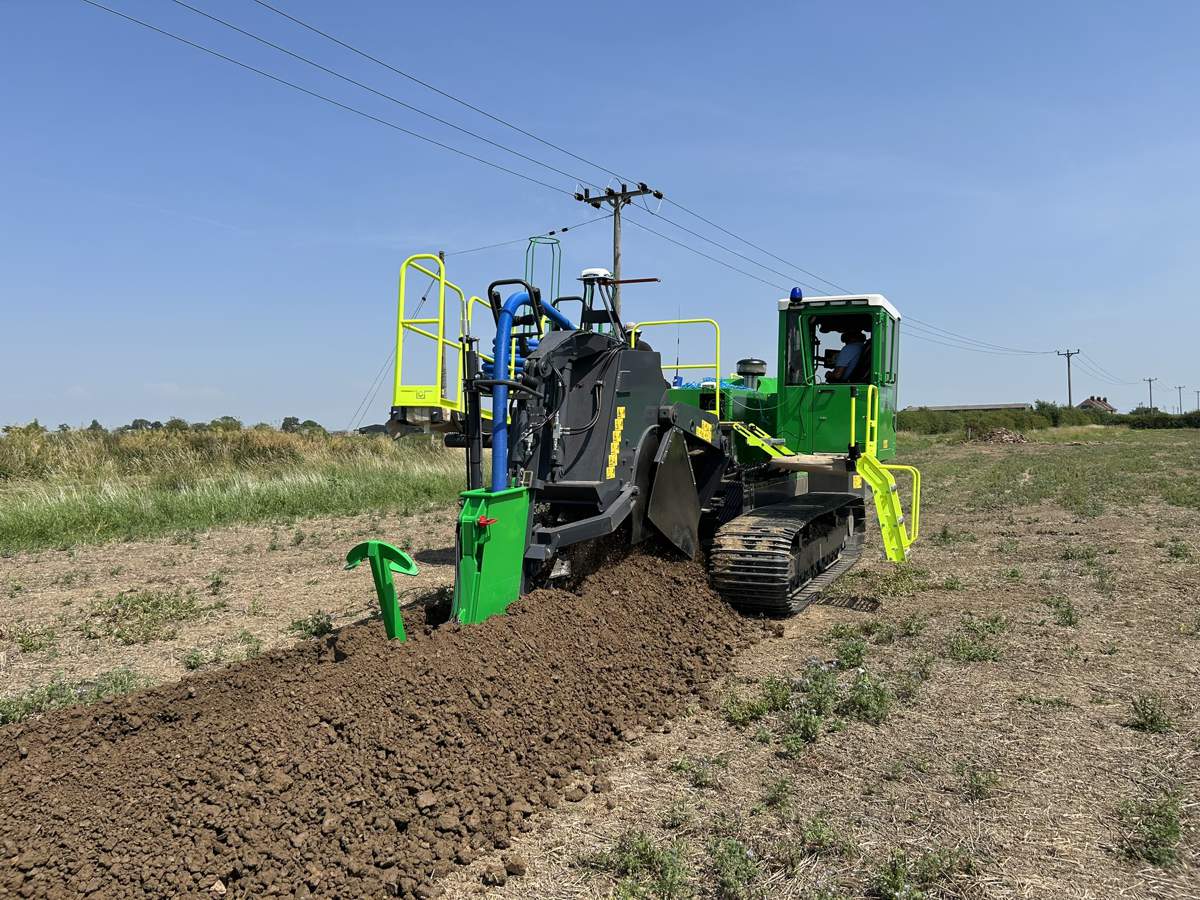
A self-propelled trencher combines the carrier, propulsion system, digging equipment and grade-control functions in one purpose-built machine. On the 20/15, a tracked undercarriage moves the machine forward while the rear digging mechanism cuts the trench. Excavated material is discharged to either side by augers, leaving an open, accurately graded trench into which drainage pipe can be installed. Mastenbroek’s current specification gives a trench width range of 132 to 450 mm, with the digging unit able to pivot five degrees either side of centre.
Modern drainage schemes increasingly add digital control to that mechanical process. Previous 20/15 installations have used Trimble GPS machine control for trench depth, grade and automatic steering, alongside surveying, drainage design and as-installed mapping. Earlier generations relied upon laser grade control, illustrating how the basic trenching principle has remained while positioning and machine-control technology around it has developed.
Agricultural systems commonly use networks of smaller lateral drains feeding larger collectors, which then carry excess water towards an appropriate outlet. The job of the trencher is therefore not simply excavation, but continuous excavation while maintaining the designed depth and gradient over the drainage run.
Engineering Around the Operator
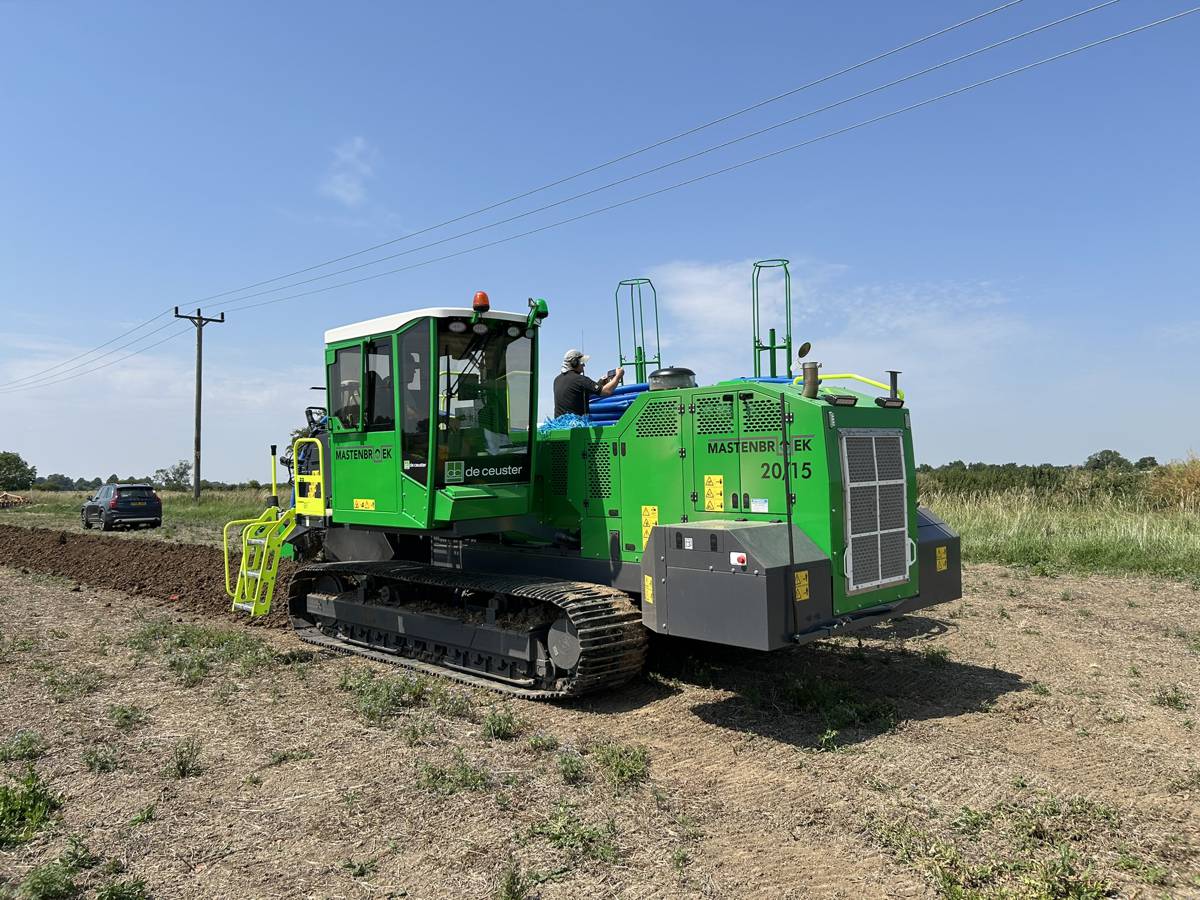
The most visible changes to the 2026 20/15 concern access around the machine. Mastenbroek has added a full-length walkway providing three-point-of-contact access to the engine fluid housing, hydraulic cooler and digging mechanism. The hydraulic cooler incorporates a reversing fan intended to clean the outside of its screen automatically, while the digging mechanism itself has been strengthened.
A second walkway allows personnel to cross the machine and improves movement between the cab and either side of the trencher. These are relatively straightforward engineering changes, but specialist trenchers present an unusual access problem because their working equipment occupies a considerable proportion of the machine and operators regularly need to inspect components away from the cab.
Visibility has received similar attention. The ROPS-certified, air-conditioned cab can be elevated by 500 mm and moved outwards by as much as 150 mm, giving the operator a clearer view of the digging mechanism.
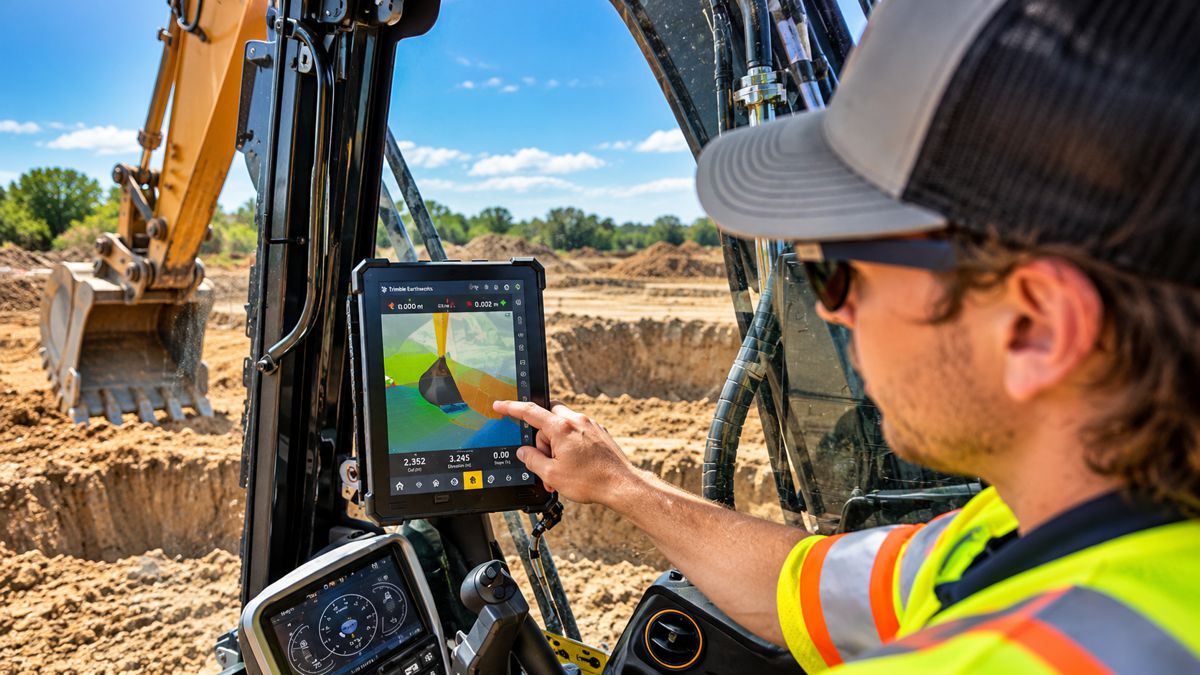
Controls are through joysticks mounted with the heated, air-suspension seat, with the left joystick handling the digging equipment and the right controlling track drive. A rail-mounted HMI running Mastenbroek’s machine-control system can be repositioned for convenient viewing and access to the machine’s functions.
Serviceability in the Field
Maintenance access has been addressed with toolboxes positioned beside the engine and hydraulic bays, both reached through large lockable doors. More extensive work can now be carried out with the complete engine canopy removed.
For equipment likely to spend much of its life away from a conventional construction yard, those details have a practical value. Agricultural drainage contractors frequently work across large geographic areas and within seasonal windows dictated by ground and weather conditions. A service operation that can be completed more easily in the field can affect utilisation just as readily as digging performance.
Previous experience with the 20/15 helps explain why Mastenbroek has continued refining the model rather than replacing it with an entirely different concept. UK contractor AUS Ltd selected a 20/15 partly because its 2.9-metre transport width and sub-19-tonne weight made it easier to move into difficult sites. Its machine was equipped with Trimble GPS grade control and automatic steering, and the contractor reported that the combination improved both certainty and productivity on drainage schemes around the UK.
The attraction of a relatively compact specialist machine becomes particularly apparent when access deteriorates. AUS described working in locations across Cumbria, Scotland, Wales and Devon where narrow gateways and difficult approaches could complicate not only moving the trencher but also bringing stone onto site.
The 2026 changes build on those established characteristics rather than altering the basic proposition of the machine. The digging mechanism is stronger, access is easier and the operator has better visibility of the work, while service areas have been arranged with field maintenance more clearly in mind.
Four Decades of Development
Mastenbroek introduced the 20/15 in 1981, during a period when specialist drainage machinery was considerably more mechanical and grade control commonly depended on laser systems. The underlying requirement has changed remarkably little: excavate a narrow trench at a controlled gradient, install drainage infrastructure efficiently and keep the operation moving across variable ground.
The technology surrounding that task has changed considerably. A 20/15 supplied to White Horse Contractors in 2021 used Trimble GPS not only for trench depth and grade but also automatic steering, topographical surveying, drainage design and as-installed mapping. The contractor’s first Mastenbroek machine, bought in 1980, had used a Spectra Physics laser system for depth and grade control and carried a crane for handling clay drainage tiles.
The comparison captures much of the development that has taken place around the basic trenching operation. Hydraulic and mechanical capability remains at the heart of the machine, but positioning, electronic controls, operator ergonomics and the way drainage projects are surveyed and recorded have moved on considerably.
Christopher Pett, Commercial Director at Mastenbroek, says customer feedback played a central role in deciding where the latest engineering effort should go. “The 20/15 is one of our most successful trenchers with both agricultural and utility contractors depending on it around the world,” he said.
“As a company focused on continuous improvement, we’ve listened to the feedback we’ve received from customers and incorporated those requests in this latest version. We’ve also included the enhancements that our in-house software team have developed to give operators the easiest possible access to features and controls.
“The first of the new 20/15s was bought by De Ceusters in Belgium, where, on arrival, it will be sent straight out to work on a drainage scheme.”
The company referred to as “De Ceusters” in the supplied quotation is Belgian contractor De Ceuster. Mastenbroek reported in July that Jasper Pittoors and colleagues from the company had travelled to its Boston, Lincolnshire facility to test their new 20/15 ahead of delivery. De Ceuster works across horticulture, sports, infrastructure and agricultural drainage, and lists drainage as a dedicated part of its operation.
The first 2026 machine is now destined for Belgium, where it is due to go directly into work on a drainage scheme.
Key Industry Questions
- What is a self-propelled trencher? It is a purpose-built mobile machine that propels itself while continuously excavating a trench. Unlike using an excavator to dig individual sections, a drainage trencher can advance along the drainage alignment while controlling trench depth and grade.
- What is the Mastenbroek 20/15 designed for? It is primarily an on-grade subsurface drainage trencher for agricultural lateral and collector drains, with additional applications in utility and cross-country trenching.
- How deep can the 20/15 trench? The 2026 machine is specified to trench to a maximum depth of 2.5 metres.
- How wide is the trench? Mastenbroek’s current technical specification gives a range of 132 to 450 mm.
- Why is accurate grade control important in land drainage? Buried drainage pipes commonly rely upon gravity to carry water through laterals and collectors. Maintaining the designed depth and gradient is therefore fundamental to the hydraulic performance of the finished system.
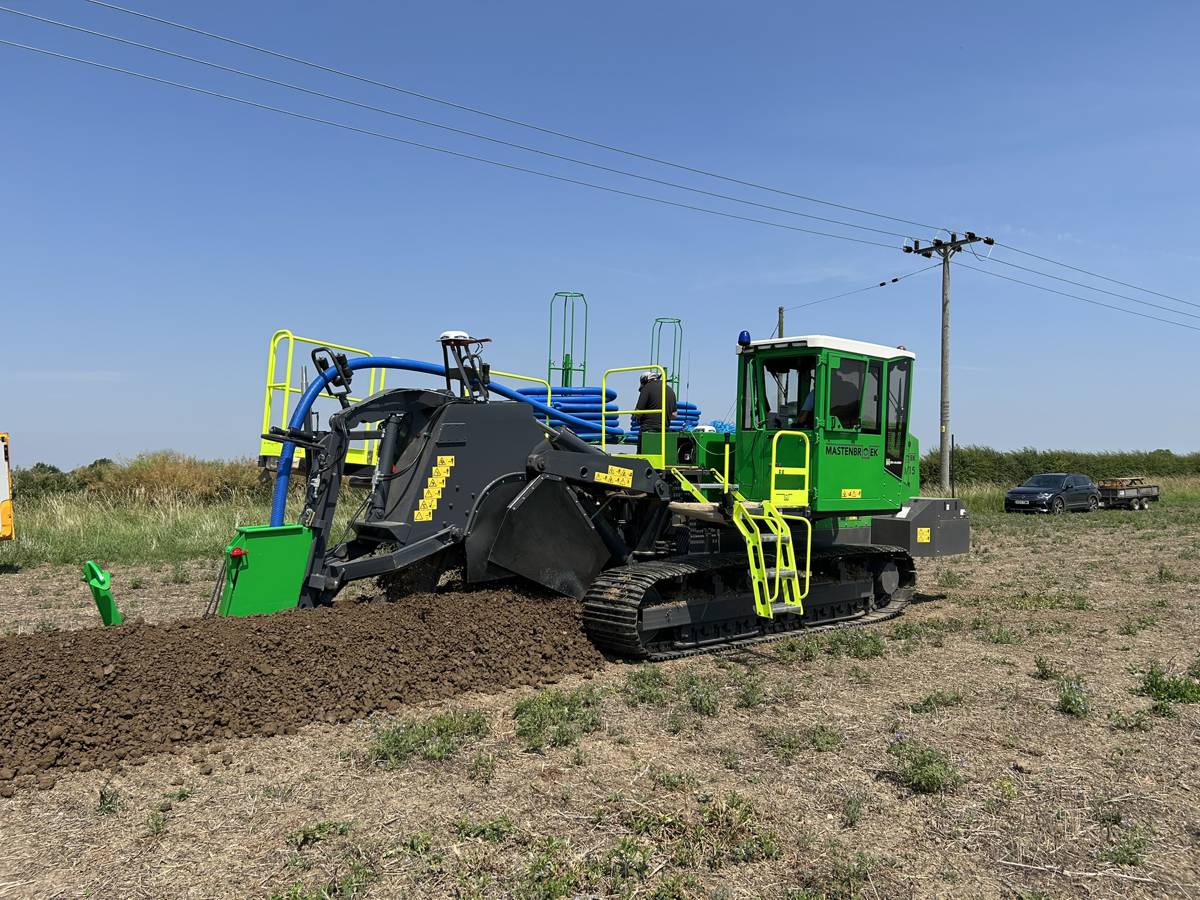
- What has changed on the 2026 machine? Changes include strengthened digging equipment, two new walkways, improved access to major components, a removable engine canopy, an elevating and outward-moving cab, revised operator controls and an adjustable HMI installation.
- What engine does it use? Mastenbroek’s 2026 announcement specifies a 315 hp Volvo D8 meeting EU Stage V and US EPA Tier 4 Final emissions requirements.
- Who has bought the first upgraded 20/15? Belgian drainage contractor De Ceuster has acquired the first machine and tested it in Lincolnshire before deployment on a drainage project in Belgium.
Strategic Takeaways
- The 2026 upgrade concentrates investment on operator access, serviceability and the working mechanism rather than changing a proven basic machine architecture.
- Specialist drainage trenchers combine continuous excavation and grade control in a purpose-built machine.
- Improved cab visibility and control ergonomics complement the increasing use of GPS and digital grade-control systems.
- Easier component access and removable bodywork are particularly relevant to contractors maintaining machines away from conventional workshops.
- The 20/15’s longevity shows how specialist machinery can remain relevant through successive mechanical, emissions, control and software upgrades.