AI and Remanufacturing Reshape Vehicle Repair at Automechanika Frankfurt
An autonomous vehicle inspection robot, an AI-assisted diagnostic system and technology for repairing high-voltage EV batteries are among the innovations recognised at the 2026 Automechanika Innovation Awards in Frankfurt, where the automotive aftermarket is confronting a rapidly changing definition of vehicle repair.
A 17-member international jury selected the winners from 185 entries, with 47 products and technologies reaching the final round. Awards were presented across ten categories covering areas including Sustainable Drive Solutions, Smart Workshop & Service Solutions, Advanced Parts & Vehicle Technologies and Circular Economy & Remanufacturing.
The range of winning technologies reaches well beyond conventional workshop equipment. Modern repair businesses are increasingly expected to diagnose software-rich vehicles, work safely with high-voltage systems, calibrate sensors and driver assistance equipment, and decide whether expensive components should be repaired, remanufactured or replaced.
That transition runs throughout Automechanika Frankfurt 2026. Taking place from 8 to 12 September, the exhibition brings together around 4,400 exhibitors from more than 80 countries across approximately 300,000 square metres of exhibition space. Messe Frankfurt says exhibitor numbers have risen by about 5 per cent despite difficult economic conditions.
Briefing
- Around 4,400 exhibitors from more than 80 countries are participating in Automechanika Frankfurt 2026.
- The Innovation Awards attracted 185 entries, of which 47 reached the final round.
- Winners include autonomous inspection, AI diagnostic, used-parts management and remanufacturing technologies.
- Autocraft’s REVIVE EV Battery Workshops received the 2026 Green Award.
- AI, vehicle data, electrification and circular repair are prominent themes across the five-day exhibition.
Technology Moves Into the Workshop
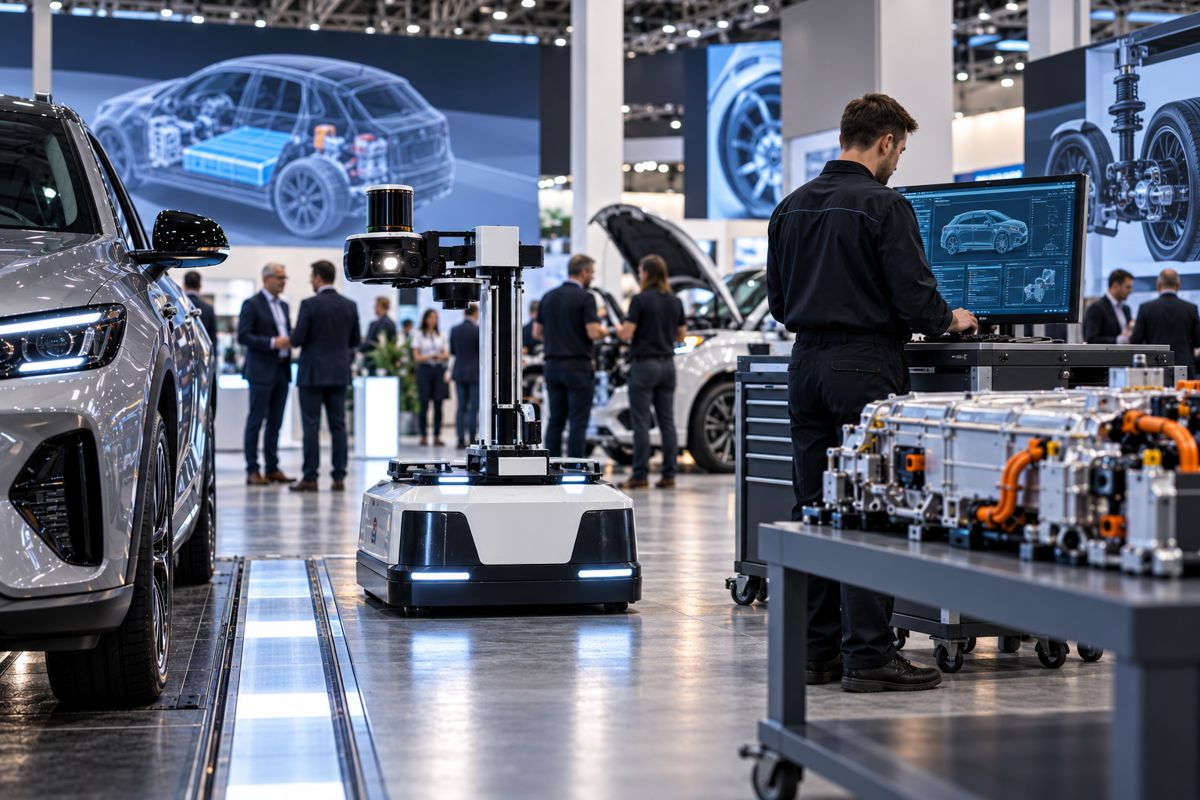
Among the award-winning technologies is MAHA’s MAIA autonomous vehicle inspection system, designed to perform defined inspection tasks independently and record the results digitally. Automation of repetitive inspection procedures offers the prospect of greater consistency while producing structured information that can feed into subsequent diagnostic and maintenance decisions.
AI is moving further into that diagnostic process. An AI-supported diagnostic assistant was also among the award winners, reflecting the increasing volume of electronic information available to technicians as vehicles accumulate sensors, control units, software functions and connected services.
Another winning system addresses the return and evaluation of used components. This is a less conspicuous part of the aftermarket, but an important one as repair and remanufacturing depend on identifying components, understanding their condition and moving them efficiently through increasingly complex reverse supply chains.
The awards were assessed against criteria including innovation, cost-effectiveness, user benefit, functionality, aftermarket relevance, safety, durability and quality, alongside environmental protection and resource conservation.
Michael Johannes, Brand Manager Automechanika at Messe Frankfurt Exhibition GmbH, framed innovation in practical terms:
“An idea becomes an innovation when it makes a difference in practice: when it improves processes, conserves resources, opens up new possibilities or solves a specific problem.”
That test is particularly relevant in the workshop. Sophisticated technology still has to work economically in garages, fleet facilities and repair centres where technicians need dependable information quickly enough to make decisions about real vehicles.
Repairing the Electric Vehicle
Electrification concentrates considerable value inside batteries and electric drivetrains. Replacing a complete assembly can be operationally straightforward, but a fault in one part of a battery pack does not necessarily justify discarding cells, cooling systems, electronics and structural components that remain serviceable.
Autocraft’s REVIVE EV Battery Workshops received the event’s Green Award for an approach designed around repairing and reconditioning high-voltage batteries. The concept can be deployed through mobile or fixed workshop facilities, allowing batteries to be diagnosed and repaired rather than automatically routed towards complete replacement or recycling.
This depends heavily on knowing what has actually failed. Battery condition can be assessed at cell level, allowing faults to be isolated before a decision is made about repair, reconditioning or replacement. The engineering principle is familiar even if the hardware is new: retain as much of a valuable assembly as possible when doing so is safe and economically justified.
Electric drive motors are beginning to follow a similar route. Autocraft is also presenting remanufacturing technology for failed electric drive units, extending practices already established around engines, transmissions, starters and alternators into the electric drivetrain.
The components have changed, but much of the underlying aftermarket logic has not.
Remanufacturing Returns to the Foreground
Automechanika has given remanufacturing its own platform during the 2026 exhibition, with the fourth Remanufacturing Day taking place on 9 September in collaboration with APRA Europe.
Electrification potentially strengthens the case for recovering high-value components rather than treating complex assemblies as disposable units. It also makes the process more technically demanding. Diagnostic systems have to determine what has failed, technicians need procedures for working safely on high-voltage equipment, and supply chains must recover suitable components and return remanufactured products to service.
Digital systems for returning and assessing used components therefore sit naturally alongside battery repair and electric motor remanufacturing. Circularity at this level involves engineering, information and logistics working together.
The economics will vary considerably by component. Labour, transport, testing, warranty exposure, residual life and access to replacement parts all influence whether repair or remanufacturing makes commercial sense. Some assemblies will remain better candidates for replacement.
Better information allows that decision to be made with greater precision, rather than treating an entire assembly as failed because one part of it has stopped working.
Vehicle Data and Workshop Access
The growing dependence on diagnostic information brings another issue into the workshop: access to vehicle data.
Automechanika’s new HighTech4Mobility forum covers software-defined vehicles, autonomous driving and digital services, including discussion involving the European Commission, CLEPA, FIA and other organisations on the EU Data Act and its implications for the automotive market.
For independent workshops, the question is practical as much as regulatory. Faults increasingly sit within networks of sensors, electronic control units, software and connected services. Diagnosing them depends on having access to the information needed to understand what the vehicle is reporting.
AI can help technicians interpret that expanding body of data, but it does not remove the need for accurate information or competent technical judgement. A diagnostic recommendation still has to result in a repair that can be carried out safely and economically.
Training consequently occupies a substantial part of the Frankfurt programme. Sessions cover damage diagnosis, measurement, specialist repair techniques, ADAS diagnostics and alternative powertrains, with additional programmes for commercial vehicle and caravan professionals.
More than 4,000 school pupils are also expected to attend the event’s AMBITION programme, which combines technology demonstrations with information about apprenticeships and automotive careers. Workshop technology can change quickly; building a workforce capable of using it confidently takes considerably longer.
A More Technical Aftermarket
Automechanika Frankfurt remains enormous in conventional automotive terms. Parts, tools, workshop equipment, paint, body repair, engines and mechanical systems have not disappeared because artificial intelligence and electric vehicles have arrived. They are increasingly surrounded by another technical layer.
A technician may now encounter mechanical wear, electronic faults, software behaviour, sensor calibration, battery degradation and connected vehicle data within the same working environment. The equipment required to investigate those problems is becoming more sophisticated, but so are the choices available once the fault has been found.
An inspection can be automated and its results recorded digitally. Diagnostic systems can process information that would take a technician considerably longer to interpret manually, while better knowledge of component condition can make selective repair or remanufacturing practical where complete replacement might once have been the default.
The winning technologies at Frankfurt sit at different points in that process. Some improve the inspection of the vehicle, others help establish what has failed, and others are concerned with recovering components and returning them to useful service. Together they show an aftermarket developing a much more detailed understanding of the assets passing through its workshops.
For an industry built around keeping vehicles working after they leave the factory, that may prove considerably more consequential than simply adding another generation of replacement parts.
Key Industry Questions
- How many entries were submitted for the 2026 Automechanika Innovation Awards? The competition received 185 entries, with 47 products and solutions progressing to the final round.
- How were the Innovation Award winners selected? A 17-member international expert jury assessed entries using criteria including innovation, cost-effectiveness, user benefit, functionality, aftermarket relevance, safety, durability, quality and environmental performance.
- What won the Automechanika Green Award in 2026? Autocraft’s REVIVE EV Battery Workshops received the Green Award for its high-voltage battery repair and reconditioning concept.
- Why is EV battery repair becoming important to the aftermarket? Battery packs are high-value assemblies containing many individual components. Effective diagnosis can allow faults to be isolated and potentially repaired without replacing an entire battery pack.
- Can electric drive motors be remanufactured? Yes. Electric drive units can be dismantled, inspected, repaired, tested and returned to service where their design and condition make remanufacturing technically and economically viable.
- Where does AI fit into vehicle servicing? AI can assist technicians in interpreting diagnostic information and identifying faults as vehicles generate increasing quantities of electronic and operational data.
- Why does vehicle data access matter to independent workshops? As diagnostic and maintenance information becomes embedded in connected vehicle systems, access to that data can affect an independent repairer’s ability to identify faults and perform repairs.
- When is Automechanika Frankfurt 2026 taking place? The exhibition runs from 8 to 12 September 2026 at the Frankfurt Exhibition Centre.
Strategic Takeaways
- Better diagnosis can make selective repair economically viable where complete assembly replacement was previously the simpler option.
- EV batteries and electric drive units are creating new opportunities for specialist repair and remanufacturing.
- Automated inspection can improve consistency while generating structured information for subsequent workshop decisions.
- AI diagnostic systems still depend on reliable vehicle data and technicians capable of interpreting the results.
- Remanufacturing increasingly combines physical engineering with diagnostics, software, component traceability and reverse logistics.