When the Robot Is the Easy Part
Boston Dynamics says experience from more than 2,000 Spot robots working around the world has allowed it to develop an increasingly repeatable process for industrial deployment. Alongside the distinctive quadruped machine, the company has accumulated something increasingly valuable: a sizeable body of experience in what happens after an organisation decides to put one to work.
Its new Getting Started with Spot: Implementation & Integration Guide is ostensibly a roadmap for customers introducing autonomous robotic inspections. Yet much of the document is concerned with things other than robotics. Networks have to provide reliable coverage. Inspection routes must be mapped. Data collection points need defining. Employees require training. Success criteria have to be agreed, and someone eventually needs to take responsibility for the system when the manufacturer’s deployment team leaves.
Boston Dynamics says organisations following its established process can move from preparation to on-site autonomous inspections in as little as eight to twelve weeks. More revealing is how much of that period can pass before the robot arrives. Most organisations spend six to eight weeks planning and preparing, evaluating use cases, identifying internal stakeholders, agreeing objectives and success metrics, and preparing the site.
Industrial robotics is beginning to encounter a familiar engineering problem. Once the machine itself works reliably, successful deployment depends increasingly on everything built around it.
Briefing
- More than 2,000 Spot robots are working around the world, according to Boston Dynamics’ latest implementation guide.
- Boston Dynamics describes a repeatable implementation process capable of reaching autonomous on-site inspection in approximately eight to twelve weeks.
- Planning can begin six to eight weeks before Spot arrives, covering use cases, infrastructure, networking, personnel and success criteria.
- Site acceptance testing examines autonomous mission success, inspection completion and the accuracy of collected data, with Boston Dynamics citing target metrics around 95%.
- Mature deployments can develop from a single robot into multi-robot, multi-site programmes requiring internal support and integration with wider maintenance and data systems.
From Demonstration to Deployment
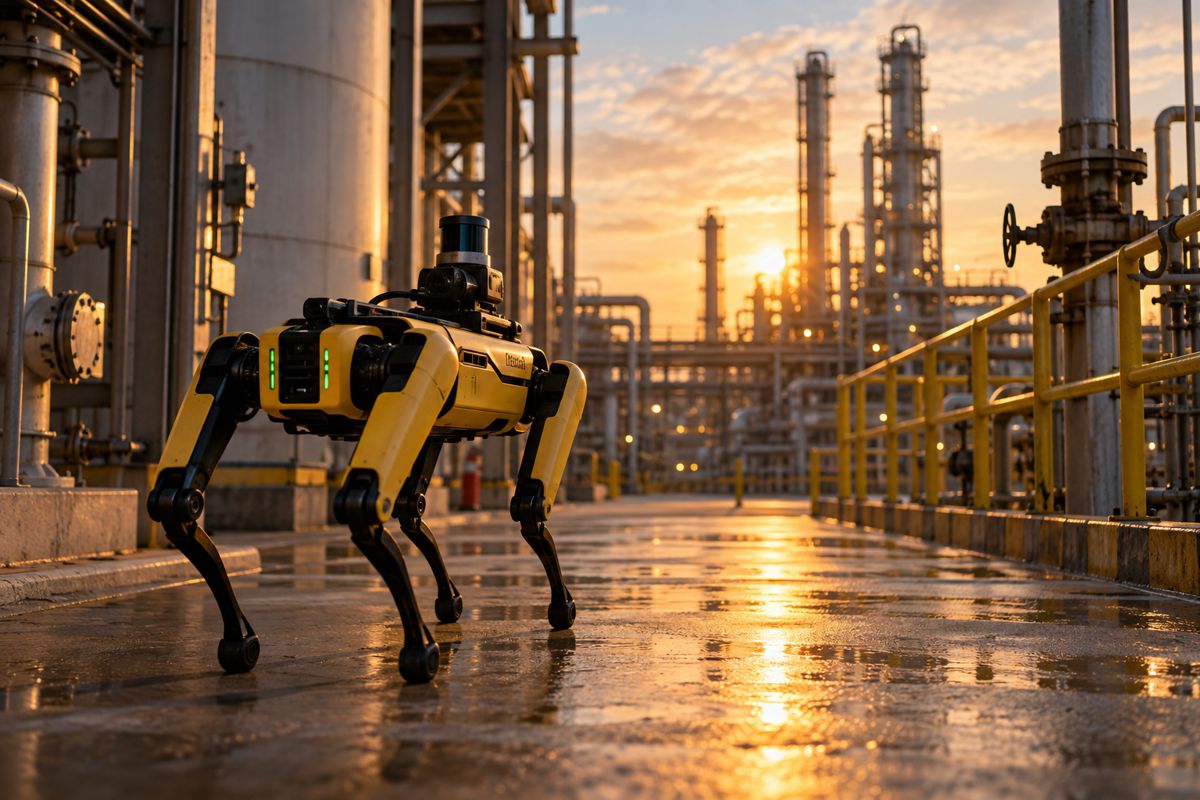
Spot’s physical capabilities are well established. The four-legged platform can negotiate stairs and uneven terrain, operate autonomous missions and carry sensing equipment for visual, thermal, acoustic and other forms of inspection. Boston Dynamics positions it as a mobile sensing platform rather than simply a remotely controlled robot, with autonomous charging and the ability to replan around obstacles.
An impressive robot walking through a plant proves mobility. An inspection system has to return to the correct assets repeatedly, collect the required measurements and continue doing so reliably enough for operations and maintenance teams to depend upon it.
Boston Dynamics’ implementation process therefore begins with a site evaluation rather than delivery of the machine. An engineer assesses whether Spot can operate autonomously in the intended environment while the customer and deployment team examine candidate applications, operating schedules and charging requirements. Inspection routes and individual data collection points can begin to be mapped at this stage.
The resulting statement of work establishes scope, timetable and deliverables, including site acceptance criteria and success metrics. It also assigns responsibilities for infrastructure, resources and coordination. The question is no longer simply whether the robot can perform a task, but what constitutes a successful robotic inspection and how it will be measured.
Preparing the Site
A mobile autonomous robot brings infrastructure requirements that are easy to overlook when attention is concentrated on the hardware. Boston Dynamics says customers commonly need to make changes to wireless connectivity and network configurations before Spot arrives, ensuring adequate coverage throughout planned inspection routes. A cross-functional deployment team can include technical project managers, field engineers and customer success personnel, while the customer’s side may involve site leadership, IT, an executive sponsor and a designated robot operator.
Autonomous inspection depends on a physical operating environment the robot can navigate safely and repeatedly, together with communications infrastructure capable of supporting its missions and transferring the information it collects. Real deployments show how quickly those details can become operational constraints.
RATP, which maintains more than 35,000 civil works components across the Greater Paris transport network, has used Spot for inspections in environments where access can expose personnel to risk. In one tunnel application, deteriorating Wi-Fi coverage led to the use of additional radio equipment and mesh-network antennas to maintain communications over a 450-metre tunnel.
Preparation also extends to the people working around the machine. Boston Dynamics recommends explaining a deployment to the wider workforce before Spot appears, particularly where employees are concerned that autonomous systems could replace jobs. Operators need training, but maintenance technicians, safety personnel, IT departments and contractors may also encounter the robot during ordinary operations.
Boston Dynamics describes successful preparation as both technical and cultural. Its suggestions range from formal training and safety information to introducing Spot in communal areas so employees become accustomed to seeing it. The aim is for a conspicuous four-legged robot eventually to become another piece of site equipment.
Designing the Inspection
Once Spot reaches the site, Boston Dynamics describes a deployment and integration period lasting approximately two to four weeks. Operators gain hands-on experience while preliminary inspections expose problems with routes, configurations and workflows.
System installation itself typically occupies around two weeks. Engineers configure the robot and network, walk proposed inspection routes, record final paths, set alert parameters and validate missions. Boston Dynamics says many organisations begin recording missions within 24 hours of its engineers arriving on site.
The robotics engineers understand Spot, but plant personnel understand the equipment, hazards, access restrictions and operating routines of their facility. Designing a useful autonomous inspection requires both.
The same principle applies in construction and infrastructure, where conditions may be considerably less controlled than a factory floor. Boston Dynamics has documented a California Department of Transportation application in which Spot carried lidar through a damaged culvert. The robot completed a geo-referenced 3D scan in less than ten minutes, identifying a fracture and helping engineers determine the excavation required above. Caltrans estimated that the operation avoided more than $50,000 in permitting, unnecessary excavation and possible environmental mitigation costs.
Here, the value came from carrying the right sensor into a difficult location and returning information engineers could use to make a decision.
The Data Has to Go Somewhere
Boston Dynamics describes Spot’s value proposition as collecting information that can be difficult, time-consuming or dangerous for people to obtain, but organisations still need a plan for what happens to that information. Storage, integration with existing systems and the response to anomalous measurements all need to be considered. An abnormal reading, for example, might ultimately need to generate a maintenance work order rather than remain inside a robotics application.
Boston Dynamics has been building that layer through Orbit, its fleet and facility management platform. Orbit can schedule and edit missions, provide remote robot operation, manage inspection information and issue alerts. The platform also supports APIs and webhooks for connecting robotics data with enterprise systems, alongside low-code work-order generation currently described by the company as beta.
Autonomous missions can be scheduled through Orbit, while information gathered during inspections can be integrated with enterprise asset management systems. Thermal measurements, for example, can be compared with previous readings to identify trends rather than treated as isolated observations.
Spot then becomes the mobile end of a much larger information system, moving sensors to places where measurements are required and feeding those measurements into the operational processes already used to manage plant and infrastructure assets. A robot repeatedly photographing a gauge is useful. A system recognising that the reading has moved outside an acceptable range, alerting the maintenance team and creating the appropriate work order is much closer to autonomous inspection as an operational capability.
Acceptance Rather Than Demonstration
Boston Dynamics’ deployment process includes a stabilisation period before formal site acceptance testing. Performance metrics are monitored while operators become accustomed to the robot and inspection data, with routes and configurations adjusted as real operating conditions expose problems that were not apparent during installation.
Acceptance testing begins once those adjustments have finished. Boston Dynamics describes targets in the 95% range for several objectives. Mission success measures whether Spot completes an inspection autonomously without human intervention. Inspection completion checks whether all intended information has been collected, while inspection results assess whether that information is accurate.
Those measures provide a more useful definition of autonomous operation than whether a robot can navigate from one end of a facility to another. A machine that completes 99% of its route but regularly misses the instrument containing the critical measurement has not delivered a successful inspection. Nor has a robot that gathers every measurement but requires frequent human intervention to finish its mission.
Once Spot is reliably completing its routes and collecting the intended measurements, the customer assumes responsibility for normal operation. Boston Dynamics describes the end state as a running schedule of proven missions providing a steady flow of information about equipment condition, with trained operators managing the robot and looking for further applications.
Scaling Beyond One Robot
Boston Dynamics says organisations commonly start with limited applications and expand after demonstrating a return on investment and developing internal expertise. Mature installations can grow into multi-Spot, multi-site programmes with teams dedicated to operating the robots and finding additional applications.
At that point, robotics starts to resemble another technical discipline within the organisation. Someone must own maintenance and understand network requirements and software integration. Inspection missions need managing as facilities change. Sensors require configuration, data pipelines have to remain functional, and new applications need evaluating without disrupting established ones.
Boston Dynamics draws a comparison with the arrival of workplace computers, which eventually created a requirement for dedicated IT support. Its guide does not suggest that a company buying a single Spot immediately needs a robotics department, but it does recommend establishing clear ownership of troubleshooting and maintenance and building internal expertise as deployments expand.
The comparison is apt because computers eventually became unremarkable workplace infrastructure. Industrial robots may be travelling along a similar, if much earlier, path.
When the Robot Becomes Infrastructure
Spot remains an unusually visible piece of technology. A quadruped robot walking around a steelworks, power station, tunnel or construction site inevitably attracts more attention than the wireless network, database and maintenance system behind it. Operationally, those less conspicuous components may determine whether the deployment lasts.
Boston Dynamics makes a similar observation in its guide. Every new Spot has the same underlying hardware and software specification, while outcomes differ according to the operational framework organisations construct around their robotics programmes. Preparation, data planning and support capability sit alongside the machine itself.
Caltrans offers an early example of how that progression can develop in infrastructure. Following its initial applications, the agency purchased a second Spot and has considered further uses involving culverts, bridge cells, landslides and tunnels. The machine that began as a way of entering difficult or potentially hazardous spaces becomes more valuable as the organisation learns where else the same capability can be applied.
The technological achievement behind this remains formidable: a commercially available machine capable of walking through complex environments while carrying useful sensing equipment. Deployment at scale poses a different engineering challenge. The robot has to disappear into the operation around it.
When inspection missions run according to schedule, measurements arrive in the systems where engineers already work, abnormal conditions produce the appropriate maintenance response and employees regard the machine as ordinary site equipment, the novelty of the four-legged robot becomes considerably less important.
Key Industry Questions
- How quickly can Spot be deployed for autonomous industrial inspections? Boston Dynamics says its established implementation process can put Spot into on-site inspection work in approximately eight to twelve weeks, although individual deployments vary according to site complexity and readiness.
- What preparation is required before Spot arrives? Typical work includes identifying suitable applications, defining success criteria, assessing the operating environment, mapping inspection routes, preparing network coverage and assigning internal responsibilities.
- Does Spot require continuous Wi-Fi coverage? Network requirements depend on the deployment and communications architecture, but Boston Dynamics specifically identifies wireless connectivity and network configuration as important elements of site preparation. Some difficult infrastructure environments may require additional communications equipment.
- How does Boston Dynamics determine whether an installation is working successfully? Site acceptance testing considers autonomous mission success, completion of the intended inspections and accuracy of the resulting data, with target metrics described as being around 95%.
- What happens to data collected by Spot? It can be managed through Boston Dynamics’ Orbit platform or integrated with wider enterprise systems, allowing inspection results and alerts to become part of existing asset-management and maintenance workflows.
- Can Spot be used on construction and infrastructure projects? Yes. Documented applications include construction reality capture and inspections of tunnels, culverts and other difficult or hazardous infrastructure environments.
- Why is workforce preparation part of a robotics deployment? Employees need to understand what the robot will do, how it will interact with existing operations and how individual roles may change. Boston Dynamics recommends beginning that process before the robot reaches the site.
- What changes when an organisation moves from one robot to a fleet? Fleet deployments increase the importance of centralised mission management, maintenance, technical support, data integration and internal robotics expertise. Boston Dynamics says mature deployments can develop into multi-robot and multi-site programmes.
Strategic Takeaways
- Industrial robotics deployment is becoming an integration problem as much as a hardware problem, particularly once autonomous inspection moves beyond pilot projects.
- Defining the measurement and operational response before programming the robot can prevent technically successful deployments from producing data nobody uses.
- Site acceptance criteria provide a practical bridge between robotics demonstrations and operational reliability.
- Existing network infrastructure can become a constraint when autonomous robots are introduced across large or difficult industrial environments.
- Organisations scaling robotic inspection are likely to need internal ownership of the technology rather than treating robots indefinitely as vendor-managed equipment.