ADB Backs the Next Five Years of the Indonesia-Malaysia-Thailand Growth Triangle
More than $3.7 billion of Asian Development Bank support was benefiting areas within the Indonesia-Malaysia-Thailand Growth Triangle by August 2026, as the three countries prepare a new five-year programme covering transport links, economic corridors and regional development projects.
The Indonesia-Malaysia-Thailand Growth Triangle, better known as IMT-GT, is approaching a handover point. Its Implementation Blueprint 2022–2026 is reaching its conclusion while governments prepare the 2027–2031 programme that will determine which roads, railways, ports, border connections and associated projects move forward.
At the 32nd IMT-GT Ministerial Meeting in Medan, North Sumatra, the Asian Development Bank reaffirmed its role as the programme’s Regional Development Partner. ADB has supported IMT-GT since its establishment in 1993 and has formally occupied that position since 2006.
“As the region’s main bank, ADB remains committed to supporting ASEAN and its subregional cooperation programs, including IMT-GT, in advancing connectivity, sustainability, resilience, and economic opportunity,” said Nianshan Zhang, Director General of ADB’s Southeast Asia Department.
IMT-GT has spent more than three decades developing economic corridors linking ports, cities, industrial areas, border crossings and tourism centres. With another blueprint now being prepared, attention is increasingly turning to the projects required to make those connections work.
Briefing
- ADB support benefiting IMT-GT areas exceeded $3.7 billion as of August 2026.
- Almost $2.7 billion comprises 23 sovereign loans and grants.
- Eight private-sector investments in energy and ICT account for approximately $805 million.
- The new IMT-GT Implementation Blueprint will cover 2027–2031.
- Transport connectivity remains central to the development of the subregion’s economic corridors.
Building the Next Blueprint
Indonesia, Malaysia and Thailand adopted the current Implementation Blueprint for 2022–2026 as the second five-year programme supporting IMT-GT Vision 2036. Its framework covers agriculture and agro-based industry, tourism, halal products and services, transport connectivity, trade and investment facilitation, environment, human resource development and digital transformation.
Physical connectivity sits beneath much of that agenda. Roads, railways, ports, border facilities and other transport links are intended to connect centres of economic activity rather than exist as isolated infrastructure projects.
The current programme identified 41 priority connectivity projects. ADB reporting records four as completed, 32 as ongoing, four postponed and one requiring an update, leaving most of the portfolio still under implementation as the existing blueprint reaches its final year.
Preparation of the successor programme has continued through 2026. A workshop in Bangkok in February examined progress, implementation gaps and priorities for the following five years, while transport representatives from the three countries met again in July to review physical connectivity projects and consider priorities for the next period.
The 2027–2031 blueprint is being developed around economic resilience, integrated networks and shared prosperity. ADB has supported its preparation and has indicated that its role could extend to identifying projects and mobilising financing once implementation begins.
Economic corridors ultimately depend on individual pieces of infrastructure working together. A port upgrade delivers less if its hinterland road remains constrained; a new border facility cannot remove delays elsewhere in the customs system; improved highways cannot create seamless freight movements if maritime and rail connections remain disconnected.
From Corridors to Projects
IMT-GT’s physical connectivity programme is built around six economic corridors connecting commercial centres, ports, tourism areas and other economic nodes across the three countries.
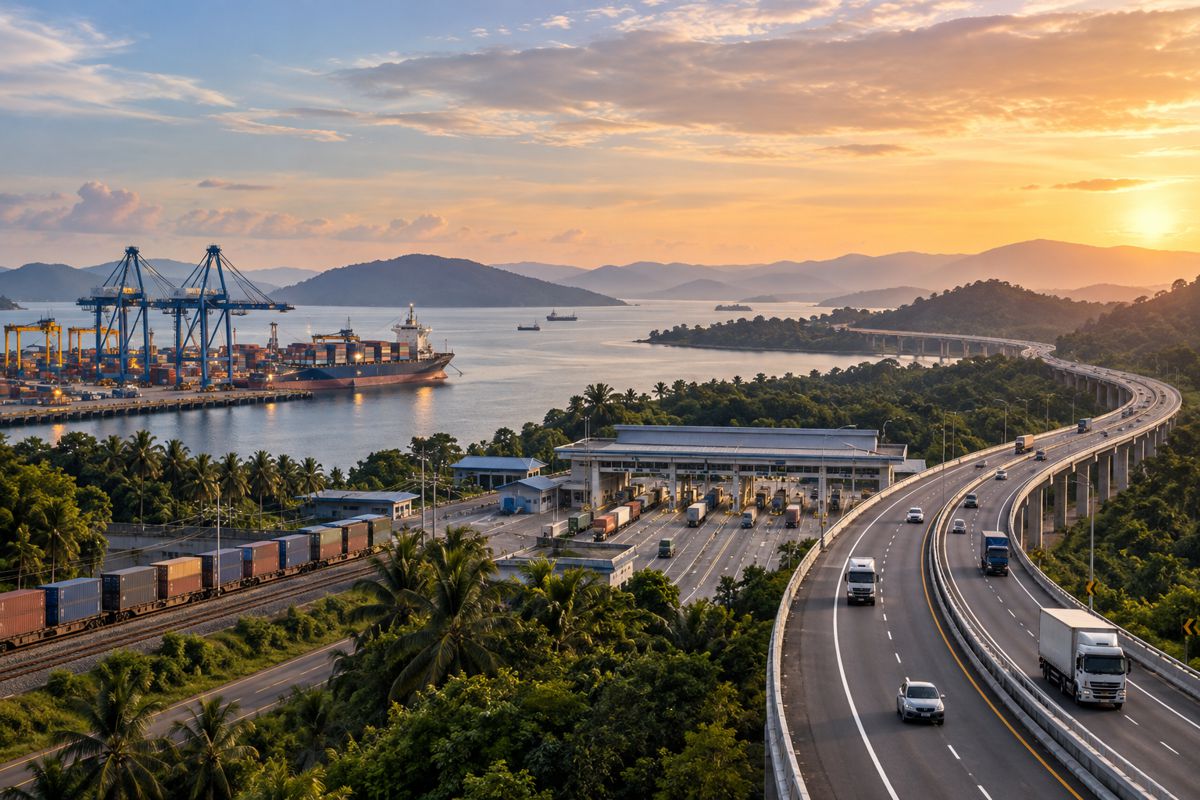
The approach reflects the geography of the Growth Triangle itself. It covers Sumatra and other parts of Indonesia, Peninsular Malaysia and southern Thailand, placing maritime transport alongside roads, railways and border infrastructure. The objective is to develop networks through which production, trade, tourism and investment can operate across national boundaries with fewer physical and administrative barriers.
Earlier IMT-GT connectivity programmes have involved portfolios worth tens of billions of dollars, encompassing roads, bridges, ports, airports, customs, immigration and quarantine facilities, ICT infrastructure and other strategic connections. The current programme continues that corridor-based approach, with Physical Connectivity Projects addressing individual gaps by road, rail, air and sea.
At the September ministerial meeting, Indonesia pushed the discussion towards delivery. Coordinating Minister for Economic Affairs Airlangga Hartarto called for 92 ongoing projects across the wider IMT-GT programme to be completed rather than remaining principally subjects of discussion.
That wider figure is separate from the 41 priority connectivity projects identified under the physical connectivity programme, but both point to the scale of the pipeline now moving into the next planning cycle. After more than three decades of strategies, corridors and project identification, the 2027–2031 period will inherit a substantial body of unfinished and proposed work.
ADB’s Financing Base
ADB’s existing exposure gives some indication of the financial mechanisms available. As of August 2026, more than $3.7 billion of its support was benefiting IMT-GT areas across transport, energy, agriculture, education, health, water, urban services, finance and trade, including 23 sovereign loans and grants worth almost $2.7 billion.
Private capital forms a smaller but still substantial component. Eight private-sector investments in energy and information and communication technology total approximately $805 million, alongside 40 technical assistance initiatives worth more than $24 million.
Technical assistance can begin long before construction, particularly where projects involve several jurisdictions, institutional coordination or new regulatory arrangements. Private investment can become relevant where projects or services support commercially viable structures, while sovereign lending remains available for infrastructure and public-sector programmes.
ADB has consequently worked within IMT-GT as financier, knowledge provider, capacity builder and strategic adviser, supporting successive roadmaps and implementation blueprints as well as institutional development and project preparation. Ministers from Indonesia, Malaysia and Thailand acknowledged that contribution in their joint statement in Medan, including ADB’s support for green cities, tourism, economic corridors and zones, institutional strengthening and project management.
Regional Integration and Delivery
The September meeting took place against a less predictable international trading environment than the one in which IMT-GT was created in 1993. The joint ministerial statement referred to geopolitical uncertainty and trade fragmentation, while artificial intelligence and digital transformation were identified as strategic enablers for productivity, innovation and competitiveness.
Better-connected ports, roads, border facilities, digital systems and production centres can give businesses more options for sourcing, manufacturing and distribution within the subregion. Physical infrastructure, however, operates alongside customs procedures, compatible regulation, investment conditions, freight services and commercial demand. A completed transport asset does not automatically create an effective economic corridor.
IMT-GT’s longevity has allowed it to establish corridors and maintain cooperation between national governments, provincial authorities, the private sector and development institutions. It also means the next blueprint begins with an extensive legacy of plans and projects rather than a blank sheet.
ADB is already financially involved across the subregion, the three governments have established project pipelines, and transport connectivity remains embedded within the wider Vision 2036. The work ahead is increasingly about selecting, financing and completing those connections.
For the roads, railways, ports and border crossings of the Growth Triangle, the next five years will be measured in what moves from the project pipeline onto the ground.
Key Industry Questions
- What is the Indonesia-Malaysia-Thailand Growth Triangle? IMT-GT is a subregional cooperation programme established in 1993 to encourage economic integration between participating areas of Indonesia, Malaysia and Thailand.
- What is the IMT-GT Implementation Blueprint 2027–2031? It is the next five-year strategic programme supporting IMT-GT Vision 2036, succeeding the 2022–2026 blueprint. It is being developed around economic resilience, integrated networks and shared prosperity.
- How much ADB support is already associated with IMT-GT areas? As of August 2026, ADB support benefiting IMT-GT areas was valued at more than $3.7 billion.
- How much of that support involves sovereign finance? Twenty-three sovereign loans and grants account for almost $2.7 billion.
- Does ADB invest directly in private-sector projects in the subregion? Yes. Eight private-sector investments in energy and information and communication technology total approximately $805 million.
- What infrastructure does IMT-GT prioritise? Its Physical Connectivity Projects include roads, railways, ports, maritime infrastructure, border connections and other transport links supporting its economic corridors.
- How many priority connectivity projects are included in the 2022–2026 programme? ADB records 41 priority connectivity projects, with four completed, 32 ongoing, four postponed and one requiring an update.
- Why are economic corridors important to IMT-GT? They provide a framework for connecting ports, cities, commercial centres, production areas, tourism destinations and border crossings rather than developing individual infrastructure assets in isolation.
Strategic Takeaways
- The 2027–2031 blueprint inherits a substantial infrastructure pipeline rather than beginning with a new regional concept.
- ADB’s involvement combines sovereign lending, private-sector investment, technical assistance and institutional support.
- Physical infrastructure remains fundamental, but economic corridors also depend on border procedures, regulation, logistics services and commercial demand.
- Most of the 41 priority connectivity projects identified under the current programme remain under implementation.
- Financing and completing existing connections will be central to the next five-year programme.