From Prompt to Production: The Changing Economics of Visual Content
A commercial photograph can begin with an idea that takes seconds to describe and end with days of work involving a photographer, location, equipment, models, transport, permissions, post-production and approval. Illustration, architectural visualisation and sophisticated product rendering carry their own production chains, with much of the cost incurred before anyone knows whether the original creative idea will work.
Generative artificial intelligence is compressing that process. Image generation itself is no longer particularly novel. The more consequential development is the ability to generate, reject, alter and regenerate visual ideas quickly enough for AI to become part of an ordinary production workflow.
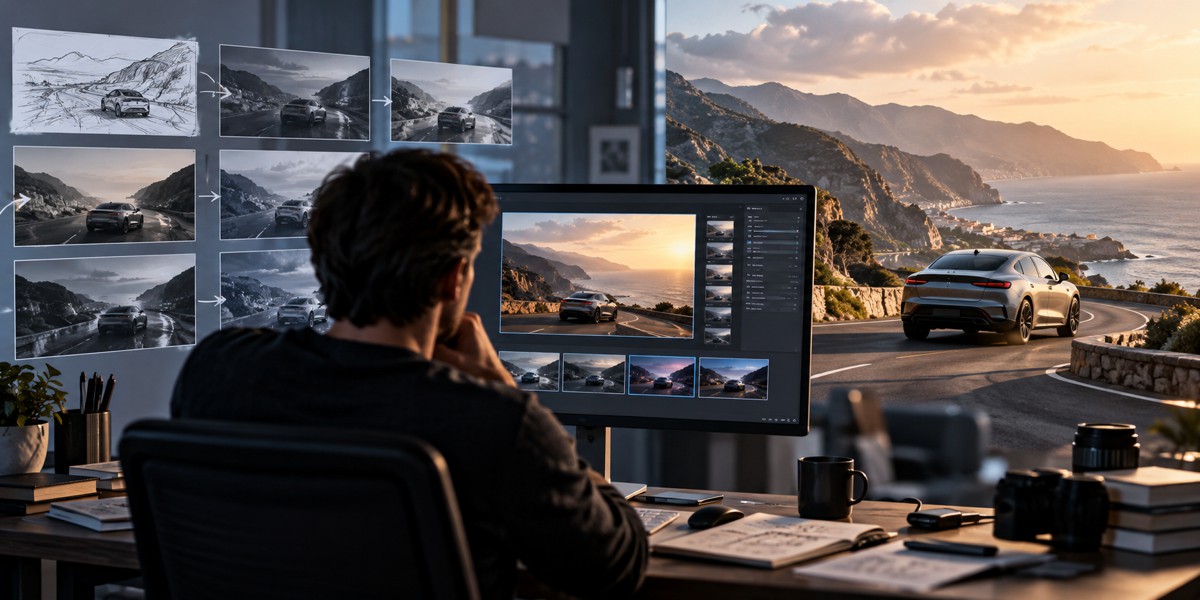
The economics change when experimentation becomes cheap. A creative team can explore ten compositions rather than committing to two, test a different location without travelling there, alter lighting without rebuilding a scene and discard unsuccessful ideas with little more invested than a few minutes and some computing capacity. Professional production remains valuable, but increasingly it can begin after more of the creative uncertainty has been removed.
Briefing
- AI image systems are moving from one-off generation towards repeated, controlled editing and refinement.
- Faster generation reduces the practical cost of testing and rejecting visual concepts.
- Reference preservation and selective editing are becoming as important as text-to-image generation.
- Generative capabilities are increasingly being incorporated into established creative software and production workflows.
- As synthetic imagery becomes abundant, judgement, provenance and authentic real-world imagery may become more valuable.
From Generation to Iteration
The first wave of generative imagery was dominated by the prompt. A user described an astronaut riding a horse, a futuristic city, a product photograph or an imaginary landscape and waited for the model to interpret the instructions. The results could be remarkable, but commercial use exposed the limitations quickly.
Producing an attractive image was easier than producing the right one. Characters changed between generations, products acquired different proportions, logos mutated and background elements appeared or vanished. A request to alter one detail could unexpectedly change the composition around it. Users responded with longer prompts, seeds, reference images, negative instructions and other techniques intended to constrain systems designed to generate rather than preserve.
The current development effort is increasingly focused on control. Reference images need to remain recognisable, existing edits need to survive subsequent instructions, and users need to be able to change a background, object, expression or composition without rebuilding everything around it.
OpenAI’s ChatGPT Images 2.5 reflects that direction. Released in September 2026, the system places greater emphasis on editing, reference preservation and generation speed. OpenAI says generation latency has been reduced by up to 50% compared with Images 2.0, alongside improvements intended to preserve earlier edits through successive instructions.
Speed alters the working process. When each attempt carries little cost in either money or waiting time, there is less reason to protect a mediocre idea. Four versions can become twelve. A daytime scene can be tested at dusk, the camera moved, people removed, the format changed and an earlier version revisited without commissioning another round of conventional production.
Specialist platforms are also building workflows around this behaviour. Tools providing access to ChatGPT Images 2.5 allow visual ideas to be generated and refined through successive iterations, placing the emphasis on reaching a useful result rather than treating the initial generation as a finished image.
The perfect prompt consequently becomes less important. An imperfect first image is perfectly serviceable when correcting it is fast and inexpensive.
The Economics of the Draft
Traditional visual production puts considerable pressure on decisions made early. Commissioning a photographer requires somebody to decide what should be photographed. An illustrator needs a brief. A detailed 3D scene requires choices about materials, perspective, lighting and composition before substantial production time is committed.
AI allows more of those decisions to remain provisional.
A retailer can explore campaign directions before arranging photography. An architect can investigate atmosphere and presentation before commissioning detailed visualisation. Publishers can test cover concepts before handing a direction to a designer, while film and advertising teams can investigate scenes and camera positions before committing resources to storyboards, locations or physical production.
None of these applications requires the final asset to be generated by AI. The saving can occur earlier, when inexpensive synthetic images replace ideas that previously had to be described, sketched or partially produced before they could be judged.
That changes the value of a draft. Historically, even preliminary creative work consumed labour, so there was an economic incentive to limit the number of alternatives. When dozens of plausible concepts can be produced in an hour, generating another option becomes trivial. Choosing between them does not.
Art direction, visual literacy, technical knowledge and an understanding of the audience retain their value because abundance does not resolve the problem of judgement. A beautifully rendered poor idea is still a poor idea, however quickly it was produced.
Digital photography provides a useful precedent. Removing film and processing costs made taking another photograph almost free, allowing hundreds or thousands of exposures where a photographer might once have used a few rolls of film. Professional photography survived because the cost of pressing the shutter had never been the sole source of its value.
Generative imagery extends the same economic principle into composition itself.
AI Enters the Production Workflow
Generative imagery is also moving inside the software already used for professional production. Adobe has incorporated generative functions across Photoshop, Illustrator, Express and Firefly, covering image generation, expansion, replacement and other forms of AI-assisted editing. OpenAI’s image models have also become available through Adobe Firefly, allowing generative models from different providers to sit inside established creative workflows.
Google and other technology companies are developing their own combinations of image generation and editing, while dedicated AI platforms continue to compete on speed, quality, reference handling and control.
The distinction between generating an image and editing one is becoming increasingly artificial. A production sequence might begin with a photograph, use generative AI to extend the frame, replace part of the background, introduce a conceptual element, return to conventional editing for detailed adjustment and then use another model to produce alternative formats.
Authorship becomes more complicated in such a workflow. So does the idea of an “AI-generated image”. The finished asset may contain photography, conventional digital editing, generated material and human retouching without belonging neatly to any one category.
The underlying economics are easier to identify. AI models require substantial computing infrastructure and their use is paid for through subscriptions, credits and API charges, but the marginal cost of exploring another idea has fallen sharply. Small organisations can now investigate visual directions that would previously have been rejected before production simply because they were too expensive to test.
Abundance and Visual Quality
Cheap production inevitably increases supply. Websites, ecommerce platforms, advertising systems and social networks can absorb enormous quantities of visual material, and generative systems remove much of the labour that previously constrained how much could be produced.
Quantity does not solve the problem of quality.
Generative models are already capable of producing technically polished imagery that would once have required considerable effort. As that capability becomes commonplace, polish alone carries less distinction. A flood of competent imagery may instead increase the value of originality, recognisable creative direction and material that has an authentic connection with its subject.
There may even be a premium for work whose human origins are obvious. Bespoke photography, physical illustration and distinctive design retain qualities that become easier to recognise when synthetic alternatives are abundant. The economics do not eliminate scarcity so much as move it from production towards originality and judgement.
The same process is likely to expose mediocre commercial imagery more quickly. Generating fifty options does little for an organisation unable to recognise which of the fifty is worth using. Lower production costs can therefore widen access to visual communication without making creative expertise redundant.
The Value of Reality
Some images have another property that cannot be recreated through visual quality alone: they document something that happened.
A photograph of a bridge inspection needs to show the bridge that was inspected. Construction progress photography needs to record the actual project. Engineering documentation, scientific records, journalism, insurance evidence and property marketing all depend to varying degrees on a reliable relationship between an image and the physical world.
As synthetic imagery becomes easier to create and harder to distinguish visually from photography, provenance acquires greater practical value. Original files, authenticated capture, documented sources and trusted publishers can establish something that a convincing generated image cannot establish by appearance alone.
OpenAI says ChatGPT Images 2.5 outputs continue to include C2PA metadata and invisible watermarking intended to assist identification of AI-generated content. Such mechanisms form part of a wider attempt to preserve provenance as synthetic and conventional imagery become increasingly difficult to separate by inspection.
This creates an unusual divergence in the economics of visual content. Inventing a convincing scene is becoming cheaper, while demonstrating that an image records something real may require stronger chains of evidence.
Creative Work After Cheap Generation
The effect on photographers, designers, illustrators, 3D artists and other creative professionals will not be uniform. Routine commercial work is particularly exposed where a client primarily needs an acceptable image quickly and cheaply, while other areas may use AI to reduce preliminary production without removing the specialist responsible for the finished work.
A designer can investigate variations before developing the chosen direction. A photographer can arrive at a shoot with compositions already explored. Advertising teams can reject weak concepts before committing production budgets, while 3D artists can spend more time on final-quality assets and less on speculative work that never progresses beyond an early review.
Human and machine production can consequently occupy different stages of the same job. Concept generation, photography, synthetic imagery, conventional editing, rendering and retouching can move backwards and forwards according to what each does best.
The commercial pressure will fall most heavily on work whose value rested largely on the time required to produce it. Work based on judgement, technical accuracy, originality, access or the ability to document reality has a different economic foundation.
Production Becomes Cheap, Judgement Does Not
The first generation of AI image tools demonstrated that language could be converted into convincing pictures. The emerging generation is making those pictures easier to control, edit and incorporate into ordinary creative work.
As generation becomes faster, the cost of exploring an idea continues to fall. Businesses can investigate concepts they would not previously have funded, creators can pursue alternatives they would not have had time to develop, and expensive stages of production can begin after weak directions have already been discarded.
The resulting abundance does not make creativity automatic. It makes the distinction between producing an image and deciding what deserves to be produced much clearer.
The cost of making an image is heading towards zero. The value of knowing which image is worth making isn’t.
Key Industry Questions
- How does faster AI image generation reduce production costs? It allows more concepts to be tested before expensive photography, illustration, rendering or design work begins. Savings can therefore occur during development even when AI is not used for the final image.
- Will AI image generation replace professional photography? Some routine commercial photography may face greater competition, but photography also provides authenticity, access, technical control and documentary evidence that synthetic imagery cannot automatically reproduce.
- Why is image editing becoming more important than text-to-image generation? Commercial workflows require consistency and control. Being able to preserve a subject while altering selected parts of an image is often more useful than generating an entirely new composition.
- What happens to designers when visual concepts become cheap to generate? The value of producing basic alternatives may decline, while art direction, judgement, finishing, brand consistency and specialist technical skills remain important.
- Can AI-generated images be used for engineering documentation? Generated imagery should not substitute for factual visual records where the image is expected to document actual equipment, conditions, defects, construction progress or other physical evidence.
- Why does provenance become more important as AI imagery improves? Visual appearance alone becomes a weaker indicator that an image records a real event or object. Metadata, original files, authenticated capture and reliable sourcing can provide evidence of origin.
- Are AI images effectively free to produce? No. Generation consumes computing resources and is commonly paid for through subscriptions, credits or API charges. The major reduction is in the marginal cost of producing and testing additional alternatives.
- What is likely to remain scarce if image generation becomes abundant? Original ideas, judgement, authentic imagery, specialist knowledge, access to real subjects and trusted provenance remain difficult to automate simply by increasing the number of images generated.
Strategic Takeaways
- Faster generation makes unsuccessful visual experiments cheaper to discard before substantial production resources are committed.
- Reliable editing and reference preservation are becoming central to commercial AI image workflows.
- Generative AI can reduce pre-production costs even where the final asset remains professionally photographed, illustrated or rendered.
- Abundant polished imagery increases the relative importance of creative judgement, originality and recognisable visual direction.
- Authentic imagery and verifiable provenance may gain value as convincing synthetic content becomes inexpensive and commonplace.