TVS RTR 125 LC Brings Performance Engineering to the 125cc Motorcycle Market
TVS Motor Company has unveiled the production-ready RTR 125 LC at EICMA 2026 in Milan, introducing a lightweight sports motorcycle with the engine output permitted under Europe’s A1 licensing category and a chassis specification more commonly associated with larger machines.
Powered by a liquid-cooled 125cc engine producing 11 kW, the new motorcycle combines a six-speed transmission and assist and slipper clutch with 41 mm KYB upside-down forks, a trellis frame and dual-channel ABS. A five-inch TFT display, connected navigation and selectable riding modes complete a package aimed at younger riders and those looking for a performance-oriented alternative to conventional urban commuters.
The RTR 125 LC is part of a wider European expansion by the Indian manufacturer, which is introducing four production-ready models at EICMA while developing its distribution and servicing network across the continent.
Briefing
- TVS Motor unveiled the production-ready RTR 125 LC at EICMA 2026 in Milan.
- The liquid-cooled 125cc DOHC engine produces 11 kW at 9,000 rpm and 12 Nm at 7,000 rpm.
- A six-speed gearbox, assist and slipper clutch, KYB suspension and Bybre brakes form part of the specification.
- A five-inch TFT display provides Bluetooth connectivity, map mirroring and turn-by-turn navigation.
- The motorcycle joins TVS Motor’s expanding European portfolio alongside three electric models.
Engineering a 125cc Performance Motorcycle
The RTR 125 LC uses a liquid-cooled, four-valve, double overhead camshaft engine producing 14.9 PS at 9,000 rpm, with peak torque of 12 Nm delivered at 7,000 rpm.
These figures place the motorcycle at the power ceiling of Europe’s A1 category. Under the European motorcycle licensing framework, conventional motorcycles in this class are restricted to a maximum engine capacity of 125cc, an output of 11 kW and a power-to-weight ratio of 0.1 kW/kg.
TVS has paired the engine with a six-speed gearbox and multiplate assist and slipper clutch. The additional gear ratios allow riders to manage engine speed across different road conditions, while the clutch arrangement reduces lever effort and helps moderate rear-wheel disturbance during rapid downshifting.
The four-valve cylinder head and liquid-cooling system support an engine designed to operate at relatively high speeds, with maximum power arriving at 9,000 rpm. The six-speed transmission should give riders sufficient flexibility to make use of that output in both urban traffic and on faster roads.
One important figure remains absent from the published specifications. TVS has not confirmed the motorcycle’s homologated weight, which will determine its final power-to-weight ratio. At the quoted 11 kW output, the A1 limit requires a motorcycle mass of at least 110 kg under the applicable calculation.
Chassis, Suspension and Braking
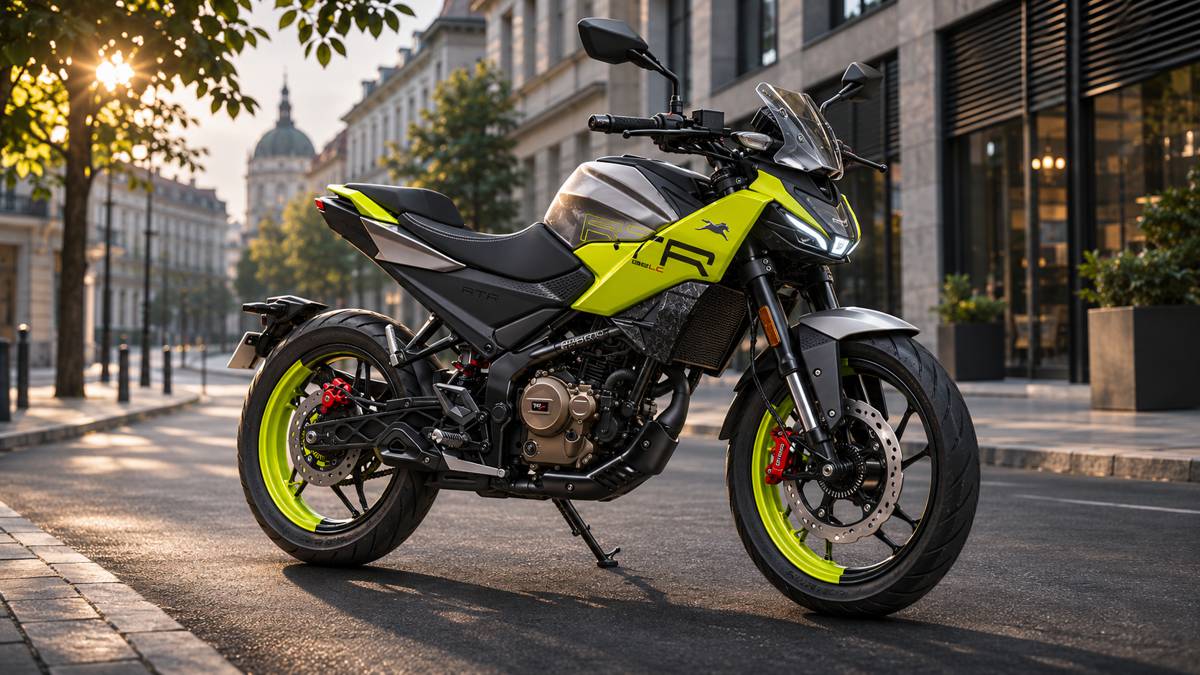
The RTR 125 LC is built around what TVS calls its Synchro Stiff chassis, combining an exposed trellis frame with a cast swingarm.
Suspension duties are handled by 41 mm upside-down forks supplied by KYB and an adjustable rear monoshock. The arrangement follows a familiar performance motorcycle layout, with the large-diameter front fork providing a rigid structure for steering and braking loads.
Braking hardware is equally substantial for a 125cc machine. A 300 mm front disc is paired with a radially mounted Bybre caliper, while a 240 mm rear disc is operated by a second Bybre caliper. Dual-channel ABS manages braking at both wheels.
The motorcycle runs on 17-inch alloy wheels, fitted with a 100/80-17 front tyre and a wider 140/70-R17 rear. The rear tyre contributes to the appearance of a larger-capacity naked motorcycle, particularly when viewed alongside the exposed frame and sharply sculpted fuel tank.
TVS has also incorporated selectable riding modes, allowing the rider to adapt the motorcycle’s operating characteristics to changing conditions. The company has not yet detailed the individual modes or explained precisely how they alter the engine and electronic control systems.
The complete chassis geometry, suspension calibration and weight distribution have yet to be published, leaving the motorcycle’s handling characteristics to be established through independent road testing.
Streetfighter Styling and Connected Technology
The RTR 125 LC adopts a compact streetfighter design, with its mass-forward proportions, angular tank shoulders and exposed structural components giving the small-capacity motorcycle a distinctly sporting appearance.
A rectangular LED projector headlamp with an integrated daytime running light defines the front, while a three-part LED tail lamp provides a distinctive rear lighting signature. The bodywork is closely integrated around the chassis and engine, avoiding the extensive fairings associated with fully enclosed sports motorcycles.
The instrumentation includes a five-inch TFT display with Bluetooth connectivity, full-screen map mirroring and turn-by-turn navigation. Route guidance can therefore be displayed directly in front of the rider without requiring a separate navigation unit.
The manufacturer has not yet confirmed the full range of supported smartphone platforms, mapping applications or market-specific connectivity functions.
Together with the riding modes and braking equipment, the digital instrumentation gives the RTR 125 LC a specification that extends well beyond the essentials of everyday transport.
TVS Motor Expands Its European Presence
The RTR 125 LC is one of four production-ready models presented by TVS Motor at EICMA 2026, alongside the electric Orbiter, M1-S and TVS X.
The launches extend the manufacturer’s European offering across conventional sports motorcycles, urban electric scooters and more sophisticated connected electric mobility products. Several of the models draw on technologies and manufacturing experience already established within the company’s international operations.
According to TVS Motor’s European expansion announcement, the company now has more than 100 retailers in Italy, with a further 22 operating across Spain and Portugal. It also reports that Italian sales have increased by 110 per cent over the preceding year, although the underlying sales volumes were not disclosed.
Further expansion is planned in France and Germany, with investment continuing in dealer operations, parts distribution and aftersales services.
The Indian manufacturer brings considerable production experience to this programme. Its ownership of British motorcycle manufacturer Norton Motorcycles also provides a European engineering connection, complementing TVS Motor’s established manufacturing operations in India.
For the RTR 125 LC, that international industrial base provides a foundation for entering a competitive European segment already served by well-established Japanese and European motorcycle brands.
The machine’s technical specification gives it several points of differentiation, but retail pricing, warranty arrangements, spare parts availability and servicing costs will be equally important when buyers compare it with existing 125cc alternatives.
Peyman Kargar, President, International Business at TVS Motor Company, outlined the company’s approach: “Europe is a key part of our international growth plans with significant opportunities across electric mobility, performance motorcycles and premium urban transportation. Success in these markets requires a deep understanding of customer needs, strong local execution and a robust distribution and service network.”
From EICMA to European Showrooms
Although TVS describes the RTR 125 LC as production-ready, European retail pricing, delivery dates and individual market availability have not yet been announced.
The complete technical specification also remains outstanding, including homologated weight, seat height, fuel capacity and consumption figures. Those details will help establish how the motorcycle compares with established models in a segment where operating costs and accessibility often influence purchasing decisions as much as styling and performance.
The RTR 125 LC launch gives TVS a performance-oriented entry point into the European A1 market, backed by a growing dealer network and an increasingly broad product portfolio.
Its combination of a full-output 125cc engine, sophisticated chassis components and connected electronics is a promising starting point. Whether it can secure a lasting position in European showrooms will depend on the final retail proposition and the quality of support available to owners.
Key Industry Questions
- What licence is required to ride the TVS RTR 125 LC in Europe? The motorcycle is designed for the A1 category, which covers motorcycles up to 125cc and 11 kW, with a maximum power-to-weight ratio of 0.1 kW/kg. The final homologated specification must meet these requirements, while rider age and licensing arrangements vary by country.
- How much power does the TVS RTR 125 LC produce? Its liquid-cooled 125cc engine develops 11 kW (14.9 PS) at 9,000 rpm, with maximum torque of 12 Nm at 7,000 rpm.
- What transmission does the RTR 125 LC use? The motorcycle has a six-speed gearbox and a multiplate assist and slipper clutch, designed to reduce clutch effort and improve control during downshifting.
- What suspension components are fitted? The front suspension uses 41 mm KYB upside-down forks, while an adjustable monoshock supports the rear of the Synchro Stiff chassis.
- Does the TVS RTR 125 LC have ABS? Yes. Dual-channel ABS operates with a 300 mm front disc and 240 mm rear disc, both using Bybre braking components.
- What connectivity features are included? A five-inch TFT display supports Bluetooth connectivity, full-screen map mirroring and turn-by-turn navigation. Detailed compatibility information has not yet been published.
- What is the weight of the RTR 125 LC? TVS has not confirmed the homologated motorcycle weight in its initial technical specifications.
- When will the TVS RTR 125 LC be available in Europe? The motorcycle was presented as production-ready at EICMA 2026, but country-specific availability, retail prices and delivery schedules remain unconfirmed.
Strategic Takeaways
- Engineering differentiation: With engine output constrained by A1 regulations, TVS has concentrated on chassis components, braking equipment and rider technology to distinguish the RTR 125 LC.
- A wider product range: The combination of petrol-powered performance motorcycles and electric urban models allows TVS to address several European customer segments through an expanding retail network.
- Manufacturing experience: Established production operations in India and European engineering connections provide TVS with an industrial foundation for international expansion.
- Dealer support: The growing network in Italy, Spain and Portugal will need to be matched by dependable parts supply, technical support and aftersales services.
- Pricing remains decisive: The final European retail price and ownership costs will determine whether the motorcycle’s relatively sophisticated specification translates into a competitive market position.