Protecting Workers During Commercial Solar Installations
A flat commercial roof looks like friendly ground. It is wide, open, and mostly level. That first impression is what makes solar work tricky because the roof will not stay the way the crew found it. Racking goes down, conduit gets pulled, pallets pile up near the edge, and a hazard someone walked past on Monday sits somewhere new by Thursday.
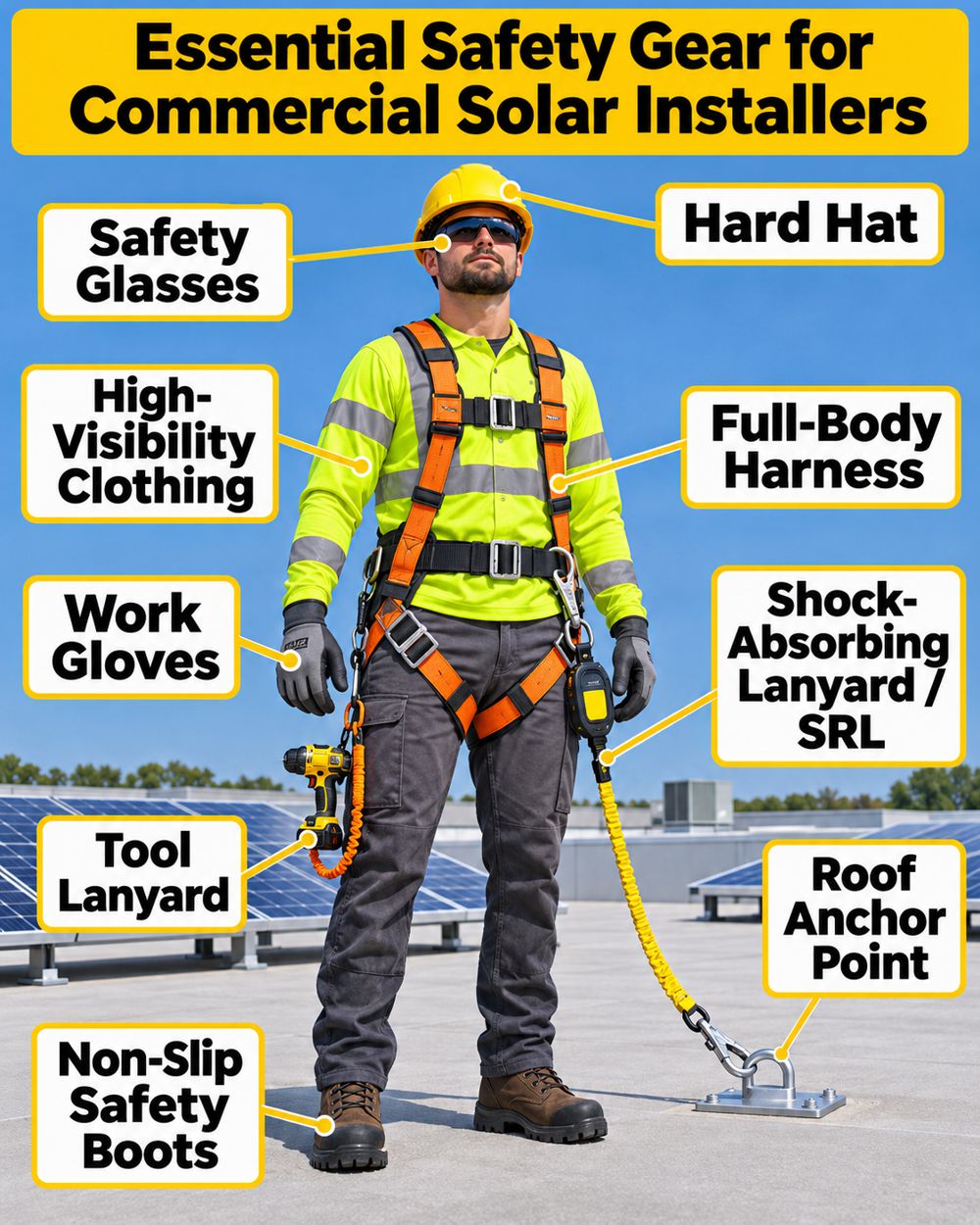
Protection starts with a system, not a single product. Well-fitting solar installer safety harnesses give crews the body support that holds up through a full day of kneeling, lifting, and reaching, but a harness only works when it is paired with the right anchorage and connecting device. Plan all three together before the first module leaves the truck.
Getting Onto the Roof
Access comes first, and many incidents start there. Ladders, roof hatches, stair towers, and lifts each carry their own risks. A ladder should extend three feet above the landing so workers have something solid to grab while stepping across. The transition is the moment of greatest exposure, and it happens dozens of times a day with tools in hand.
Choose one primary route and protect it. Keep the others closed.
A Work Area That Keeps Moving
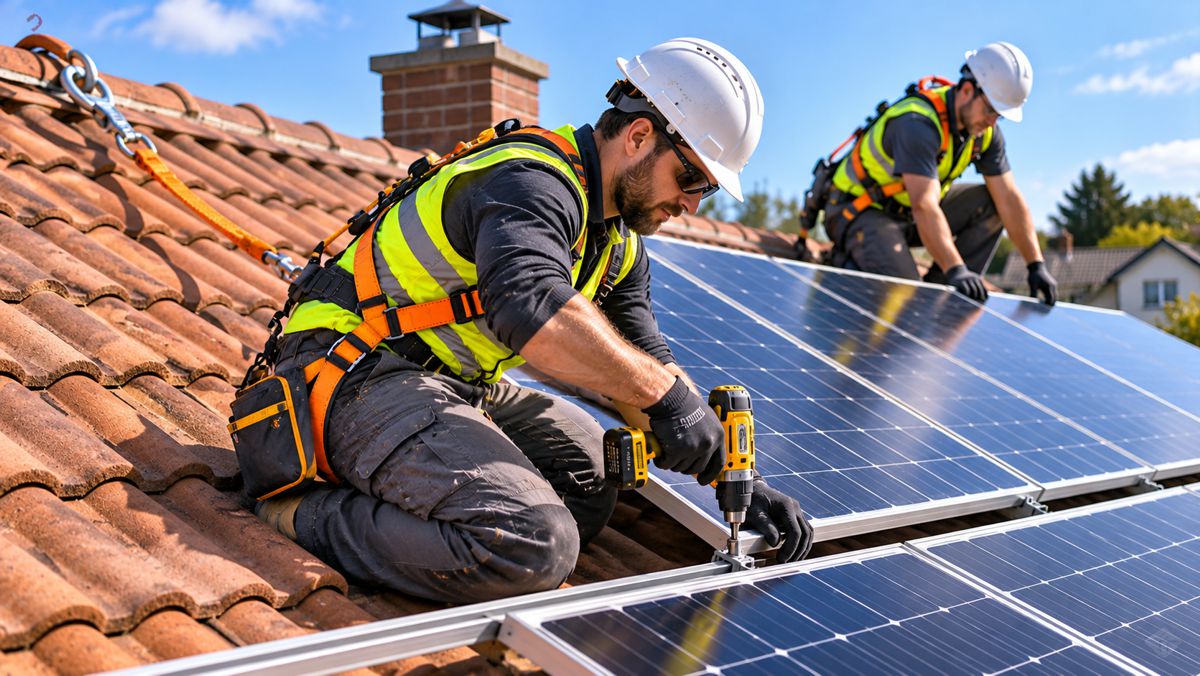
Solar roofs change by the hour. Staging zones shift, array rows advance, and wiring paths cross the surface. Have a competent person walk the roof each morning and mark the day’s boundaries, edges, and no-go areas before anyone starts.
Fragile surfaces deserve special attention. Skylights, fiberglass panels, aged membranes, and corroded metal decking can fail without warning, and a skylight painted over or dusted with debris is nearly invisible. Guard or cover each one. Do not trust a surface just because it held yesterday.
Electrical Exposure
Modules produce voltage whenever light reaches them, so a job that seems idle may still carry a live DC circuit. Falls and shocks are linked. A sudden jolt can throw a worker off balance, and a worker near an edge has little room to recover.
Treat metal hardware as a conductor. Keep lifelines, connectors, and lanyards clear of exposed conductors, and confirm with the electrical team which circuits are energized before anyone moves nearby. Lockout and de-energizing steps belong in the written plan, not in someone’s memory.
Anchor Placement and Worker Movement
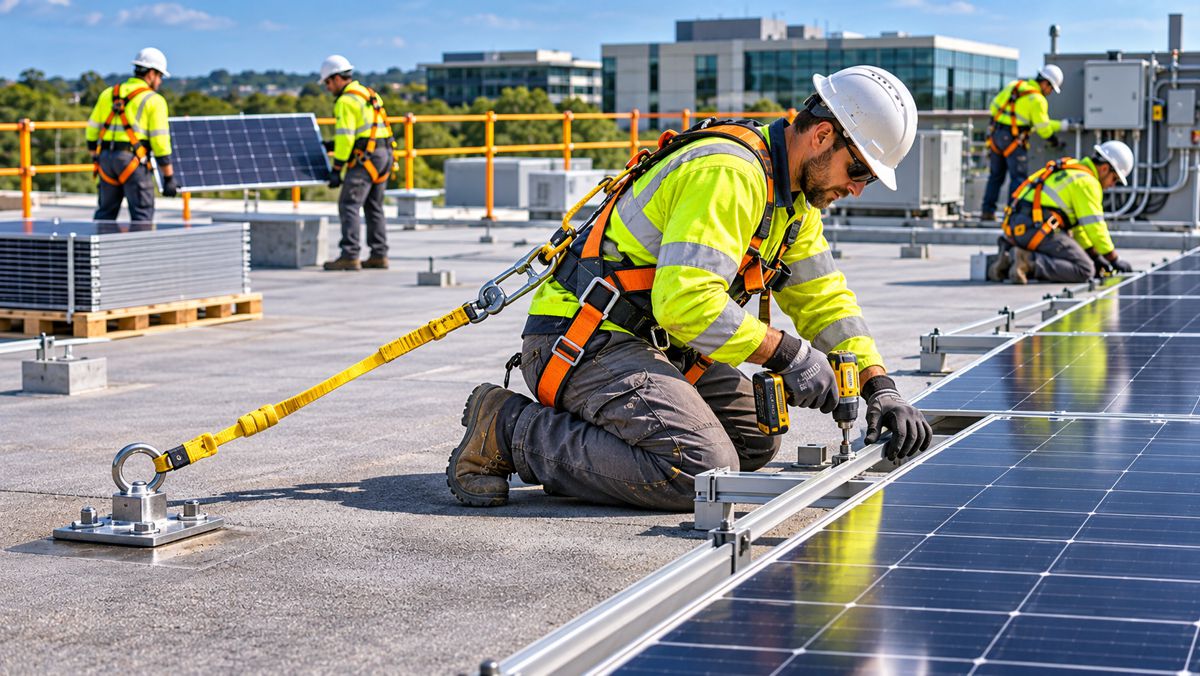
Select anchor locations before crews arrive rather than improvising on the roof. Rooftop fall protection anchors and the structure beneath them need to be compatible. Coordinate with the roofer on any anchor that penetrates the membrane to ensure the waterproofing stays intact. Ballasted or non-penetrating options may suit some roofs. A qualified person should confirm the load path either way.
Now think about how people actually move. An installer works down a row, reaches across, kneels, stands, and repeats. Each shift changes the angle to the anchor. Place it well, and the worker stays in a tight, predictable arc. Place it badly, and one slip becomes a swing toward a parapet or a skylight.
Fall clearance matters just as much. Determine required fall clearance using the manufacturer’s instructions for the complete system and the actual anchorage and worker positions, then compare it with the available clearance. For long rows or heavy lateral travel, self-retracting lifelines can limit free fall and keep slack off the surface. Check that the unit carries the ANSI Z359.14 marking for the exposure, including leading edge use where an edge is in play.
Material Handling and Weather
Modules are awkward. A single panel can weigh 50 pounds or more, and its large flat face catches wind like a sail. Carrying one along an unprotected edge takes two hands, leaving none for balance. Hoists, tag lines, covered containers, and tool tethering are work-at-height solutions that keep loads and tools where they belong and protect anyone standing below.
Weather deserves a line in the plan, too. Set a wind limit for lifting panels and stick to it. Dark membranes and hot modules add heat stress, and sweaty hands lose their grip.
Morning dew or frost turns a smooth surface into a skating rink. Glare hides edges and texture changes. If conditions slip past the limits, stop and reset.
Coordination Between Crews
Roofers and electricians share a roof but rarely share a schedule. One crew may remove a guardrail section to pull material while the other is already working nearby. Nobody meant to create a gap, yet there it is.
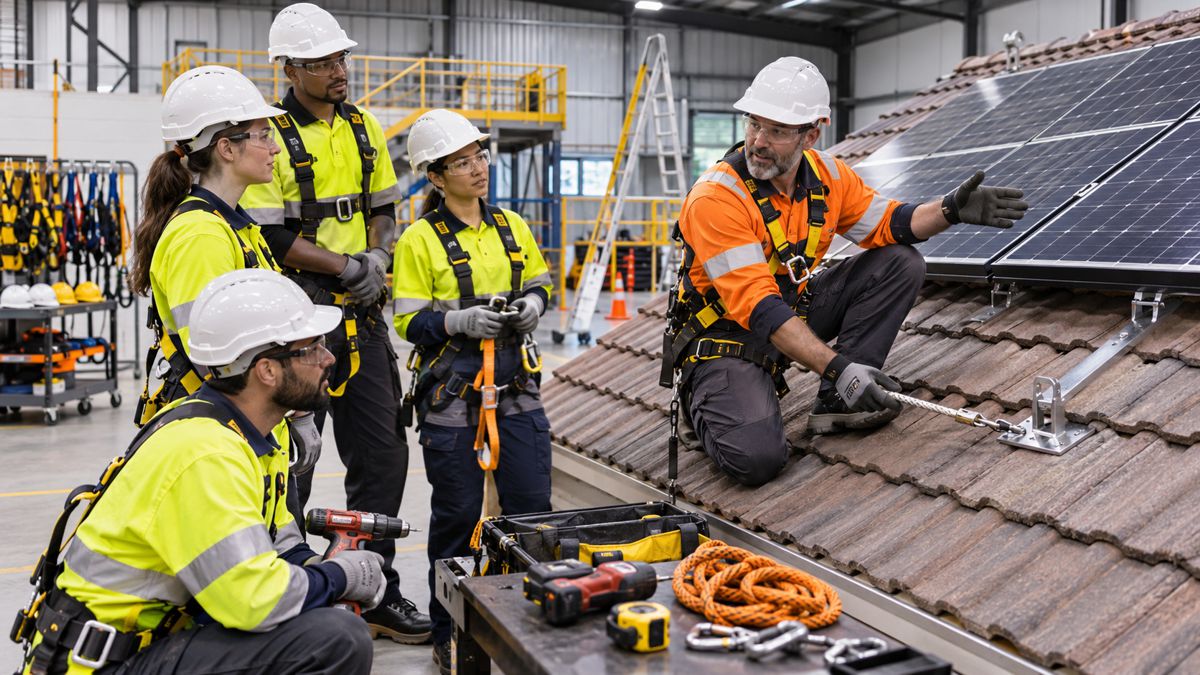
Fix that with a single plan. Hold a short briefing at the start of each shift, share a simple map of anchors, routes, and hazards, and name one person who can change the rules. When the roof changes, everyone hears about it at the same time. Sequence matters, too.
Roofers should finish edge protection and anchor work before electricians start pulling wire, and any change to that order goes through the person running the plan. Ask each crew what it needs from the other. A five-minute conversation costs less than a rework.
Rescue Access
Arresting a fall is only half the job. A suspended worker needs to be reached quickly, and on a large roof, help may be a long walk away. Decide who performs the rescue, what equipment they will use, and how they will reach the worker from the roof, a lift, or the ground. Then practice it.
Suspension is not a short-term problem, because a worker who cannot reach a footing can lose consciousness. Keep rescue equipment on the roof rather than in a truck, and make sure at least two people on every crew know how to use it.
Bringing It Together
Commercial solar work will keep growing, and so will the number of crews on rooftops. Good planning is not complicated. It just has to happen before the crew climbs up.
Protect the route up, watch the surface, respect the electrical hazards, place anchors with intent, control the loads, and keep both trades talking. Do that well, and everyone goes home at the end of the shift.