Infravision Brings Drone-Enabled Construction to India’s Transmission Expansion
Infravision has secured agreements covering approximately 25,000 kilometres of transmission lines in India as the country undertakes one of the world’s largest electricity network expansion programmes. The company is introducing an integrated drone-assisted and mechanised conductor stringing system, supported by a new Indian operation and plans for a specialist training facility.
The agreements provide a right of first refusal to undertake stringing work for major Indian transmission developers, rather than guaranteed contracts covering the entire distance. They nevertheless offer Infravision a substantial prospective pipeline in a market where construction capacity, difficult terrain and ambitious project schedules are placing increasing demands on transmission contractors.
The company’s technology uses drones to establish initial pulling lines between transmission structures, allowing mechanised equipment and specialist crews to complete the conductor installation. Infravision estimates that its integrated approach could reduce stringing labour requirements by approximately 50% compared with conventional Indian construction methods, although project-specific results will determine how consistently those savings can be achieved.
Briefing
- Infravision has secured right-of-first-refusal agreements covering approximately 25,000 km of potential transmission stringing work in India.
- India’s National Electricity Plan calls for more than 191,000 circuit-km of new transmission lines at 220 kV and above between 2022–23 and 2031–32.
- Drone-assisted stringing reduces the need for ground access and work at height during the initial installation of pulling lines.
- Infravision estimates potential stringing labour reductions of approximately 50%, subject to project conditions and construction methods.
- The company has established operations in Noida and plans a dedicated training facility for Indian transmission construction personnel.
India’s Transmission Construction Programme
India’s electricity network is undergoing a substantial expansion to accommodate growing industrial demand, new renewable energy developments and stronger connections between regional power systems. Much of the country’s new generating capacity is being developed far from its principal centres of electricity consumption, requiring long-distance transmission corridors and additional high-voltage infrastructure.
The government’s National Electricity Plan for Transmission, launched in October 2024, provides for more than 191,000 circuit-kilometres of additional transmission lines operating at 220 kV and above during the decade ending in 2031–32. The programme also includes approximately 1,270 GVA of additional transformation capacity and new high-voltage direct current connections, with an estimated investment opportunity exceeding ₹9.15 lakh crore across the transmission sector.
The network is already expanding rapidly. According to the Indian Ministry of Power’s July 2026 assessment, the country’s transmission system had reached approximately 509,000 circuit-kilometres by June 2026, with plans to expand to around 648,000 circuit-kilometres by 2032.
Constructing the towers and substations represents only part of this programme. Once transmission structures are erected, contractors must install conductors across successive spans while maintaining controlled tension, appropriate electrical clearances and protection for roads, railways, waterways and existing infrastructure beneath the route.
These operations become particularly demanding in mountainous regions, heavily cultivated areas and locations where temporary access roads or large construction compounds are difficult to establish. Stringing crews must also work around existing electricity networks, sometimes under strict operating windows and access restrictions.
Bringing Drones into Conductor Installation
Conventional transmission stringing begins with the installation of a lightweight pilot line between towers. This is used to draw progressively stronger pulling ropes through stringing blocks attached to the structures, eventually allowing the permanent conductors to be installed using mechanical pulling and tensioning equipment.
Depending on the terrain and construction methodology, the initial lines may be installed by ground crews, specialist access equipment or helicopters. Each method involves different costs, safety considerations and access requirements, particularly where structures are separated by steep ground, rivers or existing infrastructure.
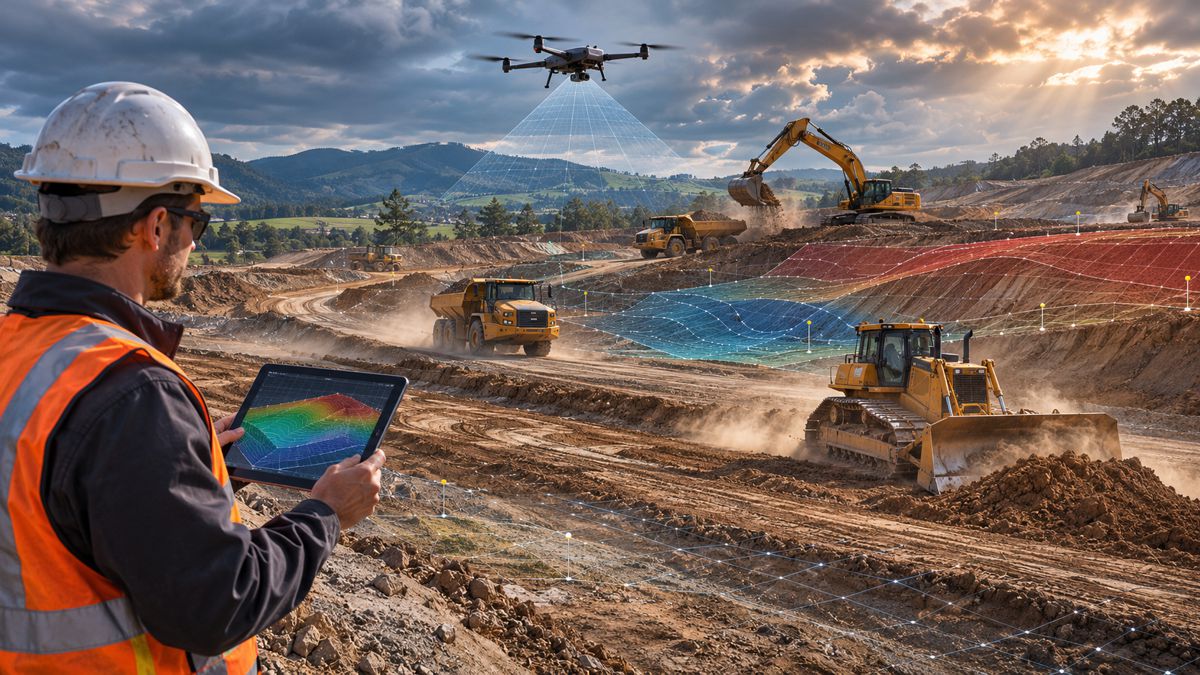
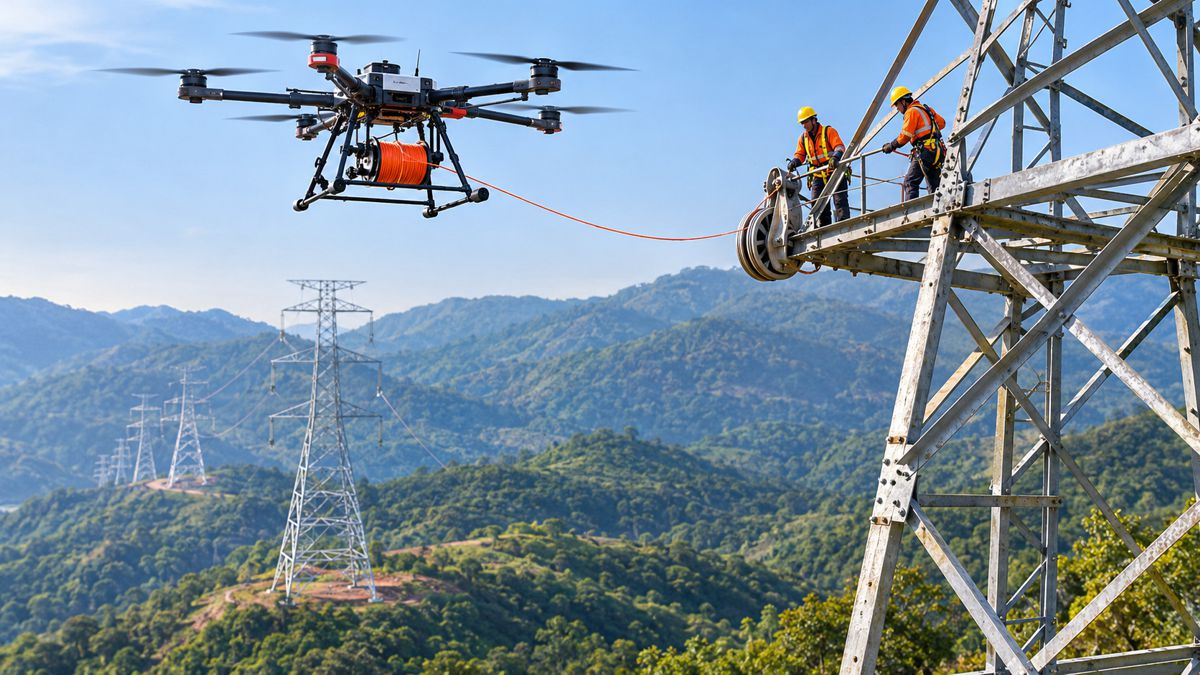
Infravision’s drone-enabled stringing system uses unmanned aircraft to carry lightweight lines between transmission structures. The lines are positioned through tower-mounted stringing blocks and subsequently connected to the mechanical equipment used to install the heavier pulling ropes and conductors.
The company’s integrated approach combines drones, specialised stringing hardware, mechanised ground equipment, software and experienced field crews. Pulling and tensioning operations remain under controlled mechanical supervision, while the aerial element reduces the need to move personnel and equipment through difficult terrain during the initial installation sequence.
A drone can carry a pilot line across a ravine, watercourse or road without requiring workers to traverse the ground beneath it. For long transmission corridors, avoiding repeated access arrangements and temporary works can simplify construction logistics, particularly where environmental restrictions or landowner permissions limit the available working space.
The aircraft does not replace the specialist engineering involved in conductor installation. Mechanical tensioning, conductor handling, sagging, clipping-in, jointing and final inspections remain essential, and the operation must be coordinated around the structural capacities of towers and temporary installation equipment.
Infravision is seeking to improve the complete stringing sequence by integrating the aerial and mechanical operations, rather than treating drone deployment as an isolated construction activity.
Experience on Operational Transmission Projects
Infravision’s expansion into India follows deployments in Australia and the United States, where the technology has been used on operational transmission projects involving difficult crossings and limited ground access.
An early application took place in 2020 through a partnership with Australian transmission operator Transgrid near Burrinjuck Gorge in New South Wales. The work involved stringing the 992 transmission line across steep and largely inaccessible terrain, including an 800-metre span with approximately 200 metres of elevation difference between structures.
Transgrid had been examining alternatives to helicopter stringing near existing power lines, where close-proximity flying presented safety concerns. Drones were selected after consideration of operational safety, environmental conditions and cost, allowing the pulling ropes to be installed without establishing conventional access throughout the crossing.
A more recent deployment involves Entergy’s Amite South Reliability Project in Louisiana, where Infravision is working alongside Utility Lines Construction Services (ULCS) on new 230 kV and 500 kV transmission infrastructure. The project extends for more than 150 miles between Plaquemine and Westwego, crossing farmland, marshland and numerous existing infrastructure corridors.
According to Infravision’s November 2026 project announcement, the drones are being used to install initial pulling lines through blocks mounted on the transmission structures. ULCS crews then follow with the heavier lines and permanent conductors, allowing some of the aerial work to proceed independently of other construction activities.
Entergy construction supervisors reported that rope installation time on certain sections had fallen by approximately 75%, from around seven days to one and a half days. The reported improvement applies to the initial rope installation operation rather than the overall transmission construction programme, but provides an indication of the time savings available when repeated manual activities can be replaced by a coordinated aerial process.
The Louisiana deployment also demonstrates a practical benefit beyond difficult terrain. By establishing pulling lines ahead of the main stringing crews, the drone team can prepare successive work sections while conventional construction equipment remains occupied elsewhere on the project.
Mechanisation and Construction Productivity
For its Indian operations, Infravision estimates that its integrated system could reduce stringing labour requirements by approximately 50% compared with conventional methods. The calculation concerns the conductor stringing operation, rather than the entire workforce involved in building a transmission line.
The potential saving comes from reducing labour-intensive installation activities and coordinating the movement of specialist equipment between work sections. Tower construction, conductor finishing, testing and commissioning remain necessary, while pulling and tensioning operations continue to require experienced personnel and careful supervision.
Productivity depends heavily on the organisation of the site. Pullers and tensioners must be correctly positioned, anchoring arrangements established and communication maintained between the crews operating at different ends of the stringing section. Even with the initial pilot line installed, unsuitable equipment positioning or interruptions elsewhere in the construction programme can hold up the subsequent work.
India presents a different economic environment from Australia and North America. Labour costs, equipment mobilisation, local contracting practices and the availability of experienced personnel will influence the comparative cost of mechanised and conventional methods. On long transmission corridors, specialist equipment and crews may be able to progress through successive work packages with relatively little interruption, while shorter or fragmented projects may offer fewer opportunities to recover mobilisation costs.
The advantages are also likely to vary with terrain. A transmission line crossing steep hillsides or densely developed infrastructure may offer greater opportunities to reduce access work than a straightforward corridor across open ground where traditional stringing methods are already efficient.
Infravision has not published independently verified comparative cost data or completed Indian project results supporting its estimated 50% labour reduction. Its earlier international deployments provide operational experience, but sustained performance across India’s varied transmission projects will depend on local execution and the integration of equipment and crews.
Establishing an Indian Construction Operation
Infravision’s agreements with major Indian developers cover approximately 25,000 kilometres of prospective stringing work, although the company has not identified the counterparties or disclosed individual project values. The right-of-first-refusal arrangements provide an opportunity to undertake work as projects progress, subject to subsequent commercial and operational decisions.
The distance also requires careful interpretation alongside the government’s national programme. India’s transmission targets are expressed in circuit-kilometres, which account for the circuits carried by a route, while Infravision has not specified an equivalent measurement basis for its agreement coverage.
To support its expansion, the company has established an Indian headquarters in Noida, with local engineering personnel, construction crews and management working alongside its international technology and operations teams. The business is led by Pradeep Kumar, whose background includes submarine engineering in the Indian Navy and leadership roles in major transmission construction.
“For our customers, the value is in how much work a crew can complete and how reliably we can deliver against the project schedule,” Kumar said.
“Over more than 20 years, my work has taken me from submarine engineering in the Indian Navy, including India’s first indigenous nuclear submarine project, to leading large-scale transmission construction. That experience taught me how much performance depends on well-designed systems, rigorous preparation, and people who know how to work together. India’s grid ambitions demand that we bring that same discipline to transmission construction at scale.”
The company is also establishing a dedicated training facility to develop personnel familiar with drone-enabled and mechanised stringing. The initiative is intended to expand the pool of specialist transmission construction workers rather than rely entirely on recruitment from an existing workforce already facing considerable project demand.
Operating an integrated system requires a combination of aviation knowledge, electrical safety awareness, mechanical equipment expertise and conventional transmission construction skills. Drone crews must coordinate closely with ground personnel, understand the hazards associated with nearby electricity infrastructure and work within the applicable aviation and site safety requirements.
Training local personnel also reduces dependence on the repeated mobilisation of international specialists. As crews accumulate experience with particular equipment, tower configurations and operating conditions, they can refine working methods and develop the consistency needed for larger construction programmes.
The decision to build a permanent Indian operation suggests that Infravision is preparing for sustained participation in the market rather than a series of isolated technology demonstrations. The eventual scale of that operation will depend on project awards and the ability to maintain a sufficiently continuous construction workload.
Scaling Transmission Construction in India
India offers Infravision an opportunity to apply drone-assisted and mechanised stringing across a transmission programme extending far beyond the difficult individual crossings where the technology first demonstrated its advantages.
The company’s experience in Australia and the United States has established practical applications for aerial pilot-line installation, while its integrated system seeks to carry those efficiencies into the wider conductor stringing operation. India’s large project pipeline provides the setting for repeated deployment across different terrain, contractors and construction conditions.
Conventional stringing methods will continue to have a place, particularly where access is straightforward and existing equipment and labour arrangements remain economical. Mechanised alternatives must demonstrate their value through completed work, reliable equipment utilisation and measurable construction performance.
For India’s transmission developers, the immediate challenge remains delivering thousands of kilometres of high-voltage infrastructure within demanding construction schedules. Infravision is positioning its equipment and newly established Indian workforce to undertake a share of that work, with the first completed domestic projects providing the clearest measure of how effectively the approach translates to local conditions.
Key Industry Questions
- What agreements has Infravision secured in India? Infravision has secured right-of-first-refusal agreements with major Indian transmission developers covering approximately 25,000 kilometres of prospective stringing work. These arrangements do not constitute guaranteed construction awards.
- How does drone-assisted transmission stringing work? Drones carry lightweight pilot lines between transmission structures, positioning them through stringing blocks. Mechanical pulling and tensioning equipment subsequently installs stronger ropes and the permanent electrical conductors.
- Can drones install high-voltage conductors directly? Infravision’s drones primarily perform the initial aerial line installation. Heavy conductor installation remains a mechanical operation requiring specialised ground equipment and experienced construction crews.
- How much labour could the technology save? Infravision estimates potential stringing labour reductions of approximately 50% compared with conventional Indian methods. Actual savings will depend on project conditions, construction practices and equipment utilisation.
- Where is drone-enabled stringing most useful? Applications include mountainous terrain, river crossings, environmentally sensitive corridors and locations intersecting existing roads or electricity infrastructure. The method can reduce ground access requirements during initial line installation.
- Has the technology been demonstrated on operational projects? Yes. Infravision has undertaken transmission stringing work in Australia and the United States, including Transgrid’s Burrinjuck Gorge crossing and Entergy’s Amite South project in Louisiana.
- What transmission infrastructure is India planning to build? India’s National Electricity Plan calls for more than 191,000 circuit-kilometres of additional transmission lines at 220 kV and above between 2022–23 and 2031–32, alongside substantial substation and interconnection development.
- Will Infravision train Indian construction workers? The company is establishing a dedicated training facility to develop local expertise in drone operations, mechanised stringing, equipment coordination and specialist transmission construction practices.
Strategic Takeaways
- Construction efficiency: Integrating drone operations with mechanical stringing equipment offers opportunities to reduce labour-intensive activities and improve coordination between construction crews.
- Project economics: The commercial advantage of mechanisation will depend on terrain, labour costs, equipment utilisation and the continuity of available work.
- Market access: Infravision’s right-of-first-refusal agreements provide a substantial prospective pipeline, although individual awards remain subject to further decisions.
- Domestic capability: Establishing local engineering and training operations could support more consistent deployment while reducing dependence on international specialist personnel.
- Operational evidence: Completed Indian projects will provide the basis for comparing mechanised and conventional stringing methods across different construction conditions.