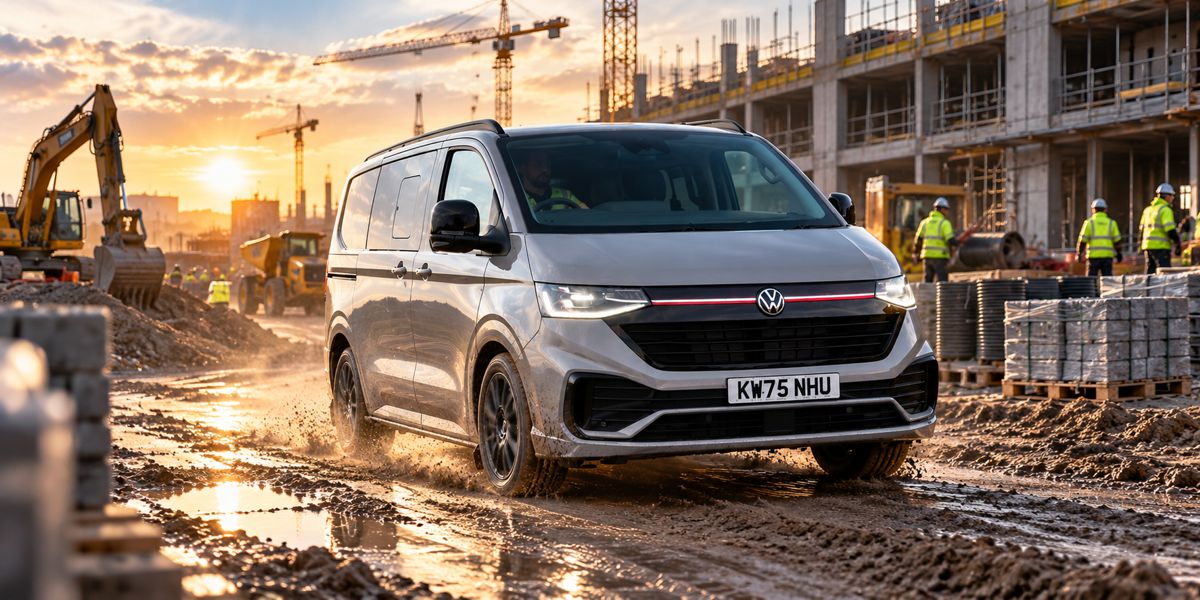
Volkswagen Transporter Takes Van of the Year as Practicality Returns
Volkswagen Commercial Vehicles says its seventh-generation Transporter has been named Van of the Year at the 2026 News UK Motor Awards in London, giving the latest version of one of Britain’s longest-established commercial vehicle names an early endorsement in a particularly competitive part of the van market.
The judges focused less on novelty than on the numbers that determine whether a van works as a working vehicle. The new Transporter offers up to 6.8 m³ of load volume in long-wheelbase form, a diesel payload of around 1.2 tonnes and towing capacity of up to 2.8 tonnes. Volkswagen has also broadened the range beyond conventional combustion powertrains, with plug-in hybrid and fully electric versions now forming part of the UK line-up.
That gives operators considerably more choice over how the vehicle fits into a fleet. Diesel remains available for conventional long-distance and heavy-duty work, while hybrid and electric versions can serve operations built around shorter routes, depot charging or urban driving.
Briefing
- Volkswagen Commercial Vehicles says the seventh-generation Transporter has been named Van of the Year at the 2026 News UK Motor Awards.
- The long-wheelbase Transporter provides up to 6.8 m³ of load volume.
- Diesel models offer payload capacity of around 1.2 tonnes and towing capacity of up to 2.8 tonnes.
- The UK range includes turbodiesel, plug-in hybrid and fully electric powertrains.
- Volkswagen’s UK ownership package includes five years of warranty and roadside assistance alongside servicing and MOT provision, subject to programme terms.
Payload and Load Space
The dimensions reveal where Volkswagen has concentrated much of the engineering effort. The short-wheelbase Transporter measures 5,050 mm long, while the long-wheelbase version extends to 5,450 mm. Maximum internal load width is 1,777 mm, with 1,392 mm available between the wheel arches, allowing Euro pallets to be accommodated more easily.
Cargo volume is 5.8 m³ in the short-wheelbase model and 6.8 m³ in the long-wheelbase version. Volkswagen has also announced a high-roof configuration capable of increasing capacity to 9 m³. The long-wheelbase load compartment extends beyond three metres, while a load-through bulkhead can increase usable load length to 3,450 mm on suitable configurations.
These remain conventional commercial-vehicle measurements, but they are still central to fleet purchasing. Connectivity, driver assistance and electrification have added new criteria to procurement without changing the basic requirement to carry the tools, equipment or materials needed for the job.
Diesel, Hybrid and Electric
Commercial fleets rarely operate every vehicle on the same duty cycle, making the Transporter’s three propulsion routes useful for quite different applications. Diesel remains suited to fleets covering substantial distances, towing equipment or operating where charging access is limited. The e-Transporter provides a fully electric alternative, with Volkswagen quoting a combined WLTP range of up to 225 miles depending on specification.
Plug-in hybrid models occupy the middle ground for operators whose daily work combines shorter electrically driven journeys with longer routes where charging cannot always be guaranteed. Payload varies with propulsion, with Volkswagen quoting up to 1.28 tonnes for some diesel configurations and up to one tonne for fully electric versions. That difference deserves attention from fleets carrying consistently heavy loads, particularly in construction, utilities and mobile service operations.
A mixed fleet could therefore use diesel Transporters for higher-mileage or heavier work while deploying electric versions on predictable depot-based routes, without moving drivers and fleet managers between completely different vehicle platforms.
The Ownership Package
The award judges also drew attention to something less visible than payload or drivetrain: Volkswagen’s UK aftersales package. Under its current 5 Plus Promise, the Transporter comes with five years’ warranty and roadside assistance, together with a servicing and MOT package. Volkswagen estimates the package’s value at up to £3,500 for combustion-engined vehicles, although terms, mileage limits and exclusions apply.
Rob Gill, Motors Editor for The Sun, highlighted that package when explaining the judges’ decision: “The Transporter is our ‘Van of the Year’ – it’s a no-brainer, really. It’s cheaper than the Ford, comes with a five-year care package (servicing, MoT, roadside, assistance), a five-year warranty (Ford’s is three years) plus more kit. And the top-spec Sportline looks fantastic, too.”
For commercial operators, warranty and servicing provision feed into the same calculations as scheduled maintenance, downtime, roadside support, depreciation, energy or fuel consumption and financing. Purchase price remains important, but it is only one component of the cost of keeping a working vehicle on the road.
A Familiar Name in a Changing Market
The Transporter name has been part of Volkswagen’s commercial vehicle range for more than seven decades. The latest generation carries that familiarity into a market where established manufacturers are expanding their propulsion choices while competing with new electric vehicle platforms.
The previous News UK Motor Awards illustrate that movement. The Kia PV5 Cargo, Kia’s first entry into the electric light-commercial market, received The Sun’s Van of the Year award in 2025. Volkswagen is approaching the transition differently, retaining diesel while adding electric and plug-in hybrid alternatives around the same commercial vehicle family.
Eve Tyers, Head of Marketing at Volkswagen Commercial Vehicles, said: “The Transporter has always been a reliable and versatile vehicle, and with the new Transporter, there really is a vehicle to suit every business need – it’s great to have this and the vehicle’s generous specification recognised by the esteemed News UK judging panel. Winning the ‘Van of the Year’ award is a great validation for the quality of products we deliver to keep our customers safe and comfortable on the road.”
The award gives the new generation useful recognition, but fleets will ultimately judge the Transporter through far more prosaic measures. Payload, usable load space, towing ability, downtime and operating costs will determine how well it performs once the trophies have been put away.
Key Industry Questions
- What is the load capacity of the new Volkswagen Transporter? The long-wheelbase Transporter provides up to 6.8 m³ of cargo volume, while the short-wheelbase version provides 5.8 m³. Volkswagen has also announced a high-roof version offering up to 9 m³.
- How much can the Volkswagen Transporter carry? Volkswagen quotes payload capacity of up to 1.28 tonnes for certain diesel configurations and up to one tonne for fully electric versions. Actual payload varies according to model, equipment and configuration.
- What is the Transporter’s maximum towing capacity? Diesel Transporter models can tow up to 2.8 tonnes, depending on specification.
- Is the Volkswagen Transporter available as an electric van? Yes. The Transporter range includes the fully electric e-Transporter alongside turbodiesel and plug-in hybrid versions.
- What is the range of the e-Transporter? Volkswagen quotes a combined WLTP range of up to 225 miles, depending on model and specification. Real-world range will vary according to load, temperature, driving conditions and other factors.
- Why does payload differ between diesel and electric vans? Battery packs add substantial vehicle mass. Because a commercial vehicle must remain within its permitted gross vehicle weight, that additional mass can reduce the payload available for cargo, equipment and occupants.
- Does Volkswagen provide an extended ownership package with the Transporter? Volkswagen’s current UK 5 Plus Promise includes warranty, servicing, MOT and roadside assistance provisions, although precise coverage and limits depend on the applicable terms.
- Why are multiple powertrains useful for commercial fleets? Different commercial operations have different duty cycles. Electric propulsion can work particularly well for predictable routes with reliable charging, while diesel can remain practical for longer distances, heavier duties and operations where charging infrastructure is unavailable.
Strategic Takeaways
- Payload, load dimensions and towing capability remain central purchasing criteria despite the increasing technological sophistication of commercial vehicles.
- Offering diesel, plug-in hybrid and electric versions allows fleets to match propulsion to individual duty cycles rather than applying one drivetrain across every vehicle.
- Electric van payload needs to be considered alongside range because battery mass affects the weight available for equipment and cargo.
- Warranty, servicing and roadside assistance can materially affect whole-life fleet costs and vehicle availability.
- The Transporter is entering a van market where established manufacturers increasingly compete with new electric platforms as well as traditional rivals.