AEye and NVIDIA Halos Advance Safety Standards in Physical AI Systems
The rapid convergence of artificial intelligence, automation, and real-world infrastructure is reshaping how transport networks, vehicles, and industrial systems are designed and deployed. Yet, as these technologies move from controlled environments into live roads, cities, and construction sites, one issue continues to dominate boardroom discussions and regulatory frameworks alike: safety.
AEye has announced its participation in the NVIDIA Halos AI Systems Inspection Lab, a move that signals a broader shift in how the industry approaches the validation of AI-driven systems. Developed by NVIDIA, the Halos framework aims to unify fragmented safety practices into a single, end-to-end system that spans the entire lifecycle of AI deployment.
For infrastructure professionals, transport planners, and policymakers, this is more than a technical partnership. It reflects a growing recognition that scalable AI in the physical world depends not just on performance, but on demonstrable, standardised safety at every level.
A New Era of Integrated AI Safety
The launch of the NVIDIA Halos AI Systems Inspection Lab represents a notable evolution in safety governance. Traditionally, safety in transport and infrastructure systems has been handled through a patchwork of standards, covering everything from functional safety to cybersecurity and software validation. While effective in isolation, these frameworks often struggle to keep pace with AI systems that continuously learn, adapt, and interact with complex environments.
By contrast, the Halos approach integrates these elements into a unified architecture. It combines hardware validation, software assurance, AI model testing, and simulation-based verification into a single safety pipeline. Crucially, the lab is accredited by the ANSI National Accreditation Board, providing an internationally recognised benchmark for compliance.
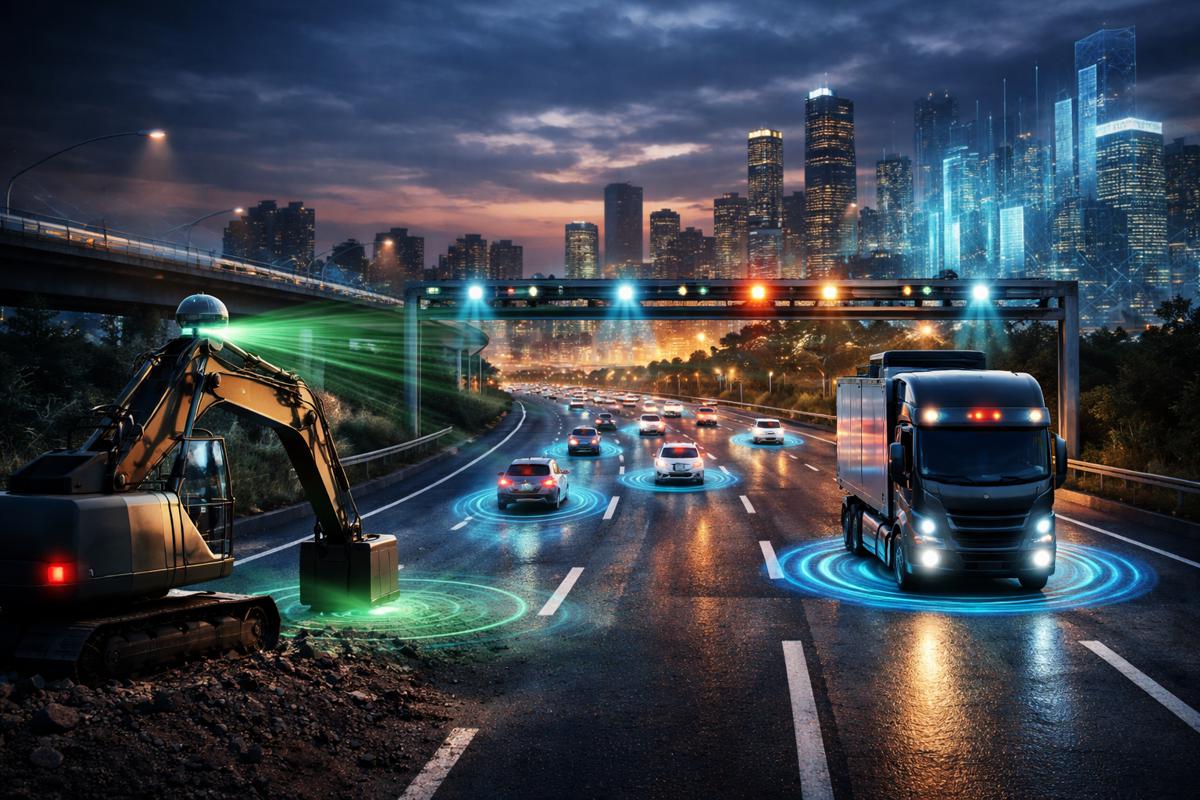
This matters because AI is no longer confined to digital applications. In transport and construction, it directly influences physical outcomes. From autonomous haul trucks in mining operations to smart traffic management systems in urban corridors, the consequences of failure are tangible and immediate. A unified safety framework helps ensure that these systems behave predictably under real-world conditions.
AEye Participation
AEye’s decision to join the Halos inspection lab reflects its strategic positioning within the perception technology market. Known for its long-range lidar systems, the company focuses on enabling machines to interpret their surroundings with high precision, a capability that sits at the core of autonomous mobility and intelligent infrastructure.
Its flagship Apollo lidar platform, capable of detecting objects at distances of up to one kilometre, is designed for applications where early detection and rapid decision-making are critical. These include high-speed motorway environments, rail crossings, and large-scale industrial sites.
Matt Fisch, CEO of AEye, emphasised the importance of safety in scaling AI systems: “Safety is foundational to scaling physical AI. Our participation in the NVIDIA Halos program reinforces our commitment to delivering perception solutions that meet the highest standards of functional safety, validation rigor, and ecosystem interoperability. By aligning with NVIDIA’s full-stack safety architecture, we are helping our customers accelerate the deployment of advanced driver assistance and autonomous systems with confidence.”
For the construction and infrastructure sectors, this alignment is significant. Perception systems are increasingly being embedded into equipment, vehicles, and monitoring platforms. Ensuring that these systems operate reliably across diverse environments, from congested urban streets to remote construction sites, is essential for both safety and operational efficiency.
The Role of Full Stack Safety in Autonomous Systems
The concept of full stack safety, as embodied by NVIDIA Halos, addresses one of the most persistent challenges in AI deployment: the gap between component-level validation and system-level assurance.
In traditional engineering, components are tested individually before being integrated into larger systems. However, AI systems behave differently. Their performance is shaped not only by individual components, but also by the interactions between hardware, software, and data inputs. This creates a level of complexity that conventional validation methods struggle to address.
By integrating simulation tools, real-world testing, and continuous validation processes, the Halos framework seeks to bridge this gap. It allows developers to test AI systems under a wide range of scenarios, including edge cases that may rarely occur in practice but have significant safety implications.
For infrastructure projects, this has far-reaching implications. Consider smart motorways equipped with AI-driven traffic management systems. These systems must respond to unpredictable events such as sudden congestion, accidents, or adverse weather conditions. A full stack safety approach ensures that responses are not only technically accurate, but also compliant with regulatory and operational requirements.
Interoperability Across a Growing Ecosystem
One of the key objectives of the NVIDIA Halos AI Systems Inspection Lab is to validate interoperability between different technologies within the AI ecosystem. This is where AEye’s involvement becomes particularly relevant.
The company’s lidar solutions have already been validated on platforms such as NVIDIA DRIVE AGX Orin and demonstrated on NVIDIA DRIVE AGX Thor. By participating in the Halos programme, AEye can further ensure that its systems integrate seamlessly with NVIDIA’s broader hardware and software stack.
This level of interoperability is critical for large-scale infrastructure deployments. Modern transport systems are increasingly composed of interconnected components, including sensors, edge computing devices, cloud platforms, and control systems. Ensuring that these components work together reliably reduces the risk of system failures and simplifies the process of regulatory approval.
Moreover, it enables a more modular approach to system design. Infrastructure operators can select best-in-class components from different suppliers, confident that they will function together within a validated safety framework.
Regulatory Alignment and Industry Implications
As governments around the world grapple with the implications of AI in physical systems, regulatory frameworks are evolving rapidly. In Europe, for example, the EU AI Act is introducing new requirements for high-risk AI applications, including those used in transport and infrastructure. Similar initiatives are underway in North America and Asia.
The NVIDIA Halos AI Systems Inspection Lab is designed to help companies navigate this complex regulatory landscape. By providing a structured approach to safety validation, it enables organisations to demonstrate compliance with multiple standards simultaneously.
For policymakers, this offers a potential pathway towards harmonised regulations. Instead of developing separate frameworks for each aspect of AI safety, regulators can build on integrated systems that address functional safety, cybersecurity, and AI integrity in a cohesive manner.
From a commercial perspective, this also reduces barriers to market entry. Companies that can demonstrate compliance through recognised frameworks are better positioned to scale their technologies across different regions.
Infrastructure Applications Beyond Automotive
While much of the discussion around AI safety focuses on autonomous vehicles, the implications extend far beyond the automotive sector. In construction, for instance, AI-driven perception systems are being used to enhance site safety, optimise equipment utilisation, and monitor project progress in real time.
Similarly, in rail and port operations, AI is enabling more efficient traffic management, predictive maintenance, and improved safety monitoring. These applications rely on the same underlying technologies as autonomous vehicles, including sensors, machine learning algorithms, and edge computing platforms.
AEye’s participation in the Halos programme therefore has relevance across a wide range of infrastructure domains. By ensuring that its perception systems meet rigorous safety standards, the company is contributing to the broader adoption of AI in critical infrastructure.
Building Confidence in Physical AI Deployment
As AI continues to move into the physical world, trust will be a defining factor in its adoption. Stakeholders, from regulators and investors to operators and the public, need assurance that these systems are safe, reliable, and accountable.
The collaboration between AEye and NVIDIA represents a step towards building that confidence. By aligning with a comprehensive safety framework, AEye is not only enhancing its own technology, but also contributing to the development of industry-wide standards.
Looking ahead, the success of initiatives like the NVIDIA Halos AI Systems Inspection Lab will depend on widespread adoption across the ecosystem. If successful, it could set a new benchmark for AI safety, shaping the future of transport, construction, and infrastructure systems worldwide.
In a sector where the margin for error is measured in human lives and economic impact, that’s not just desirable. It’s essential.