China’s Tethered UAV Firefighting Systems Turn Drones into Aerial Infrastructure
Last year, we explored the idea of drone swarms in wildfire response, outlining a future where coordinated fleets of UAVs could attack fires early, repeatedly and with increasing precision. It was a compelling vision, built around mobility, autonomy and scale.
Now, developments emerging from China suggest a different, more grounded direction is taking shape. Rather than relying solely on free-flying swarms, engineers are deploying truck-mounted drone systems that combine autonomous UAVs with tethered aerial platforms, creating an approach that prioritises endurance, control and immediate operational readiness.
It’s a shift that doesn’t replace the swarm concept, but reframes it. Instead of chasing range and autonomy alone, these systems focus on delivering sustained aerial firefighting capability exactly where it’s needed.
Briefing
- China is advancing vehicle-mounted drone firefighting systems with integrated deployment infrastructure
- Systems combine tethered UAVs for continuous operation with untethered drones for flexible response
- Tethering enables unlimited flight time, stable communications and potential hose-fed suppression
- The approach prioritises reliability and persistence over range and autonomy
- Marks a broader shift toward containerised, deployable emergency response systems
A New Model for Firefighting UAV Deployment
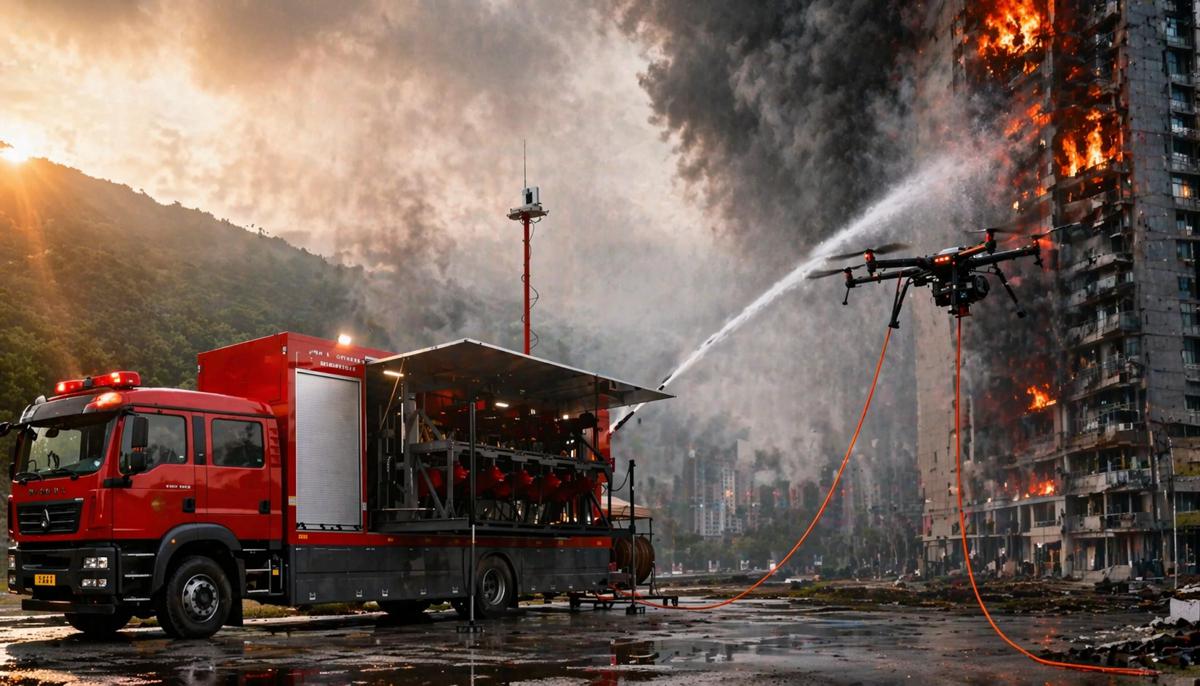
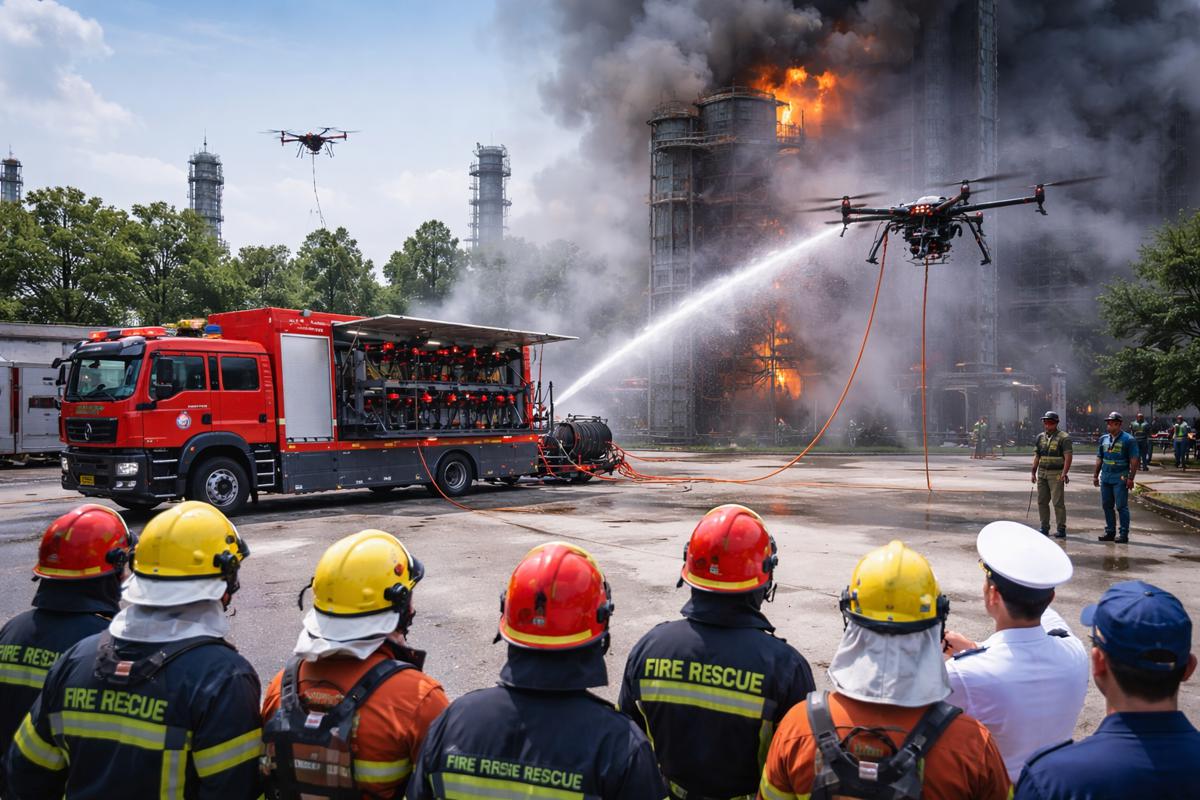
Across several recent demonstrations and product showcases, Chinese manufacturers and research bodies have introduced mobile drone command vehicles designed specifically for emergency response. These platforms typically consist of a heavy-duty truck fitted with a containerised module housing multiple UAVs, control systems, power supply and deployment infrastructure.
In many cases, these systems are described as rapid deployment units, capable of arriving on-site and launching drones within minutes. They are equipped with a mix of reconnaissance UAVs and firefighting drones, alongside payload systems that include extinguishing agents or suppression charges.
This level of integration represents a clear departure from the more fragmented deployment models seen elsewhere. Instead of transporting drones separately and assembling operations in the field, the entire system is pre-configured as a self-contained operational asset.
The Role of the Tether in Modern Firefighting Drones
One of the defining characteristics of these Chinese systems is the use of tethered UAVs. At first glance, this might seem counterintuitive in a field that has largely focused on maximising drone autonomy. However, in firefighting applications, the tether introduces several critical advantages.
Endurance without compromise
Battery limitations have long constrained drone effectiveness in emergency response. Even high-performance UAVs struggle to maintain meaningful payload operations for extended periods, particularly under the demanding conditions of heat, smoke and turbulence.
Tethered drones eliminate this constraint by drawing power directly from the ground vehicle. This allows them to remain airborne for extended durations, effectively transforming them from short-term tools into persistent aerial assets.
Stable communications in complex environments
Firegrounds are notoriously difficult environments for wireless communication. Dense smoke, structural interference and electromagnetic noise can all disrupt signal reliability.
By maintaining a physical connection to the command vehicle, tethered drones benefit from stable, high-bandwidth data transmission, ensuring continuous video feeds and precise control. This is particularly valuable in urban or industrial settings where situational awareness is critical.
Continuous suppression capability
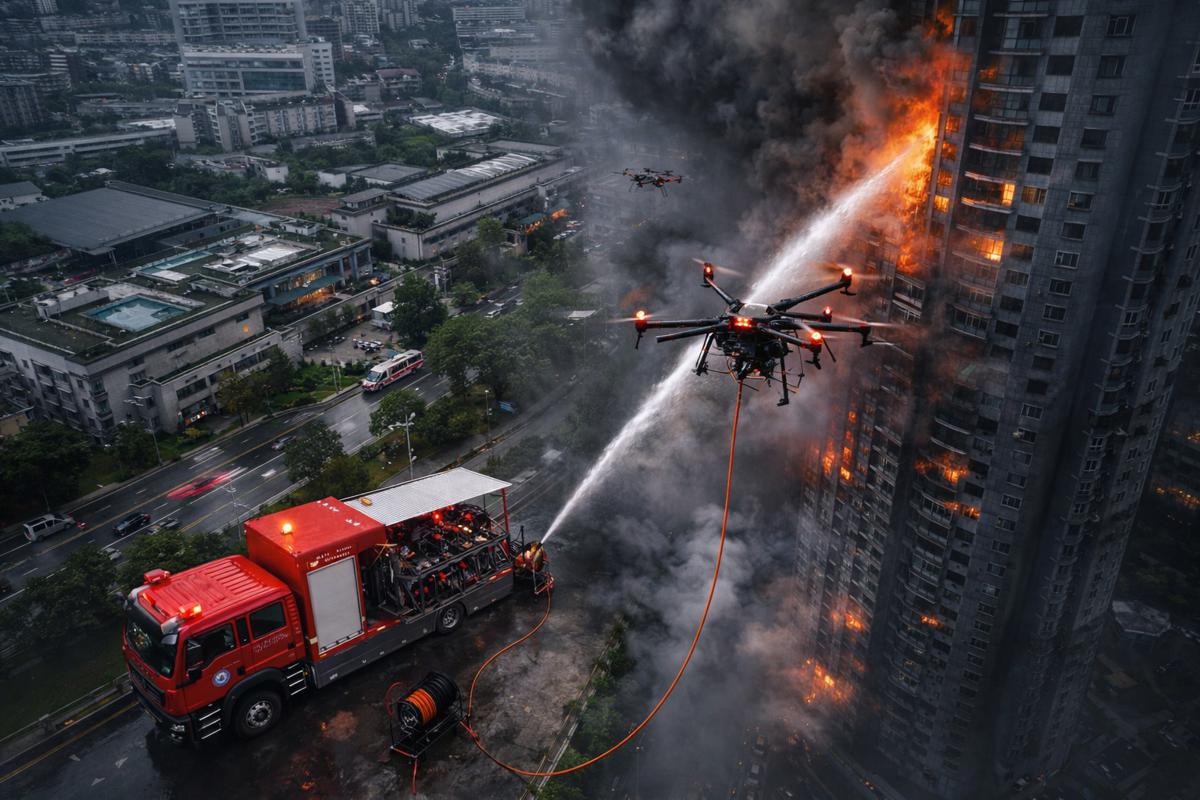
In some configurations, the tether does more than deliver power and data. It can also serve as a conduit for fire suppression agents, enabling drones to operate as elevated delivery systems for water or foam.
This approach effectively turns the UAV into a flying extension of ground-based firefighting equipment, capable of maintaining a continuous stream of suppressant at height. For high-rise fires or complex industrial incidents, this offers a level of sustained intervention that battery-powered drones simply cannot match.
Combining Flexibility with Persistence
The integration of tethered and untethered drones within a single platform creates a hybrid operational model.
Tethered UAVs provide:
- Continuous overwatch
- Persistent suppression capability
- Reliable communications
Untethered drones, meanwhile, offer:
- Rapid deployment across wider areas
- Flexible targeting of hotspots
- Delivery of extinguishing payloads or charges
Together, these systems create a layered response capability that balances mobility and endurance, allowing operators to adapt to different phases of an incident.
Industrialising Emergency Robotics
What distinguishes these developments is not just the technology itself, but the way it is being packaged and deployed.
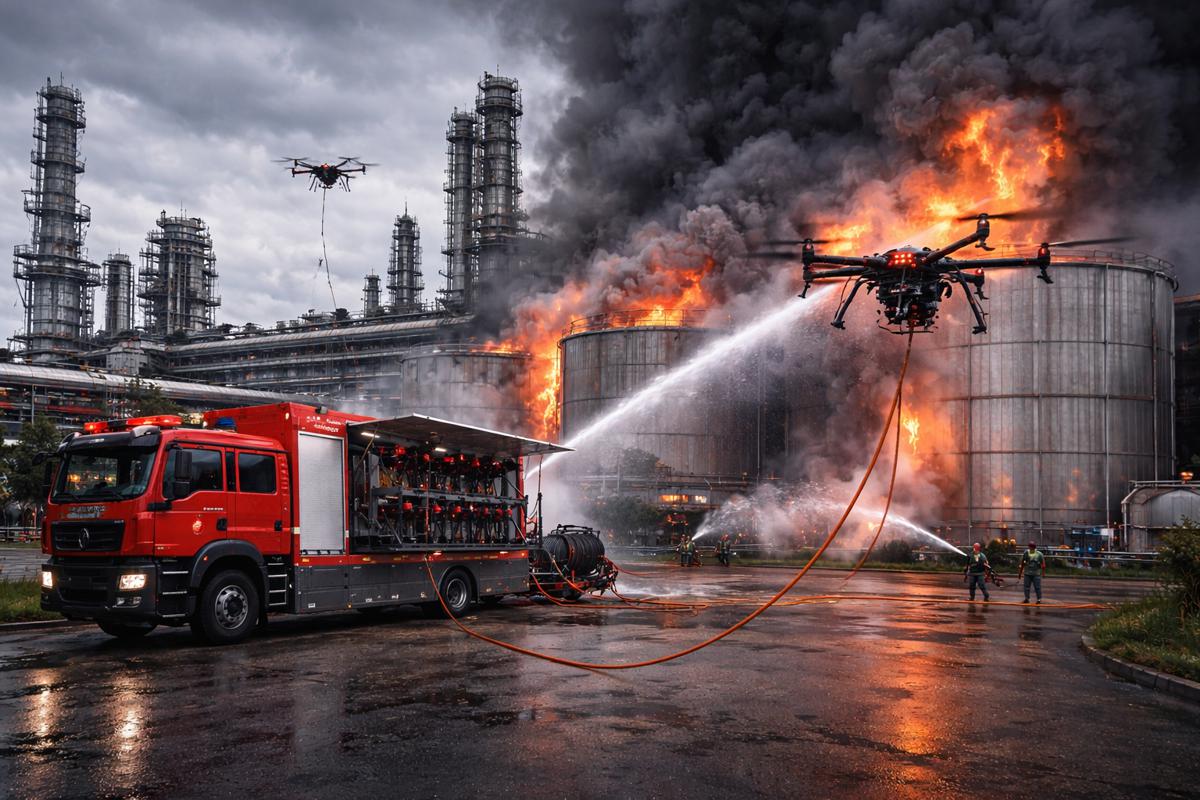
China’s approach reflects a broader trend toward industrialising robotics for emergency response. Rather than focusing on individual devices, manufacturers are building integrated systems that combine hardware, software and logistics into a single deployable unit.
Several Chinese companies are active in this space, including:
- China Aerospace Science and Industry Corporation, which has been involved in advanced unmanned systems and integrated response technologies
- Norinco, known for its work in specialised vehicles and robotics
- Specialist UAV manufacturers such as EHang and MMC UAV, which have explored firefighting and heavy-lift drone applications
While not all systems are directly attributed to a single company, they often emerge from collaborative ecosystems involving manufacturers, research institutes and municipal emergency services.
Applications Beyond Wildfires
While early discussions around drone swarms focused heavily on wildfires, these tethered hybrid systems are clearly designed for a broader range of scenarios.
- Urban firefighting: High-rise buildings present significant challenges for traditional firefighting methods. Tethered drones can provide sustained suppression at height, reducing reliance on ladder trucks and improving access to upper floors.
- Industrial and petrochemical sites: Facilities with hazardous materials require remote intervention capabilities. Drones can operate in environments that would be dangerous for human crews, delivering suppressant while maintaining a safe distance.
- Mountainous and remote terrain: In areas where access is limited, mobile drone units can be deployed quickly, providing immediate aerial support without the need for extensive infrastructure.
A Different Set of Trade-offs
The use of tethered systems introduces clear limitations. Range is restricted, and deployment requires proximity to the incident. However, these constraints are balanced by significant gains in reliability and operational effectiveness.
This reflects a broader engineering philosophy: optimising for real-world conditions rather than theoretical capability.
In many firefighting scenarios, particularly in urban and industrial contexts, the ability to maintain continuous suppression in a fixed area is more valuable than the ability to roam freely over long distances.
Implications for Infrastructure and Emergency Planning
The emergence of these systems has implications that extend beyond firefighting technology.
- Integration into emergency fleets: Mobile drone units are likely to become standard components of modern emergency response fleets, alongside traditional fire engines and specialised vehicles.
- Design considerations for buildings: As aerial suppression capabilities evolve, building design may begin to incorporate features that facilitate drone access, particularly in dense urban environments.
- Expansion of robotic ecosystems: The move toward integrated systems suggests a future where robotics are embedded across multiple layers of infrastructure, from construction and maintenance to emergency response.
A Pragmatic Evolution of Drone Firefighting
The vision of autonomous drone swarms remains compelling, particularly for large-scale wildfire management. But the systems now emerging from China demonstrate a more immediate, pragmatic evolution.
By combining tethered endurance with autonomous flexibility, these platforms deliver a form of aerial firefighting that is less about technological ambition and more about operational reliability.
It’s a reminder that innovation doesn’t always follow the most obvious path. Sometimes, it takes a step back from autonomy to achieve something more valuable — a system that can be deployed quickly, operate continuously and deliver results when it matters most.
In that sense, tethered drone firefighting isn’t a compromise. It’s a recalibration, grounded in the realities of the fireground and focused firmly on what works.