Nikon and Aeva Advance Smart Manufacturing With Laser Radar
Modern manufacturing lives or dies by precision. Whether assembling aircraft fuselage sections, welding vehicle body shells or validating energy infrastructure components, the margin for error keeps shrinking. Tolerances are tighter, production speeds are faster, and labour shortages continue to push factories toward automation. In that environment, metrology is no longer a back-room quality check. It has become a frontline productivity tool.
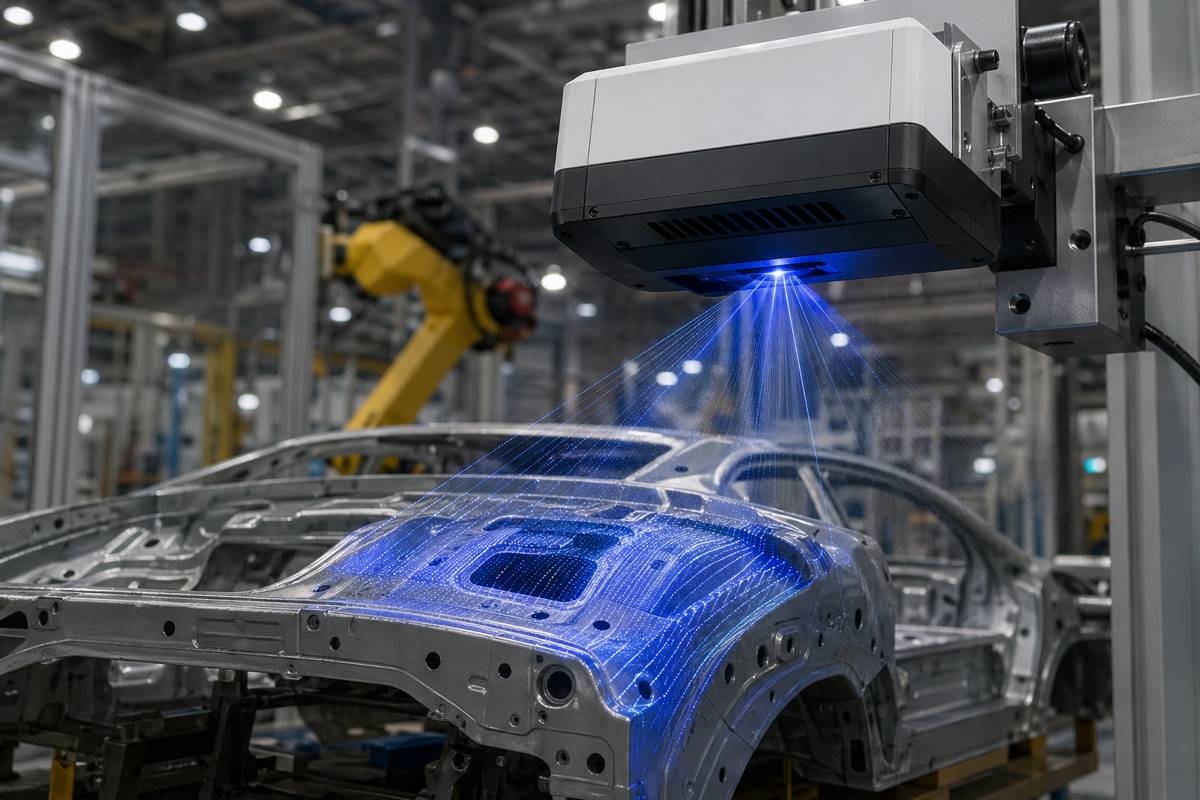
That is why the commercial deployment of the new Nikon APDIS MV5X Laser Radar system carries weight far beyond a routine product launch. Developed by Nikon Corporation and powered by sensing technology from Aeva Technologies, the system blends advanced non-contact measurement with robotic inspection capabilities aimed at high-volume industrial operations. It signals a wider shift taking place across automotive, aerospace, heavy industry and energy production, where intelligent inspection systems are becoming as important as the machines that make the products.
The companies confirmed that Aeva’s Eve high-precision sensor technology is now integrated into Nikon’s new MV5X Laser Radar under a multi-year production agreement. That arrangement suggests more than a one-off collaboration. It points to a deeper industrial partnership focused on scaling next-generation inspection tools for global manufacturers.
Briefing
- Nikon has begun commercial deployment of its APDIS MV5X Laser Radar inspection system.
- The platform uses Aeva’s Eve high-precision sensor technology.
- Target industries include automotive, aerospace and energy manufacturing.
- The system is designed for faster, more accurate and automated non-contact measurement.
- The deal highlights growing demand for intelligent metrology in high-throughput factories.
Precision Inspection Moves Centre Stage
For years, quality assurance often sat downstream from production. Components were made first, checked later, and defects corrected at significant cost. Today, manufacturers increasingly want real-time inspection embedded into the production process itself. That reduces scrap, avoids delays and improves traceability across entire supply chains.
Laser radar systems play a valuable role in that evolution. Unlike contact probes or slower manual methods, they can inspect complex geometries at distance, capture dimensional data rapidly and verify large assemblies without physically touching the product. For industries building vehicle frames, aircraft structures, turbine housings or energy modules, that matters enormously.
Nikon’s APDIS range has already established a presence in industrial measurement. The new MV5X model appears to build on that installed base with improved automation, higher throughput and a smaller hardware footprint. In practical terms, that means easier integration into robotic cells, smarter factory layouts and faster return on capital investment.
Speed and Accuracy
Manufacturers are under pressure from every angle. Electric vehicle programmes require new architectures and battery production lines. Aerospace firms are dealing with supply chain disruption while trying to increase output. Energy projects demand large fabricated components that must meet strict standards. At the same time, labour markets remain tight in many industrial economies.
Against that commercial reality, faster inspection is not merely convenient. It can be the difference between hitting output targets or missing them. If measurement systems create bottlenecks, the entire plant feels it. If they operate seamlessly, throughput rises and defects fall.
According to the companies, the MV5X delivers enhanced measurement accuracy, quicker data acquisition and a more compact design. Those three factors are especially relevant because factories need systems that are not only precise, but practical to deploy at scale.
Aeva Pushes Beyond Automotive Roots
Aeva Technologies is best known in many markets for its work in next-generation lidar and perception systems, particularly for autonomous mobility applications. Its move deeper into industrial automation reflects a wider trend among sensor developers seeking revenue streams beyond transport.
The company’s Eve sensor technology is based on Frequency Modulated Continuous Wave, or FMCW, sensing. Unlike conventional time-of-flight approaches, FMCW methods can offer advantages in measuring velocity and distance simultaneously while improving resilience to interference. Those characteristics have drawn attention in both automotive autonomy and industrial environments.
Factories can be noisy places from an optical standpoint. Reflective surfaces, moving machinery, dust, variable lighting and multiple scanning systems can all create complications. More robust sensing technologies therefore hold obvious appeal for manufacturers seeking consistent performance.
Mina Rezk, Co-Founder and CTO of Aeva, said: “Our Eve high-precision sensor technology is purpose-built to bring a new level of precision and performance to sensing. Its integration into Nikon’s MV5X Laser Radar highlights the ongoing scaling of our unified perception platform beyond automotive into precision industrial automation. Together with Nikon, we’re enabling the next generation of intelligent inspection systems that can measure and understand the physical world with unprecedented accuracy.”
Nikon Strengthens Its Industrial Solutions Position
Nikon Corporation may be widely recognised for imaging products, but its industrial metrology and precision systems business has become increasingly significant. Global manufacturing customers already use Nikon solutions for dimensional inspection, X-ray CT scanning and advanced measurement across multiple sectors.
That industrial pedigree matters. Manufacturers buying metrology systems typically seek long-term support, calibration confidence and integration expertise, not just technical specifications. Nikon’s established reputation in precision engineering gives it credibility when launching new inspection platforms.
Yoshihiro Maki, General Manager of the Industrial Solutions Business Unit at Nikon Corporation, said: “Nikon has a long history of delivering industry-leading solutions that enable our customers to achieve the highest levels of quality and productivity. By integrating Aeva’s technology into our MV5X Laser Radar, we are advancing the capabilities of automated inspection systems with improved accuracy, speed, and reliability—all within a new compact design. The MV5X Laser Radar will help manufacturers meet the growing metrology demands of modern, high-throughput production environments.”
Smart Factories Need Smart Measurement
The broader Industry 4.0 movement has often focused on robotics, connected machines and analytics dashboards. Yet inspection systems are just as central to the smart factory model. Data gathered during measurement can feed process control loops, predictive maintenance systems and digital twins.
When measurement data is captured quickly and accurately, factories can detect drift earlier, refine tooling setups and improve first-time-right performance. Over time, those gains compound into better margins and stronger competitiveness.
Research groups including McKinsey & Company and World Economic Forum have repeatedly highlighted that digitally enabled quality systems can materially improve productivity and reduce waste in advanced manufacturing. The Nikon-Aeva partnership sits squarely within that trend.
Implications for Automotive Aerospace and Energy
Automotive production remains a natural fit for automated laser radar systems. Vehicle bodies involve numerous stamped and welded assemblies that must align precisely for safety, fit and finish. As EV platforms multiply, production lines need flexible inspection systems capable of adapting quickly.
In aerospace, large composite and metallic structures demand meticulous dimensional control. Manual inspection can be time-consuming, so automated non-contact systems can help reduce cycle times while preserving traceability.
Energy infrastructure may prove equally important. Wind components, turbine assemblies, pressure vessels and other heavy engineered products require strict quality control. As energy investment rises globally, the need for scalable industrial metrology is likely to grow alongside it.
A Clear Signal for the Future of Manufacturing
This announcement matters because it illustrates where industrial production is heading. Factories increasingly want machines that do not merely make products, but also inspect, analyse and optimise in real time. Measurement is becoming embedded intelligence.
For Nikon, the MV5X strengthens its hand in the premium metrology market. For Aeva, it demonstrates that advanced perception technology can move beyond automotive into profitable industrial applications. For manufacturers, it offers another route to faster output, tighter tolerances and lower rework costs.
Put simply, the race to automate production is now joined by a race to automate precision itself.