Methanol Moves Into the Engine Room
Shipping sits in an awkward position in the global decarbonisation story. While road transport has gathered momentum around electrification and construction equipment is steadily exploring hybrid and alternative fuel pathways, marine transport continues to wrestle with a far tougher equation. Vessels need energy density, reliability, long operating cycles and infrastructure that already exists. For inland and coastal fleets especially, replacing diesel outright has remained easier to discuss than deliver.
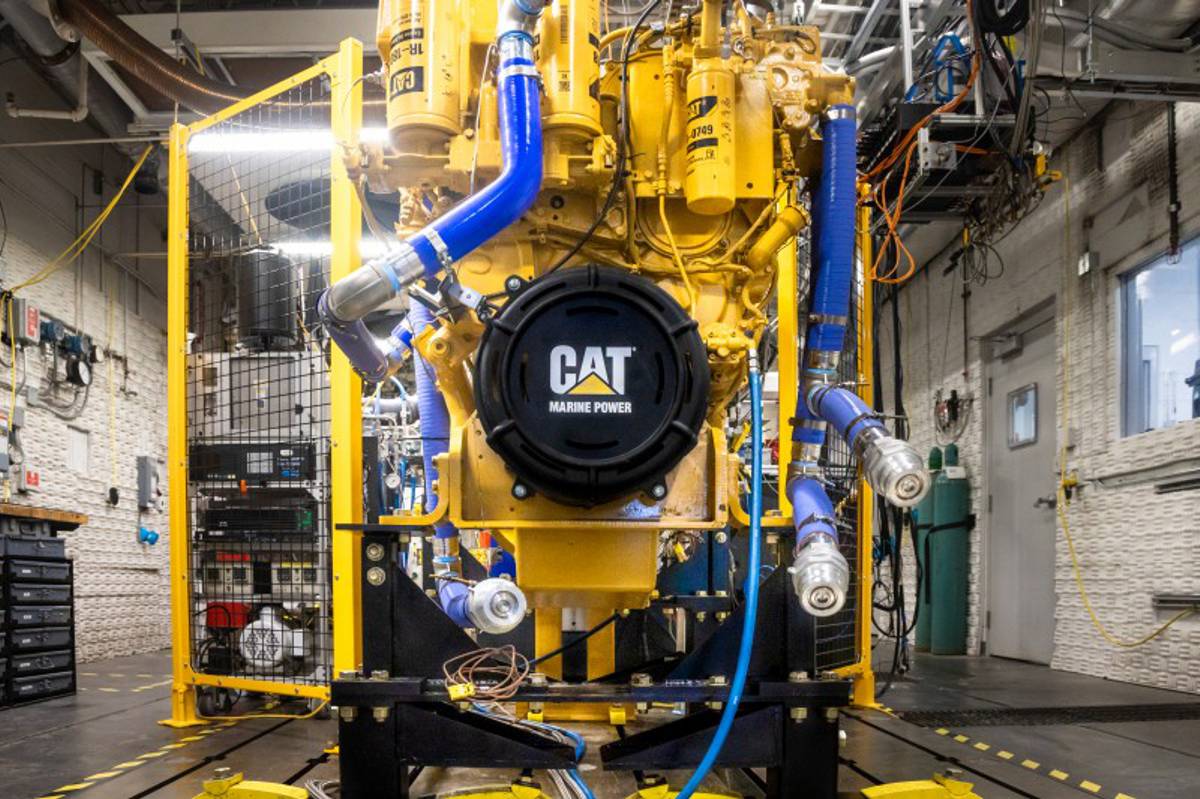
Now, research emerging from Oak Ridge National Laboratory in collaboration with Caterpillar suggests there may be a more practical route forward. Rather than abandoning conventional compression ignition technology, the team has developed a dual fuel combustion system capable of operating marine engines on more than 75 percent methanol while maintaining performance across a broad operating range. The approach relies on using a relatively small amount of diesel as a pilot fuel to initiate combustion, allowing methanol to perform the majority of the work without requiring a complete redesign of the engine platform.
For an industry balancing tightening emissions expectations against commercial reality, that distinction matters. Vessel owners rarely replace functioning assets overnight. Retrofitting existing fleets, extending asset life and reducing fuel risk tend to carry far more weight than radical reinvention.
Briefing
- Oak Ridge National Laboratory and Caterpillar have demonstrated a dual fuel marine combustion strategy enabling more than 75 percent methanol substitution.
- The system uses a small amount of diesel as pilot fuel to solve methanol ignition challenges in compression ignition engines.
- Existing marine platforms could potentially be upgraded rather than completely redesigned.
- The development aligns with broader maritime decarbonisation and fuel diversification efforts.
- Inland and coastal vessel operators may gain greater flexibility without sacrificing operational performance.
The Marine Sector’s Search for Practical Decarbonisation
Marine transport faces pressures that differ sharply from passenger mobility. Commercial vessels operate in environments where downtime is expensive, fuel availability matters enormously and reliability cannot be compromised. Coastal cargo fleets, harbour operations, inland waterways and specialist service vessels all operate under different conditions, yet they share one common challenge: achieving emissions reductions without undermining economics.
The International Maritime Organization’s evolving greenhouse gas ambitions have intensified that pressure across the sector, encouraging operators and manufacturers to evaluate fuels ranging from LNG and biofuels through to ammonia, hydrogen and methanol. Among these contenders, methanol has quietly gained traction because it can be handled as a liquid fuel using infrastructure and operational practices that remain familiar to operators.
Methanol also offers flexibility in sourcing. Conventional production often relies on natural gas, although increasing attention is turning toward renewable and lower-carbon production pathways. Storage and transport remain considerably simpler than hydrogen, which has helped position methanol as one of the more commercially realistic transition fuels currently under evaluation across maritime markets.
Solving the Ignition Problem Without Reinventing the Engine
Methanol’s appeal has always come with a technical catch. Unlike diesel, methanol does not readily ignite under compression. That creates a significant obstacle for compression ignition engines that dominate commercial marine operations.
The ORNL and Caterpillar programme focused directly on this limitation. Instead of attempting to force methanol into a combustion environment where it naturally struggles, researchers introduced a dual fuel strategy that retains compression ignition characteristics through controlled pilot injection.
ORNL’s system uses a modest quantity of diesel to trigger combustion while methanol provides the majority of the energy input. Engine operating parameters including intake conditions, injection timing and pressure control were adjusted to maintain stable combustion across a wide load range. According to published research outcomes, this enabled methanol substitution rates exceeding 75 percent without sacrificing operational capability.
Derek Splitter, project lead for the Cooperative Research and Development Agreement with Caterpillar, said: “This system allows marine engines to use more than 75 percent methanol under a wide range of power levels and without reducing performance.”
The significance lies not simply in fuel replacement percentages but in maintaining predictable behaviour across changing load conditions, something that remains essential for marine applications.
Retrofit Economics Could Change the Conversation
One of the most commercially relevant aspects of the development is what it does not require.
According to ORNL, deployment would require engine modifications but avoids full engine redesign. Operators would retain the ability to run conventional diesel operation or switch into methanol dual fuel mode depending on availability and operational requirements.
That flexibility changes the investment discussion considerably.
Marine assets often remain operational for decades. Entire vessel classes cannot be replaced simply because fuel strategies evolve. Retrofit pathways allow operators to spread capital expenditure, reduce stranded asset risk and maintain operational continuity.
The wider industry has already begun moving in this direction. Caterpillar previously announced methanol support pathways for selected marine platforms, while multiple engine manufacturers are developing methanol-ready architectures designed to accommodate future conversion. Demonstrator programmes are increasingly focusing on upgrading existing fleets rather than forcing wholesale replacement cycles.
For ports, infrastructure planners and policymakers, this may also reduce the scale and pace of supporting investments needed to encourage adoption.
Lessons for Construction and Heavy Industry
Although the immediate focus is marine transport, the implications extend well beyond vessels.
Construction, mining, quarrying and industrial sectors face many of the same decarbonisation constraints. Equipment must operate reliably under heavy loads, frequently in remote locations and often for long service lives.
Interestingly, the original collaboration framework highlighted broader relevance across off-road sectors including construction, mining, agriculture and heavy transportation. These industries are widely recognised as harder to decarbonise than passenger transport because battery solutions remain constrained by weight, charging logistics and operating cycles.
If dual fuel combustion strategies continue to mature, they could influence future thinking across stationary generators, industrial engines and specialist off-highway equipment.
That does not mean methanol becomes the universal answer. Fuel availability, storage requirements, safety procedures and economics remain highly location dependent. Yet practical transition technologies often gain traction because they work within existing systems rather than demanding complete replacement.
Infrastructure Will Decide the Pace of Adoption
Fuel transitions rarely succeed on engine technology alone.
Methanol bunkering networks remain immature compared with conventional marine fuel infrastructure, although investment activity has increased across major shipping hubs. Operators considering conversion must evaluate storage requirements, safety measures, crew training and local fuel access.
Methanol also carries operational trade-offs. Its lower energy density means vessels generally require larger fuel volumes compared with diesel for equivalent range, creating implications for vessel design and cargo capacity. Additional fuel handling and ventilation requirements must also be addressed.
Yet those challenges increasingly appear manageable rather than prohibitive.
Engine flexibility may ultimately prove more valuable than choosing a single winning fuel. Owners capable of operating across multiple fuel pathways gain resilience as energy markets evolve.
Building a Bridge Rather Than Waiting for Perfection
Marine decarbonisation has reached the point where incremental progress may matter more than theoretical end states.
The ORNL and Caterpillar work reflects a broader shift occurring across transport and industrial sectors. Instead of waiting for perfect zero-carbon technologies, organisations are increasingly pursuing transitional systems that reduce emissions while preserving operational practicality.
For inland and coastal vessel operators, dual fuel methanol capability could represent precisely that sort of bridge. Not a final destination, not a silver bullet, but a measurable step that lowers barriers and expands options. Infrastructure industries understand this logic better than most.
Progress rarely arrives as a clean break from the past. More often, it arrives through clever engineering that keeps existing systems moving while quietly changing what powers them.