Railserve Wires Real Time Safety into the Industrial Railyard
The industrial railyard has always been one of the most unforgiving workplaces in the freight chain. Heavy steel rolls on steel, sightlines vanish behind strings of cars, and crews lean heavily on radio chatter and hand signals to keep everyone clear of moving equipment. Federal data tells the story plainly: roughly half of all railroad accidents and more than a third of worker injuries happen in yards, and the injury and fatality rate for yard workers runs at well over double the national average across industries. Human factors, not mechanical failure, sit behind the majority of those events.
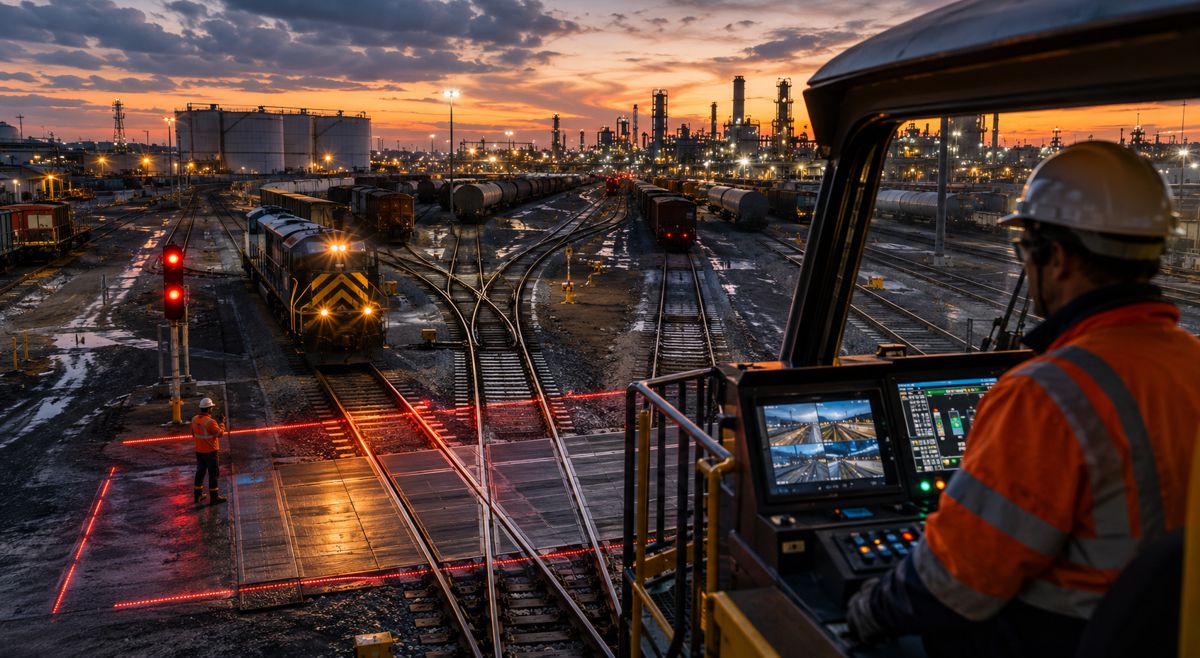
Railserve, the Marmon Rail company that runs in-plant switching at more than 100 sites across North America, has rolled out YardGUARD, an integrated safety system that folds real-time engineered controls straight into everyday switching work. Rather than bolting on another standalone gadget, Railserve has built a coordinated web of sensing, vision and monitoring technologies into the way its crews actually operate. The move signals something bigger than a product launch: it points to where on-site rail services are heading as automation creeps deeper into the yard.
Briefing
- Railserve, part of Marmon Rail and ultimately Berkshire Hathaway’s Marmon Holdings, has launched YardGUARD, an integrated railyard safety system embedded into its switching operations across a 100-plus-site North American footprint.
- The system links six components covering crossings, derails, foul zones, switch gaps, emergency stops and in-cab hazard detection, several with automatic braking support.
- It targets the yard’s costliest weak spots: poor visibility, over-reliance on radio, switch misalignment, derail status and railcar fouling.
- The launch lands as Railserve deepens an AI perception partnership with Israel’s Rail Vision, signalling a shift towards semi-autonomous yard operations.
- For plant operators and infrastructure investors, it reframes contract switching as a technology-led service rather than a labour-only one.
Why Embedded Beats Bolt On
The pitch that separates YardGUARD from the usual safety kit is integration. Plenty of yards already run isolated tools, a derail indicator here, a crossing alarm there, but they rarely talk to one another, and they almost never feed information into the cab where decisions get made in seconds. YardGUARD is configured site by site and stitched into Railserve’s operating model, pulling sensing, vision, communications and cloud-based monitoring together so that yard-side indications and in-cab alerts stay synchronised during live railcar moves. The result is meant to be a single, shared picture of the yard rather than a scatter of competing signals.
That shared picture matters because so many yard incidents trace back to people working off different information. A switchman believes a point is lined one way, the operator assumes another, and the gap between those two beliefs is where someone gets hurt. Laurie Stiles, President of Railserve, framed the intent directly.
“YardGUARD™ gives crews and operators real-time visibility across the yard, ensuring everyone works from the same information,” she said. “It strengthens existing safety checks with added verifications and situational awareness that allow crews to identify and address risks before they become incidents.” It’s a layered approach, with confirmation stacked on confirmation, and it leans hardest on the conditions that catch crews out, namely low light, bad weather and high-tempo shifts when the pressure to keep cars moving runs up against the need to keep people safe.
Six Guards, One System
The system’s value sits in how its parts cover the yard’s highest-risk moments. CrossingGUARD tightens control at crossings while equipment is on the move, and DerailGUARD provides multi-layered confirmation of derail status, triggering emergency braking when it’s needed. FoulGUARD reinforces clearance awareness in foul zones, the stretches of track where a parked car can clip a passing move, again with automatic braking support. GapGUARD sharpens switch alignment and point-gap visibility, the very misalignment problem that turns routine moves into derailments.
Rounding out the set, StopGUARD layers automated emergency braking and crew awareness into critical scenarios, while WatchGUARD delivers in-cab hazard detection and automatic braking. Taken together, they’re designed to create continuous monitoring backed by engineered controls that don’t simply warn a crew but can intervene. That distinction, from advisory to active, is the heart of where yard technology is going, and it’s a meaningful step beyond the buzzers and lights that have policed yards for decades.
A Yard Where The Numbers Have Been Stubborn
Industry safety data explains why this push has teeth. The freight rail sector as a whole has trimmed its risk profile, with Class I railroads cutting their yard accident rate per million switching miles by around 11% in the most recent federal figures, and employee injury and fatality rates sitting near record lows. Yet the yard remains a problem child. The Federal Railroad Administration’s long-running Switching Operations Fatality Analysis group keeps circling the same root causes year after year, among them inexperience, close or no clearance, and weak job briefings, the human-scale failures that engineered controls are well placed to backstop.
For a contractor like Railserve, whose entire business is putting people and locomotives inside other companies’ plants, those statistics aren’t abstract. They shape insurance costs, customer confidence and the licence to operate. Embedding safety intelligence into the workflow is partly a moral argument and partly a hard commercial one, since a single serious incident can shut a plant’s rail operation and ripple straight into production schedules for the manufacturer next door.
The Automation Thread Behind The Launch
YardGUARD doesn’t arrive in isolation. Railserve has been working with Rail Vision, the Ra’anana-based developer of AI perception systems, since a 2024 commercialisation deal for its ShuntingYard platform, technology that can detect and classify objects up to 200 metres out in any weather or light. In late May 2026, the two firms signed a memorandum of understanding to widen that work, having already moved the system from an advanced driver assistance tool towards an active, intervening platform that supports semi-autonomous operations. Rail Vision chief executive David BenDavid said the firms intend to explore “new opportunities for deployment across the Marmon Rail Group.”
Read alongside that partnership, YardGUARD looks less like a one-off and more like the foundation of a connected, technology-enabled operating model for industrial rail. Stiles positioned the company squarely in that lane, saying: “Railserve leads the industry in advancing integrated, intelligence-driven solutions” and adding that: “by combining field-proven execution with real-time visibility and automated safeguards, we’re enabling a higher level of consistency and control in complex yard environments.” For a sector that’s historically been slow to digitise the last mile of track inside a plant gate, that’s a notable change of pace.
The Backing And The Bottom Line
There’s deep financial muscle behind all this. Railserve operates under Marmon Rail, itself part of the roughly 8-billion-dollar Marmon Holdings, a Berkshire Hathaway company, which gives it the balance sheet to invest in technology that smaller switching contractors simply can’t match. With 17 Fortune 500 customers and a footprint spanning industrial, manufacturing and production plants, the firm is effectively setting a benchmark that rivals will have to answer.
Railserve is offering site assessments and customer demonstrations as it rolls the system out, a sensible way to prove value yard by yard given how differently each facility is laid out. For plant operators weighing the cost, the calculation is straightforward enough: fewer incidents, steadier throughput and a switching partner carrying more of the safety burden on engineered systems rather than radio discipline alone.
Whether YardGUARD becomes the template for industrial rail or just an early mover, it’s nudged the conversation about yard safety away from compliance paperwork and towards real-time control, and that’s a shift the wider infrastructure world would do well to watch.