Rented Steel Bridge is Keeping Bristol Airport Open Through its Expansion
Airports are among the most awkward places in the built environment to carry out major construction, not because the engineering is exotic but because the asset cannot be switched off while the work proceeds. Passengers keep arriving, aircraft keep turning around, and baggage keeps moving, all while contractors try to thread plant and materials through a site that was never designed to host a building programme.
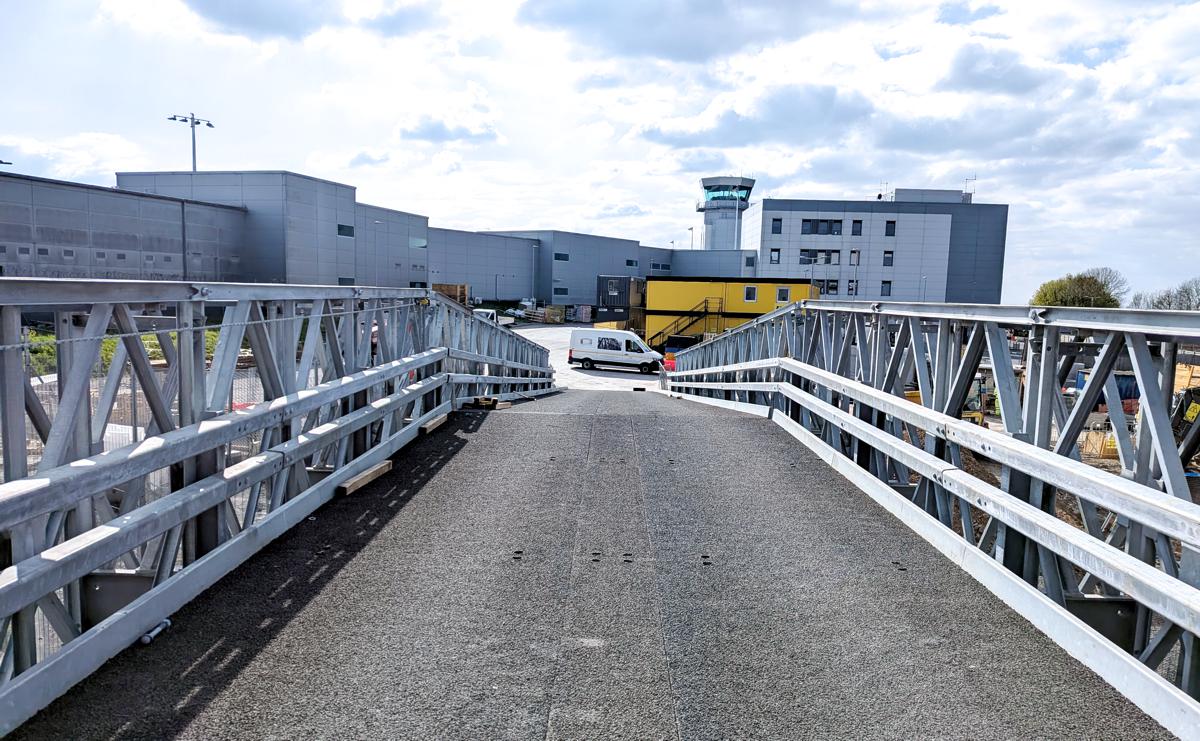
At Bristol Airport, that tension has produced a neat piece of construction logistics: a 60-metre modular steel bridge, supplied by Acrow and rented by main contractor Farrans, that carries construction traffic clean over the operational core of the site without ever entering an airside zone or interrupting baggage operations.
The structure itself is unremarkable to look at, which is rather the point. Its significance for the wider industry lies in what it represents rather than what it spans, namely a low-friction method of building around live infrastructure that avoids the permits, escorts and stop-start working that normally make airside construction so slow and so expensive. As airports across the United Kingdom push through capacity upgrades to meet recovering travel demand, the ability to keep an asset earning while it is rebuilt is becoming a commercial discipline in its own right, and temporary modular bridging is quietly emerging as one of its most useful tools.
Briefing
- A 60-metre Acrow 700XS modular steel bridge has been installed at Bristol Airport to carry construction traffic from landside to an elevated coach deck without entering airside areas.
- The structure was rented by Farrans, a Sisk Company, prebuilt in three sections of 21, 18 and 21 metres plus a 12-metre ramp, and craned into position within a four-hour lifting window.
- It holds a minimum 2.2-metre clearance over the airport’s sole baggage-drop access route, preserving 24-hour vehicle movements throughout the construction period.
- The works form part of Bristol Airport’s current multi-year upgrade toward its approved 12 million passenger cap, with a separate £500 million proposal to reach 15 million now before North Somerset Council.
- The deployment reflects a broader shift toward rented, reusable modular bridging as a way to de-risk construction logistics on busy transport assets.
Keeping the Airport Earning While It Is Rebuilt
The commercial logic of the installation becomes clear once the site constraints are understood. The works span an area that straddles both landside and airside, and the ground beneath the new bridge is the only access route for baggage drop operations, so any solution had to leave that corridor open at all hours. Rather than route construction vehicles through airside space, with the security escorts, permits and timing restrictions that this implies, the bridge lets them travel directly from landside, pass above the airside area without entering it, and climb to an elevated coach deck roughly three metres above ground level.
The arrangement has cut the need for special permits, shortened delivery times and helped to keep a lid on project costs, all of which matter on a programme where access delays compound quickly.
That operational continuity is the real prize for the contractor and the airport alike. A live terminal generates revenue every hour it stays open, and an access failure that grounded baggage handling would carry consequences far beyond the construction budget.
Laura Jones, Business Development Manager, UK at Acrow, framed the challenge in plain terms, noting: “Maintaining safe, efficient access during airport construction is always complex, particularly during busy times of the day with flights arriving and departing,” and adding: “The Acrow modular bridge has provided a practical solution that supports construction progress while keeping critical airport operations running smoothly.” For an operator weighing the cost of a rented structure against the risk of disruption to a working airport, that calculation tends to favour the bridge.
Engineering Around a Four-Hour Window
The technical interest lies in how much had to be accommodated within a small envelope. Built around Acrow’s 700XS panel system, the bridge runs to a total length of 60 metres across three spans, supported by four towers also supplied by Acrow, with a single-lane width of 4.2 metres and an epoxy anti-skid deck. It is rated for a design load of a single 44-tonne vehicle in accordance with CS454, the National Highways standard governing the assessment of highway structures, which means it can take the heaviest goods vehicles the construction programme is likely to send across it.
Holding a 2.2-metre clearance above the baggage route while lifting traffic up to a deck three metres above ground demanded careful geometry, since the structure had to clear what passed beneath it without breaching the height limits imposed above it.
Prefabrication did most of the heavy lifting, in both senses. Assembling the bridge into three sections off site allowed the team to compress on-site work into a single crane operation carried out within a strict four-hour lifting window, under a ceiling-height restriction that ruled out a more leisurely build.
That ability to drop a complex structure into a tightly policed slot is precisely what modular systems are built for, and Michael Treacy, CEO of Acrow Global Limited, pointed to the same flexibility when he said the company was: “proud to have been selected to be a part of this important infrastructure upgrade,” and that: “Acrow’s modular bridge solutions offer the versatility to be rapidly deployed, adapted to site-specific constraints, and configured for either permanent or temporary use across a wide range of applications.” On a constrained airport apron, that adaptability is not a marketing line so much as a basic entry requirement.
The Expansion Behind the Bridge
The bridge is a small component of a much larger story about Bristol’s growth ambitions. The present airport opened at Lulsgate in 1957, succeeding the earlier Whitchurch aerodrome that Bristol Corporation had developed from 1929, and it has expanded in fits and starts ever since to keep pace with a growing regional population. It is currently working through a multi-year upgrade aimed at delivering its approved cap of 12 million passengers a year, a programme that has already included a new public transport interchange and continues with terminal and airfield improvements of the kind the Acrow bridge now supports.
Around 10.8 million passengers presently use the airport, so the headroom to 12 million is being built out rather than merely planned.
Beyond that approved work sits a more contested proposition. In March 2026 the airport submitted plans to North Somerset Council for a roughly £500 million investment programme intended to lift the annual cap from 12 million to 15 million passengers by the late 2030s, with a larger terminal, runway and taxiway changes to handle bigger aircraft, highway upgrades on the A38 and the prospect of long-haul services to North America and the Middle East.
The proposal has drawn objections from local campaigners worried about road pressure and emissions, and a decision is expected later in the year, so the present construction should be read as delivery against the secured 12 million cap rather than as part of the still-pending 15 million scheme. For investors, the ownership backdrop is equally relevant, with Macquarie Asset Management having taken a 55 per cent stake in the airport in November 2025 alongside a group of institutional co-owners, a structure that signals continued appetite for regional airport infrastructure as a long-duration asset class.
Why Modular Bridging Is Moving From Emergency to Everyday
Acrow’s heritage is rooted in rapid and emergency deployment, with the company citing more than 75 years of service to the transport and construction industries and bridge projects in over 150 countries across Africa, Asia, the Americas, Europe and the Middle East. The 700XS platform that underpins the Bristol job is the same family of bolt-together steel panels the firm sells for permanent crossings, military gap-bridging and disaster relief, which is exactly why it transfers so readily to a congested construction site. Components are designed to be transported flat, assembled without welding and, crucially, dismantled and reused once the job is done, so a temporary access structure does not become stranded capital at the end of a programme.
That reusability is reshaping how contractors think about construction logistics on brownfield and live-asset projects. Renting a modular bridge for the duration of the works, as Farrans has done here, converts what might otherwise be a bespoke civil-engineering exercise into an off-the-shelf, time-boxed service, with the structure returning to the supplier’s pool afterwards.
For asset owners under pressure to keep operations running and budgets contained, the appeal is obvious, and the model maps neatly onto the wider trend toward prefabrication and offsite manufacture across the sector. What was once reserved for floods, war zones and washed-out roads is increasingly being specified as a routine enabling work for planned construction.
What the Bristol Job Signals for Live-Asset Construction
The detail that should interest construction and infrastructure professionals is not the span length or the load rating but the working method behind them. Building over rather than through a live operation, compressing on-site disruption into a single short lift, and treating the access structure as a rented and returnable asset together describe a template that applies well beyond a single airport apron. The same logic suits railway estates, ports, hospitals and any other facility where the cost of stopping operations dwarfs the cost of the temporary works needed to avoid it.
For Bristol specifically, the bridge buys the wider expansion programme something valuable, which is the freedom to keep building while the larger questions about the airport’s future capacity are settled through the planning system. Whether or not the 15 million passenger proposal is approved, the discipline of delivering construction without grounding operations will remain. On that measure the modest steel structure now spanning the apron is doing more than carrying lorries, since it is demonstrating, in a way that contractors elsewhere will recognise, how to rebuild a working asset without first switching it off.