Walnut Shell Catalyst Reframes Recycling Plastic into Chemicals
A new study out of Shihezi University has quietly shifted the terms of a debate that matters far beyond the laboratory bench. For years the chemical recycling industry has chased a single number: how much high-value liquid a catalyst can wring from a batch of waste plastic. New work on waste agricultural mulch film suggests that this instinct, while understandable, may be steering plant designers toward the wrong optimisation.
The researchers found that the temperature at which the catalytic bed operates sets a trade-off between maximising olefin-rich pyrolysis oil and producing carbon deposits that are cheap and easy to remove. In an industry where catalyst deactivation is one of the largest recurring operating costs, the second of those two outcomes may prove more commercially decisive than the first.
Advanced recycling is currently moving from pilot demonstrations into commercial infrastructure, and petrochemical majors are building plants that convert hard-to-recycle plastics into feedstock for new polymers, and the catalysts inside those reactors are becoming a strategic cost line rather than a footnote. The Shihezi team, led by Haiyan Yan and Yunfeng Zhao and published in Sustainable Carbon Materials on 5 March 2026, chose an unglamorous but abundant feedstock and a deliberately low-cost catalyst cut from walnut shells. In doing so they produced a piece of process intelligence that speaks directly to the people who will have to run these plants for decades rather than describe them in a prospectus.
Briefing
- Researchers at Shihezi University report that in microwave-assisted catalytic pyrolysis of waste plastic mulch film, the catalytic bed temperature governs a trade-off between olefin-rich oil and carbon deposits that regenerate more easily.
- At 350 °C the phosphoric acid-activated walnut shell biochar catalyst reached its most favourable window for liquid chemicals, with olefin selectivity of 69 per cent and oil yield peaking at 72.0 wt%.
- At 400 °C olefin selectivity gave way to more aromatics, at 18 per cent, while the coke that formed was far easier to burn off, carrying an apparent activation energy of roughly 40 to 50 kJ/mol.
- The result challenges yield-first thinking, because for commercial plants catalyst regenerability and reactor uptime can influence operating cost more than headline product yield.
- The catalyst is derived from walnut shell waste, offering a low-cost and doubly circular alternative to the zeolites that dominate today’s chemical recycling catalyst market.
Regenerability Becomes the Real Measure of Catalyst Value
The central contribution of the study is not a record yield but a reframing of what operators should be measuring. Catalytic pyrolysis works by passing hot plastic vapours over an acidic catalyst that cracks long polymer chains into shorter, more valuable molecules. Over time, tar and coke build up on the catalyst surface, block its pores and strip it of activity, at which point it must be regenerated by burning off the carbon or replaced outright.
Both routes cost money, and both interrupt production, which is why catalyst deactivation is routinely cited across the technical literature as one of the principal barriers to scaling the technology economically.
Seen through that lens, the Shihezi results carry a commercial message that peak-yield tables tend to obscure. The temperature that delivered the most valuable liquid also encouraged side reactions that chemically poisoned the catalyst’s active sites, a form of deactivation that is harder to reverse. A slightly higher temperature sacrificed some of that liquid value, yet the carbon it left behind was more reactive and came away during regeneration at a much lower energy cost.
For a plant operator weighing total cost of ownership, a catalyst that surrenders a few percentage points of selectivity but keeps running through more regeneration cycles may generate more value across a year of production than one that peaks briefly and then fouls. This is the kind of calculation that separates a promising laboratory result from a viable industrial process, and it is precisely the calculation the study was designed to inform.
Reading the Temperature Window
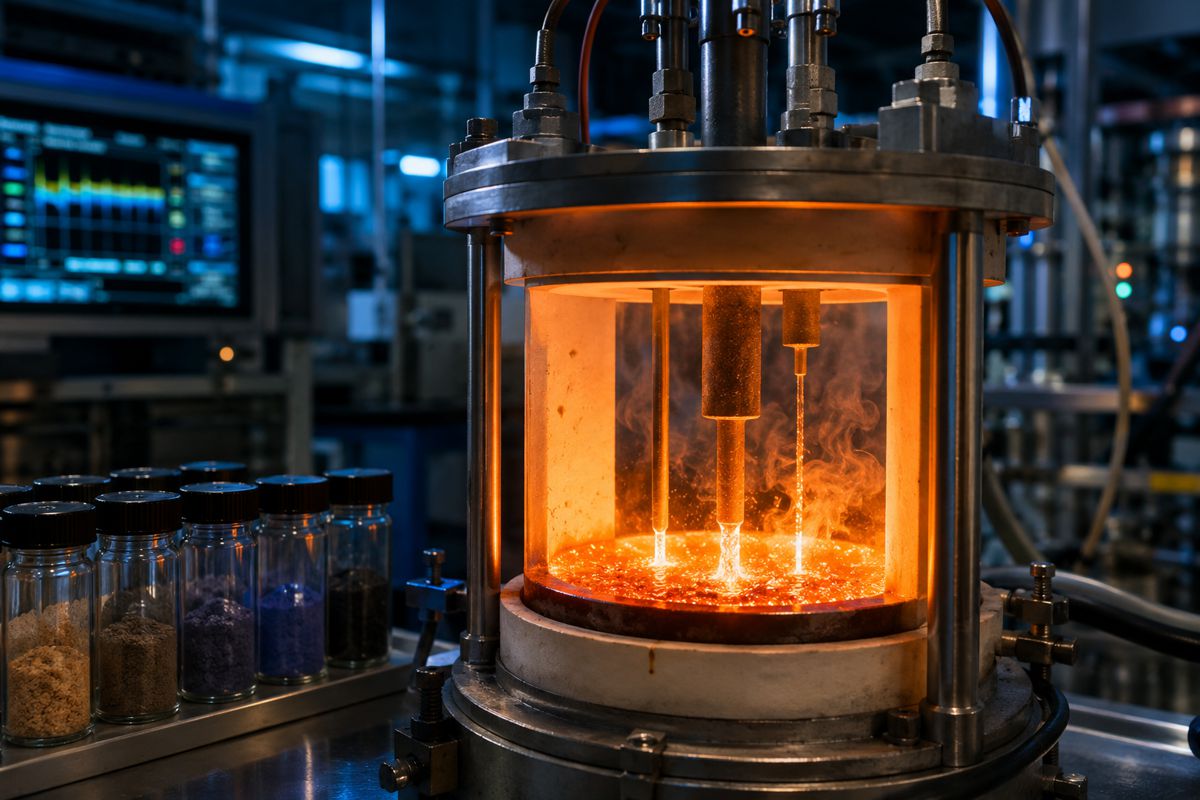
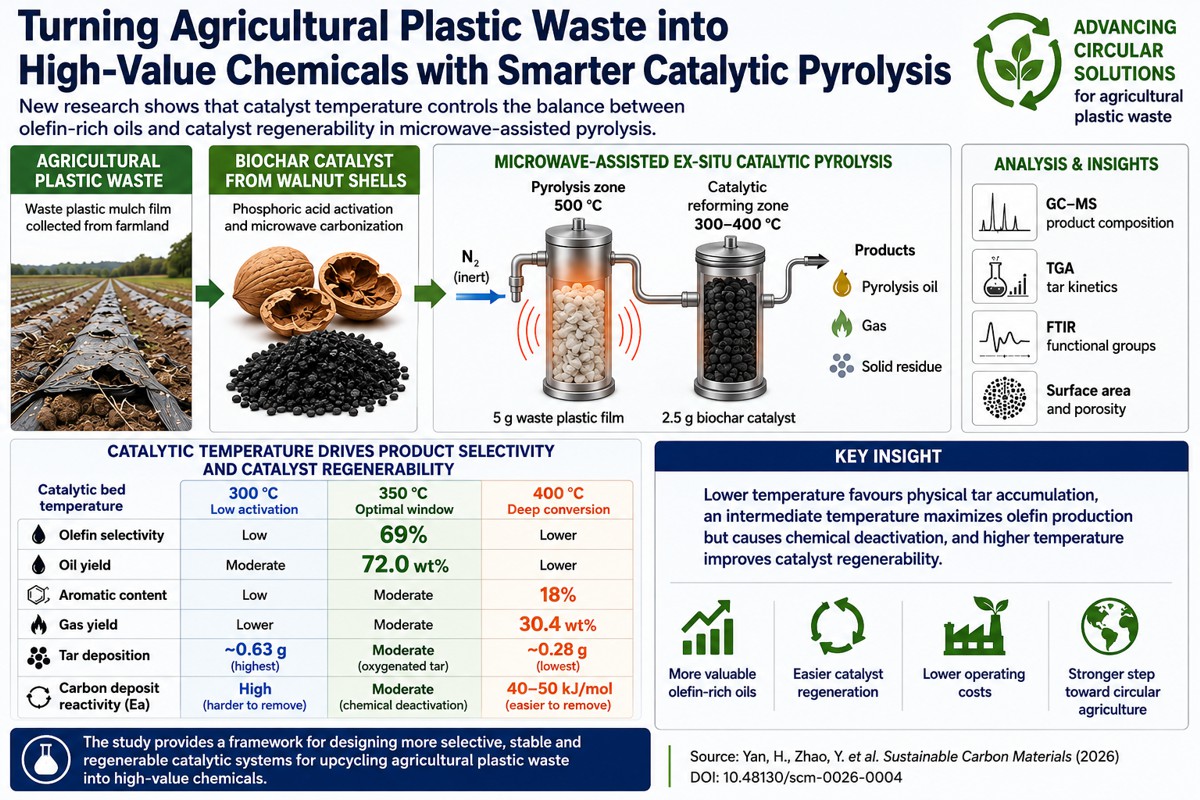
Beneath the headline trade-off sits a detailed picture of how the chemistry shifts across a narrow band of temperatures. The team ran the pyrolysis zone at a constant 500 °C and separately regulated the downstream catalytic bed at 300, 350 or 400 °C, feeding five grams of waste film past two and a half grams of catalyst in each run. At 300 °C the catalyst was barely activated, so the reaction was dominated by the random thermal cracking of plastic chains rather than any selective catalytic effect. That regime produced the most tar, about 0.63 grams, made up largely of heavy hydrocarbons that physically clogged the catalyst pores and proved relatively stable once lodged there.
At 350 °C the catalyst reached its productive sweet spot. Olefin selectivity in the oil climbed to 69 per cent and the oil yield peaked at 72.0 wt%, driven by acid sites on the catalyst promoting a carbocation-mediated β-scission that snips heavier molecules into lighter olefins. The same conditions, however, opened the door to esterification and other side reactions that generated oxygen-bearing tar capable of chemically deactivating the catalyst. Pushing the bed to 400 °C tilted the balance again, deepening the conversion so that aromatic content rose to 18 per cent and gas yield reached 30.4 wt%, while tar deposition fell to 0.28 grams.
Kinetic modelling showed that this higher-temperature coke carried the lowest apparent activation energy of the three cases, in the region of 40 to 50 kJ/mol, meaning it burned off readily during regeneration. Taken together, the three regimes describe a controllable dial: lower temperatures invite physical fouling, an intermediate setting maximises liquid olefins at the cost of chemical poisoning, and a higher setting trades some selectivity for a catalyst that is much simpler to keep in service.
A Low-Cost Catalyst Cut From Waste
The choice of catalyst is as commercially telling as the temperature findings. Much of the chemical recycling industry leans on zeolites, engineered aluminosilicates prized for their acidity and shape selectivity, which command roughly two fifths of the plastic chemical recycling catalyst market by value according to Fact.MR. Zeolites are effective, but they are expensive and notoriously prone to rapid coking, and every regeneration or replacement cycle adds to running costs. Biochar catalysts occupy the opposite end of the cost spectrum. Derived from carbonised biomass waste, they are cheap, widely available and, because their own carbon matrix resembles the coke that forms on them, unusually tolerant of deposition and comparatively straightforward to regenerate.
The Shihezi team built theirs from walnut shells, washing, drying, grinding and impregnating the material with phosphoric acid before a microwave-assisted carbonisation step created the porous, acidic structure the process needs. That pairing carries a neat circular logic, since an agricultural by-product is enlisted to upcycle an agricultural waste. The reactor arrangement reinforced the practical intent. By running an ex-situ, two-stage configuration in which vapours are generated first and only then passed over the catalyst in a separate zone, the researchers followed a layout that the wider literature associates with better control over reaction conditions, longer catalyst life and easier recovery and regeneration.
Microwave heating added a further advantage for a material as thermally stubborn as polyethylene film, delivering rapid, even energy transfer to a feedstock that conventional heating struggles to warm efficiently. None of these choices is exotic, and that is the point, because a process built from cheap catalysts and established reactor concepts is far easier to picture at commercial scale than one dependent on premium materials.
The Feedstock Nobody Wants to Handle
Plastic mulch film is one of modern agriculture’s quiet dependencies and one of its more intractable waste problems. Laid over soil to raise temperature, suppress weeds and cut evaporation, it lifts yields of high-value crops, yet it is thin, tears easily during removal and comes off the field caked in soil and plant debris. Recovered mulch commonly carries between 30 and 80 per cent surface contamination, which frustrates conventional mechanical recycling and pushes much of the material toward landfill, open burning or slow degradation in the ground, where it fragments into microplastics that are effectively impossible to retrieve. Estimates put global agricultural plastic use at more than 10 million tonnes a year, of which mulch film accounts for roughly 2.5 million tonnes, and reliance on these plastics is expected to rise by around half by 2030.
The geography of the problem gives the Shihezi work added relevance. China is the world’s largest user of mulch film, having embraced the technology to raise productivity and, by some assessments, to avoid bringing millions of additional hectares into cultivation. Xinjiang, home to Shihezi University and to the Production and Construction Corps that helped fund the research, is one of the most film-intensive farming regions anywhere, so the feedstock the team studied is not a laboratory abstraction but a waste stream sitting on their doorstep in enormous volumes.
Because chemical recycling tolerates the contamination and mixed condition that defeat mechanical routes, a robust catalytic pyrolysis process aimed squarely at mulch film addresses a category of plastic that the cleaner, more commoditised recycling streams tend to leave behind. That combination of scale, difficulty and neglect is exactly where a durable, low-cost process can create disproportionate value.
Fitting Into a Chemical Recycling Build-Out
The timing situates the research within a rapidly maturing industry rather than a speculative one. Allied Market Research valued the chemical recycling market at just over four billion US dollars in 2025 and projects it climbing toward roughly 14 billion by 2035, while McKinsey has framed plastics recycling more broadly as a 50 to 75 billion dollar economic opportunity by the same horizon, with more than nine million tonnes a year of pyrolysis capacity already announced and under development. Pyrolysis dominates the process mix because of its tolerance for mixed and contaminated polyolefin waste, and the commercial pipeline is tangible. LyondellBasell has been building its first commercial-scale catalytic recycling plant in Germany, BASF runs chemically recycled pyrolysis oil through its integrated production under its ChemCycling and Ccycled programmes, and INEOS, SABIC, Shell and others have moved from trials to production runs across Europe and Asia.
What makes olefin selectivity such a meaningful metric in that context is the destination of the product. The most valuable use of pyrolysis oil is as a drop-in substitute for fossil naphtha in steam crackers, where it is converted into the ethylene and propylene that underpin new polymer production, closing the loop between waste plastic and virgin-grade material. Regulation is sharpening the incentive, with the European Union’s Circular Economy Action Plan requiring that all plastic packaging be reusable or recyclable and carry 30 per cent recycled content by 2030, and extended producer responsibility schemes spreading the compliance pressure across markets.
A process that can turn contaminated agricultural film into an olefin-rich stream, using a catalyst that is cheap to source and simple to regenerate, speaks to two of the industry’s tightest constraints at once, namely feedstock difficulty and operating economics. For investors weighing where advanced recycling capital should flow, the durability of the catalyst system is fast becoming as important a question as the purity of the output.
From Laboratory Bench to Industrial Reactor
The distance between a bench-scale result and a running plant remains considerable, and the study is candid about the mechanisms rather than the megatonnes. What it offers the industry is a framework, one that connects oil composition, tar chemistry, coke reactivity and deactivation pathways into a single picture that plant designers can reason with. The immediate next steps are familiar to anyone who has watched a promising catalyst make the journey to commercial scale: long-run stability testing across many regeneration cycles, validation on the messy, variable feedstock that real farmland produces, and techno-economic analysis to confirm that the operating savings from easy regeneration outweigh any yield given up. Those are engineering questions rather than scientific unknowns, which is a comfortable place for a technology to sit.
For construction, infrastructure and industrial technology audiences, the wider signal is worth registering. The materials that build and equip the modern world increasingly come with a circularity expectation attached, and the plants that will meet it are being designed now around the unglamorous realities of catalyst life, reactor uptime and total cost of ownership.
Work such as this reframes the conversation away from headline yields and toward the operating characteristics that actually determine whether a recycling plant makes money year after year. A walnut shell catalyst cracking waste mulch film in a Chinese laboratory is a long way from a cracker complex on the North Sea, yet the logic it demonstrates travels well, and it is the sort of logic that turns an environmental obligation into a durable industrial business.
Key Industry Questions
- Why does catalyst regeneration matter more than peak yield for commercial recycling plants? Peak yield describes a single batch under ideal conditions, whereas a commercial plant runs continuously for years. Every time a catalyst fouls with coke it must be regenerated or replaced, which costs energy, materials and lost production. A catalyst that produces slightly less high-value liquid but keeps working through many regeneration cycles can deliver more value over a year than one that peaks briefly and then deactivates. The Shihezi study quantifies this by showing that a higher catalytic temperature sacrifices some olefin selectivity but produces coke with much lower activation energy, meaning it burns off cheaply. For operators focused on total cost of ownership, that durability often outweighs a marginal yield advantage.
- What makes agricultural mulch film harder to recycle than other plastics? Mulch film is thin, low-density polyethylene that tears during removal and comes off the field heavily contaminated with soil and plant debris, often between 30 and 80 per cent by surface. That contamination degrades the quality of mechanically recycled material and frequently makes conventional recycling uneconomic, so much of the film ends up in landfill, burned, or left to fragment into microplastics in the soil. Chemical recycling through pyrolysis tolerates this contamination far better because it breaks the plastic down to molecular level regardless of surface dirt. That tolerance is why catalytic pyrolysis is a credible route for a waste stream that cleaner, more commoditised recycling systems tend to reject.
- What are olefins and why is 69 per cent selectivity commercially significant? Olefins, principally ethylene and propylene, are the basic building blocks of most plastics and many industrial chemicals. When pyrolysis oil is rich in olefins it can substitute for fossil naphtha in steam crackers, allowing waste plastic to be turned back into virgin-grade polymer and closing the material loop. An olefin selectivity of 69 per cent means most of the liquid produced is directly useful to petrochemical producers rather than a low-value mixed stream. High selectivity reduces the downstream separation and upgrading needed before the oil can be used, which improves the economics of the whole chain and makes the recovered product more attractive to cracker operators bound by recycled-content targets.
- How does a biochar catalyst compare with the zeolites used industrially? Zeolites are engineered aluminosilicates valued for their acidity and shape selectivity, and they hold a large share of the chemical recycling catalyst market, but they are expensive and deactivate quickly as coke blocks their fine pores. Biochar catalysts, made from carbonised biomass waste such as walnut shells, are far cheaper and more widely available. Because their own carbon structure resembles the coke that forms on them, they tolerate deposition better and regenerate more easily. They generally offer lower peak activity than premium zeolites, so the practical question is whether their cost and durability advantages outweigh that gap. For difficult, high-volume waste streams, the balance can favour biochar.
- Where does this fit within the broader chemical recycling market? Chemical recycling is scaling from demonstration into commercial infrastructure. Analysts value the market at roughly four billion US dollars in 2025, rising toward 14 billion by 2035, with pyrolysis the dominant process because it handles mixed and contaminated polyolefins. Petrochemical majors including LyondellBasell, BASF, SABIC, INEOS and Shell have moved from trials to production. Regulation is reinforcing the trend, notably the European Union’s requirement for 30 per cent recycled content in plastic packaging by 2030. Research that improves catalyst durability and feedstock flexibility feeds directly into this build-out, addressing the operating-cost and feedstock-supply constraints that most often slow commercial deployment.
- Is microwave-assisted pyrolysis important to the result, or incidental? It is more than incidental for this particular feedstock. Polyethylene film has low thermal conductivity, so conventional heating struggles to warm it quickly and evenly, which can limit throughput and product consistency. Microwave heating transfers energy rapidly and uniformly through the material, improving the efficiency of the pyrolysis step. Combined with an ex-situ, two-stage reactor layout that separates vapour generation from catalytic upgrading, it gives operators tighter control over reaction conditions and easier catalyst recovery. These are practical engineering choices that make the process more plausible at scale, though the core finding about the temperature-driven trade-off between yield and regenerability would remain relevant across other heating methods.
- What still has to be proven before this reaches commercial scale? The study establishes mechanisms rather than plant-scale performance, so several steps remain. Operators will want long-run stability data across many regeneration cycles to confirm the catalyst holds up, validation on genuinely variable farm-collected film rather than prepared samples, and full techno-economic analysis to verify that easier regeneration outweighs the yield given up at higher temperatures. Scaling microwave pyrolysis and ensuring consistent product quality from contaminated feedstock are further engineering challenges. None of these are scientific unknowns, which is encouraging, but they are the questions that determine whether a laboratory framework becomes a bankable process, and they typically take years of pilot and demonstration work to answer.
- Why should construction and infrastructure professionals pay attention to plastics chemistry? The materials sector is under growing pressure to demonstrate circularity, and recovered chemical feedstocks increasingly flow back into the plastics, coatings and composites used across construction and infrastructure. Recycled-content mandates and extended producer responsibility schemes are reshaping supply chains, and the plants being built to meet them are industrial infrastructure in their own right. Understanding what actually governs their economics, in this case catalyst durability rather than headline yield, helps professionals assess supplier claims, procurement risk and the credibility of circularity commitments. As waste-to-chemicals capacity expands, the reliability and cost of recovered feedstock will influence material availability and pricing across the built environment.
Strategic Takeaways
- Catalyst regenerability, reactor uptime and total cost of ownership are emerging as the decisive metrics for commercial plastic-to-chemicals plants, displacing single-batch yield as the primary measure of a catalyst’s worth.
- Waste-derived biochar catalysts offer a credible low-cost alternative to premium zeolites for difficult feedstocks, and their cost and durability profile could reshape procurement decisions as chemical recycling scales.
- Contaminated agricultural mulch film represents a large, neglected feedstock that chemical recycling can address where mechanical routes fail, opening a route to value from a waste stream that runs into millions of tonnes a year.
- Olefin-rich pyrolysis oil that substitutes for fossil naphtha in steam crackers is the highest-value output of the process, and regulatory recycled-content mandates are turning that output into a compliance asset for petrochemical producers.
- Investors and infrastructure planners assessing advanced recycling capacity should weigh operating durability alongside headline performance, since the plants that endure will be those designed around catalyst life and regeneration economics rather than peak laboratory figures.